A warning about the first 48 hours
South Korea's planned fleet of four electronic warfare aircraft is scheduled to arrive by 2034, and its independent satellite navigation system is targeted for 2035. North Korea's interference with navigation signals is already affecting aircraft and ships, while the commander of U.S. Forces Korea is warning that military systems built around uninterrupted communications could fail early in a conflict.
Contents
- A warning about the first 48 hours
- Navigation interference is already reaching civilians
- Russian equipment and battlefield learning add pressure
- Why allied information still moves too slowly
- Four aircraft, with a 2034 deadline
- Navigation backups offer different kinds of protection
- Drone failures expose a testing problem
- Some drones require more than jamming
- Regional cooperation brings decisions about data
- Key Points
Gen. Xavier Brunson delivered that warning at the TechNet Indo-Pacific 2026 conference in Honolulu on October 27. His concern reaches beyond buying better equipment: South Korean and American forces must keep exchanging information when satellites, radio links and ground networks are under attack.
Brunson, who commands U.S. Forces Korea, described the danger facing equipment that depends on ideal communications conditions:
If your military assets require flawless satellite communication, infinite bandwidth (data transmission capacity), and uninterrupted fiber-optic connections to function properly, those systems will not survive 48 hours after the outbreak of war on the Korean Peninsula.
His proposed response combines alternate communications routes with a shared network connecting allied sensors, commanders and weapons. That would require changes to software, information access rules, training and procurement, alongside new aircraft and satellites.
South Korea faces several overlapping deadlines. Dedicated electronic attack aircraft and independent satellite navigation remain years away. Drone demonstrations have exposed reliability concerns, while North Korea is drawing on Russian equipment and experience from the war in Ukraine. The immediate task is to make today's forces function under interference while those larger programmes advance.
Navigation interference is already reaching civilians
Documented North Korean GPS jamming incidents rose from 39 in 2023 to 578 in 2024, according to a July 2025 paper by Daniel Kelleher of the VUB Brussels School of Governance. Those figures represent an increase of about 14.8 times in one year.
A jamming campaign from May 29 to June 2, 2025, disrupted more than 500 aircraft and hundreds of ships. For pilots and crews, the practical problem is losing a dependable electronic position while navigating airspace, approaching an airport or moving through coastal shipping routes.
GPS receivers calculate their location using weak radio signals sent by satellites. A jammer broadcasts interference that can overwhelm those signals. Military and civilian users can therefore face disruption in the same area, even though their equipment and backup procedures differ.
Electronic warfare includes three connected activities. Electronic attack interferes with an opponent's equipment. Electronic protection helps friendly systems keep working. Electronic support detects and studies signals to identify their source or locate a threat.
Brunson identified the West Sea as an area of continuing GPS interference and warned of attempts to disable servers, sensors and networks. Protecting navigation is therefore one part of a wider requirement: forces also need to preserve the links that carry orders and information about targets.
Russian equipment and battlefield learning add pressure
Brunson told a discussion at the Center for Strategic and International Studies that North Korea had acquired new Russian jammers. He said their operation at maximum power could seriously disrupt South Korean and American forces throughout the operational area, including South Korean territorial waters.
The U.S. commander described the equipment as a new capability for Pyongyang:
These are systems North Korea did not possess before.
Kelleher's research connects Russian electronic warfare technology transfers with the June 2024 Comprehensive Strategic Partnership between Moscow and Pyongyang. The relationship also gives North Korea access to lessons from a war in which drones, communications interference and rapid equipment changes are central to daily operations.
Ukrainian President Volodymyr Zelenskyy has warned that North Korean forces are gaining practical experience in drone operations and responses to electronic warfare. For South Korean planners, the concern is a cycle of learning: equipment encounters a defence, operators identify weaknesses, and manufacturers or units adjust their tactics.
That cycle matters for procurement. A communications system or drone selected today may face a different pattern of interference by the time it enters service. South Korea's protection measures will need repeated testing and updates, rather than a single assessment before delivery.
Why allied information still moves too slowly
Brunson's Honolulu address identified language barriers, outdated security classifications and different operational displays as sources of friction between allied forces. South Korean and American officers can work in the same combined operations centre while looking at different representations of the battlefield.
He illustrated the problem with a hypothetical radar detection: a South Korean officer should not need to copy tracking data into an American chat window before U.S. forces can use it. A missile or drone continues moving while people transfer and interpret the information.
Brunson described the urgency facing the combined force:
There is no room for even 10 minutes of delay in the Korean Peninsula operational zone.
His proposed kill web would connect multiple surveillance systems, command centres and weapons through a network with several possible routes. If one connection fails, information could travel another way. Commanders could also choose among different available responses rather than depend on one fixed sequence of equipment.
Brunson called for artificial intelligence to assist translation and information integration, giving commanders a common operational picture, a shared view of friendly forces, threats and relevant activity. His ambition is to exchange target information in milliseconds, while commanders retain responsibility for operational decisions.
South Korea's March 2023 Defense Innovation 4.0 plan already proposed developing its three-axis response to North Korean nuclear and missile threats into a kill web. That concept includes surveillance, missile defence, precision attacks and electronic or cyber operations. Brunson's proposal puts additional weight on connecting those capabilities across national boundaries.
Four aircraft, with a 2034 deadline
South Korea's Block-I Electronic Warfare System Development Project is intended to give the air force four dedicated aircraft for electronic attack. The Defense Acquisition Program Administration approved the programme's master plan in April 2025, with approximately 1.7775 trillion won planned through 2034.
DAPA described the intended aircraft as capable of disrupting enemy air defence networks and wireless command and communications systems during a crisis. Such aircraft would give South Korea a dedicated airborne means of attacking hostile electronic networks, an area where it currently relies heavily on American capabilities.
Korea Aerospace Industries and Hanwha Systems proposed an aircraft based on the Bombardier Global 6500. A competing consortium of Korean Air and LIG Nex1 proposed a Gulfstream G550 platform. KAI unveiled its design in Seoul on September 17, 2025.
The programme and associated navigation plans show the distance between the current threat and major equipment deliveries:
- March 2023: Defense Innovation 4.0 sets out plans to develop a Korean kill web.
- 2024: South Korea's terrestrial eLoran navigation backup receives operational certification.
- April 2025: DAPA approves the electronic warfare aircraft master plan.
- October 27, 2026: Brunson warns about communications vulnerability in Honolulu.
- 2034: The aircraft programme is scheduled to deliver its planned capability.
- 2035: The Korean Positioning System is targeted to become operational.
From late 2026, the aircraft deadline is roughly eight years away. Communications protection, alternate navigation and joint training must carry much of the burden during that interval.
Navigation backups offer different kinds of protection
South Korea already has a terrestrial alternative to satellite navigation. Its enhanced Long Range Navigation system, known as eLoran, received operational certification in 2024 and provides positioning accuracy of approximately 20 metres.
eLoran uses transmitters on the ground rather than GPS satellites. It gives suitably equipped users another source of position information when GPS reception is disrupted. Its separate signal and infrastructure make it a useful backup for maritime and other navigation tasks.
The Korea Augmentation Satellite System, or KASS, improves GPS positioning accuracy during normal operation. Users still need usable GPS signals to obtain that benefit. The Korean Positioning System, or KPS, has a different purpose: providing South Korea with its own satellite navigation capability, targeted for 2035.
Communications need similar layers. Brunson recommended high frequency radio, satellites in low Earth orbit and ground mesh networks. A mesh network allows equipment to pass information through other nearby nodes, providing alternate routes when a direct connection is unavailable.
South Korea's military network of communications satellites in low Earth orbit remains a development gap. Its first reconnaissance satellite, launched in December 2023, supports surveillance. Keeping command traffic moving requires communications capacity as well as the ability to collect images and other intelligence.
DAPA has committed 16 trillion won to space defence over 10 years, covering areas including surveillance, communications infrastructure and awareness of activity in space. Those investments sit alongside a 2026 national defence budget of 65.8642 trillion won, but individual capabilities still have their own development and deployment schedules.
Drone failures expose a testing problem
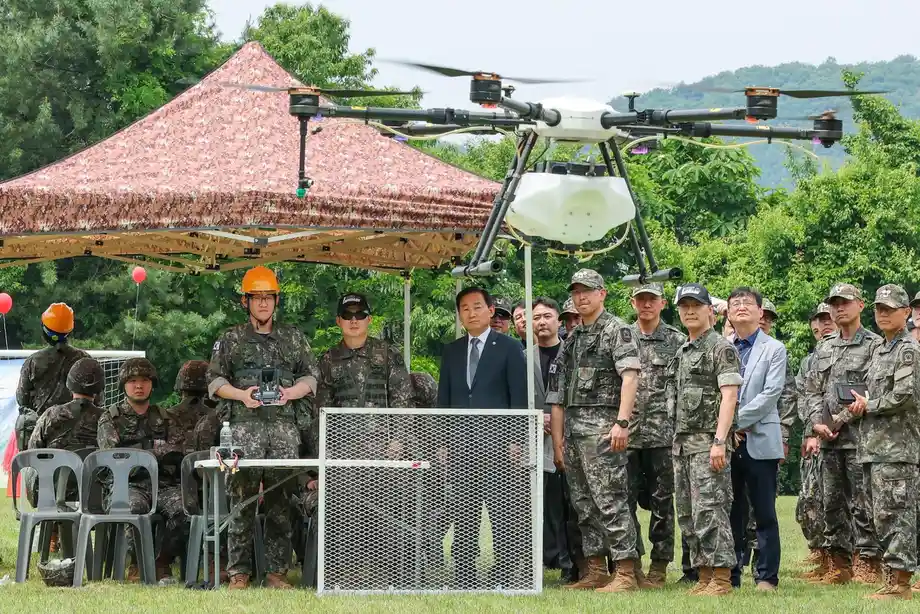
At the 2026 South Korea National Defense Drone Technology Exhibition in Pocheon, Gyeonggi Province, five of nine domestic civilian drones participating in demonstrations crashed or failed to complete their missions. That is more than half of the participating aircraft.
Military specialists who witnessed the event suspected interference from spectators' smartphones and other communications devices. The cause remained unconfirmed. Even so, the failed missions put practical reliability at the centre of the debate over adapting civilian technology for military use.
A military drone may need to operate where its control signal is weak, GPS is unavailable and hostile transmitters are active. Testing must examine whether it can continue its task, return safely or respond predictably when one of those links disappears.
Yang Uk, a research fellow at the Asan Institute for Policy Studies, has urged the government and defence manufacturers to make electronic warfare protection a standard requirement for weapons. His warning connects operational readiness with export competitiveness: equipment buyers also need systems that can work under interference.
North Korea's October 29 Unmanned Aerial Technology Development 2026 event added urgency. Kim Jong Un watched demonstrations involving attack drones and mock South Korean guard posts, K9 self propelled guns and American M1 Abrams tanks. The display also included drones presented as stealth designs and 600 mm rocket artillery.
Some drones require more than jamming
Lee Gi-jin, a Konyang University professor who heads a defence robotics and wearable technology centre, identified a particular concern in his November 3 assessment: drones apparently guided through fibre optic cables. Those aircraft carry commands through a physical cable rather than a radio control link, so defenders need ways to detect and intercept them beyond radio interference.
Lee connected North Korean learning in Russia's Kursk region with tactics built around large numbers of expendable drones. He argued for relatively inexpensive interceptor drones, lasers and combined detection using radar, radio frequency sensors and optical or infrared cameras.
Ko Sung-yoon, a former policy adviser to South Korea's defence ministry, Joint Chiefs of Staff and unification ministry, similarly called for layered protection. His recommendations link detection and interception with specialist personnel, realistic training, production capacity and the integration of artificial intelligence under human control.
The two assessments point to a broader procurement problem. South Korea needs drones that can operate despite interference and defences capable of stopping drones that use different guidance methods. A force may need electronic attack against one aircraft and physical interception against another.
Lee also proposed navigation based on images for operations without GPS, faster acquisition, earlier attention to overseas certification and a target of producing 80% of key drone components domestically by 2030. Motors and electronic speed controllers were among the components he identified as dependent on foreign suppliers. His proposed target would require policy and industrial action.
Regional cooperation brings decisions about data
Brunson's latest remarks build on his April kill web proposal, which envisaged linking South Korean, Japanese and potentially Philippine capabilities. In Honolulu, he again presented Seoul, Tokyo and Manila as a strategic triangle within the wider network of American alliances.
He proposed assigning security classifications and access rights to individual pieces of information. That would allow a partner to receive information needed for a particular task while other sensitive data remained restricted.
South Korea would still need decisions about onward sharing and permitted uses. Information collected to track North Korean missiles could be valuable elsewhere in the region, making rules governing access by Japan or the Philippines, and operations beyond the peninsula, central to any agreement. Brunson did not announce a detailed regional construction programme or define South Korea's participation.
Cooperation is also expanding through exercises. South Korea's first participation in the U.S. Space Force's Partner to Win tabletop exercise is scheduled for November 2–6, 2026, in Orlando, alongside the United States, the Netherlands, Sweden, Poland and Brazil. Participants work through simulated space conflict scenarios and coordination problems.
The exercise follows an April 2024 bilateral drill involving South Korean and American space personnel that addressed satellite communications interference and GPS disruption. These activities give officers opportunities to practise decisions and information sharing while major equipment programmes continue.
South Korea's readiness challenge therefore has several practical parts: keeping existing equipment connected, testing drones under interference, preparing alternate navigation, building dedicated electronic attack capabilities and agreeing how allied information can be used. The 2034 and 2035 programmes address major gaps, while the pressure on today's networks is already present.
Key Points
- Gen. Xavier Brunson warned that equipment dependent on uninterrupted communications could fail within the first 48 hours of a Korean conflict.
- Documented North Korean GPS jamming incidents rose from 39 in 2023 to 578 in 2024, according to Daniel Kelleher's research.
- South Korea plans four dedicated electronic warfare aircraft through 2034 and independent satellite navigation for 2035.
- Existing eLoran navigation and alternate communications routes provide nearer term backup options.
- Five of nine civilian drones failed during a Pocheon demonstration; specialists suspected radio interference, but the cause remained unconfirmed.
- Defence specialists recommend layered drone protection, stronger testing, trained personnel and reliable component supplies.
- A regional allied kill web would require agreements on access to South Korean intelligence and its permitted uses.