168 deaths, four departments and a demand for accountability
Hong Kong Chief Executive John Lee accepted Housing Secretary Winnie Ho's resignation and ordered an investigation into individual civil servants after an independent committee found that four government bodies bore part of the responsibility for the Wang Fuk Court fire, which killed 168 people.
Contents
- 168 deaths, four departments and a demand for accountability
- Why Winnie Ho stepped down
- How the fire spread through occupied homes
- Where government supervision failed
- A three month investigation into individual responsibility
- Dismissal and other possible penalties
- Private companies face criminal charges
- Reforms target rigged bids and unanswered complaints
- Residents want justice and practical help
- The dates that shape the next steps
- Key Points
The report, released on October 29, 2026, runs to more than 1,000 pages. It describes failures in the supervision of renovation work, repeated safety complaints that went unresolved, and construction practices involving deception and suspected bid rigging. Lee said 1,984 families were affected by the disaster.
Ho stopped performing her duties immediately. Deputy Financial Secretary Michael Wong took on the additional role of acting housing secretary, while Lee asked the Central People's Government to formally remove Ho under Article 48(5) of the Basic Law.
Lee and seven senior officials bowed in apology before the government news conference. The chief executive said the deaths had deeply saddened him and promised to lead the response.
As the chief executive, I apologize to the disaster victims and the public, and commit to fulfilling my responsibilities to lead the government with full force in resolving problems," he said. "Comprehensive reforms will also be carried out. Similar incidents will never be allowed to happen again.
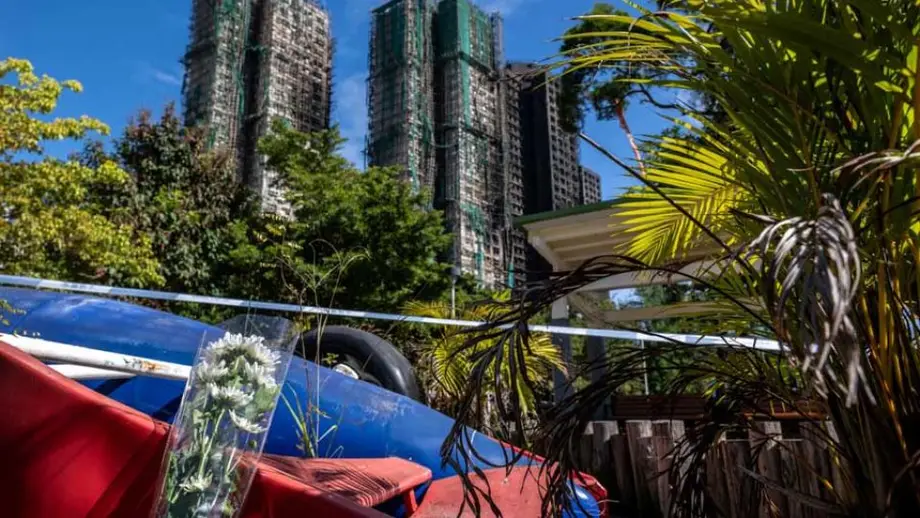
The fire swept through seven towers, each with 31 storeys, at the residential complex in Tai Po in November 2025. Renovation scaffolding and dust netting surrounded the buildings. Thousands of people lost the use of their homes in Hong Kong's deadliest fire since 1948.
The government response now has three parts: political responsibility at ministerial level, an administrative investigation into public employees, and criminal proceedings involving private companies and individuals.
Why Winnie Ho stepped down
Lee said Ho should bear political responsibility because the Housing Bureau's Independent Checking Unit had responsibility for coordinating oversight within the relevant area of work. He said the fire did not involve personal wrongdoing by Ho, but that her position as bureau head required her to accept responsibility for the unit under her authority.
Political responsibility means a minister answers for serious failures within the organisation they lead. The separate civil service investigation will examine what individual employees did, what duties they held and whether their conduct warrants disciplinary action.
Ho met Lee on October 28 and offered her resignation. In a statement, she said she was willing to accept political responsibility for the fire and hoped bereaved families could move forward from their grief.
Ho, the first official to resign over the disaster, had led the Housing Bureau since July 1, 2022. Her departure statement listed work on Light Public Housing, shorter waits for public rental housing, standards for subdivided flats and action against misuse of public housing. She also expressed support for the extensive reforms being prepared after the fire.
Lee said he had considered several factors before accepting her resignation. He instructed political appointees to concentrate on reform, learn from the disaster and exercise stronger leadership.
How the fire spread through occupied homes
The committee found that the fire most likely began when a burning cigarette end ignited materials on a flat roof between two apartments on the first floor of Wang Cheong House. Investigators found cigarette butts and partially burned materials, including cardboard boxes, there. The committee also heard substantial evidence of construction workers smoking at the site.
Foam boards, scaffolding nets without adequate resistance to fire, and canvases contributed to the spread. The report connects the likely ignition point with renovation materials that allowed a small fire to develop into a disaster across several buildings.
Smoke inhalation caused most deaths. Some staircase windows had been replaced with movable aluminium composite panels or wooden boards for workers' convenience, allowing smoke into escape routes. Opaque foam boards covering windows blocked residents' views and delayed evacuation.
The shutdown of the fire alarm system also contributed to the death toll. Residents faced several dangers at once: rapidly spreading flames outside, smoke entering routes intended for escape, obstructed views and an alarm system that was out of operation.
Where government supervision failed
The committee identified deficiencies in the Housing Bureau's Independent Checking Unit, the Buildings Department, the Fire Services Department and the Labour Department. Their responsibilities overlapped around the renovation work and its fire risks, yet complaints failed to produce an effective response.
Residents had raised safety concerns for more than a year before the blaze. The committee found that no department had taken effective ownership of the various fire safety issues, leaving complaints without a body that saw them through to resolution.
The Independent Checking Unit and Buildings Department were the main agencies responsible for supervising the maintenance work. The committee assigned a greater share of responsibility to the checking unit, citing its failure to properly investigate foam boards and the fire resistance of scaffolding nets despite repeated complaints.
The unit also gave consultants and contractors advance notice of inspections. Such notice gave the parties being inspected time to prepare, while the committee's findings describe hazards that remained uninvestigated.
The report also described registered contractors and building professionals who performed no substantive work but lent their names to statutory forms for payment. Those forms are documents required by law, intended to confirm that responsible professionals have carried out the necessary checks. Here, the committee found that paperwork and assurances helped conceal unsafe practices.
A three month investigation into individual responsibility
The Public Service Commission will conduct an administrative responsibility investigation under the government's mechanism for holding department heads accountable. Lee ordered it to finish within three months and recommend disciplinary action or administrative sanctions where warranted.
Commission chair Maisie Cheng estimated that about 40 to 50 people would be investigation subjects. Close to 100 government personnel could be invited to meetings, including witnesses. Investigators will seek departmental documents and examine how particular employees discharged their duties.
The inquiry will cover possible neglect of duty and breaches of departmental requirements, the Civil Service Code and rules governing civil service management. Cheng said it would begin with the independent committee's report and published information, then collect further evidence from the departments.
Anyone involved in supervising fire risks associated with the Wang Fuk Court works may be invited for an interview, regardless of rank or professional grade. That includes relevant people who have already left government service. Lee said the commission would have full autonomy and could investigate up to the highest levels of government.
Secretary for the Civil Service Ingrid Yeung said two directorate administrative officers had been seconded to help establish a support office. Cheng described the work as complex because the four departments' responsibilities were closely connected.
Yeung compared the deadline with the nine months taken by the internal investigation following the Lamma Island ferry collision. The new deadline is one third as long. The three months cover fact finding and recommendations; the government will then consider those recommendations and begin disciplinary hearings where appropriate.
Dismissal and other possible penalties
Yeung said the most serious disciplinary outcome could be dismissal. Other possible penalties include compulsory retirement, demotion, severe reprimand, reprimand and fines, depending on the seriousness of the conduct established.
Lee also addressed employees approaching retirement. He said the existing system allows pension payments to be withheld where disciplinary action is required against someone about to retire. Relevant former employees will also be invited to assist the investigation.
The government is revising the Public Service (Administration) Order to speed up disciplinary hearings. Yeung said the changes were expected to take effect by the end of 2026 and would apply to future hearings. The commission's immediate task is to identify responsibility and recommend what action should follow.
Private companies face criminal charges
The committee placed primary responsibility on the renovation project's main contractor, Prestige Construction & Engineering, and consultant, Will Power Architects. It found that both had cut corners and that deception by private contractors and consultants had succeeded partly because regulators relied too heavily on their assurances.
Police and anti corruption authorities have brought at least 25 charges against the two companies and seven individuals. The charges include manslaughter, conspiracy to defraud, money laundering and tax evasion.
Authorities allege that the two companies and some defendants conspired to defraud apartment owners by concealing earlier litigation records involving the company awarded the renovation contract. The contract was worth more than HK$300 million.
The criminal cases concern alleged offences by the defendants. The administrative investigation concerns public employees' duties, while the committee examined the fire's causes and the wider supervision of renovation work. Each process addresses a different part of responsibility for the disaster.
The committee held 30 hearings, heard from 80 witnesses and examined more than one million files and submissions. Witnesses included residents, renovation personnel, property management staff, engineering and fire specialists, officials and regulators. Before publication, critics had questioned whether the committee's lack of the statutory powers of a full public inquiry would limit its ability to establish all the facts.
Reforms target rigged bids and unanswered complaints
Chief Secretary Eric Chan will lead a steering committee overseeing reforms arising from the report. Lee announced plans to criminalise bid rigging across the construction industry, with proposed maximum penalties of HK$10 million in fines and 10 years in prison.
Bid rigging happens when supposed competitors secretly arrange a tender instead of genuinely competing. Building owners may believe they are choosing among independent bids when the result has already been manipulated. The committee described widespread misconduct involving multiple parties, some with links to triad organised crime groups.
The government also plans to overhaul complaint handling and create a data system connecting departments. Information such as violation records would be shared, helping officials see problems that might otherwise remain in separate departmental files.
A new organisation would support residents undertaking building maintenance projects. For homeowners choosing contractors and paying for major works, that support would address a process in which technical decisions, legal documents and large financial commitments are closely connected.
The government scheduled two detailed briefings for October 30: one on building maintenance regulation and support services, and another on measures against bid rigging. The penalties announced by Lee form part of proposed reforms that will require legislation.
Residents want justice and practical help
Phyllis Lo, whose mother died in the fire, said there had been progress but justice had yet to be served. She said the criminal trial had not begun and that one senior official's departure was insufficient. Lo also considered the apology late, although better than none.
Lo focused on the circumstances of Ho's departure when explaining why she remained dissatisfied.
"She was not being sacked. She resigned herself," Lo said.
Dorz Cheung, a resident displaced by the fire, said the news conference concentrated too much on future promises. He wanted practical issues resolved first, including tax questions connected with residents buying replacement homes.
Those concerns put immediate household needs alongside the government's longer programme of reform. Families are dealing with bereavement, lost homes and decisions about where to live while investigations and criminal proceedings continue.
Beijing's Hong Kong and Macao Affairs Office praised the government's response, saying it showed responsibility, a focus on people and respect for the rule of law. The central government's liaison office in Hong Kong also expressed support.
The dates that shape the next steps
The response has moved from a broad examination of the disaster to decisions about individual responsibility and changes to the renovation system. The main dates and deadlines are:
- November 2025: Fire swept through seven Wang Fuk Court towers, killing 168 people.
- October 28, 2026: Winnie Ho met John Lee and offered her resignation.
- October 29, 2026: The committee report was released, Ho stopped performing her duties and Lee announced the administrative investigation.
- October 30, 2026: The government scheduled briefings on maintenance regulation, support services and measures against bid rigging.
- Within three months: The Public Service Commission must complete its investigation and make recommendations.
- By the end of 2026: Changes intended to speed up disciplinary hearings are expected to take effect.
No criminal trial start date or timetable for resolving the relocation tax issues raised by residents was announced. The next scheduled public explanations concern the proposed reforms, while the commission begins gathering evidence about individual officials.
Key Points
- The Wang Fuk Court fire killed 168 people and affected 1,984 families.
- Winnie Ho resigned as housing secretary; Michael Wong became acting secretary.
- The committee found oversight failures in four government bodies and assigned greater supervisory responsibility to the Independent Checking Unit.
- A burning cigarette end was the likely ignition source; renovation materials, smoke entering escape routes and the alarm shutdown contributed to the disaster.
- The Public Service Commission has three months to investigate individual administrative responsibility.
- Two companies and seven individuals face criminal charges.
- Planned reforms cover bid rigging, complaints, information sharing and support for residents managing maintenance projects.