Nine Countries Agree to Protect the Foundations of AI
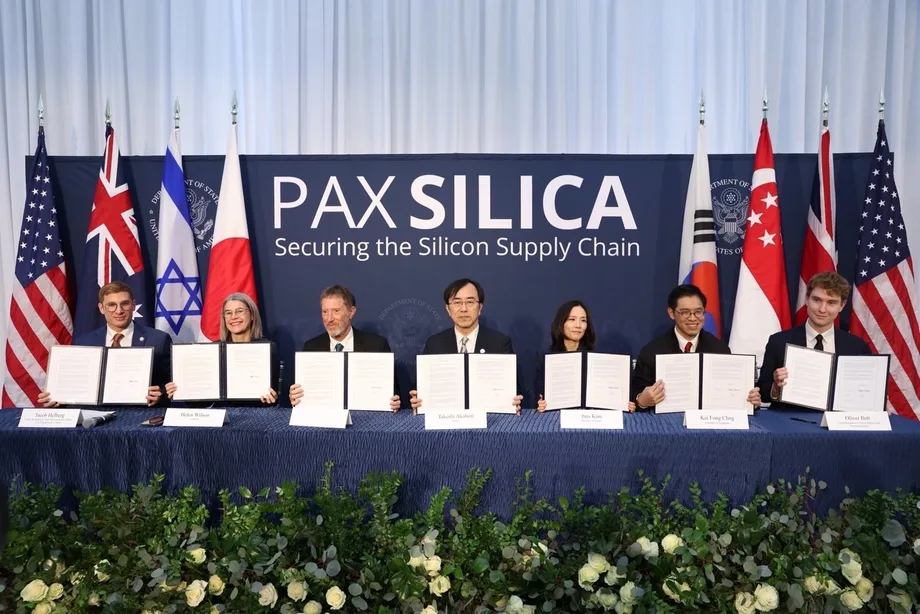
The United States and eight partners signed the San Francisco Declaration on the Secure Foundations of Enduring Prosperity on November 15, 2026, agreeing to identify the technologies, materials and infrastructure that need stronger protection as artificial intelligence expands. Japan, Australia, Israel, the United Kingdom, South Korea, India, Qatar and the United Arab Emirates joined Washington in the agreement.
Contents
- Nine Countries Agree to Protect the Foundations of AI
- What the Partnership Covers
- Why Chips, Minerals and Electricity Are Connected
- How the Agreements Developed
- Why Europe Wants More Precise Terms
- Security Cooperation Meets Different AI Rules
- Panama Offers a Practical Supply Chain Test
- Factories Need Skilled People as Well as Funding
- China Competition Shapes the Next Stage
- Key Points
The countries intend to develop a shared list of sensitive technologies and critical supply chains, exchange information about vulnerabilities and organize working groups to address them. Their plans also include industrial hubs designed to attract investment into the factories, computing systems and energy supplies behind AI.
The agreement expands Pax Silica, a US initiative launched in December 2025, as Washington seeks to reduce dependence on China, especially for critical minerals. Its central argument is that economic security and national security are closely connected: a country can struggle to protect itself if essential technology or materials become unavailable.
Jacob Helberg, the US undersecretary of state for economic affairs, said the initiative reflects the way AI production crosses borders. American chip designs, Japanese equipment, South Korean memory chips and materials processed elsewhere can all contribute to the same computing system.
European participation in the new declaration is moving more cautiously. Germany, Sweden, the Netherlands and the European Commission were expected to sign during the week after November 15, while EU governments sought clearer definitions and safeguards for their ability to set their own rules.
What the Partnership Covers
The State Department's Pax Silica declaration describes a partnership stretching far beyond semiconductor factories. It includes software and platforms, advanced AI models, communications networks, computing capacity, semiconductors, advanced manufacturing, transport logistics, mineral refining and processing, and energy.
A supply chain is the sequence of businesses and infrastructure needed to make and deliver something. For AI, that sequence reaches from minerals and electricity to chips, data centers and the software running on them. A shortage at an early stage can delay work much further along.
The original declaration calls for cooperation on investment security, trusted information networks and reduced dependence on unreliable suppliers. Investment security means checking whether ownership, financing or control of an important business could expose sensitive technology or infrastructure to unwanted access.
The November agreement adds a more explicit focus on identifying what needs protection. It also calls for preventing theft or unauthorized technology transfers that could give hostile actors military or intelligence advantages. Participating governments would share responsibility for guarding systems whose production and operation span several countries.
Why Chips, Minerals and Electricity Are Connected
The United States has major strengths in chip design, Japan supplies semiconductor materials and manufacturing equipment, and South Korea is a leading producer of memory chips. AI computers need these different capabilities together. A processor performs calculations, while memory holds the information it needs to use.
China's strong position in processing critical minerals is another reason for the agreement. Extracting a mineral from the ground is only one step. It must also be separated, refined or processed into a material manufacturers can use. Building alternative supplies therefore requires processing capacity as well as access to deposits.
Rare earth elements are part of this concern. They are used in permanent magnets found in energy equipment, industrial automation and electronic devices. Washington wants more extraction and processing outside China so that restrictions or disruptions in one country have less power to interrupt production elsewhere.
Electricity is equally central. Data centers need power to operate computing equipment and cooling systems. The proposed industrial hubs would bring semiconductor production, computing infrastructure and energy capacity closer together, connecting investment decisions that might otherwise be made separately.
Helberg, describing the initiative on the State Department's website, connected computing power with the physical resources required to produce it:
If the 20th century ran on oil and steel, the 21st century runs on compute and the minerals that feed it.
How the Agreements Developed
Pax Silica has grown through several declarations and projects. The November agreement builds on the original supply chain partnership, while a separate statement adopted in June addressed regulation and opportunities for AI businesses.
The key dates show how the initiative moved from a broad partnership toward more detailed security coordination:
- December 2025: Helberg launched Pax Silica, according to the State Department.
- June 2026: The European Union joined the original initiative.
- June 26, 2026: The State Department published the outcomes of the second Pax Silica Summit, announcing ten additional partners and a total of 24 signatories at that stage.
- November 11, 2026: EU governments authorized the European Commission to negotiate the new economic security declaration with Washington.
- November 15, 2026: The United States and eight partners signed the San Francisco declaration.
The State Department's June summit fact sheet named Argentina, Chile, Costa Rica, El Salvador, the European Union, Germany, Greece, Kazakhstan, the Netherlands and Panama as the ten partners added at that summit.
The department's broader Pax Silica page also lists countries including Italy and Paraguay. Taiwan appears separately as a participant that has endorsed the declaration's principles through a joint statement on economic security cooperation. Membership in that wider partnership and participation in the November declaration follow separate approval processes.
Why Europe Wants More Precise Terms
EU governments authorized negotiations on November 11, but some wanted more time to check that the new declaration matched Europe's approach to economic security. Their concerns involved the wording, the breadth of the commitments and provisions concerning AI.
Several governments sought objective criteria for deciding which technologies and infrastructure count as sensitive. Such criteria would help determine which investments, suppliers or transfers might face closer scrutiny. Broad definitions could give Washington considerable discretion while increasing pressure on partners to adopt similar restrictions.
The European Commission also proposed an explanatory note saying that the EU understands "superintelligence" to mean artificial intelligence. Washington uses the term for its technology ambitions, while the EU already has a legal definition of AI in its Artificial Intelligence Act. Brussels wants terminology that fits its existing law.
European authorization to negotiate covered discussions with Washington; approval to sign the final text required a further decision. The expected signatures during the week after November 15 therefore depended on completing that process.
Security Cooperation Meets Different AI Rules
Washington has proposed a Pax Silica working group on regulatory approaches intended to support innovation. The June summit had already produced a Joint Statement on AI Opportunity, signed by the United States and close to three dozen economies, with a focus on builders, startups, developers and private investment.
EU governments want to preserve their ability to regulate the digital market. Their concern connects supply security with a practical question: how much policy alignment will be expected from countries seeking dependable access to American technology?
The 2025 AI Diffusion Framework remains relevant to that discussion. Introduced under the Biden administration, it would have restricted access to advanced AI chips for several EU countries. The Trump administration scrapped it before it took effect.
Those planned restrictions had troubled European governments because the EU single market depends on goods moving freely among member countries. Different access rules for different members could have complicated that system. The new negotiations are taking place against that recent experience of Washington changing the conditions for access to advanced computing technology.
Panama Offers a Practical Supply Chain Test
Panama is the proposed starting point for a more concrete Pax Silica project. In its June fact sheet, the State Department outlined plans for a competitive funding opportunity to develop a platform that checks the credentials and origins of shipments moving through the country's ports.
The platform would cover semiconductors, AI infrastructure, critical minerals and related products. It is intended to connect with existing customs systems, port operators and shipping companies so that vetted cargo can move through logistics and customs procedures more quickly.
Provenance means a product's origin and history. For a shipment, that can include records showing where goods came from and how they moved through the supply chain. Credentialing checks whether the parties or shipments meet the standards required for trusted treatment.
The State Department described Panama as a pilot. Expansion to other Pax Silica countries and economies would follow if the initial project succeeded. For businesses, the intended benefit is a more predictable route for important cargo, with security checks supported by connected records rather than disconnected systems.
Factories Need Skilled People as Well as Funding
Helberg also announced Foundry School at the June summit, a workforce initiative developed with Stanford University. The plan begins with a seminar series bringing together founders and chief executives from advanced manufacturing businesses.
Stanford and the State Department are developing an accompanying curriculum that educational institutions across Pax Silica economies can adopt. Its purpose is to give future technologists, policymakers and industrial leaders a shared understanding of the industrial capabilities behind economic strength and national security.
The workforce project addresses a different part of the same supply problem. New factories require people who understand production processes, equipment and the organization of industrial businesses. Funding machinery and buildings addresses only part of what is needed to establish manufacturing capacity.
The November proposal for industrial hubs would connect these capabilities with computing infrastructure and power supplies. Locations, financing arrangements, investment timetables and the detailed shared list of protected technologies have not been specified. Working groups are expected to develop the practical measures.
China Competition Shapes the Next Stage
The San Francisco agreement comes ahead of a planned meeting between US President Donald Trump and Chinese President Xi Jinping at the Asia-Pacific Economic Cooperation summit in Shenzhen, China. Washington has accused Beijing of failing to meet commitments made under a trade truce reached in late 2025.
Access to rare earth materials remains a major source of tension. The United States is trying to broaden its choices by bringing together countries with resources, technology, manufacturing capacity and capital. The approach depends on partners building reliable alternatives across several stages of production.
The original Pax Silica declaration also calls for coordination against market practices such as excess production capacity and unfair dumping. Dumping refers to selling goods abroad at prices considered unfairly low under trade rules. The declaration connects these concerns with protecting private investment and maintaining fair competition.
For companies, the next stage will be shaped by the technologies governments select for protection, the standards used to judge suppliers and the investment attached to new industrial capacity. For European governments, the immediate task is completing negotiations while preserving control over their own rules. For Washington and its partners, working groups must turn the broad commitment into specific supply and security arrangements.
Key Points
- The United States and eight partners signed the San Francisco declaration on November 15, 2026.
- The agreement seeks a shared list of sensitive AI technologies and supply chains requiring stronger protection.
- Pax Silica covers minerals, energy, manufacturing, chips, networks, logistics, software and AI models.
- EU governments want clearer definitions and protection for their authority to regulate technology.
- A proposed Panama pilot would connect shipment checks with customs, port and shipping systems.
- Industrial hub locations, financing and investment schedules remain unspecified.