A Phone in Your Pocket Could Become Your Train Ticket
JR East plans to introduce Suica gates that passengers can walk through without taking out their smartphones at 40 stations in spring 2028. Before that launch, about 400 commuters will test the system at 14 stations from April 10, 2027, to February 29, 2028, checking whether it records journeys accurately and works in crowded conditions.
Contents
- A Phone in Your Pocket Could Become Your Train Ticket
- How Will the Gates Recognise a Passenger?
- Who Will Take Part in the Trial?
- What Changes for Existing Suica Users?
- Why Start With Central Tokyo and Airport Routes?
- Which Companies Are Building the System?
- From 14 Trial Stations to About 550
- A Further Change Is Planned for the Mid-2030s
- Key Points
The first commercial rollout will cover every station on the Yamanote Line, stations at Narita Airport, Tokyo Monorail stations at Haneda Airport and Monorail Hamamatsucho Station. Passengers will need a compatible smartphone running Mobile Suica, the mobile version of the electronic ticket and payment service.
JR East announced the plans on November 10, 2026, with President Yoichi Kise appearing at a press conference. Its Suica Renaissance announcement sets out the trial and rollout as the sixth instalment of the programme. The company says passengers should be able to pass through at a speed comparable to current gates, including during busy commuting periods. The practical change is simple: a phone could stay inside a pocket or bag while the gate checks the ticket.
How Will the Gates Recognise a Passenger?
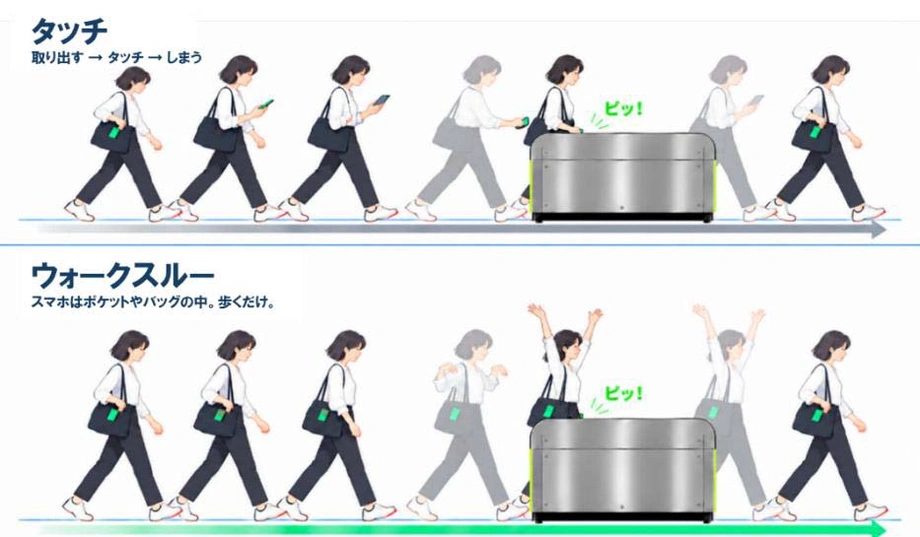
Ultra-wideband, usually shortened to UWB, is the wireless technology behind the new gates. It can measure position and distance to within a few centimetres, helping the system work out where a compatible phone is as its owner approaches and passes through.
UWB will work alongside near field communication, or NFC, the technology used for close contact exchanges such as tapping a phone at a reader. The new equipment combines precise positioning with ticket communication, allowing passengers to move through without deliberately holding their phones over the familiar Suica touch panel.
Antennas will be fitted to existing gates to support the system. JR East plans one walk-through entry lane and one walk-through exit lane at each gate entrance for the full rollout, so the change will arrive within the gate areas passengers already use.
JR East says the system will maintain the passage speed of conventional touch gates. The trial will test that promise alongside processing accuracy: the gate needs to recognise the right passenger and correctly record entry or exit even when many people are moving through nearby lanes.
Who Will Take Part in the Trial?
About 400 passengers holding eligible season tickets between participating stations will be recruited as monitors. A season ticket covers repeated travel within a specified route or area, giving the trial a defined set of journeys to test before use expands.
Five trial stations are in the wider Shinagawa area: Hamamatsucho, Tamachi, Takanawa Gateway, Shinagawa and Oimachi. The other nine are Tokyo, Ueno, Shinjuku, Shibuya, Ikebukuro, Akabane, Kitasenju, Nakano and Osaki.
Participants will initially use the walk-through function for entry and exit within their season ticket zones. Both ends of the journey must have walk-through gates during the trial. JR East intends to expand the situations in which the system can be used, and the people eligible to use it, in stages after reviewing the results.
Sharp will provide loaned AQUOS R10 smartphones equipped with a dedicated trial application developed with the company. Those phones will support both passage without tapping and conventional Suica touch operation. JR East will announce recruitment arrangements and further trial details separately; a recruitment opening date has not been given.
The trial gates will also allow conventional touch-and-go passage. Changes to gate colours and lane indicator lights will help passengers identify the appropriate lanes.
What Changes for Existing Suica Users?
Mobile Suica users will be able to retain their existing service, including season tickets and stored balances. Stored balance means money added to Suica in advance, which can then be deducted to pay for a journey.
Travel beyond a season ticket zone and journeys paid for from that balance will continue to work. The proposed change concerns how a compatible phone communicates with a gate, while familiar ticket and fare functions remain part of the service.
Passengers will also be able to combine the two types of gate on one journey after the commercial rollout. Someone could enter through a walk-through lane at an equipped station and tap their phone to leave at a station that has conventional gates. The reverse will also be possible: passengers can tap to enter at an unequipped station and use a walk-through lane to leave at an equipped one. That arrangement matters during an expansion that will take several years.
A smartphone with Mobile Suica will also need the necessary UWB compatibility for passage without tapping. The AQUOS R10 is identified for the trial, but the full list of supported phones for the 2028 launch has not been announced. JR East's official release specifies UWB but does not give device specifications; details of compatible smartphones will be announced once decided. Passengers will still have the option of conventional touch operation.
Why Start With Central Tokyo and Airport Routes?
The 40 planned launch stations bring together the Yamanote Line, a major route around central Tokyo, and rail access points for the capital's two main airports. The selection puts the new system in places used by commuters as well as people travelling with luggage.
JR East identifies large bags and strollers as situations in which removing the need to handle a phone could make passage easier. Wheelchair users could also benefit from keeping their hands available while moving through a gate.
The initial plan provides dedicated entry and exit lanes at participating stations rather than converting every lane at once. Passengers using the new function will therefore still need to approach a suitable lane, even though they will no longer need to retrieve a phone to tap it.
JR East's stated aim is to preserve the speed of existing gates while removing one small action from each journey. At a busy station, the benefit for an individual passenger may be less about walking faster and more about avoiding a pause to find a phone while managing bags or a stroller.
Which Companies Are Building the System?
Sony is developing and manufacturing readers and writers that support both UWB and NFC. A reader and writer is the equipment that exchanges information with a ticket or phone, allowing the system to check and update travel records.
FeliCa Networks is developing software that runs on a compatible smartphone's security chip. JR East Mechatronics is responsible for developing and installing the gates. Sharp's role in the trial centres on the loaned phones and dedicated application.
The division of work shows why the project involves more than adding a wireless antenna. The phone, ticket software, security components and station equipment must work together, while passengers continue using familiar Suica functions.
Sony has also announced AirAuth, a platform intended to use position and behaviour for automatic authentication. Authentication means checking that a person or device is authorised to use a service. The gate technology forms part of that wider effort to connect a person's location with an automatic access check.
From 14 Trial Stations to About 550
JR East's expansion target is all roughly 550 stations in its service area that currently have electronic ticket gates, including conventional railway and Shinkansen stations. The deadline is the end of fiscal 2031, which falls on March 31, 2032, because Japan's fiscal year runs from April through March.
The 40 stations planned for spring 2028 represent about 7% of that eventual total. That comparison shows the scale of the work after launch: the first commercial phase would still leave roughly 510 stations to reach the stated target.
The schedule sets out several distinct stages:
- November 10, 2026: JR East announces the rollout plans.
- April 10, 2027: The trial begins at 14 stations with about 400 eligible commuters.
- February 29, 2028: The scheduled trial period ends.
- Spring 2028: Commercial introduction is planned at 40 stations.
- March 31, 2032: JR East aims to have reached all roughly 550 stations that currently have electronic ticket gates.
- Mid-2030s: A separate smartphone gate concept using GPS is planned.
The expansion covers JR East's network rather than every railway operator in Japan. For passengers whose journeys reach stations awaiting installation, the ability to mix walk-through passage with conventional tapping will remain useful.
A Further Change Is Planned for the Mid-2030s
JR East also plans a proposed smartphone gate system using GPS location technology in the mid-2030s. GPS uses satellite signals to help determine a device's location. The company's stated ambition is travel across its stations without the present distinction between areas inside and outside the ticket gates.
The GPS proposal is a later stage than the UWB rollout. The 2028 service still centres on passing through equipped gate lanes; the later concept aims to change how movement through stations is recognised more broadly. Detailed operating arrangements for the GPS system have not been announced.
Suica is also undergoing changes beyond railway gates. Earlier plans for Suica app payment changes included QR and barcode payments from autumn 2026 and an increase in the balance limit from 20,000 yen to 300,000 yen. Those plans concern how Suica can be used for spending, while the gate project concerns how it records railway journeys.
For commuters and airport travellers, the nearest concrete milestones are the April 2027 trial and the spring 2028 launch. Their experience will depend on accurate ticket processing, reliable operation in crowds and compatible phones that can move between new and existing gates without interrupting a journey.
Key Points
- JR East plans walk-through Mobile Suica gates at 40 stations in spring 2028, including all Yamanote Line stations and airport locations.
- A trial at 14 stations will run from April 10, 2027, to February 29, 2028, with about 400 season ticket holders, limited to walk-through entry and exit at equipped stations within their season ticket zones.
- Participants will receive loaned AQUOS R10 phones with a dedicated trial application.
- UWB technology will let compatible phones stay in pockets or bags while passengers pass through designated lanes. The full rollout will provide one entry lane and one exit lane at each gate entrance; official smartphone compatibility details will be announced later.
- Conventional tapping, stored balances and travel beyond season ticket zones will remain available. After the commercial rollout, passengers can combine walk-through passage at an equipped station with tapping at an unequipped station in either direction.
- JR East aims to reach roughly 550 stations with existing electronic gates by March 2032, with a separate GPS concept planned for the mid-2030s.