A decade of follow up reveals a lasting health gap
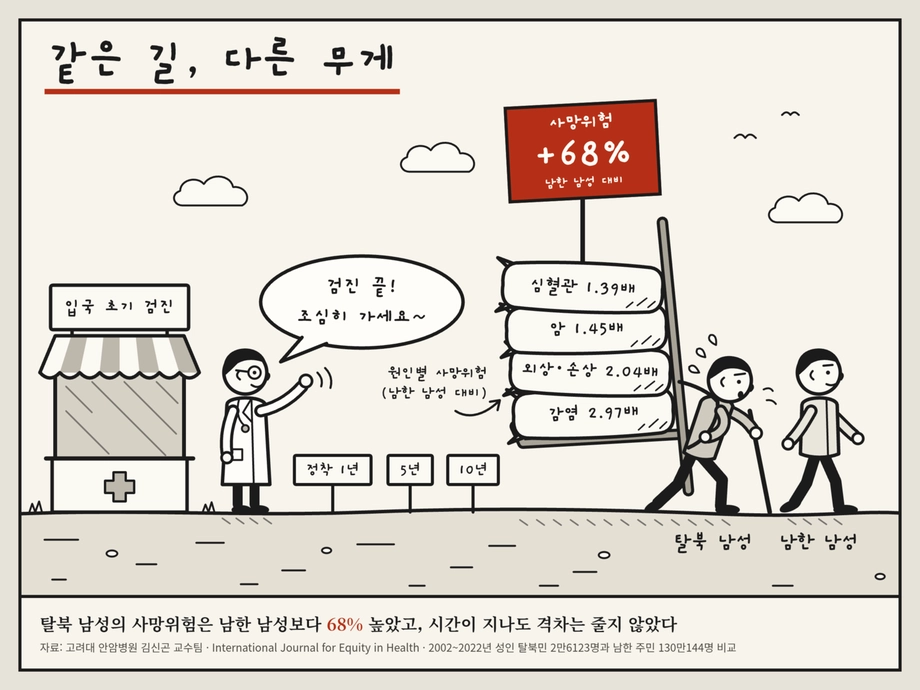
North Korean men who resettled in South Korea faced a 68% higher risk of death than comparable South Korean men, according to a study that followed adults through national health insurance and death records from 2002 to 2022. The gap persisted with longer residence, prompting researchers to call for healthcare that continues well beyond arrival and initial settlement.
Contents
- A decade of follow up reveals a lasting health gap
- What the numbers mean for men
- Women's early advantage faded with time
- Why support must extend beyond arrival
- North Korea turns toward digital medicine
- New hospitals mark a visible change
- Everyday care and medicine supplies remain central
- Who pays for treatment is changing too
- Research continues despite closed political doors
- Key Points
The findings accompany a second investigation into North Korea's push for digital health systems, artificial intelligence and modern hospitals. Together, the studies describe two challenges: strengthening everyday medical care inside North Korea and addressing health burdens that can follow people long after they leave.
The research team, led by Professor Kim Shin-gon of Korea University Anam Hospital, found different patterns for men and women. Female refugees had a lower risk of death during their first six years after settlement, but that advantage weakened over time. Both sexes faced higher risks of death from infections and injuries.
The published mortality study, released by the International Journal for Equity in Health on October 28, 2026, included 26,123 North Korean refugees aged 20 or older and 1,300,144 South Korean residents. Accompanying announcements gave the comparison population as 1,301,144; the published paper's figure is used here.
Researchers linked National Health Insurance Service records with national death records and matched participants by sex, birth year and year of entry into the study. They also adjusted their calculations for existing illnesses and medication use, making the comparison more useful than a simple count of deaths in each population.
What the numbers mean for men
Male refugees had an adjusted hazard ratio of 1.68 for death from any cause. In plain language, the statistical model estimated their rate of death during follow up at 1.68 times that of comparable South Korean men. The estimate's 95% confidence interval ran from 1.52 to 1.86, describing the uncertainty around that calculation.
Infections produced the largest difference among the causes highlighted by the researchers. Male refugees faced 2.97 times the risk of death from infections, nearly three times the comparison rate. Their risk of death from trauma or injury was 2.04 times higher, while cancer mortality was 1.45 times higher and cardiovascular mortality was 1.39 times higher.
The men's gap did not narrow substantially as settlement lengthened. Participants were observed for a median of 10 years, meaning half had shorter follow up and half had longer follow up. Some were followed for as long as 20 years.
The study accumulated 11.3 million person years of observation across both populations. A person year means one person followed for one year; adding those periods together gives researchers a measure of how much observation supports their findings.
Women's early advantage faded with time
Female refugees had a 19% lower risk of death from any cause during the first six years after resettlement. Their adjusted hazard ratio was 0.81, with a 95% confidence interval of 0.67 to 0.98. That early advantage weakened with longer residence.
Across the full follow up period, women's mortality showed no statistically significant difference from that of comparable South Korean women. Within that broader pattern, however, deaths from infections and injuries remained more frequent: the respective risks were 1.70 and 1.44 times higher.
Women therefore need continued monitoring even when their early health indicators appear reassuring. The researchers recommended attention to changes over many years, with infection and injury prevention connected to treatment and continuing care.
Why support must extend beyond arrival
Professor Kim Kyung-jin, the mortality study's first author, called for health support to continue after initial examinations and settlement assistance. Speaking about the need for sustained care, he said:
Health support for North Korean refugees should extend beyond examinations immediately after arrival and initial settlement support to long term health management.
Kim recommended earlier detection and stronger management of chronic illnesses among men, alongside continued observation of women's health as their years of residence increase. He also called for uninterrupted care from prevention through treatment for both sexes, particularly for infections and injuries.
The research team identified several stages of life that healthcare services should consider: nutrition and access to treatment before migration, experiences during escape and residence in other countries, and social and economic conditions after settlement. Insurance enrollment gives people access to the same national system, while their accumulated health needs can remain very different.
Lifestyle, mental health, housing and employment were not fully assessed, leaving the contribution of individual factors to the mortality gap uncertain. The researchers described the findings as grounds for sustained monitoring and care that also responds to social vulnerability.
An earlier study by the team, published in the August 2026 issue of the Journal of Internal Medicine, found cancer incidence about 13% higher among North Korean refugees than South Korean residents, and about 31% higher among men. Incidence measures new cancer diagnoses; the newer mortality study measures deaths. Together, those findings support attention to cancer prevention, early diagnosis and continuing treatment.
North Korea turns toward digital medicine
Inside North Korea, the team's analysis points to selective modernization. A letter in The Lancet, titled North Korea's health revolution in its 2026 medical journals, examined editorials in the second 2026 issues of nine North Korean medical journals.
Researchers Lee Yo-han, Choi Hyun-gyu, Kim Young-hoon and Kim Shin-gon found repeated attention to digital health management, telemedicine, emergency medical networks and information systems for women and children. The editorials also promoted artificial intelligence to support decisions in Koryo medicine, North Korea's traditional medical practice.
Telemedicine allows medical staff to consult or exchange information across a distance. Decision support software helps clinicians assess information when choosing care. These priorities form part of a wider effort to connect hospitals and medical services across the country.
The researchers linked that agenda to the Local Development 20×10 Policy, a programme launched in 2024 to develop facilities in 20 cities or counties annually over a decade. Initially focused on industry and consumer goods, the programme expanded to include local hospitals.
New hospitals mark a visible change
North Korea designated 2025 the first year of its health revolution and began pilot hospital projects in Kangdong, Ryonggang and Kusong. The construction campaign also brought renewed attention to Pyongyang General Hospital, whose original October 2020 completion target had passed years earlier.
The hospital programme unfolded alongside changes in healthcare financing and the team's continuing research:
- 2016: Kim Shin-gon and colleagues published a Lancet letter examining the isolation and methodological weaknesses of North Korean medical research.
- January 2024: Kim Jong Un called for nationwide implementation of a health security system based on a health insurance fund.
- February 2025: Construction began on pilot hospitals in Kangdong, Ryonggang and Kusong.
- October 6, 2025: Pyongyang General Hospital held its completion ceremony. Treatment began on November 3.
- November and December 2025: Completion ceremonies followed at the three pilot hospitals. Kangdong and Kusong began services on December 31.
- August and October 2026: The team's cancer incidence and mortality studies were published.
The modernization drive included training local doctors through central hospitals in Pyongyang, sending specialists to regional facilities and assigning medical graduates to new hospitals. Plans also called for research into emergency centres between county hospitals and rural clinics, potentially bringing urgent care closer to villages.
Hospital construction gives the campaign a visible result. The researchers' assessment places equal weight on whether staff, medicines and local services can sustain care after the buildings open.
Everyday care and medicine supplies remain central
North Korea's household doctor system assigns physicians responsibility for residents in a defined area. Known as ho-dam-dang-uisaje, it is intended to provide continuing local care, including prevention and routine health management. The team's review found limited structural strengthening of this system and community primary care alongside the hospital building campaign.
Primary care is usually a person's first point of contact with medicine: checking symptoms, managing a continuing illness and arranging specialist treatment when needed. For patients, a modern hospital and a reliable local doctor serve different but connected needs.
The journal editorials repeatedly stressed domestic medicine production and the development of traditional remedies. Researchers interpreted that emphasis as a possible response to chronic insecurity in medicine supplies. Koryo medicine combines traditional practices and preparations, including herbal treatments, within North Korea's healthcare system.
A longer view comes from researchers Bo Kyung Shin and Woo Taek Jeon at Yonsei University College of Medicine. Their health priorities analysis examined 56 editorials from eight North Korean medical journals covering 2012 to 2018. It counted 612 mentions across 12 national health priorities.
Medical science and technology received the greatest attention, while emergency or disaster response and reproductive health received the least. The authors recommended balancing technological development with basic care, supplies and workforce support. The newer focus on emergency networks and information systems for women and children adds detail to how editorial priorities have developed since that earlier period.
Who pays for treatment is changing too
Healthcare financing adds another challenge to modernization. A study of healthcare financing, titled What silence reveals: the quiet abandonment of free health care in North Korea, analysed 122,902 Rodong Sinmun articles published between January 15, 2015, and December 16, 2024.
References to the Universal Free Healthcare System fell from between 53 and 63 articles annually in 2015 to 2018 to 30 in 2019, 13 in 2020, five in 2022 and none in 2024. Mentions of preventive medicine and the district doctor system continued, making the disappearance of free care language a distinct change in state messaging.
The study also described state pharmacies introduced nationwide in May 2022 and present in all cities by 2024, selling medicines directly to consumers. Accounts from April 2025 described hospitals openly charging for services, including a hospital in North Hamgyong province where prices were posted at reception.
North Korea's Constitution and Public Health Law promise free medical services. The financing study's authors argued that the system had effectively been abandoned in practice, while noting that the government had made no formal announcement ending it. For residents, the practical concern is whether they can afford medicines and treatment when they need them.
Research continues despite closed political doors
Kim Shin-gon's team plans to continue following refugees' health and monitoring North Korean policy and medical research through NKmedline. Medical journal editorials offer a window into policy priorities and practical constraints; reliable measurement of patient outcomes remains limited.
The mortality paper identifies funding from the Patient-Centered Clinical Research Coordinating Center, or PACEN, through South Korea's Ministry of Health and Welfare, and the Brian Impact Foundation. It acknowledges assistance from the Inter-Korean Foundation for Health and Medical Education and the National Health Insurance Service's Health Insurance Research Institute. The authors state that funders had no role in the research or publication decisions.
Kim Shin-gon, the team leader and an endocrinology professor at Korea University Anam Hospital, said political tensions should not halt preparation for health cooperation. Explaining why monitoring would continue, he said:
Even if political circumstances close the door to exchanges, research and preparation must not stop.
The two research programmes point toward a common practical priority: care that works continuously. Inside North Korea, that means connecting new facilities with medicines, staff and local services. For refugees in South Korea, it means maintaining prevention and treatment as health needs change over years of settlement.
Key Points
- Male North Korean refugees faced a 68% higher risk of death than comparable South Korean men, with no substantial narrowing over follow up.
- Women had a 19% lower mortality risk during their first six years after settlement, but that advantage weakened over time.
- Both sexes faced higher risks of death from infections and injuries.
- North Korean medical journals promoted digital care, emergency networks and artificial intelligence alongside hospital modernization.
- Researchers identified continuing weaknesses in primary care and medicine supplies, while a financing study described growing payment by patients.
- The team recommended sustained healthcare beyond initial resettlement and continued monitoring of North Korea's medical system.