National records show cancer trends stayed steady
A South Korean analysis covering 36,024,394 people found no significant change in cancer incidence trends across 13 cancer categories during the 50 months after COVID-19 vaccination became widespread. The findings address fears that spread after a smaller study linked vaccination to more cancer diagnoses within one year.
Contents
- National records show cancer trends stayed steady
- What the larger analysis measured
- How the 2025 study started the dispute
- Why the starting date matters
- More screening can mean more diagnoses
- What the vaccine comparison found
- Why researchers want longer observation
- Doctors describe the cost of cancer fears
- How the evidence developed
- Key Points
The research connected National Health Insurance Service records with COVID-19 vaccination records for people born between 1955 and 2004. Researchers used August 2021, when South Korea's first dose vaccination rate passed 50%, as the dividing point, comparing the following 50 months with more than a decade of earlier cancer trends.
Jung Jae-hoon, a professor of preventive medicine at Korea University College of Medicine, presented the findings at a Korea Science Media Center briefing on October 29, 2026. Across the 13 categories, researchers found neither a significant jump in the level of cancer incidence nor a significant change in its rate of increase.
Cancer diagnoses continued along the gradual upward trajectory seen before mass vaccination, which Jung associated with population aging. A second analysis, comparing vaccines using messenger RNA with vaccines using viral vectors, also found no statistically significant differences across 12 cancer types.
The findings bring together two useful ways of examining the concern: checking whether cancer patterns changed across a large population and checking whether outcomes differed between vaccine technologies. Jung said continued monitoring remained necessary because many cancers develop over years.
What the larger analysis measured
The national trend analysis examined monthly cancer incidence using records spanning February 2011 to September 2025. Its central question was whether the trajectory changed after vaccination became common, rather than simply whether cancer diagnoses occurred after people received a vaccine.
That approach matters in an aging population. If cancer diagnoses were already increasing before vaccination, researchers need to compare later figures with that existing trend. Comparing raw totals from different years would miss the influence of a growing number of older people, who generally face greater cancer risk.
Some cancer categories showed brief increases in diagnoses before returning toward their earlier trajectory. The research team interpreted those temporary rises as a consequence of medical visits and screening recovering after social distancing restrictions eased. People whose examinations had been delayed could then receive diagnoses closer together.
The trend analysis appeared in Biomarker Research. The comparison between vaccine technologies appeared in the Journal of Korean Medical Science. Both used observational research, meaning researchers examined health records rather than randomly assigning people to receive different vaccines or remain unvaccinated.
How the 2025 study started the dispute
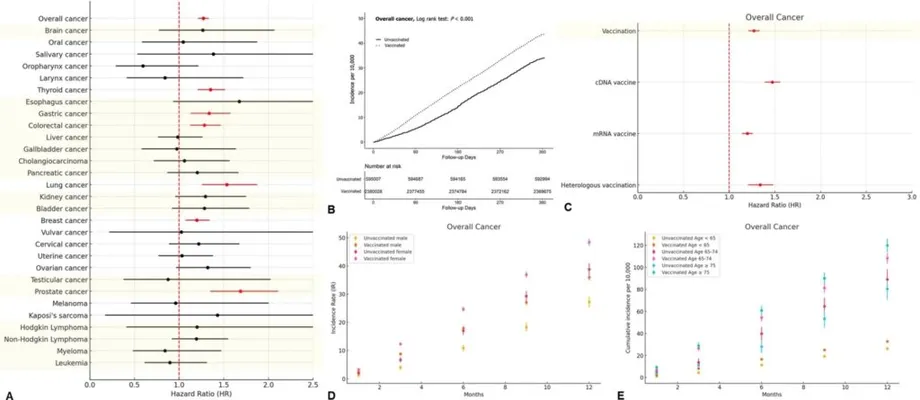
The earlier paper, published in Biomarker Research on September 26, 2025, examined South Korean health insurance records from 2021 through 2023. Its initial database covered about 8.4 million people, while the comparison after matching included approximately 2.38 million vaccinated people and 595,000 unvaccinated people.
The authors reported higher rates of diagnosis for several cancers during the year after vaccination, including stomach, colorectal, lung and breast cancers. Reported relative increases included 69% for prostate cancer and 53% for lung cancer.
Those percentages described comparisons between groups. A 69% relative increase means a rate 1.69 times the comparison rate, rather than 69 additional cases among every 100 vaccinated people. Understanding the number of additional diagnoses also requires knowing the underlying cancer rate.
The study used matching to make the groups more similar in measured characteristics, including age, sex and some health conditions. Critics identified remaining differences in who entered the groups, when observation began and how often participants might seek medical care.
The journal added an editor concerns notice on October 22, 2025. The authors themselves acknowledged in supplementary material that one year was relatively short for assessing most solid tumors and that surveillance bias or reverse causation could affect their findings. Reverse causation means an illness already developing may influence events that researchers later examine as possible causes.
Why the starting date matters
Méd éa Locquet and colleagues examined the earlier study's methods in a Frontiers in Public Health commentary published on March 31, 2026. They identified different starting dates for vaccinated and unvaccinated participants as a major problem.
Vaccinated participants entered observation according to their vaccination date, while unvaccinated participants used January 1, 2022. That difference could change which diagnoses were counted. A cancer diagnosed after vaccination during 2021 could enter the vaccinated group's results, while a cancer diagnosed in an unvaccinated person before January 2022 could lead to that person being excluded.
Dan Chaltiel, an epidemiologist and biostatistician at the Gustave Roussy Institute and the Center for Research in Epidemiology and Population Health, described this as immortal time bias. In simple terms, study rules can create a period during which a diagnosis is counted differently depending on the group.
Locquet and colleagues also highlighted calendar differences. Screening access, infection waves and health service disruptions changed during the pandemic. Starting observation at different times can expose the groups to different conditions, even before researchers consider any effect of vaccination.
The commentary recommended methods that account for vaccination status changing over time and align eligibility and observation more carefully. A fairer comparison would follow similar people from comparable starting points under the same rules.
More screening can mean more diagnoses
South Korea's screening programs for thyroid, breast, stomach and colorectal cancers were another focus of the commentary. People who use medical services more frequently have more opportunities for an existing cancer to be found, including cancers that have not yet caused symptoms.
Vaccinated and unvaccinated people may differ in their willingness or ability to attend appointments. Researchers call the resulting difference in detection surveillance bias. For example, two groups could have similar numbers of developing tumors, yet the group receiving more examinations could record more diagnoses during a short study.
The earlier study did not provide data showing that medical care seeking was similar between its groups. Locquet and colleagues also identified unmeasured or incompletely controlled factors, including smoking, alcohol consumption, family history, genetic susceptibility and screening frequency.
The commentary noted a remaining income imbalance, measured by a standardized mean difference of 0.09. Income can affect access to screening and patterns of healthcare use. It also noted that 77.22% of both groups had a recorded prior SARS-CoV-2 infection and recommended sensitivity analyses excluding previously infected participants.
The new national analysis adds a related observation: temporary increases in some diagnoses followed the return of medical visits and screening after restrictions eased. Its authors interpreted that pattern as delayed detection catching up.
What the vaccine comparison found
Jung's second analysis compared recipients of mRNA vaccines with recipients of viral vector vaccines across 12 cancer types. The reported hazard ratios ranged from 0.87 to 1.08, with no statistically significant differences.
A hazard ratio compares how frequently an outcome occurs over time in two groups. A value of 1 indicates the same estimated rate. The reported range therefore ran from estimates 13% lower to 8% higher, depending on the cancer category, without a statistically clear difference between platforms.
Messenger RNA vaccines deliver temporary instructions that cells use to produce a protein that trains the immune system. Viral vector vaccines use a modified virus to deliver instructions. Comparing recipients of the two technologies gives researchers another way to examine cancer patterns among people who accepted vaccination.
The two new analyses address different questions. One tracks changes across the population before and after widespread vaccination; the other compares outcomes among recipients of different vaccine technologies. Their consistent findings strengthen the assessment that cancer patterns remained stable during the periods studied.
Why researchers want longer observation
Locquet and colleagues assessed the 2025 study as providing low quality evidence under GRADE, a framework used to judge confidence in research findings. Their reasons included its observational design, risk of bias and remaining differences between participants.
The commentary also identified 30 analyses of cancer sites and subgroups without correction for multiple comparisons. Running many statistical tests creates more chances for an apparently meaningful result to arise by chance. Statistical corrections help researchers account for that risk.
Chaltiel observed that the earlier study's cancer incidence curves separated during roughly the first six months and then became parallel. He also questioned assumptions behind its statistical model, which relied on the relationship between the groups' diagnosis rates behaving consistently over time.
Many solid tumors develop through a long sequence of changes before diagnosis. Locquet and colleagues recommended excluding diagnoses during at least the first six to 12 months in further analyses and following participants for at least 10 years.
The same authors proposed an analysis designed to imitate a clinical trial as closely as health records allow. This would align comparison groups, account for changes in vaccination status, match healthcare use and test whether results persist under different reasonable assumptions.
Jung likewise called for continued long term surveillance. The national trend findings cover 50 months after the August 2021 dividing point, while the commentary's proposed observation period extends to at least a decade. No completion date for such a follow-up was given.
Doctors describe the cost of cancer fears
Eom Joong-sik, an infectious disease professor at Gachon University Gil Medical Center, said the cancer claims made vaccination discussions harder with older patients and people whose underlying conditions weakened their immune systems. Some refused vaccination or became deeply anxious about it.
Eom said most patients he had seen admitted to intensive care or becoming seriously ill with COVID-19 over the previous two to three years had not received a recent vaccination. His account describes his clinical experience, while the national studies examine cancer patterns across much larger populations.
The Korea Disease Control and Prevention Agency had addressed the earlier paper in October 2025. Lee Hye-rim, an official responsible for vaccination policy, pointed to the years involved in cancer development and the study's short observation period. The agency stressed vaccination for older people and others at greater risk of severe COVID-19.
The agency also said adverse event reports during the 2024–2025 vaccination season were about five per 100,000 vaccinations, following declines over three years. These figures count health events reported after vaccination; assessing their causes requires further investigation.
Eom explained that vaccine mRNA works in the cytoplasm, the area of a cell outside its nucleus, and is broken down by enzymes within days. The nucleus contains the cell's DNA. His explanation focused on the temporary instructions delivered by mRNA vaccines, alongside the population findings now available.
How the evidence developed
The dispute unfolded over more than a year, moving from a study of diagnoses within one year to methodological criticism and then analyses covering a much larger population and a longer period.
- September 26, 2025: Biomarker Research published the South Korean study linking vaccination with higher rates of several cancer diagnoses during one year of observation.
- October 2025: The Korea Disease Control and Prevention Agency challenged the study's interpretation and stressed protection against severe COVID-19.
- October 22, 2025: The journal added an editor concerns notice.
- March 31, 2026: Locquet and colleagues published their commentary identifying timing problems, surveillance bias, remaining confounding factors and multiple testing.
- October 29, 2026: Jung presented analyses of national cancer trends and differences between vaccine technologies at the Korea Science Media Center briefing.
The practical change is that clinicians now have population data covering 36 million people to discuss with patients worried about cancer. Across 13 cancer categories, the trajectory after widespread vaccination stayed consistent with the earlier trend. Continued monitoring will extend that assessment as more years of health records accumulate.
Key Points
- An analysis of 36,024,394 South Koreans found no significant change in cancer incidence levels or trends across 13 categories after vaccination became widespread.
- The national analysis compared 50 months after August 2021 with more than a decade of earlier trends.
- A second analysis found no statistically significant differences between mRNA and viral vector vaccine recipients across 12 cancer types.
- Criticism of the September 2025 study focused on different observation dates, screening differences, remaining differences between groups and multiple statistical tests.
- Researchers recommend continued monitoring because many cancers develop over years.
- Doctors said cancer fears had discouraged vaccination among some older people and patients with underlying conditions.