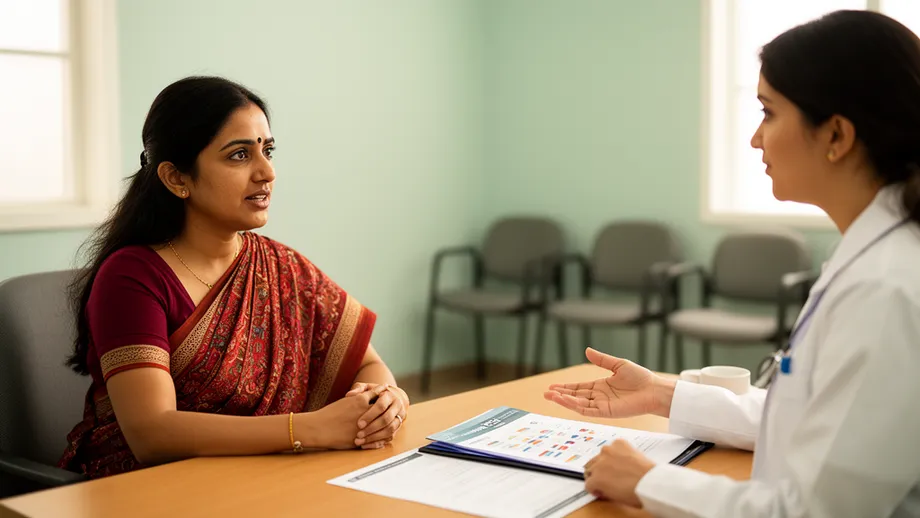
More couples use contraception, but women carry the lasting burden
Female sterilisation accounted for 56.8% of contraceptive use among currently married Indian women aged 15 to 49 in 2019–21, according to an analysis of nearly three decades of national survey data. Its share had fallen from 67.3% in 1992–93, yet it remained the dominant method in every survey examined.
Contents
- More couples use contraception, but women carry the lasting burden
- What changed across three decades?
- What does the public programme offer?
- Schooling, wealth and location shape the choices
- How much information reaches women?
- Men's attitudes help explain the imbalance
- Why a permanent procedure can seem easier
- Unmet need is falling, but younger women face a gap
- Success involves more than reaching more users
- Key Points
The study, published in Contraception and Reproductive Medicine, tracked five rounds of the National Family Health Survey (NFHS). Contraceptive use rose from about 40% to 67% over that period, while the range of methods couples actually used changed much less. Male sterilisation fell below 1% of contraceptive users.
The government's NFHS-5 national report puts the latest figures in concrete terms: 66.7% of currently married women used contraception, and 37.9% had undergone female sterilisation. Those figures describe different groups. The first covers all married women in the age range; the study's 56.8% measures sterilisation's share among contraceptive users.
The difference matters because use can grow without responsibility becoming more evenly shared. Female sterilisation increased from 36% of married women in 2015–16 to 37.9% in 2019–21, even as other methods gained users. Male sterilisation remained at 0.3%.
India's public programme promises voluntary choice from several methods. The central question raised by the findings is how well that promise reaches women whose income, schooling, location and family relationships shape what they can choose.
What changed across three decades?
The researchers examined the contraceptive method mix, meaning the share of users relying on each method. Condoms and pills gained ground, but permanent methods continued to outweigh reversible options, which allow people to prevent pregnancy now while preserving the possibility of having children later.
Female sterilisation's share fell by 10.5 percentage points between the first and latest surveys, from 67.3% to 56.8%. Over the same period, contraceptive use increased by about 27 percentage points. Coverage therefore expanded much more than the method mix diversified.
The study used the Index of Dissimilarity to compare the distribution of methods across survey rounds. In simple terms, it measures how much the balance between methods has shifted. The researchers found limited diversification since 2005–06, suggesting that the broad pattern of reliance on female sterilisation had persisted for nearly two decades.
Several milestones show the distance between the programme's changing ambitions and the choices recorded in household surveys:
- 1952: India launched its National Programme for Family Planning.
- 1977: The programme shifted towards family welfare and a cafeteria approach offering multiple contraceptive choices.
- 1992–93: About 40% of currently married women used contraception; female sterilisation accounted for 67.3% of users.
- 2005–06 onward: The study found limited further diversification of the method mix.
- 2019–21: Contraceptive use reached 66.7%, with female sterilisation accounting for 56.8% of users.
What does the public programme offer?
The National Health Mission's family planning programme lists voluntary adoption, expanding choice, quality services and an approach without numerical targets among its strategies. Its menu includes methods for spacing pregnancies and permanent methods for people who want no more children.
Spacing options include intrauterine contraceptive devices, or IUCDs, injectable contraception under the Antara programme, oral pills including Mala-N and Chhaya, and Nirodh condoms. An IUCD is a small device placed in the uterus by a trained provider. The programme also provides emergency contraceptive pills, female sterilisation and vasectomy, the procedure for male sterilisation.
The service network assigns different tasks to different levels of care. Community health workers can distribute pills and condoms at village level. IUCD insertion and injectable contraception require trained providers, while sterilisation requires trained doctors at designated facilities.
Mission Parivar Vikas began in 146 priority districts across seven states and expanded to all districts in those states and six northeastern states. Its stated aim includes making contraceptive products available throughout the health system. For a woman choosing a method, the practical requirements include a nearby provider, reliable supplies and counselling that explains the alternatives.
Schooling, wealth and location shape the choices
NFHS-5's national table covers 521,352 currently married women. Female sterilisation was used by 48.5% of women with no schooling, compared with 21.7% of women who had completed at least 12 years of education. Condom use moved in the opposite direction, from 5.2% to 17.4%.
The wealth figures reveal a more complicated pattern than a simple divide between rich and poor. Female sterilisation prevalence was similar in the lowest and highest wealth fifths, at 34.5% and 33.4%, and reached 42.3% in the middle fifth. Condom use, however, rose from 4.9% in the poorest fifth to 17.8% in the richest, more than three times as high.
Rural women also had a different mix of methods from urban women. Female sterilisation prevalence was 38.6% in rural areas and 36.3% in towns and cities. Condom use was 7.6% and 13.6%, respectively. Pills were somewhat more common in rural areas, at 5.4%, compared with 4.3% in urban areas.
The study's statistical model examined several characteristics together in the latest survey. It reported relative risk ratios for reversible modern method use of 1.75 for women in the richest wealth group, 1.67 for women with higher education, and 0.82 for rural women, against the respective comparison groups.
Those ratios describe differences within the model rather than percentages of women using a method. Their reported 95% confidence intervals were 1.58–1.93, 1.53–1.83 and 0.77–0.87, respectively. The analysis follows national trends over time, while its estimates of these social and economic associations come from the single 2019–21 survey round.
How much information reaches women?
NFHS-5 offers a direct measure of counselling. Among women sterilised during the five years before the survey, 58.7% said they had been told about possible side effects or problems, 50.8% about what to do if problems occurred, and 65% about other contraceptive methods.
Only 46.1% reported receiving all three types of information. For pill users, the corresponding figure was 54.1%; for users of an IUD or an IUD inserted after childbirth, it was 62.7%. These measures covered selected methods and recent episodes of use, with exclusions specified in the survey.
The information gap has particular weight for a permanent procedure. The survey recorded a median age at female sterilisation of 25.7 years, using its calculation for procedures undertaken before age 40. A decision taken at that age can shape decades of a woman's reproductive life.
The study's authors call for stronger access to reversible methods, better provider counselling and more equitable services. In practice, informed choice means discussing what each method does, possible problems, available alternatives and whether a person wants to delay another pregnancy or permanently stop childbearing.
Men's attitudes help explain the imbalance
Half of men surveyed in Uttar Pradesh, Bihar and Telangana said contraception was women's business and that men should not have to worry about it. Similar views were expressed by about one in three men in Andhra Pradesh, Madhya Pradesh and West Bengal, and 45% in Karnataka.
Dr S Shantha Kumari, identified as president of the Federation of Obstetric and Gynaecological Societies of India in her comments on the findings, linked low male participation to misconceptions about vasectomy and to campaigns directed mainly at women. She described how responsibility is allocated:
"I believe it should be the responsibility of both men and women, that they should be partners in this decision. But the onus is always on women," she says.
Abhinav Pandey, who led research in Uttar Pradesh, Bihar, Madhya Pradesh, Chhattisgarh and Rajasthan from 2017 to 2019, described men's fears that sterilisation would reduce masculinity or their ability to do physically demanding work. He also found resistance to condoms, including complaints about comfort and sexual pleasure.
Pandey, describing the findings from that research project, said:
"In all the states we found that male engagement in family planning programmes was very low, mainly due to a lack of awareness," Mr Pandey says.
The national programme explicitly includes increasing male participation and promoting vasectomy without a scalpel. The survey's 0.3% prevalence for male sterilisation shows how small that method's role remained.
Why a permanent procedure can seem easier
Ranjani Sharma, a mother of three living outside Lucknow, described choosing sterilisation after using condoms and experiencing two pregnancies that she ended with pills bought over the counter. She reported heavy bleeding, dizziness, blackouts and exhaustion.
Sharma said her husband initially worried about her health. When they considered whether he should instead undergo sterilisation, she objected because she feared he would become weak and unable to do heavy lifting as the family's breadwinner. Her account shows how concern for a household's income can operate alongside misinformation about male contraception.
Frontline workers face those beliefs during everyday counselling. Accounts from Accredited Social Health Activists, known as ASHA workers, in Haryana, Uttar Pradesh and Gujarat described how incentives and the wish to avoid repeated visits to health centres could make female sterilisation attractive. Some workers also favoured it after the birth of a son.
Women distributing contraception may have limited access to men or limited influence over husbands who refuse condoms. Pandey suggested recruiting male volunteers to reach them. A discussion pilot involving mothers-in-law and daughters-in-law began in 148 districts in 2016; Rajasthan included husbands in 2019, followed by Uttar Pradesh in 2020.
Pandey described some men beginning to accompany wives to counselling while remaining reluctant to use contraception themselves. Bringing husbands into a meeting and sharing contraceptive responsibility are separate steps that programmes must address.
Unmet need is falling, but younger women face a gap
NFHS-5 recorded a fall in unmet need for family planning from about 13% in 2015–16 to 9% in 2019–21. The National Health Mission gives the latest figure more precisely as 9.4%. Unmet need refers to married women who want to stop having children or delay the next birth for at least two years but are using no contraception.
Total demand for family planning rose from 66% to 76% between the two surveys. That measure combines women already using contraception with those who want to avoid or postpone pregnancy but have no method in use.
Age makes a large difference: unmet need was 18% among married women aged 15 to 19, compared with 3% among those aged 45 to 49. Younger women may need a method that allows them to delay pregnancy while retaining the option of having children later.
The government's programme page reports that 47.6% of births occurred less than three years after the previous birth, according to Sample Registration System data for 2020. It promotes a three year interval to improve infant survival. Reliable access to reversible methods is therefore relevant to the timing of births as well as the eventual number of children.
Success involves more than reaching more users
India's fertility rate reached 2.0 children per woman in the 2020 Sample Registration System, according to the National Health Mission. Modern contraceptive use also rose from 47.8% in 2015–16 to about 56.5% in 2019–21. These gains sit alongside a persistent concentration of contraceptive responsibility on women.
The study's findings bring three practical priorities together: ensure that reversible methods are consistently available, give women understandable information before they choose, and involve men in both decisions and contraceptive use. Each addresses a different part of the gap between a list of methods and a usable choice.
For women who want no more children, a voluntary decision to undergo sterilisation remains part of that choice. For women who want to postpone pregnancy, or who are uncertain about future childbearing, dependable reversible options and accessible follow-up care serve a different need. India's expanded coverage makes the quality and range of those choices the next measure of progress.
Key Points
- Contraceptive use among currently married women rose from about 40% in 1992–93 to 66.7% in 2019–21.
- Female sterilisation accounted for 56.8% of contraceptive users in the latest survey, down from 67.3% nearly three decades earlier.
- Female sterilisation prevalence was 37.9% of married women; male sterilisation prevalence was 0.3%.
- Condom use was 4.9% in the poorest wealth fifth and 17.8% in the richest.
- Only 46.1% of women recently sterilised reported receiving all three types of information measured in the survey's counselling assessment.
- Unmet need fell, but remained highest among married teenagers, at 18%.