A national health burden beyond Delhi's winter haze
India's annual limit for PM2.5 remains 40 micrograms per cubic metre, eight times the World Health Organization guideline of 5, while a nationwide study links each increase of 10 micrograms to an 8.6% rise in annual mortality. The findings put a number on a danger that extends beyond coughing and breathlessness to heart disease, stroke and damage to other organs.
Contents
- A national health burden beyond Delhi's winter haze
- What the nationwide mortality study found
- How fine particles affect the heart and kidneys
- Northern India's disease burden is measurable
- Fossil fuels, household smoke and wildfire exposure
- Why India's standards review matters
- Clean air spending has not delivered compliance
- What people can do now
- Pollution control must reach beyond city borders
- Key Points
The research, published in The Lancet Planetary Health in December 2024, examined mortality and estimated pollution exposure across India from 2009 to 2019. It estimated 3.8 million deaths over those 11 years attributable to exposure above India's national standard. Using the lower WHO guideline as the comparison, the researchers estimated about 1.5 million additional deaths each year.
Those two estimates answer different questions: how many deaths might be avoided by meeting India's current standard, and how many might be avoided by reaching the WHO recommendation. The much larger burden associated with the lower benchmark makes the choice of standard a public health decision with consequences far beyond an air quality dashboard.
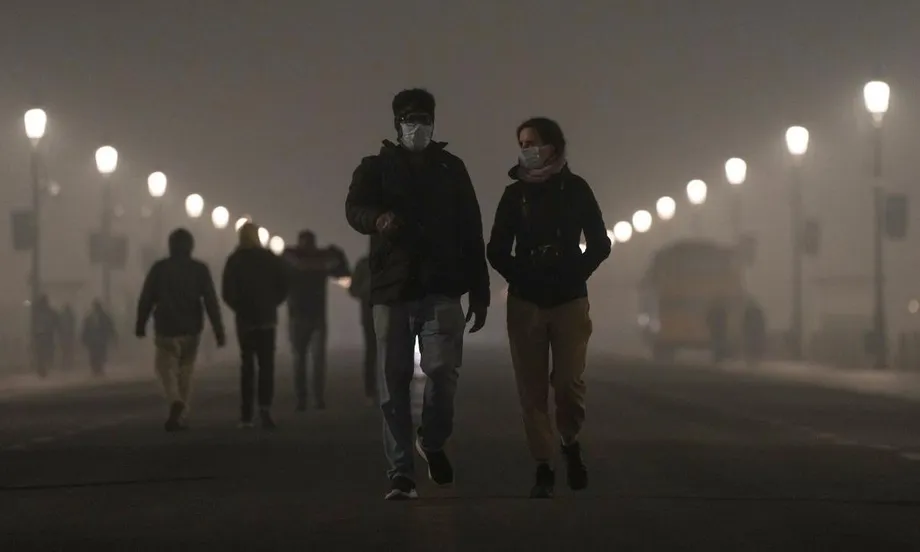
Delhi's annual average PM2.5 concentration was 96.4 micrograms per cubic metre in 2025, about 2.4 times the national limit and more than 19 times the WHO guideline. Yet the problem reaches far beyond the capital. A January 2026 assessment by the Centre for Research on Energy and Clean Air found that 1,787 of 4,041 cities exceeded the national annual standard in every assessed year from 2019 to 2024, excluding 2020.
That is about 44% of the cities examined. For commuters, construction workers, children and people exercising outdoors, exposure accumulates through ordinary daily activities, including on days when the air looks clear.
What the nationwide mortality study found
Researchers used a model estimating PM2.5 concentrations for every square kilometre of India, alongside district mortality data. Harvard T.H. Chan School of Public Health's study announcement says the entire population lived in areas exceeding the WHO annual guideline during the period examined. Concentrations in some regions reached 119 micrograms per cubic metre.
The association between pollution and mortality was stronger for increases starting below India's annual limit of 40 micrograms per cubic metre. That finding gives health authorities a reason to pursue reductions even in places already meeting the national benchmark.
Petter Ljungman, a study coauthor from Sweden's Karolinska Institute, explained what the findings mean for regulation:
The results show that current guidelines in India are not sufficient to protect health. Stricter regulations and measures to reduce emissions are of utmost importance.
The 8.6% figure describes a change in annual mortality across populations as pollution concentrations rise. A person's health assessment still depends on age, medical history, duration of exposure and other risks. Doctors need that information to decide what advice or investigations are appropriate.
How fine particles affect the heart and kidneys
PM2.5 refers to airborne particles measuring 2.5 micrometres or less across, roughly 30 times smaller than the width of a human hair. Their small size allows them to travel deep into the lungs. Some components can enter the bloodstream, while inflammation beginning in the lungs can affect other parts of the body.
Inflammation is the body's response to injury or irritation. When it persists, it can damage tissues. Pollution can also cause oxidative stress, a process in which reactive molecules damage cells, and affect blood vessel linings, blood pressure and clotting.
Dr Anshul Kumar Jain, director of cardiology at CK Birla Hospital in Delhi, describes prolonged PM2.5 exposure as a cardiovascular concern even for young adults who do not smoke. Pollution can act alongside high cholesterol, diabetes, undiagnosed high blood pressure and a family history of early heart disease.
A study published in the Journal of the American College of Cardiology in 2026 followed more than 100,000 adults in China and associated organic carbon, elemental carbon and nitrates in PM2.5 with increased coronary heart disease risk. Measuring these ingredients alongside total particle concentrations could help authorities understand which emissions need attention.
Kidneys may also be affected through inflammation, damage to their blood vessels and changes in their ability to filter blood. Dr Anupam Roy, additional director of nephrology and kidney transplant at Aakash Healthcare in Dwarka, says pollution may also harm kidneys indirectly by worsening high blood pressure, insulin resistance and cardiovascular health. Researchers are still investigating the size of the contribution to chronic kidney disease.
Dr Roy identifies people with diabetes, hypertension or existing kidney disease, along with older adults, as groups needing particular attention. Kidney disease can develop without obvious early symptoms, making regular medical care especially valuable for people who already have these conditions.
Northern India's disease burden is measurable
A northern India study published on March 1, 2025, in Ecotoxicology and Environmental Safety examined Delhi, Haryana, Rajasthan, Uttar Pradesh and Punjab. It estimated deaths associated with PM2.5 from five disease groups: lung cancer, chronic obstructive pulmonary disease, ischaemic heart disease, stroke and lower respiratory infections.
Estimated deaths across those five areas rose from 171,551 in 2019 to 175,140 in 2022. The increase was 3,589 deaths, or about 2.1%. Uttar Pradesh accounted for the largest share in 2022.
Within Uttar Pradesh, estimated stroke mortality associated with PM2.5 rose 29.48% between 2019 and 2022. The corresponding increases were 27.6% for ischaemic heart disease, 20.85% for chronic obstructive pulmonary disease and 20.35% for lung cancer. Ischaemic heart disease occurs when the heart muscle receives too little blood, commonly because arteries have narrowed.
The researchers also examined disability adjusted life years, or DALYs, which combine years lost through early death with years lived in poor health. Jahangirpuri in Delhi had the highest reported factor for potential health damage per kilogram of PM2.5 emitted, at 98.8 DALYs per kilogram. The measure connects emissions with estimated health loss, helping identify places where reducing pollution could yield substantial benefits.
Estimated economic losses associated with mortality from the five diseases ranged from about US$198 billion to US$277 billion across the study years from 2019 to 2022. These valuations express the economic burden of premature deaths, rather than household medical bills alone.
Fossil fuels, household smoke and wildfire exposure
Research tracking climate and health estimates that PM2.5 exposure was associated with more than 2.2 million deaths in India in 2023, a 22% increase from 2016. This estimate covers a different period and assessment framework from the nationwide study of 2009 to 2019; each calculation measures the burden against its own exposure assumptions.
Fossil fuel combustion contributed to 38% of the estimated PM2.5 deaths in 2023. Coal accounted for 67% of that fossil fuel share, identifying power generation and other coal use as major targets for reducing health damage.
Household air pollution from polluting fuels was associated with approximately 617,000 deaths in 2023, down from 783,000 in 2016. That is a reduction of about 21%, although the remaining burden is substantial. Smoke exposure inside homes makes access to cleaner household energy part of the same health challenge as traffic and industrial emissions.
Wildfire smoke was associated with an estimated 90,300 deaths annually during 2021 to 2025, compared with 67,800 annually during 2003 to 2012. The rise was about one third. These estimates cover overlapping pollution pathways and populations, so the figures describe different parts of the burden rather than a single combined total.
Why India's standards review matters
India continues to apply the National Ambient Air Quality Standards notified in 2009. The Central Pollution Control Board began a review in 2020, with an IIT Kanpur team tasked with work including health risk evaluation, revised limits, guidance on areas failing to meet standards and an analysis of implementation costs and benefits.
A CPCB reply under the Right to Information Act, dated October 26, 2026, said a revised technical report remained under review. No date for notifying new standards was given.
The process has stretched across several milestones:
- May 6, 2020: CPCB constituted the steering committee for the standards review.
- December 2021: CPCB and IIT Kanpur signed the agreement for the study.
- October 6, 2023: IIT Kanpur submitted its initial report.
- July 1, 2024: The steering committee held its latest meeting identified in the RTI reply.
- November 2024: The stated deadline for completing the work passed.
- December 16, 2025: IIT Kanpur submitted a revised report incorporating comments.
- October 2026: The 2009 standards remained in force.
CPCB released Rs 19.6 lakh to IIT Kanpur for the project. The review also considered whether monitoring should cover additional pollutants, including ultrafine particles. Updating a standard affects how authorities judge compliance and identify places needing action, while actual health gains depend on bringing concentrations down.
Clean air spending has not delivered compliance
The National Clean Air Programme began in January 2019. Across 130 participating cities, Rs 16,824 crore was released and Rs 12,087 crore spent over seven years, about 72% of the money released.
A CREA analysis found that 117 of those 130 cities, or 90%, remained above the national annual PM10 standard in the financial year 2025 to 2026. Only 13 met it. The number exceeding the limit had risen from 112 in 2019 to 2020.
PM10 covers particles up to 10 micrometres across, including the smaller PM2.5 fraction. The programme's revised target was a 40% reduction in PM10 by 2025 to 2026, or attainment of the annual standard of 60 micrograms per cubic metre. Tracking PM2.5 alongside PM10 would give a more direct picture of exposure to the fine particles examined in the mortality studies.
Forty three cities recorded higher PM10 levels than in 2019 to 2020 despite spending a combined Rs 2,857 crore. Reported increases included 59.3% in Navi Mumbai, 40.4% in Nashik, 24.7% in Pune and 20% in Chennai.
Delhi shows both progress and the distance still to travel. Its annual PM2.5 average fell from 131.3 micrograms per cubic metre in 2016 to 96.4 in 2025, a reduction of about 26.6%. PM10 fell from 284.2 to 197.3 over the same period, about 30.6%, but remained approximately 3.3 times its national annual limit.
What people can do now
People with persistent respiratory symptoms, existing heart or lung disease, or substantial occupational exposure should seek medical advice. Children, pregnant women and older adults also face greater vulnerability. Doctors can tailor assessments to symptoms, exposure and medical history; there is no universal diagnostic testing programme required for everyone breathing polluted air.
Practical precautions can reduce the amount of pollution inhaled:
- Check the local Air Quality Index before strenuous outdoor exercise and move activity indoors when pollution is high.
- Avoid heavily trafficked roads when choosing routes for walking or cycling.
- Use a well fitting N95 or equivalent respirator outdoors during severe pollution.
- Improve indoor air where feasible, including with an appropriately sized purifier using HEPA filtration.
- Keep up with medical care for diabetes, high blood pressure, heart disease or kidney disease, and discuss monitoring with a doctor.
Chest pressure, breathlessness, cold sweating, nausea or pain spreading to the arm, back or jaw can signal a heart attack and require immediate emergency medical help. A heart attack happens when blood flow to heart muscle is blocked. Cardiac arrest happens when the heart suddenly stops pumping effectively.
Dr Harsh Mahajan, founder and chairman of Mahajan Imaging & Labs and mentor at FICCI Health, says prevention needs to extend beyond appointments and tests:
Individual health checks cannot substitute for cleaner air. We need a stronger public health response that combines sustained action to reduce pollution, greater awareness of its long-term effects and a shift towards prevention rather than waiting for illness to develop.
Pollution control must reach beyond city borders
Transport, industry, power generation, construction, household fuel use and open burning all contribute to India's pollution burden. Winter weather can trap emissions close to the ground, concentrating exposure, while the annual measurements show that action is needed throughout the year.
Joel Schwartz, a study coauthor and environmental health faculty member at Harvard T.H. Chan School of Public Health, called for controls at coal power plants and limits on crop burning:
Delhi may get the headlines, but this is a problem all over India, and nationwide efforts are needed. Coal burning electric plants need scrubbers, crop burning needs to be limited, and most importantly, the government needs to recognize this as a major issue.
CREA chief analyst Manoj Kumar has called for regional pollution plans extending beyond municipal boundaries, separate targets for major emissions sources, and monitoring of PM2.5 and gaseous pollutants alongside PM10. Such an approach would address pollution that travels between industrial areas, towns, farms and cities.
For residents, the central measure of success is sustained cleaner air: lower annual exposure during school, work, travel and time at home. Stronger standards, targeted emissions controls and accessible medical care address different parts of that task.
Key Points
- A nationwide study associated each increase of 10 micrograms per cubic metre in annual PM2.5 with an 8.6% increase in mortality.
- India's annual PM2.5 limit is 40 micrograms per cubic metre, compared with the WHO guideline of 5.
- Fine particle exposure affects cardiovascular health, while researchers are investigating its contribution to kidney disease.
- Delhi's annual PM2.5 average fell about 26.6% between 2016 and 2025 but remained more than twice the national limit.
- Of 130 National Clean Air Programme cities, 117 exceeded the annual PM10 standard in 2025 to 2026.
- India's standards review remained incomplete in October 2026, with no notification date announced.
- Personal precautions can reduce exposure, while sustained emissions cuts are needed to protect whole populations.