A close view of a secretive spacecraft
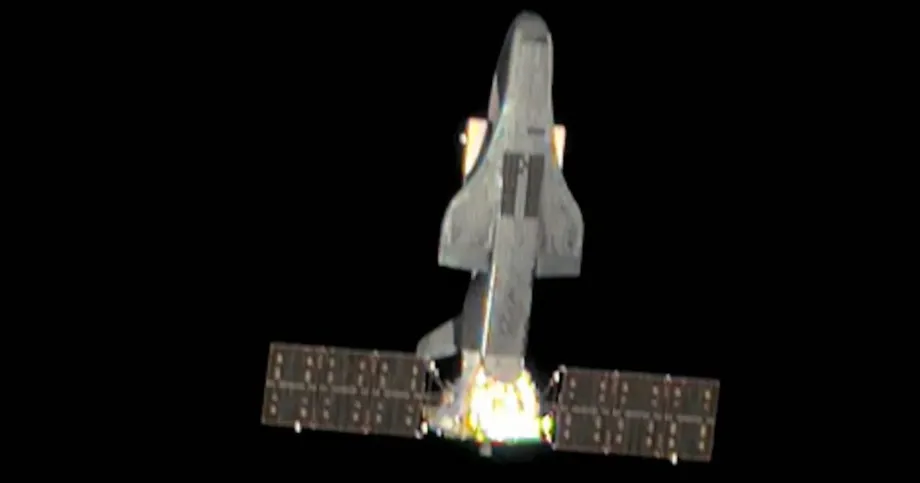
A commercial satellite photographed China's experimental spaceplane docked to another spacecraft on May 28, 2024, capturing open payload bay doors and a companion satellite with deployed solar panels from just under 90 kilometers away. The unusually detailed image now appears on page 53 of the U.S. Defense Intelligence Agency's 130-page report, Challenges to Security in Space.
Contents
- A close view of a secretive spacecraft
- What the photograph shows
- An older image becomes much clearer
- Four missions, with much longer stays in orbit
- Objects released and approached in space
- Why reusability matters to China
- How it compares with America's X-37B
- A photograph inside a wider security assessment
- Key Points
Vantor, the satellite imagery company formerly known as Maxar Technologies, confirmed that its WorldView-3 satellite took the photograph. The image has a reported resolution of 4.5 centimeters per pixel, meaning each tiny picture element represents roughly that distance at the spacecraft.
The photograph gives the public a rare view of hardware involved in China's reusable spacecraft program, commonly associated with the name Shenlong. Its most striking feature is the physical connection between the spaceplane and another satellite, an arrangement Vantor confirmed when explaining the image.
The DIA identifies the pictured vehicle as a Chinese spaceplane, while naming Shenlong and Tengyun as China's two principal spaceplane designs elsewhere in its assessment. The agency leaves the photographed model unnamed. Shenlong is the name widely used for the experimental vehicle conducting China's known orbital missions.
The photograph was taken during the third of those missions, which ran from December 14, 2023, to September 6, 2024. Its publication provides a detailed look at an earlier flight while attention is also focused on a fourth mission launched on February 7, 2026.
What the photograph shows
The Chinese vehicle has a compact body resembling a small space shuttle, wings on either side and two vertical tails. Doors above its central payload compartment are open. At the rear, the structure and solar arrays of the attached satellite are visible.
Vantor, which operates the satellite that captured the image, described the connection directly:
There is a separate satellite docked to the aft section of the vehicle whose structure and solar arrays are visible.
The company also confirmed the condition of the main cargo compartment:
The spacecraft's payload bay doors are visibly open.
A payload bay is a compartment used to carry equipment, experiments or smaller spacecraft. Opening its doors can give equipment access to space or allow a payload to be released. Here, the open doors and docked satellite show two different parts of the vehicle's working configuration during an orbital flight.
The identity and purpose of the attached satellite have not been disclosed. Other unresolved details include the Chinese vehicle's dimensions, the number of reusable vehicles China operates and the precise tasks assigned to the current mission.
The image also shows features interpreted as landing gear compartments on the underside. Together with the wings, they fit the basic approach of a spaceplane: launch into orbit aboard a rocket, operate above Earth, then return to a runway rather than descend in a capsule.
An older image becomes much clearer
The photograph itself dates to 2024, and a version with less detail was shown publicly that year. U.S. Space Force Colonel John Patrick, then head of U.S. Space Forces-Korea, included it in a presentation at the Open Space Forum in South Korea.
A photograph of that presentation subsequently circulated online. At the time, the limited detail left uncertainty about which spacecraft appeared in it. The DIA's publication supplies a clearer version and an official identification of the subject as Chinese.
The report credits Maxar Technologies, the name under which Vantor operated when WorldView-3 took the picture. Those company names refer to the same imagery business at different points in time.
Ground observers have previously photographed the Chinese spaceplane as it passed overhead. This picture offers a different perspective because another satellite took it from orbit at a distance of about 56 miles. That relatively close view makes small structural details easier to distinguish.
The public release is therefore a new level of detail for an image already glimpsed before. It also illustrates a growing commercial capability: satellites designed to observe Earth can sometimes photograph other spacecraft closely enough to reveal their configuration.
Four missions, with much longer stays in orbit
China's known orbital spaceplane flights began in 2020. The first lasted about two days. The next two lasted 276 days and 268 days, moving the program from a short initial flight to repeated missions lasting many months.
The main milestones are:
- 2020: The first known orbital mission lasted about two days.
- 2022 to 2023: The second mission lasted 276 days and included observations of activity near a companion object.
- December 14, 2023, to September 6, 2024: The third mission lasted 268 days. WorldView-3 photographed the spacecraft during this flight, on May 28, 2024.
- February 7, 2026: The fourth mission launched from Jiuquan Satellite Launch Center aboard a Long March 2F rocket.
- June 2026: LeoLabs detected another object near the spaceplane and assessed that the vehicle had released it.
The second and third flights together lasted 544 days. Each was more than 130 times as long as the approximately two days spent in orbit on the first mission. The clearest measurable change is the program's ability to keep its experimental spacecraft operating for extended periods.
The fourth mission was still described as underway when the image became the subject of October 2026 coverage. No landing date was given.
A remote airbase in northwestern China, with a runway approximately 16,400 feet long, has been identified as a possible landing location. Its connection to the program remains less firmly established publicly than the launch dates and mission durations.
Objects released and approached in space
China's spaceplane has attracted attention for releasing smaller objects and operating near them. The DIA says it has "released and interacted with an object," a brief description that leaves much of the activity undisclosed.
During the second mission, the vehicle appeared to maneuver with a companion satellite in November 2022, approaching within about 100 meters. The DIA describes possible capture and release activity. Several smaller objects were also observed during the third mission.
LeoLabs, an American company that tracks objects in orbit using radar, detected a new object near the spaceplane during its fourth mission in June 2026. The company explained its assessment:
Following additional observations across our global network and analysis via LeoLabs Delta, we have independently cataloged this object and assessed with high confidence that it was released from the Chinese space plane.
LeoLabs connected the event with earlier activity:
This activity is consistent with sub-satellite deployments conducted by the space plane in previous missions.
Astronomer Jonathan McDowell, who tracks spacecraft, later suggested that the June object might have been retrieved, possibly using a robotic arm, and released again in late August. That remains a proposed explanation for the observed movements.
Rendezvous and proximity operations are the technical terms for bringing spacecraft together and maneuvering them near one another. Docking goes a step further by physically connecting them. Such operations demand careful control of relative speed and position, even while both vehicles travel rapidly around Earth.
The docked configuration in the May 2024 photograph gives those observations a concrete visual counterpart: the Chinese vehicle can operate while another spacecraft is attached to its rear.
Why reusability matters to China
China has publicly described its experimental reusable spacecraft program as a way to test technologies for easier and cheaper travel between Earth and orbit. The Chinese space agency said those technologies:
will pave the way for more convenient and affordable round-trip methods for the peaceful use of space in the future.
A reusable spacecraft can bring equipment home for examination and potentially fly again after inspection and repairs. Researchers can then study how materials or instruments performed in space, rather than relying only on measurements transmitted to Earth.
The DIA's report places spaceplanes within a broader move toward recovering and reusing space hardware. It explains that reusable systems can be difficult and expensive to develop, but recovering and refurbishing components can reduce the cost of repeated flights.
Shenlong and Tengyun represent different publicly described approaches. Tengyun was unveiled by China Aerospace Science and Industry Corporation in 2016 as a system using a carrier aircraft and a second vehicle to reach orbit. No confirmed Tengyun orbital launch is identified in the public accounts of these missions.
China has other reusable spacecraft projects as well. Haolong, developed by Chengdu under Aviation Industry Corporation of China, has been presented as an option for delivering supplies to the Tiangong space station. These projects have different stated purposes and development histories, making the DIA's decision to leave the pictured model unnamed a relevant detail.
How it compares with America's X-37B
The Chinese vehicle's appearance invites comparison with the Boeing-built X-37B operated by the U.S. Space Force. Both have compact winged bodies, payload compartments and designs suited to returning from orbit for a runway landing.
The Chinese spacecraft appears to have a longer wing chord, the distance between a wing's front and rear edges. The X-37B is about 8.8 meters long, with a wingspan of roughly 4.6 meters. China's vehicle lacks similarly confirmed public measurements.
The American program began under NASA in 1999 before moving to the U.S. Department of Defense. Its first orbital flight took place in 2010. Two X-37B vehicles have flown eight orbital missions between them, with the eighth launched on August 22, 2025.
The Space Force has disclosed laser communications and quantum measurement experiments for that mission. Laser communications use light to transmit information. Quantum measurement instruments use the behavior of matter at very small scales to make precise measurements, with potential applications in navigation.
Both governments disclose only limited details of their spaceplane operations. In February 2025, the Space Force released its first photograph of an X-37B in orbit, showing the vehicle above Earth with what appeared to be its payload bay doors open.
The shared engineering approach explains much of the visual resemblance: a craft carrying equipment into orbit and returning through the atmosphere needs space for payloads, protection from intense heat and a way to control its descent.
A photograph inside a wider security assessment
The DIA published the Chinese spaceplane image within a report assessing challenges to U.S. space security, including developments involving China, Russia, Iran and North Korea. Its treatment of reusable spacecraft sits alongside assessments of satellites, orbital debris and weapons intended to interfere with space systems.
The agency says China's constellation of satellites dedicated to intelligence, surveillance and reconnaissance has grown more than threefold since 2018 to over 510 satellites. Those satellites collect information used to monitor places and activities on Earth.
The DIA also assesses that China is developing weapons intended to disrupt, damage or destroy other countries' satellites. Beijing describes the reusable spacecraft program in terms of technology testing and peaceful space use. The spaceplane's full mission remains classified.
Close approaches already attract scrutiny elsewhere in orbit. Russia's Kosmos-2612 recently approached the U.S. commercial radar satellite ICEYE-X36 before moving away, drawing concern from American lawmakers. Its purpose was not publicly explained.
Against that backdrop, the Chinese photograph brings together two capabilities that matter to military and commercial operators alike: maneuvering and connecting spacecraft in orbit, and observing those activities from another satellite. For China, it reveals a working configuration previously hidden by distance and secrecy. For other operators, it demonstrates how much commercial orbital photography can now expose.
Key Points
- WorldView-3 photographed a Chinese spaceplane on May 28, 2024, from just under 90 kilometers away.
- Vantor confirmed a separate satellite was docked to the rear and the payload bay doors were open.
- The image appears on page 53 of the DIA's Challenges to Security in Space report.
- The DIA identifies a Chinese spaceplane without specifying Shenlong or Tengyun.
- China's third orbital spaceplane mission lasted 268 days; its fourth launched on February 7, 2026.
- Tracking observations include releases of smaller objects and maneuvers near companion spacecraft.
- The attached satellite's identity, China's spacecraft dimensions and the current mission's landing date remain undisclosed.