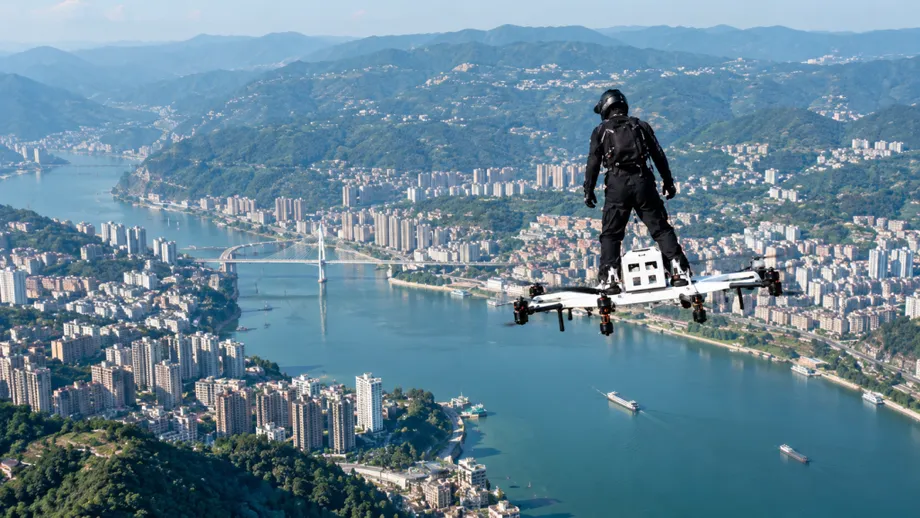
Ten electric motors carry an inventor through a Hubei canyon
A homemade flying skateboard fitted with 10 electric propulsion units carried its inventor more than 300 meters through a canyon in Badong, Hubei province, during a flight lasting just over two minutes. Scenic area employee Dai Xiaoying dated the demonstration to October 6, 2026, and described a departure from open ground beside a reception center and a landing on a platform inside the canyon.
Contents
- Ten electric motors carry an inventor through a Hubei canyon
- What happened during the October flight?
- Why the first design caught fire
- How the electric skateboard stays airborne
- AI gives advice while Song controls the board
- A workshop built with borrowed money
- The experiments that came before
- What still needs to change
- Key Points
The inventor is identified in detailed Chinese reporting as Song Xingyu, known online as 神奇阿宇AYU. Those accounts give his age as 25 and 26; an earlier English account identified him as Sun Xinyu, aged 26. The Chinese accounts consistently give his name as 宋兴宇.
Inspired by the Green Goblin's flying platform in the Spider-Man films, Song spent roughly two months developing the device. His first design used five miniature turbojet engines and caught fire during testing. The replacement uses electric motors, with a throttle attached to a ring on his finger.
Videos of the flights attracted nearly 4 million likes on Douyin, bringing attention to a project built in a converted woodworking shed. Behind the striking images is a demanding engineering problem: keeping a standing person balanced above powerful rotors while carrying enough battery energy to stay airborne.
Song has identified battery capacity, structural strength, emergency systems and rider protection as areas needing improvement. His demonstrations show a working experimental platform, while everyday transport remains beyond its present capabilities.
What happened during the October flight?
Dai said Song's team spent about four to five hours at the Baren River scenic area on October 6. Their work included checking the location, adjusting equipment and filming the flight. The journey through the canyon was completed in one continuous flight.
Other footage from the National Day holiday showed Song flying above the Yangtze River and around Badong. The canyon flight has the clearest accompanying description of its route, distance and duration: more than 300 meters in just over two minutes.
Liu Bo, chairman of Badong Hongfa Industrial Development Group, helped coordinate locations and experimental work. He said Song approached the flights cautiously and notified relevant departments beforehand. The precise scope of any aviation authorization was not stated.
The reported distance and time describe a short demonstration rather than an endurance test. Battery duration matters because an aircraft needs energy for takeoff, maintaining height, maneuvering and landing, with enough remaining to respond when conditions change.
Why the first design caught fire
Song initially chose five miniature turbojet engines, which generate thrust by expelling hot gases. The first test with the engines operating together ended in a fire that destroyed fuel lines and electrical circuits.
He then submitted testing data to an artificial intelligence system for analysis. The explanation described in the reporting was that the engines sat too close together and that hot exhaust bounced off the ground and entered their air intakes.
An engine needs suitable incoming air to operate properly. Drawing its own hot exhaust back inside can disrupt operation. This is a particular concern when several engines are packed into a small platform close to the ground.
The AI analysis recommended switching to an electric design with multiple rotors. Song followed that recommendation, replacing combustion engines with brushless electric propulsion units. The change removed the jet exhaust problem but introduced a different set of demands involving batteries, electrical current and rotor control.
How the electric skateboard stays airborne
The second version has 10 brushless propulsion units, each reportedly capable of producing more than 30 kilograms of thrust. Together, their stated output exceeds 300 kilograms of thrust. Here, kilograms describe lifting force in familiar weight terms rather than the mass of the equipment.
The motors must lift the platform, batteries, electronics and rider together. A comparison with the weight of several adults can make the thrust sound impressive, but the machine also needs spare lifting power to climb and adjust its position.
Peak electrical current reportedly reaches 2,000 amperes. Current is the flow of electric charge through a circuit. Handling such a flow requires batteries, connections, wiring and control equipment suited to the load and the heat it produces. A battery voltage was not given, so a power figure cannot be calculated from the current alone.
Like a drone with several rotors, the platform changes its attitude by varying thrust across the machine. More lift on one side can tilt it, changing the direction of movement. Carrying a standing rider makes that task harder because the person's movements also shift the combined center of gravity, the point around which the machine and rider balance.
AI gives advice while Song controls the board
Song built a monitoring setup using two mobile phones and an earpiece. The system gathers movement information and gives spoken prompts about his posture, helping him recognize when his weight has shifted and how to respond.
The reported arrangement leaves Song responsible for operating the board. AI provides balance guidance, while his finger controls the throttle and his body movements affect the platform's position.
That division of work explains why practice mattered so much. A helpful voice prompt still requires the rider to hear it, understand it and make the right movement while the board is already responding beneath his feet.
Song trained for more than 10 days before the holiday flights. During an early test, he reportedly carried 40 to 50 kilograms of equipment, mishandled the throttle and tilted too far. The accident damaged a rod and left him with sprains and scraped knees.
A workshop built with borrowed money
Song grew up in a rural part of Badong and left school at 14 to work at his father's timber business. A tablet given to him by a friend introduced him to videos of flight experiments abroad.
His first model aircraft used discarded foam board from advertising shops and secondhand electronic parts supplied by fellow hobbyists. It took about one to two years of attempts before a model managed to fly.
In June 2022, he borrowed 19,000 yuan from his father to buy a used small truck and took out another loan of more than 20,000 yuan. He returned home and converted an old woodworking shed into a laboratory, doing the wiring, furnishing and decorating himself.
Tan Fengzhen, an employee of Badong's government services center who visited the family home, described a modest earth brick house beside the workshop. Inside the laboratory were electronic instruments, microscopes, meters and hand tools. She also described a small operation that relied on temporary filming crews rather than a permanent support team.
His father, Song Chaofu, said he supported his son's ambitions but remained concerned about his safety. Song's mother has also accompanied him on trips, helping with meals and practical work.
The experiments that came before
The skateboard follows several ambitious projects, including a balloon carried aircraft, a powered flying wing and a furnished room suspended beneath a hot air balloon. Song's experimental history also includes equipment failures, injuries and substantial debt.
- June 2022: Song returned to his hometown and began turning the former woodworking shed into a laboratory.
- May 2024: His remotely controlled aircraft, Echo One, was carried toward an altitude of 40,000 meters by balloons. A separation failure and lost signal ended the mission; wreckage was recovered about 600 kilometers away.
- November 2024: He jumped from a helicopter at 5,000 meters using a homemade powered flying wing. After the main parachute failed, a reserve opened at about 600 meters.
- September 2025: He suspended a furnished living room beneath a hot air balloon and filmed himself preparing food aloft.
- December 5, 2025: He publicly described an aircraft crash, the loss of a boat and debts exceeding 2.4 million yuan.
- October 6, 2026: His electric skateboard completed the reported canyon demonstration in Badong.
After the aircraft and boat losses, Song said he borrowed money to compensate people involved, including for sponsored goods. An institution later helped him repay most of the debt.
Song's own description of the flying wing experiment combined his attraction to flight with a warning. Before that jump, the inventor said:
Only when I do these things do I feel alive. Please do not do what I do.
What still needs to change
Song's list of needed improvements reaches beyond staying in the air longer. Stronger construction, better protection and emergency systems all concern what happens when the flight stops going as planned.
Safety redundancy means having another way to preserve control when a component fails. Multiple motors can provide several sources of thrust, but continued flight after a failure depends on their layout, the control system and the lifting capacity remaining.
Rider protection presents another challenge. A standing person has to maintain balance while operating the device, and Song's training injuries show how quickly a control error can become a fall. Flights over water or through a canyon also leave limited places for an emergency landing.
Descriptions of restrictions around populated areas and water sit uneasily alongside footage described as showing river crossings and movement around the county town. Location and operating limits need to be resolved before wider use, alongside the technical work Song has already identified.
The attention has brought cooperation proposals and interview requests. On October 18, Song said he was continuing experiments and filming, with the aim of flying higher. His next practical task is broader than gaining altitude: making the device more dependable, improving emergency protection and extending flight time.
Key Points
- Song Xingyu's electric flying skateboard reportedly covered more than 300 meters in just over two minutes in Badong on October 6, 2026.
- A fire during testing ended his first design, which used five miniature turbojet engines.
- The replacement has 10 brushless propulsion units and a reported peak current of 2,000 amperes.
- Two phones and an earpiece provide AI assisted posture guidance while Song operates the platform.
- He practiced for more than 10 days and suffered injuries during early testing.
- Battery capacity, structural strength, emergency systems and rider protection still need improvement before everyday transport becomes practical.