A September infection reveals a wider surveillance gap
A man who developed mpox symptoms on 1 September 2025 while working in the Arabian Peninsula has been identified as the earliest known case of a recombinant virus containing genetic material from two mpox lineages, clades Ib and IIb. His infection was confirmed in India on 11 September, but its unusual genetic makeup became clear only after a related virus was identified in Britain and added to a global database.
Contents
- A September infection reveals a wider surveillance gap
- How the Indian case was reclassified
- What a recombinant virus is
- What the genetic comparison found
- Why growing live virus mattered
- Why routine tests gave different labels
- Two recovered patients, a broader geographic signal
- What this means for people at risk
- What WHO wants laboratories to do next
- Key Points
The World Health Organization says the Indian and British viruses were more than 99.9% genetically similar. Both patients recovered without severe outcomes, and contact tracing found no secondary cases in either reporting country. Yet their travel histories suggest that the strain's circulation extends beyond those two detections.
In its mpox outbreak notice, WHO assessed that transmission of the recombinant strain already involved at least four countries across three WHO regions. The two confirmed patients had travelled from different regions of Asia, making their closely related infections a signal for international surveillance.
The Indian investigation, conducted by researchers at the Indian Council of Medical Research's National Institute of Virology in Pune with clinical partners in Kerala and Puducherry, was published in Nature Microbiology. Researchers recovered almost the entire viral genome and grew live virus from the patient's sample.
The immediate challenge is practical: routine tests detected mpox, but tests intended to identify its genetic group gave different initial classifications in India and Britain. Reading the virus's genome revealed the connection.
How the Indian case was reclassified
The Indian patient was an overseas worker residing in a country in the Arabian Peninsula. He became ill there before returning to India, where a PCR test confirmed monkeypox virus infection. PCR detects selected pieces of viral DNA and is the main laboratory method used to diagnose mpox.
A further test on 15 September initially classified his virus as clade II. Early analysis of its genetic sequence also suggested clade IIb, the lineage responsible for the global outbreak that began in 2022.
The turning point came on 16 December 2025, when the global Nextclade database was updated to include the recombinant identified in Britain. Reassessment placed the Indian virus in the same recombinant strain. India notified WHO on 13 January 2026.
The sequence of events explains why Britain reported the strain first while India had the earlier known infection:
- 1 September 2025: The Indian patient developed symptoms while abroad.
- 11 September: PCR testing in India confirmed mpox.
- 15 September: Clade differentiation testing initially identified clade II.
- 29 September: The patient tested negative after recovering without medical complications.
- October: The British patient returned from a country in the Asia Pacific region.
- December: Britain reported the recombinant, which was incorporated into Nextclade on 16 December.
- 13 January 2026: India notified WHO of its retrospectively identified recombinant case.
WHO says symptom onset in the Indian case preceded that of the British case by more than two months. Recognition depended on connecting genetic data across borders, rather than on either patient's symptoms alone.
What a recombinant virus is
Monkeypox virus, abbreviated MPXV, has two main genetic groups, clade I and clade II. These divide into Ia, Ib, IIa and IIb. Clade Ib emerged in South Kivu in the Democratic Republic of the Congo in 2023 and subsequently spread internationally. Clade IIb drove the worldwide outbreak beginning in 2022.
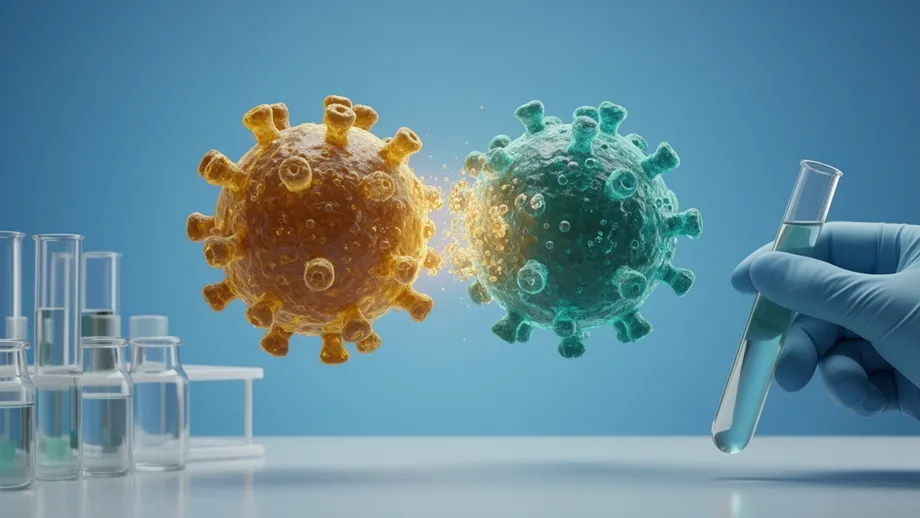
Recombination can occur when two related viruses infect the same cell and exchange genetic material while making copies. The resulting virus can contain stretches of DNA inherited from each parent, rather like a document assembled from sections of two earlier versions.
Poxviruses have large genomes made of double stranded DNA, and genetic exchange is an established part of their biology. In these cases, researchers found blocks associated with clade Ib alternating with blocks associated with clade IIb.
The Indian analysis identified mutations typical of both parental lineages arranged along a single genome. Researchers also compared individual stretches with reference sequences. Different stretches grouped with different parental clades, supporting the finding that the genome was a mosaic.
What the genetic comparison found
India recovered more than 99% of the genome from both the clinical sample and a virus isolate grown from it. WHO reported more than 99.9% similarity between the Indian and British recombinant sequences, supporting a shared evolutionary history.
The Indian study described 34 recombinant tracts, meaning continuous stretches inherited from one parental lineage or the other, and 21 mutations associated with the recombinant lineage. Its account described the British virus as also having 34 tracts; WHO's comparison counted 34 in the Indian sequence and 28 in the British sequence, with 16 shared.
Researchers used several ways to examine the relationship. Comparisons of complete genomes placed the two recombinants together between the parental groups. A genetic network produced a box shaped pattern, a way of displaying relationships involving exchanged DNA that do not fit neatly into a single branching family tree.
The strongest connection is therefore between the two viruses themselves. Their close similarity and shared mosaic structure support circulation of a related recombinant lineage before either country recognized it.
Why growing live virus mattered
The Pune team went beyond reading DNA. Researchers placed clinical material into Vero CCL-81 cells, cells commonly used in virology laboratories, and observed damage associated with viral replication by the third day of the second laboratory passage. They repeated the experiment three times with consistent results.
Recovering a living virus strengthened the finding that the mosaic sequence belonged to a virus capable of replication. The team deposited sequences from both the clinical sample and the isolate in public genetic databases, including Pathoplexus and databases participating in the International Nucleotide Sequence Database Collaboration.
British investigators also checked their finding repeatedly. They sequenced material from the original sample, a fresh extraction from that sample, another swab collected at the same time and a cultured isolate. Those procedures produced identical viral genome sequences.
Live isolates give laboratories material for the next stage of research: measuring how quickly the virus grows, how it responds to antiviral medicines and how antibodies recognize it. British authorities are continuing studies of the recombinant's biological properties.
Why routine tests gave different labels
The Indian virus initially received a clade II classification, while the British virus initially received a clade Ib classification. Both were later identified as closely related recombinants through genome sequencing.
A diagnostic PCR test looks for short, selected stretches of genetic material. A clade differentiation test examines markers used to distinguish viral groups. If a recombinant carries a marker from clade Ib in one part of its genome and clade IIb material elsewhere, its test label can depend on which stretch the assay examines.
For laboratories, that creates a distinction between diagnosing the disease and describing the virus accurately. Both patients had confirmed mpox, while the fuller genetic classification required additional analysis.
WHO says clade differentiation PCR alone may not reliably identify recombinant strains. India uses general orthopoxvirus and MPXV tests, followed by clade differentiation, and sequences positive cases. Britain sequences all samples identified as clade Ib and selected samples identified as clade IIb.
The Indian researchers outlined a workflow for investigating suspected recombinants. Unexpected or conflicting clade results are reasons to examine the whole genome. Their experience also shows the value of revisiting older sequences when a newly recognized strain enters a shared database.
Two recovered patients, a broader geographic signal
The Indian patient was hospitalized, recovered without complications and tested negative on 29 September. He reported no close contacts in India, and health authorities identified no secondary infections.
The British patient also had no severe outcome. A small number of contacts were followed, and none developed clinical features of mpox. Health workers caring for the patient had worn full personal protective equipment; contacts received advice, were offered vaccination and were monitored for symptoms.
WHO's estimate of involvement across at least four countries draws together the two countries of detection and the patients' travel histories. The strain's place of origin, the route connecting the infections and its biological effects on transmission or disease severity remain unknown.
Both patients had symptoms consistent with mpox caused by other clades. WHO has left its public health risk assessment unchanged: moderate for men who have sex with men with new or multiple partners, and for sex workers or others with multiple casual sexual partners; low for the general population without specific risk factors.
What this means for people at risk
Mpox spreads mainly through close physical contact, including sexual contact, and can also spread through contaminated materials. Symptoms can include fever, swollen lymph nodes and skin or mucosal lesions. Some people develop only a few lesions, making early recognition harder.
Katy Sinka, UKHSA's head of sexually transmitted infections, has highlighted genomic testing as a means of detecting viral changes early. She has also urged eligible people to receive vaccination, noting that mpox can sometimes cause severe illness.
Britain's routine vaccination programme targets eligible groups at greater exposure risk, including people with multiple sexual partners and people participating in group sex. Studies cited in vaccination guidance put protection against clade II at about 75% to 80%, with protection also expected against clade Ib. Research on the recombinant's response to immunity is part of the laboratory work still needed.
Since October 2024, clade Ib infections have been identified in London, East Sussex, Leeds and North East England, with limited household transmission in some clusters. Other countries reporting clade Ib include the United States, Spain, Italy, the Netherlands and Portugal. Those detections form the wider context for surveillance, alongside the two recognized recombinant cases.
WHO continues to recommend vaccination for people at risk, prompt diagnosis, appropriate clinical care and infection control. It also recommends integrating mpox services with HIV and sexually transmitted infection care, including early HIV testing and access to treatment where needed.
What WHO wants laboratories to do next
WHO recommends sequencing specimens from every confirmed case during the early stages of an outbreak. Where community transmission is established, it recommends sequencing a representative sample of at least 10% of confirmed cases, equivalent to at least one in ten.
Imported infections, unusual or severe cases and cases with relevant travel histories are priorities for closer genetic investigation. Rapid sharing of sequences allows laboratories elsewhere to compare new findings and reassess previous classifications, as happened with the Indian sample.
WHO set out its travel advice directly:
WHO recommends that no restrictions be applied for travel to, or trade with, the countries named in this report, based on the information available on the event reported here.
WHO Director General Tedros Adhanom Ghebreyesus announced on 5 September 2025 that mpox was no longer a public health emergency of international concern. Surveillance and response duties continue under standing recommendations extended to August 2026.
India's experience gives those duties a concrete purpose. Clinical care brought the patient through his illness, routine testing identified mpox, sequencing captured the unusual genome, and an international database update supplied the connection needed to name it correctly.
Key Points
- India's patient developed symptoms on 1 September 2025, making his infection the earliest known detection of the Ib/IIb recombinant strain.
- The Indian and British viral sequences were more than 99.9% similar, supporting a shared evolutionary history.
- Both patients recovered without severe outcomes, and no secondary cases were identified through contact tracing.
- Initial clade tests gave different classifications; genome sequencing revealed the recombinant relationship.
- WHO assesses that the strain's transmission involves at least four countries across three regions.
- WHO's risk assessment is unchanged, and it recommends continued sequencing, vaccination for people at risk and no travel or trade restrictions.