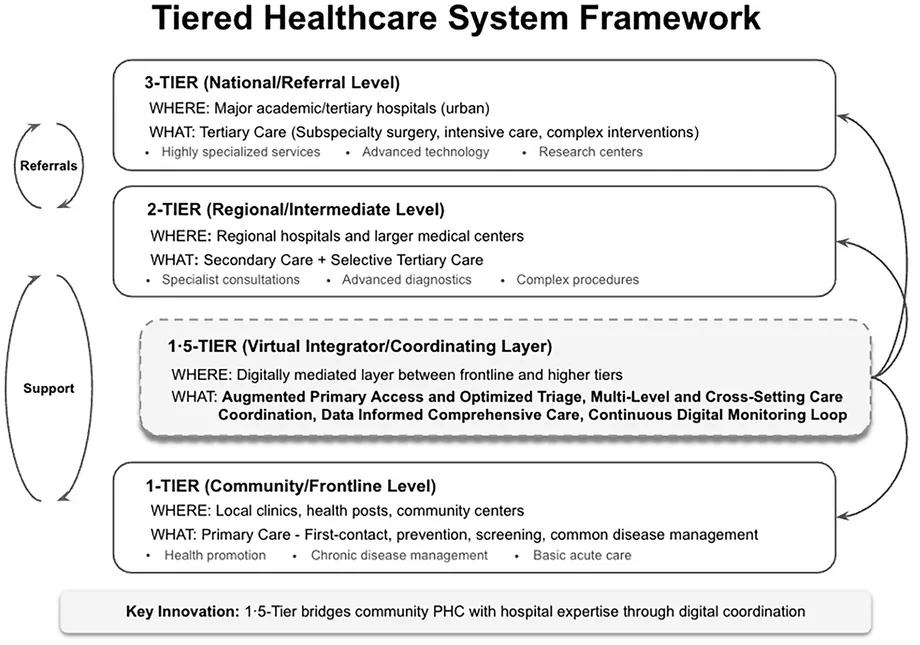
A proposed middle layer for a crowded health system
South Koreans made 18 outpatient visits per person in 2023, compared with an OECD average of 6.5. With electronic medical record adoption above 95%, the country combines extensive digital infrastructure with heavy demand for consultations. A research team now proposes using artificial intelligence to connect neighborhood clinics and major hospitals more closely, rather than adding another category of medical institution.
Contents
- A proposed middle layer for a crowded health system
- What the 1.5 tier would actually do
- Screening can find disease, but can also miss it
- Better referrals depend on more than fluent writing
- Existing scans could reveal overlooked risks
- Broader diagnosis support has different kinds of evidence
- Diabetes care could continue between appointments
- Doctors retain responsibility, with three safety loops
- Why Korea is a candidate, not a confirmed rollout
- Key Points
The proposal, called the 1.5 Tier Healthcare System, was published online on September 2, 2026, in npj Health Systems, a Nature Portfolio journal. Led by Professor Jung Se-young of the Department of Family Medicine at Seoul National University Bundang Hospital, the team describes an AI layer that would help clinics screen patients, exchange medical information, detect overlooked disease risks and monitor chronic conditions between appointments.
The published perspective paper brings together evidence from separate clinical studies. It does not report a trial of the complete healthcare model or announce a national rollout. Its central argument is that individual AI tools should be organized around the work primary care must perform, rather than introduced as disconnected technical products.
Professor Park Sang-min of Seoul National University College of Medicine and National Assembly member Cha Ji-ho also participated. The listed authors include Seong-Ho Han, Eojin Yi, Wooin Seo and Yeonsoo Kang. The team announced the publication on September 17, 2026.
The distinction between a proposal and an operating system matters. The authors identify South Korea as a promising place to test the framework, while acknowledging that the incentives, institutional governance and monitoring needed to support it are not yet established at scale.
What the 1.5 tier would actually do
The proposed middle layer is a technical bridge between primary care and specialist services. Patients would still visit local clinicians and receive hospital care when necessary. AI would support the decisions and information transfers that connect those settings.
The framework organizes that support around four established functions of primary care: first contact, coordination, comprehensiveness and continuity. These mean assessing a new health concern, keeping care aligned across providers, addressing a broad range of health needs and maintaining care over time.
For example, a clinic could use AI to interpret a screening image, prepare a referral document and combine a hospital discharge summary with readings from a patient's home monitoring device. The intended benefit is a more complete picture of the patient without requiring clinicians to reconstruct that picture manually at every visit.
The authors describe their ambition as making the attentive, individualized care associated with concierge medicine available more widely. In the paper's abstract, the research team calls the model a scalable alternative to that approach:
concierge care for all.
That is a stated goal, not a demonstrated result. Evidence that a tool improves a specific task does not establish that the full system can deliver more personal care without additional staffing or expense.
Screening can find disease, but can also miss it
One example comes from a prospective Australian study that combined automated retinal photography with AI screening for glaucoma in primary care. Referable glaucoma, meaning disease warranting specialist assessment, was identified in 18 of 161 previously undiagnosed participants, or 11.2%.
The paper also gives performance figures that put that detection rate in context: sensitivity of 65.0%, specificity of 94.6% and an area under the receiver operating characteristic curve, or AUROC, of 0.80.
Sensitivity describes how well a test identifies people who have the condition. Specificity describes how well it identifies people who do not. The reported sensitivity indicates that the screening approach did not detect every case. Its relatively high specificity does not remove that limitation.
AUROC measures how well a test distinguishes between cases and noncases across different decision thresholds. A value of 0.80 indicates useful discrimination, but it is not the same as saying that 80% of patients received a correct diagnosis.
These results support using AI to expand screening and help route patients toward appropriate care. They do not support treating a negative result as a guarantee that disease is absent. That distinction is central to the proposed model: screening assistance must remain connected to clinical assessment and referral.
Better referrals depend on more than fluent writing
For coordination, the researchers point to large language models that generate referral letters and discharge summaries from electronic medical records. The paper cites accuracy of up to 99.25% in zero shot summarization, alongside evidence of strong agreement with summaries written by clinicians.
Zero shot means the model performed the requested task without receiving task specific examples in that evaluation. It does not mean the model had never been trained. Large language models undergo extensive training before they are asked to produce a medical document.
The potential benefit is practical. A patient moving from a local clinic to a hospital needs a clear account of symptoms, investigations and treatment. On returning to community care, medication changes and specialist recommendations need to travel with the patient. Automating the first draft could reduce the time spent assembling those details.
However, the cited accuracy figure belongs to a particular evaluation. It is not a guarantee that every referral letter produced in another clinic will be complete or safe. A polished document can still omit a crucial fact, which is why the framework retains professional responsibility for care decisions.
Coordination also extends beyond hospitals. The paper describes a Nebraska initiative using a digital care navigation platform to identify unmet social needs, connect patients with community resources and support follow up through community health workers. That example broadens the proposal beyond document generation: information should help connect patients to services, rather than simply produce more text.
Existing scans could reveal overlooked risks
The comprehensiveness component asks whether AI can help a generalist address more of a patient's health needs using information already collected. One example is opportunistic screening, in which a scan taken for one reason is examined for evidence of another condition.
In the US NOTIFY-1 project, AI identified coronary artery calcium on existing chest computed tomography scans. Calcium deposits can indicate atherosclerosis, the buildup of plaque in arteries. Researchers then notified clinicians and patients about the findings.
The academic paper reports statin prescription rates of 51.2% versus 6.9% at six months, a difference of 44.3 percentage points and approximately a 7.4 times ratio. Statins lower cholesterol and are used to reduce cardiovascular risk in eligible patients.
Reports describe the figures as a rise from 6.9% before screening to 51.2% afterward. The academic account instead presents them as a comparison at six months and states that none of the patients were receiving statins at baseline. The 6.9% figure should therefore not be treated as the baseline prescription rate.
The result measures a change in prescribing, not a demonstrated reduction in heart attacks. It also reflects a combined intervention: AI detection followed by notification to doctors and patients. Detection alone cannot be credited with the entire effect.
Broader diagnosis support has different kinds of evidence
The paper also cites a randomized trial of AI assistance for spirometry, a test that measures how much air a person can breathe out and how quickly. It is commonly used when evaluating breathing disorders.
AI decision support improved clinicians' preferred diagnosis prediction by 9.0 percentage points across cases. For chronic obstructive pulmonary disease, or COPD, the improvement was 15.9 percentage points. The reported 95% confidence intervals were 4.5 to 13.3 points and 9.0 to 22.7 points, respectively.
These are improvements in a diagnostic task, not proof that AI can independently manage respiratory disease. The authors place such tools within workflows requiring clinician verification and referral when a case exceeds the scope of primary care.
A separate study by Pickhardt and colleagues modeled AI screening of existing CT scans for cardiovascular disease, osteoporosis and sarcopenia, which is loss of muscle mass and function. In modeled cohorts of people aged 55, the approach was projected to save costs and produce better clinical outcomes over 10 years than strategies of treating everyone or treating no one.
That evidence differs from a clinical trial. A model estimates results using assumptions about disease, treatment and costs. It can help assess whether an approach warrants testing, but its projected savings should not be presented as money already saved by the proposed Korean framework.
Diabetes care could continue between appointments
For continuity, the researchers focus on information and care that persist outside the consultation room. Continuous glucose monitors collect frequent readings, allowing a care team to see patterns that occasional clinic measurements may miss.
A randomized trial of the Twin Precision Treatment system combined glucose monitoring, AI guided lifestyle advice and digital feedback. It reported that 71.0% of participants with type 2 diabetes achieved remission or reduced their medication.
That is a combined outcome. It does not mean that 71.0% achieved remission, nor does it mean that everyone in that group stopped medication. The distinction matters when describing what patients might expect from a similar program.
In the United Arab Emirates, the GluCare.Health model combined remote monitoring with AI clinical decision support. The paper reports an HbA1c decrease of 2.19 percentage points, compared with 0.10 percentage points under standard care, a difference of 2.09 points. HbA1c reflects average blood glucose over roughly two to three months.
Both examples concern packages of care, not software acting alone. Monitoring devices, lifestyle support and clinical management accompanied the AI component. They support testing more continuous care, but do not establish that AI by itself produced the reported improvements.
Doctors retain responsibility, with three safety loops
The proposal assigns diagnostic and treatment responsibility to licensed clinicians and healthcare institutions. AI would support intake, documentation, prioritization, risk assessment and monitoring rather than independently assume responsibility for patients.
The intensity of oversight would increase with the autonomy of the tool and the consequences of its output. Administrative summaries and scheduling could undergo retrospective review. Triage priorities and clinical prompts would need clinician review before action. Diagnoses, prescriptions and other consequential treatment decisions would require professional confirmation.
The authors also specify three safety loops: clinical, governance and learning. Together, these describe the need to supervise care, maintain institutional accountability and use experience after deployment to monitor and improve the system.
The distinction is useful because a successful laboratory or clinical evaluation does not settle how a tool performs after it enters everyday practice. A framework connecting multiple tools needs oversight of the combined service, as well as checks on each individual application.
The same principle applies to records. The researchers propose combining institutional medical records with patient generated information from wearables, personal health records and digital therapies. They discuss standardized clinical terminology, including SNOMED CT, to help different systems interpret the same information consistently. Widespread digital records are a starting point, not proof that records already move reliably between institutions.
Why Korea is a candidate, not a confirmed rollout
South Korea's 18 outpatient visits per person were about 2.8 times the OECD average of 6.5, using the figures cited for 2023. Alongside extensive electronic records and population wide national health insurance, that high volume gives the researchers a reason to test whether better primary care support can reduce fragmented care and pressure on major hospitals.
The authors nevertheless identify unresolved conditions for implementation: aligned incentives, governance boards and infrastructure for monitoring after deployment are not yet established at scale. The proposal does not provide a confirmed pilot start date, implementation deadline or national funding commitment.
The chronology separates the underlying health system figures from the publication and announcement:
- 2023: South Korea recorded 18 outpatient visits per person, against the cited OECD average of 6.5.
- September 2, 2026: The perspective was published online in npj Health Systems, volume 3, article 80.
- September 17, 2026: The research team announced the publication.
The authors declare no competing interests. Their paper sets out an agenda for testing a service model, rather than evidence that Korea has already reorganized care around it.
The framework also proposes different uses elsewhere. In wealthy urban settings, AI triage and automated paperwork would support clinics facing specialist demand and administrative pressure. In rural areas with few doctors, nurses and community health workers could use portable screening tools and refer patients. In conflict or disaster zones, lightweight tools capable of operating without internet access could help preserve essential services.
Those are proposed adaptations, not reported deployments of the complete system. The common aim is to make existing clinical capacity more useful while keeping screening, referrals and monitoring tied to accountable medical care.
Key Points
- Korean researchers propose an AI layer connecting primary care clinics with specialist hospitals, not a new category of medical institution.
- The September 2026 paper is a perspective drawing on separate studies, not a trial of the complete framework.
- Applications cover screening, medical documentation, broader disease detection and care between appointments.
- Clinical results vary by task, and benefits from combined care programs cannot be attributed to AI alone.
- Clinicians retain responsibility for diagnoses, prescriptions and treatment decisions.
- South Korea is proposed as a test site, but governance, incentives and monitoring are not yet established at scale.
- No confirmed national rollout or pilot deadline is announced.