Eight minutes of alarm, followed by an emergency fix
Japan's earthquake warning system issued an alert for a magnitude 9.9 earthquake at 12:40 p.m. on October 16, 2026, sending warnings across an area stretching from Hokkaido to central Japan. The actual earthquake, near Russia's Kamchatka Peninsula, measured magnitude 6.9. Japan recorded only slight shaking, reaching seismic intensity 1 in Hakodate, Hokkaido.
Contents
- Eight minutes of alarm, followed by an emergency fix
- What happened on October 16?
- How the calculations went wrong
- A distance safeguard failed when it was needed
- Why magnitude 9.9 caused such alarm
- Why canceling the warning sounded another alarm
- Passengers stopped and students waited for shaking
- What the repair changed, and what comes next
- Key Points
The Japan Meteorological Agency (JMA) traced the false warning to errors in software used to process distant earthquakes. The system used an unsuitable calculation formula, handled the earthquake's location inconsistently and failed to exclude readings from observation stations too far from the quake.
The warning was canceled at 12:48 p.m., eight minutes after it was issued. By around 9:30 p.m. that evening, the agency had made an emergency software correction and checked that the same earthquake data would no longer trigger a warning.
The JMA's initial October 16 statement confirmed that its processing system had placed the earthquake in the Kuril Islands and overestimated its magnitude at 9.9. At that stage, the agency said it was still investigating the cause.
The subsequent findings explain how a distant earthquake produced a forecast of extreme shaking across a large part of Japan. They also reveal that a safeguard introduced after a similar false alarm in 2020 failed to operate.
What happened on October 16?
The earthquake occurred near Kamchatka at a depth of about 160 kilometers. Its occurrence was given as around 12:38 p.m. in the incident reporting, while a later disaster chronology put it at around 12:35 p.m. The warning and cancellation times were consistently recorded as 12:40 p.m. and 12:48 p.m.
- About 12:35 to 12:38 p.m.: A magnitude 6.9 earthquake occurred near Kamchatka.
- 12:40 p.m.: The JMA issued an earthquake early warning covering Hokkaido through central Japan, with predicted shaking reaching intensity 7.
- 12:48 p.m.: The agency canceled the warning after observations showed only weak shaking.
- About 9:30 p.m.: The JMA corrected the malfunctioning distance filter and checked the earthquake data again.
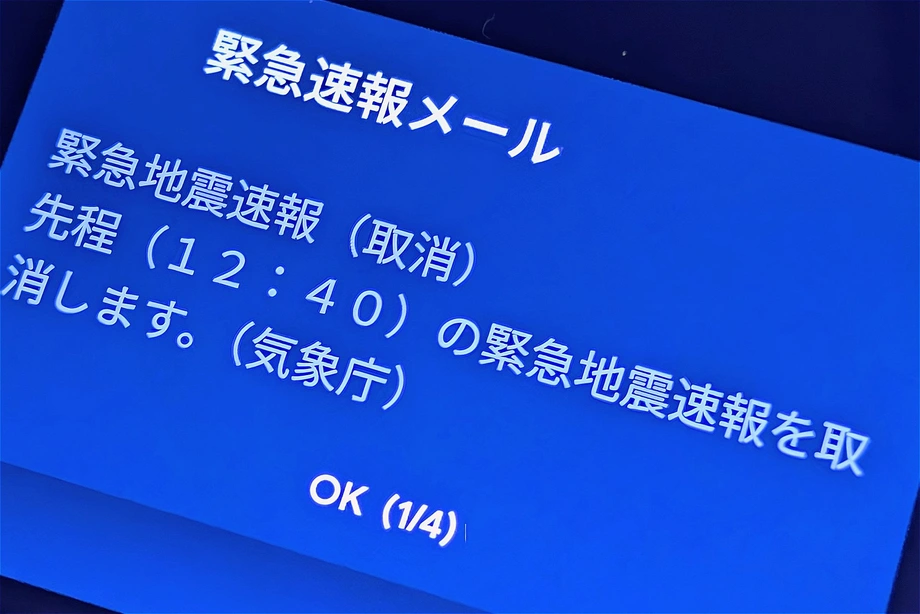
The cancellation was the first withdrawal of a public earthquake early warning since the service began full operation in 2007. Earlier false alarms had occurred, but this event brought an additional emergency notification telling recipients that the warning had been withdrawn.
How the calculations went wrong
The warning system combines readings from seismometers to estimate where an earthquake has occurred, how large it is and how strongly different places will shake. Each calculation needs to fit the others. An incorrect location can affect both the estimated magnitude and the expected shaking.
In this case, the JMA identified two linked calculation errors in the processing of a distant earthquake. A formula intended for earthquakes near Japan was applied to the Kamchatka event. The system also used different estimated earthquake locations for calculating magnitude and predicting shaking, although both calculations should have used the same location.
The magnitude calculation placed the earthquake farther from Japan than its actual location. The shaking forecast then used a location closer to Japan. Together, those errors produced an exaggerated earthquake size and an exaggerated forecast of the shaking that would reach the country.
The agency's initial statement described the location used in the warning process as the Kuril Islands. The later explanation showed why the problem involved more than simply putting the earthquake in the wrong place: different parts of the calculation were working with different locations.
Ayataka Ebita, head of the JMA's earthquake and tsunami observation division, explained that the system generates these calculations automatically rather than waiting for staff to approve each result.
"We do not watch the calculations in real time as each result is generated. The system produces them automatically, so we cannot necessarily observe these changes as they happen," Ebita said.
A distance safeguard failed when it was needed
The JMA also found that a protective filter had failed. The filter was supposed to keep readings from stations 700 kilometers or more from the earthquake out of the magnitude calculation.
The nearest observation station, in Nemuro, Hokkaido, was about 1,200 kilometers from the earthquake. That was roughly 500 kilometers beyond the exclusion threshold. If the filter had operated correctly, those distant readings would have been left out of this calculation.
The agency had introduced the safeguard after a false warning involving an earthquake near Torishima in July 2020. Its failure in October meant that data the system was designed to reject entered the processing chain.
Distance matters because the system must work backward from waves recorded at a station to estimate the earthquake that produced them. Ebita said the reliability of the estimate depends on the number of stations and that readings can become less reliable when the earthquake is far from them. Here, both the handling of distant readings and the calculations using them went wrong.
Why magnitude 9.9 caused such alarm
The JMA said 9.9 is the highest magnitude value its systems can send externally. The false alert therefore carried the maximum number the system could transmit, alongside a forecast of intensity 7, the highest level on Japan's seismic intensity scale.
Magnitude and seismic intensity describe different things. Magnitude measures the size of an earthquake at its source. Intensity describes how strongly the ground shakes at a particular place. One earthquake has a magnitude, but its shaking intensity varies from town to town.
The actual maximum intensity in Japan was 1, recorded in Hakodate. At that level, only some people notice the shaking. The forecast had instead reached the top of the intensity scale, creating a huge gap between what people were told to expect and what they experienced.
Magnitude numbers also grow much faster than an ordinary counting scale. An increase of one magnitude represents about 32 times as much released energy. A magnitude 9.9 earthquake would release roughly 22 times the energy of the magnitude 9.0 earthquake that struck northeastern Japan in 2011. The largest earthquake recorded worldwide, in Chile in 1960, measured magnitude 9.5.
Why canceling the warning sounded another alarm
The JMA withdrew the alert after observations confirmed that the shaking was weak. Ebita said a cancellation is issued when the maximum observed intensity is 2 or lower, or when the signal is found to have come from something other than an earthquake. The maximum observed intensity in this event was 1.
Smartphones sounded again when the cancellation arrived. For people still waiting for strong shaking, another loud emergency tone created an additional moment of confusion before they could read the message.
The event exposed two separate tasks for the warning service: getting the earthquake forecast right and communicating a correction in a way people can quickly understand. The cancellation ended the warning, but it reached many users through the same attention grabbing sound that had announced the danger.
Suggestions following the incident included sending cancellation messages without the emergency warning tone. The JMA's announced emergency software correction addressed the distance filter used in earthquake calculations; no decision on changing cancellation sounds was announced.
Passengers stopped and students waited for shaking
Central Japan Railway said the Tokaido Shinkansen stopped for 15 minutes after its automatic safety system responded to the warning. The interruption showed how a calculation error can move beyond phone screens and immediately affect transport.
Chief Cabinet Secretary Minoru Kihara said the government had received no reports of damage related to the Kamchatka earthquake. He also acknowledged the anxiety and burden experienced by people who evacuated, took protective action or had their travel and business activities interrupted.
In Tokyo, Lola Milroy-Tompkins, a 20-year-old British student at Waseda University, was eating lunch in a campus cafeteria when the alert sounded. She described expecting a much more violent event.
"I have never experienced an earthquake before and I expected the grand style shaking and everything to start falling around me," Milroy-Tompkins said.
Her account captures the immediate effect of the forecast: people had to prepare for severe shaking while waiting to find out what would happen. Across the warning area, phones, public loudspeakers and television broadcasts delivered urgent messages before the agency withdrew the alert.
What the repair changed, and what comes next
The JMA's emergency correction restored the function that excludes stations at least 700 kilometers from the earthquake. The agency then checked the October 16 event with the correction applied and confirmed that it would no longer produce a public warning.
The agency apologized for the inconvenience and burden caused by the false alert and said it would continue a detailed investigation and introduce further measures to prevent a recurrence. It did not give a completion date for that work.
Earlier incidents offer specific comparisons. In July 2020, an incorrect location estimate and an exaggerated magnitude triggered warnings in 15 prefectures, including Tokyo. In August 2013, noise from a seabed seismometer was combined with readings from a small earthquake, causing widespread false warnings in the Kinki region. Neither event produced observed shaking of intensity 1 or higher, according to the JMA.
The October case brought those concerns together in a different way: a real distant earthquake, inconsistent location estimates, an unsuitable formula and a failed safeguard. The immediate repair targeted the filter that should have stopped the distant station readings from entering the magnitude calculation. The continuing investigation concerns the wider chain of errors that turned those readings into a warning of extreme shaking.
Key Points
- A false warning at 12:40 p.m. on October 16, 2026, estimated magnitude 9.9 and forecast shaking up to intensity 7.
- The actual earthquake near Kamchatka measured magnitude 6.9. Japan's strongest recorded shaking was intensity 1 in Hakodate.
- The system used an unsuitable formula and different earthquake locations for magnitude and shaking calculations.
- A safeguard excluding stations at least 700 kilometers from the earthquake failed to operate.
- The JMA canceled the warning after eight minutes and repaired the distance filter that evening.
- The Tokaido Shinkansen stopped for 15 minutes. The government reported no damage related to the earthquake.