A Birthday Built From Care and Nostalgia
Nov. 23, 2026, marked 30 years since Bandai launched Tamagotchi in Japan on Nov. 23, 1996. The handheld pet asks players to feed, clean and play with a tiny character on a small screen. What began as a novelty among high school girls became a social phenomenon, then a business with more than 100 million units sold or shipped worldwide. Bandai's latest figure is higher, at more than 106.5 million units, and the brand now spans toys, fashion, character goods, anime, shops and online play.
Contents
- A Birthday Built From Care and Nostalgia
- How a Tiny Egg Became a Sensation
- Why Feeding a Pixel Creature Felt Real
- Three Decades in Dates
- The Crash That Almost Ended the Pet
- Who Keeps Buying Tamagotchi Now
- How New York Celebrated a Digital Pet
- Japan's Convenience Store Party Has 47 Items
- Digimon and Tamagotchi Swap Shells
- What Comes Next for the Brand
- Why the Care Loop Still Works
- Key Points
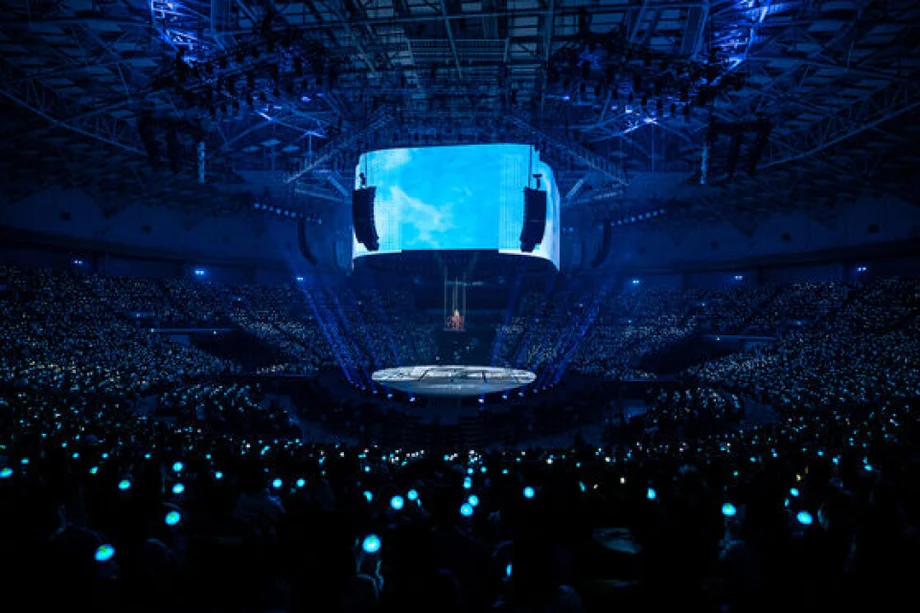
The anniversary was staged at street scale. On Nov. 22 in New York, fans packed Duffy Square in Times Square for a free event running from 9 a.m. to 7:30 p.m., with appearances by Mametchi and Mimitchi, product displays, a birthday cake monument and a screen takeover at 7 p.m. lasting 30 minutes. In Japan, Seven-Eleven stores have been running a fair with 47 items since Nov. 13, and Bandai Spirits has opened reservations for a Digimon crossover set that will be delivered in June 2027.
How a Tiny Egg Became a Sensation
Akihiro Yokoi, owner and director of toy design studio Wiz Co., is credited with the idea. He has said it came after seeing an advertisement about a child who wanted to take a pet turtle on a trip. Bandai, then under financial pressure, wanted a product unlike anything it had made before. The project reached the company in 1995, and Bandai planner Aki Maita turned it into a product aimed from the start at high school girls.
The name joins tamago, Japanese for egg, with watch. An early plan used a wristwatch shape, but electronic parts were too thick, so the toy became a small device carried on a ball chain. That change also lowered manufacturing cost. The first model cost 1,980 yen when it went on sale, and test sales in Tokyo and Osaka on Oct. 10 drew stronger interest than expected, especially among female students.
Production rose from 60,000 units to 300,000 and then to 1 million before the full launch. Even that was not enough. Bandai received more than 10,000 calls a day from people saying they could not buy one, and the toy reached 10 million units within eight months. At a time when 1 million units counted as a major Japanese toy hit, Tamagotchi was operating on another scale.
Why Feeding a Pixel Creature Felt Real
A virtual pet is a small electronic game built around care rather than winning. Tamagotchi hatches, signals hunger, makes messes, gets sick and can die if neglected. Feeding, playing and cleaning change how the character grows. The loop kept the device in pockets and school bags, where friends could see it and ask about it.
Its roots also fit a Japanese habit of collecting insects in containers so children could watch and care for them. The device, shaped like an egg, moved that habit into a screen. Some internal Bandai staff worried that the death mechanic was too strong for a children's toy, but that same seriousness made the creature feel alive to many buyers.
The original device had three buttons and a monochrome screen. Later models kept the duty of care while adding color displays, more characters and new ways to connect. The 2025 Tamagotchi Paradise offered 51 characters across 12 species in nine languages, while still running on two AAA batteries, a small reminder of the first toy's portable design.
Three Decades in Dates
The anniversary spans product launches, a costly crash and several revivals.
- Nov. 23, 1996: Tamagotchi goes on sale in Japan at 1,980 yen.
- January 1997: Bandai's forecast is cut to a 9 billion yen deficit while merger talks with Sega are underway.
- March 1999: The first boom collapses. Bandai records a special loss of about 6 billion yen and halts sales.
- November 2004: Tamagotchi returns with models aimed at elementary school girls and sells about 5 million units in a year.
- August 2007: The first official goods shop, Tamagotchi Department Store, opens at Tokyo Dome.
- November 2008: Tamagotchi Plus Color becomes the first model with a color liquid crystal display.
- 2021: Tamagotchi Smart adds food delivery features inspired by services that spread during the COVID-19 pandemic.
- July to August 2025: Cumulative sales pass 100 million units, using figures through July.
- Nov. 13, 2026: The Seven-Eleven 30th anniversary fair starts across Japan.
- Nov. 22, 2026: The Tamagotchi Times Square Spectacular takes place in New York.
- Nov. 23, 2026: Japan marks the 30th anniversary.
- June 2027: The Digimon and Tamagotchi anniversary set is scheduled for delivery.
The dates show how often the brand had to reinvent its route back to buyers. Sales stopped after the first crash, resumed with a new audience, then expanded into characters, accessories and shared play.
The Crash That Almost Ended the Pet
The first boom ended quickly. Bandai had built stock around early demand, then watched sales fall. The company booked a special loss of 6 billion yen for the year ended March 1999 and stopped Tamagotchi sales. Honjo Shoichi, now 70, a former Bandai planner who worked on the original toy, has said the comeback was beyond anything he imagined at the time.
November 2004 brought a second life. Bandai targeted elementary school girls, and the relaunch sold about 5 million units in one year, roughly five times the production run of 1 million units that followed early 1996 test sales. Communication between devices became part of the fun, turning the pet into a schoolyard topic.
The rebound was covered in How Tamagotchi Rebounded, which described the disposal of more than 2.5 million unsold devices and the later push into clothing, plush toys, shops and digital entertainment. The broader arc was also traced in Tamagotchi Marks 30 Years, including the English launch in May 1997 and FAO Schwarz selling 10,000 units in the first 24 hours. About half of worldwide shipments have gone overseas, so the anniversary also has two timelines: Japan in 2026, overseas markets in 2027 after the 1997 English launch.
Who Keeps Buying Tamagotchi Now
Taro Tsuji, Bandai's managing director and chief Tamagotchi officer, has said the audience splits into three groups: people in their thirties who remember the first launch, people in their twenties drawn to the 2008 anime and the return of 2000s style, and young children. The middle group helps explain the retro look on bags and keychains.
Adults buying toys for themselves are often called kidadults. They pick up Tamagotchi alongside Furby, Polly Pocket and Playmobil, looking for a small link to childhood when work and daily life feel heavy. Tsuji has also said the little egg has become an accessory hung from a bag, while phones can feel cold by comparison.
Tsuji said the emotional center has stayed intact while the technology changed. He described the anniversary as a meeting point for longtime fans and children meeting the pet for the first time.
Technology and the way we connect have changed enormously in 30 years, but the simple emotional connection at the heart of Tamagotchi has not. Seeing what started as a few special pixels in 1996 now light up Times Square three decades later is a remarkable way to celebrate how far the brand has come. It gives us the chance to bring longtime fans and a new generation together for a moment of appreciation and celebration that belongs to all of them.
How New York Celebrated a Digital Pet
New York turned the anniversary into a public party. Beacon Media, a subsidiary of Kartoon Studios, worked with Bandai Namco Toys & Collectibles America on the Times Square event. The free gathering included displays of older devices, a Tamagotchi Paradise play corner, greetings with Mametchi and Mimitchi, exclusive trading cards and a huge cake monument. The screens showed a Gotchi UFO landing, older devices and a cake scene.
Crystal Velasquez, a company employee from New Jersey, 38, owns 57 Tamagotchis. She said the characters on the big screens gave her goosebumps and described the toy as a brief escape from the "crazy real world." Other fans raised phones to photograph Mametchi and Mimitchi, shouted "I love you, Tamagotchi," sang a birthday song and joined Tamagotchi calls.
Comedian Yuriyan Retriever attended as a fan who said she had cared for Tamagotchi since childhood. She had asked Tsuji at a Nov. 6 event in Tokyo to bring her to the New York celebration, then joked about her hometown being New York City and Yoshino in Nara Prefecture. She described the toy as something carried in the heart and aimed that line at fans around the world.
Do you know where Tamagotchi is? Tamagotchi is in your heart!
Kathleen Campisano, global chief marketing officer and general manager at Beacon Media Group, worked on the event through Beacon. She framed the anniversary as a chance to place a familiar brand in a very visible public setting and to connect different generations of fans.
The Tamagotchi 30th anniversary is a terrific example of the scale, cultural relevance and broad consumer appeal that can come together around an iconic global brand. We're pleased to be working with Bandai to help bring this milestone to life in one of the world's most visible settings. Times Square creates an extraordinary opportunity to engage fans, generate attention and celebrate a brand that has connected generations.
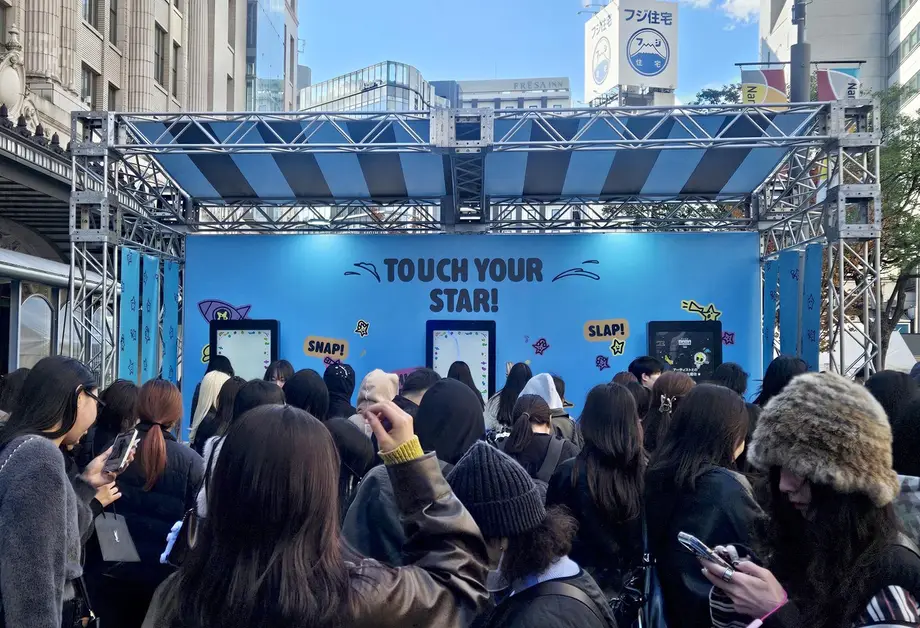
The New York program reached beyond Times Square. Other anniversary stops included the FAO Schwarz flagship at 30 Rockefeller Plaza, MINISO events at American Dream in East Rutherford, N.J., and Barton Creek Square in Austin, Texas, plus an experience lasting a month in Roblox's Main Street RP, a role play space inside the online game Roblox.
Japan's Convenience Store Party Has 47 Items
Seven-Eleven Japan started its Tamagotchi fair nationwide on Nov. 13, ahead of the anniversary date. Japan's convenience store collaboration brought 47 items to shelves, including toys, stickers, lottery prizes, snacks and prepared foods.
The Original Tamagotchi Gourmet Star uses 30th anniversary artwork and costs 3,080 yen, tax included. The Tamamori Sticker Refill Gourmet Planet Set costs 638 yen and lets fans decorate devices with puffy stickers that can be moved and rearranged. The Ichiban Kuji Tamagotchi zodiac lottery, a draw for themed prizes, costs 781 yen per draw and started on Nov. 21.
Food makers joined in with six items using the characters. They included a cheese nikuman, a steamed bun, at 198 yen, Mimitchi vegetable sticks with apple and carrot mayo at 429 yen, and a Mametchi custard and milk crepe at 214 yen. Strawberry and milk dorayaki, a sweet pancake, egg salad rolls and Oyajitchi oden, a hot Japanese soup dish, rounded out the set.
Shopping campaigns added more collectibles. Buyers of three qualifying gum packs could receive a slider pouch, buyers of two ice creams could receive a clear card, and other purchases came with gotchi cards or stickers. All were limited and handed out on a first come, first served basis. Tsuji appeared at a media event for the fair and said the basic pleasure of raising a character has stayed unchanged even as device specifications evolved.
Digimon and Tamagotchi Swap Shells
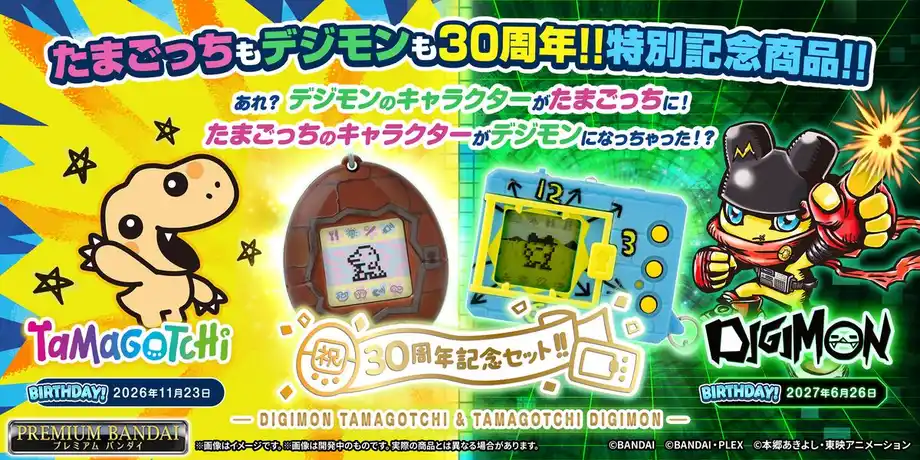
Bandai Spirits' EC Strategy Department published the anniversary set announcement on Nov. 23. It says the set marks Tamagotchi's 30th anniversary on Nov. 23, 2026, and Digital Monster's 30th anniversary on June 26, 2027. Digimon began in 1997 as a digital pet that let players connect devices and have monsters battle.
The set contains two units with designs swapped. DIGIMON TAMAGOTCHI uses a Tamagotchi shell with Digimon designs and lets fans raise Agumon, Greymon, MetalGreymon and Monzaemon in Tamagotchi style. TAMAGOTCHI DIGIMON uses a Digital Monster shell and turns Mametchi style characters, including Mamechimon, Nyoromon, Kuchipamon and Ginjiromon, into Digimon. Illustrator Kenji Watanabe drew the Digimon version of the Tamagotchi characters, and both units come in special packaging based on artwork from the first generation.
The price is 8,800 yen, tax included, with shipping and handling extra. That is more than four times the 1,980 yen price of the first Tamagotchi. The DIGIMON TAMAGOTCHI measures about 53 by 43 by 18 millimeters, and the TAMAGOTCHI DIGIMON about 44 by 63 by 19 millimeters, excluding the keychain part. Each uses one CR2032 battery, included. The target age is 8 and up.
Reservations opened on Nov. 23 at 10 a.m. and run until Dec. 22 at 11 p.m., with delivery planned for June 2027. The seller is Bandai Co., and international buyers can order through Premium Bandai. The notice said prepared stock is limited, specifications can change, and overseas or store sales are possible. It also said the communication battle function on TAMAGOTCHI DIGIMON works only with this product.
What Comes Next for the Brand
Bandai's current devices show how the pet has followed changing habits. The line has reached 38 models. The 2025 model added a way to connect machines and play together, matching a wish for contact with people nearby. The 2025 Tamagotchi Paradise has 51 characters, 12 species and nine languages, and a color screen. The Original Tamagotchi series alone sold about 11.52 million units by the end of July 2025. Bandai describes the current revival as its fourth boom.
Bandai plans to release Tamagotchi Ring in February 2027, playable rings meant to make the pet part of fashion as well as play. The company named the month but did not give an exact day. The Digimon set notice also did not say how many units would be prepared.
The Super Tamagotchi Festival in Shibuhara runs in Harajuku and Shibuya until Dec. 6 with free admission. Tamagotchi Paradise Neon Planets went on sale on Nov. 21. In 2022, Bandai brought overseas TAMAGOTCHI designs back to Japan as Original Tamagotchi Rainbow, and fashion and artist collaborations helped the toy ride the Heisei retro wave. The Heisei era ran from 1989 to 2019.
Young buyers now attach devices in favorite colors to clothing and bags, a practice linked to oshi katsu, or supporting a favorite character or idol. That changes the job of the toy. A child may feed a creature and watch it grow; an older fan may wear the same device as a badge of taste and memory.
Why the Care Loop Still Works
The original Tamagotchi taught a simple routine in a form small enough to carry. Feed the creature, clean up after it, respond when it calls. A virtual pet differs from a normal game because it keeps asking for attention even when the player is away. That need made some schools restrict the devices in 1997, and it also made owners talk about them.
Bandai later expanded the same emotional hook into films, television anime, plush toys and character goods. A Bandai representative said some people buy character plushies without owning a device. A French exchange student in her twenties at Bandai headquarters said the toy felt like a digital friend, even though she had never played with it.
The business lesson lies in the way Bandai kept changing the wrapper while protecting the routine. Food delivery arrived when delivery apps were common. Device connection arrived as people looked for ways to meet through play. Fashion collaborations and character goods made the brand visible even when a child was not pressing the three buttons.
The 100 million shipments story showed that nostalgia alone was not the whole engine. Original players returned, new children discovered the toy, and collectors treated devices as objects to display. Bandai now sells the same promise of care to several generations, with a product that still fits in a palm.
Key Points
- Tamagotchi marked 30 years since its Nov. 23, 1996 Japanese launch.
- Bandai's latest count exceeds 106.5 million units, above the 100 million milestone reached in 2025.
- The first boom ended with a 6 billion yen special loss and a sales halt in 1999; sales resumed in 2004.
- New York celebrated with a Nov. 22 Times Square event and a screen takeover lasting 30 minutes.
- Japan's Seven-Eleven fair offers 47 items, including an anniversary device priced at 3,080 yen.
- A Digimon crossover set costs 8,800 yen, with reservations closing Dec. 22 and delivery planned for June 2027.
- Tamagotchi Ring is planned for February 2027, and the Shibuhara festival runs until Dec. 6.