A tiny pet with a much bigger business
Tamagotchi reached 100 million worldwide shipments on July 31, 2025, according to Bandai Namco Holdings, nearly three decades after its debut in Japan on November 23, 1996. The milestone followed a costly collapse: in 1999, Bandai disposed of more than 2.5 million unsold devices and recorded a ¥6 billion loss after its first enormous boom faded.
Contents
- A tiny pet with a much bigger business
- Why the first egg became a sensation
- How a shortage became millions of unwanted toys
- The comeback arrived through connection
- Parents returned, bringing a new audience
- More features, higher prices
- Overseas customers are central to the next expansion
- A business beyond the device
- Anniversary events turn attachment into shared experiences
- Key Points
Now Bandai has another number in mind. In its Tamagotchi anniversary feature, the company sets out an ambition to double the brand's current market size to approximately ¥100 billion. The plan reaches beyond selling electronic pets to clothing, plush toys, shops, exhibitions and digital entertainment.
The anniversary also has two dates. Japan marks 30 years in November 2026, while overseas markets, where the toy arrived a year later, reach that milestone in 2027. Overseas shipments already account for 51% of the series total, giving international customers a central role in the next expansion.
Bandai describes the present resurgence as Tamagotchi's fourth wave, supported by interest in products associated with Japan's Heisei era, which ran from 1989 to 2019. Original players are returning as adults, some with children of their own, while younger buyers also use the devices as fashion accessories.
The business has changed more than the basic promise. A small creature still needs someone to feed it, clean up after it and pay attention. Bandai's challenge is to turn that attachment into lasting demand without repeating the production mistakes that once left millions of devices unwanted.
Why the first egg became a sensation
Inventors Akihiro Yokoi and Aki Maita developed Tamagotchi around a simple idea: a pet that could travel with its owner. Yokoi traced the inspiration to an advertisement showing a boy upset because he could not take his turtle on holiday. The name combined tamago, the Japanese word for egg, with a Japanese rendering of watch.
Bandai's official history says the original sold 10 million units in Japan within eight months. Its small screen, three buttons and portable shape made the rules easy to understand. Feed the creature, play with it and clean up its waste. Neglect could lead to illness or death.
The device made care feel urgent. Beeping alerts brought the pet's needs into classrooms, and schools in Japan, the United States, Britain and Australia restricted or banned the toys in 1997. Scarcity also drove resale prices to as much as 20 times the original price.
Historical estimates for spring 1998 put sales at either 20 million worldwide or about 40 million, with the larger estimate divided roughly equally between Japan and overseas markets. Bandai's official anniversary history provides the earlier, firmer milestone of 10 million sold in Japan within eight months.
Taro Tsuji, Bandai's managing director and Chief Tamagotchi Officer, argues that the bond between people and the product matters more than technical specifications. In the company's anniversary feature, he said:
I believe that the value of content lies not in its specs but in the relationships it generates.
How a shortage became millions of unwanted toys
Customers desperate to secure a Tamagotchi sometimes reserved one at several shops, then bought only a single device. Those overlapping reservations made demand appear larger than the number of purchases people intended to make. Increasing production against that inflated signal created a serious risk.
Bandai also struggled to move sales information through the company quickly enough. A retrospective account of the crisis describes design and manufacturing teams continuing to develop and produce new versions while retailers were returning unsold stock.
Mikiko Hashimoto, chief in Bandai's Media Department, gives a related explanation in the official anniversary feature. Bandai expanded production because customers could not find the toy, but counterfeit products entered the market as the company increased capacity. When the craze ended, substantial excess inventory remained.
The result was the disposal of more than 2.5 million units and a ¥6 billion loss in 1999. The episode returned to public attention after a Japanese television retrospective in 2022 and later discussions about shortages of Bandai's popular Gundam model kits.
The practical lesson concerns the difference between an order signal and an actual customer. A reservation can be duplicated, a retailer can return inventory, and a factory can keep producing after shoppers have moved on. Bandai's later strategy became more deliberate about identifying who would buy each Tamagotchi model and why.
The comeback arrived through connection
Bandai brought Tamagotchi back in 2004 with infrared communication, allowing nearby devices to exchange information. Players could share items and arrange relationships between their characters, including marriages. Caring for a pet became something friends could do together.
Elementary school girls became an important audience for that revival. The 2004 generation sold about 5 million devices in its first year, while the broader connected series went on to sell approximately 39 million over eight years. Those figures cover different periods and show both the initial response and the longer life of the renewed product family.
Bandai also changed its protection against imitation. Its official history says the 2004 launch used the original device's registered shape and withheld product designs from advertising before release. Earlier, in 1997, it had filed 147 trademark applications covering 39 names across 27 countries and regions.
The main developments came in stages:
- November 23, 1996: The original Tamagotchi launched in Japan.
- 1997: Overseas sales began, taking the craze into international markets.
- 1999: Excess production ended in a ¥6 billion loss and the disposal of more than 2.5 million units.
- 2004: Infrared communication made interaction between devices a central attraction.
- 2008: Color screens added richer expressions, seasons and changes in the time of day.
- 2023: Tamagotchi Uni launched simultaneously worldwide with Wi-Fi connectivity.
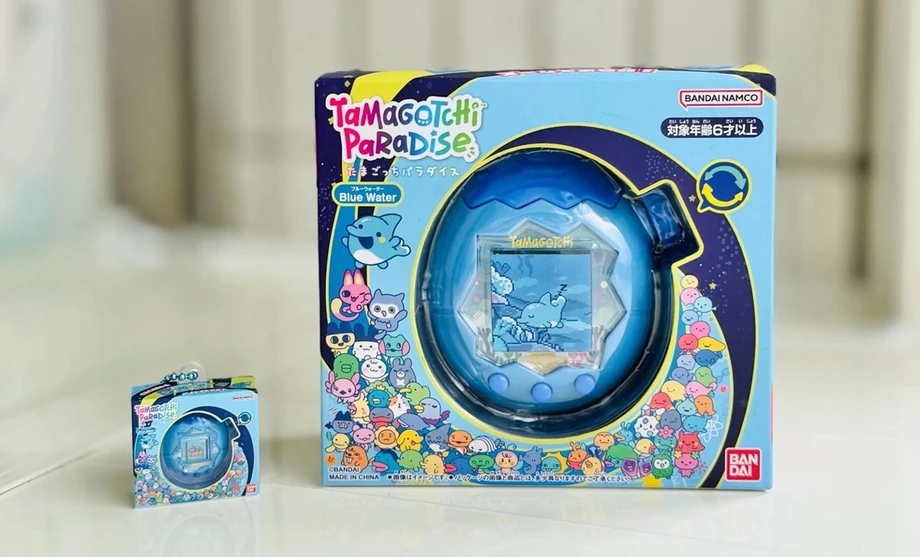
- July 2025: Tamagotchi Paradise arrived as the 37th model.
- 2026 and 2027: Japan and overseas markets respectively reach their 30th anniversaries.
Parents returned, bringing a new audience
Japan's sales fell sharply from their 2006 peak in the early 2010s. New technology, including color displays, NFC for communication at close range and links to apps, gave the devices more functions, but the audience still needed a reason to return.
The 2016 Tamagotchi m!x launch and the brand's 20th anniversary campaign helped renew interest in raising pets, collecting characters and revisiting childhood memories. By then, the first owners were adults with their own spending power.
Bandai's current audience includes women in their 20s, 30s and early 40s, alongside children. Some remember the original craze; others grew up with the connected models, color screens or animated series. The company now sees several generations of memories feeding demand at once.
Miyuki Nakashima of Bandai's corporate planning department explained the role of adult buyers when the shipment milestone was announced in August 2025:
We've gained support from 'kidults,' who want to share the nostalgic toys they loved as children with their own kids at home.
The word kidult combines kid and adult. For Tamagotchi, it describes a concrete change in the customer base: an adult can buy a device for personal enjoyment, introduce it to a child, or purchase clothing and character goods without buying another electronic pet.
More features, higher prices
Tamagotchi Paradise, released in July 2025, costs ¥5,800 before Japanese consumption tax, or ¥6,380 including tax. Its new dial lets players move between views ranging from a broad, cosmic perspective to the creature's cellular level. Devices can also connect so their inhabitants can battle, form families and have children.
Earlier models pursued different features. Tamagotchi Smart introduced a touchscreen, while Tamagotchi Uni added Wi-Fi and a shared international launch. Their cited prices of about ¥7,980 and ¥6,990 put them well above the simplest reissues, which remain around ¥2,000.
Historical launch price figures for the original are given as both ¥1,500 and ¥1,980. The ¥5,800 price before tax for Paradise is approximately 2.9 times the latter figure. That comparison describes the listed prices; today's device also has substantially different hardware and functions.
Bandai therefore serves several spending levels rather than asking every customer to buy the most advanced model. A basic version provides a relatively inexpensive return to the original experience, while more elaborate devices appeal to buyers willing to pay for new ways to play.
The commercial shift is substantial. The first craze depended heavily on selling huge quantities of an affordable toy. Today's range combines those entry points with more expensive hardware and a growing selection of products built around the characters.
Overseas customers are central to the next expansion
Bandai's official figure puts overseas markets at 51% of cumulative series shipments. A geographic breakdown accompanying the 2025 milestone places Japan at 49%, the United States at 33%, Europe at 16% and Asia outside Japan at 2%.
The United States and Europe together account for 49 percentage points, compared with 2 for Asia outside Japan. That helps explain why Bandai is seeking growth in inland China and other Asian markets while continuing to invest in North America and Europe.
Physical shops support that effort. A British store opened in 2024, and locations have also been established in New York, New Jersey and Madrid. In Taiwan, anniversary activities have included pop-up stores in Taipei and Kaohsiung and a special edition incorporating pineapple cakes, sky lanterns and woven market bags.
Bandai is giving local group distribution companies master licenses, which let them organize regional licensing strategies. In practical terms, local teams can work with businesses that understand their customers rather than waiting for every product idea to originate in Japan.
Hashimoto says European teams have proposed designs that Japanese staff might not have conceived, while South Korea has generated numerous inquiries about cosmetics collaborations. The international anniversary in 2027 gives those teams a further occasion to introduce products and events.
A business beyond the device
Bandai's approximately ¥100 billion ambition refers to the market around Tamagotchi, rather than a stated target for profit or device revenue. Tsuji says it would be twice the current market size, putting the existing scale at roughly ¥50 billion. The company has not specified a deadline for reaching the larger figure.
Licensing is one of its two main growth plans, alongside international expansion. Licensing allows another business to use Tamagotchi characters or branding under an agreement. Bandai says its more organized push into this area began around 2022.
The brand now has more than 1,500 characters, providing material for products far beyond electronic pets. Collaborations have included Sanrio and Disney, while a 2025 UNIQLO UT collection brought Tamagotchi to clothing shoppers. Hashimoto identifies the UNIQLO collaboration, which also included an Original Tamagotchi device, as a recent success.
The Original Tamagotchi range introduced in 2018 had reached 11.52 million devices by the end of July 2025. Its performance shows that simpler hardware and familiar styling can retain commercial appeal alongside newer technology.
Digital products offer another route. The 2018 mobile game My Tamagotchi Forever included purchases of food, clothing and decorations. Bandai is also pursuing video, music and virtual spaces in Roblox, particularly in North America. Each creates another place where people can encounter the characters.
Anniversary events turn attachment into shared experiences
TAMAGOTCHI FACTORY, Bandai's permanent store in Harajuku, carries more than 100 items, including Tamagotchi Paradise and exclusive merchandise. Located in Tokyu Plaza Harajuku Harakado, it also offers activities such as a workshop where customers personalize purchased badges.
The traveling 30th Anniversary DAI-TAMAGOTCHI-TEN exhibition is scheduled to visit Japanese cities through winter 2027. Its experiences invite visitors to imagine entering the device and becoming a Tamagotchi character, alongside exclusive products and reissued stickers and cards.
Fans have also built their own social routines around the toys. Gatherings known as Tama meetups provide places to exchange care tips and connect devices. Downloads at participating shops give players another reason to bring their pets into shared physical spaces.
Bandai's recovery rests on matching those relationships with more careful commercial decisions. The company once expanded production against demand signals that turned out to be unreliable. Its current plan reaches several age groups, price levels and markets, while giving customers ways to participate without purchasing every new device.
The same need for attention that made Tamagotchi disruptive in classrooms now helps connect parents, children and adult collectors. After the ¥6 billion inventory crisis, the brand survived by repeatedly finding a new audience for that familiar act of care.
Key Points
- Tamagotchi reached 100 million worldwide shipments by July 31, 2025, according to Bandai Namco.
- Bandai disposed of more than 2.5 million unsold devices and recorded a ¥6 billion loss in 1999.
- Infrared communication, color screens and connected play supported successive revivals.
- Adult fans and parents sharing the toys with children are helping drive the current fourth wave.
- Overseas markets account for 51% of cumulative series shipments.
- Bandai aims to double the Tamagotchi market to approximately ¥100 billion through international growth and licensing.
- Japan's 30th anniversary falls in November 2026; overseas markets follow in 2027, with the Japanese traveling exhibition scheduled through winter 2027.