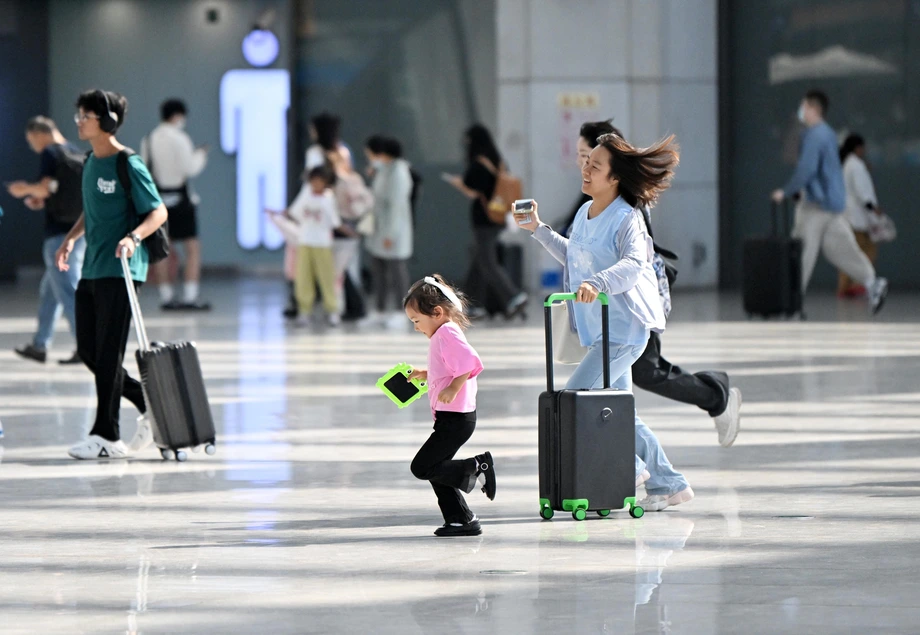
More trains carry a record number of passengers
China's railways carried 4.13 billion passenger trips from January through October 2026, up 4.7% from the same period a year earlier, according to China State Railway Group. The total set a record for the first 10 months of a year, while October 1 brought the busiest single day in the network's history: 25.204 million trips.
Contents
- More trains carry a record number of passengers
- October 1 was far busier than an average day
- The dates behind the holiday surge
- Tourism trains connect journeys with events and destinations
- Local connections help passengers finish the journey
- Hong Kong and Laos traffic grows at different scales
- Booking changes target regular travelers and families
- Quiet carriages, pets and bicycles get more space
- Conventional trains remain part of the expansion
- Key Points
The figures, released on November 14, bring together two developments: steady growth across the year and a much sharper surge during the National Day holiday. Railways operated an average of 11,670 passenger trains a day during January through October, an increase of 5%. On October 1, they ran 14,885 trains, also a daily record.
Passenger trips count journeys rather than individual people. Someone taking a train to another city and returning later contributes two trips. The 4.13 billion total therefore measures how often people used the railway, with frequent travelers appearing repeatedly in the count.
Using the rounded total and growth rate, the network carried approximately 185 million more trips than during the same period of 2025. Train departures increased slightly faster than passenger journeys, showing that the expansion involved more services as well as more travelers.
China Railway said it used newly opened lines, stations and equipment, adjusted schedules to match demand and added capacity on popular routes. Alongside those changes, it expanded tourism trains, booking products and services for passengers traveling with pets, luggage or bicycles.
The growth also extended beyond domestic travel. Journeys across the Hong Kong boundary and the China-Laos border increased, while foreign nationals made 22.52 million trips on China's railways, up 32.9%.
October 1 was far busier than an average day
October 1 passenger traffic rose 9% from a year earlier, according to China Railway. Its 25.204 million trips were about 1.86 times the daily average of roughly 13.59 million calculated from the January through October total. Train departures that day were about 28% above the average of 11,670.
The holiday peak required extra services on busy corridors. Advance ticket sales identified Beijing, Guangzhou, Shanghai, Chengdu and Shenzhen among the leading departure cities. Other major departure points included Hangzhou, Wuhan, Xi'an, Zhengzhou and Nanjing.
Xi'an-Chengdu journeys in both directions were among the busiest routes, alongside services from Beijing to Shenyang, Zhengzhou and Qingdao. The pattern spread demand across several large urban centres rather than concentrating it on one corridor.
The Ministry of Transport put total journeys between regions across all transport modes at 329.495 million on October 1, down 1.9% from a year earlier. Rail passenger trips totaled 25.204 million, up 9%. Road journeys accounted for 300.36 million, down 2.8%; water transport carried 1.416 million, up 7.2%; and aviation carried 2.515 million, up 0.5%.
Rail therefore accounted for about 7.6% of that day's total journeys between regions, calculated from the ministry's figures. Its traffic increased even as the much larger road category declined, giving rail a different holiday pattern from transport as a whole.
The dates behind the holiday surge
China Railway planned for a travel period extending beyond the National Day holiday itself. Its forecast covered September 23 through October 8, spanning travel associated with the Mid-Autumn Festival and National Day.
- September 23 to October 8: China Railway forecast approximately 284 million passenger trips during the holiday travel period.
- October 1: The network carried a record 25.204 million trips and operated 14,885 passenger trains.
- October 2: China Railway forecast 20.39 million trips and scheduled 1,462 additional trains.
- November 14: Figures for January through October showed a record 4.13 billion passenger trips.
The October 2 and full holiday figures were forecasts issued during the holiday period. The January through October total and the October 1 record were reported as completed journeys.
Across all transport modes, the Ministry of Transport forecast 308.19 million journeys between regions on October 2, up 2.1% from a year earlier.
Tourism trains connect journeys with events and destinations
China Railway operated 3,236 tourism trains during the first 10 months of 2026. Services included the Xiangwang train, Panda tourism trains, the Jinxiu Shanhe · Duocai Guizhou service and Qilu No. 1, connecting passengers with scenery, historic sites and local food.
Another part of the tourism programme matched train services to events. Railways operated 1,084 services for concert audiences, sports fans, educational trips and related activities, coordinating departures with sporting events, exhibitions and performances.
For passengers, an event train can put transport closer to the timing and location of the activity they are attending. For destinations, bringing visitors by rail creates opportunities for spending at attractions, restaurants and accommodation after passengers leave the station.
The company presented tourism services as a way to support spending on travel and recreation. Its update counted the trains operated, without assigning a revenue total to the tourism programme.
Local connections help passengers finish the journey
Datong showed how railway authorities were addressing the part of a trip beyond the station. The Taiyuan railway group worked with local transport departments and attractions to add shuttle buses from Datong South Station to the Yungang Grottoes and the Hengshan Mountain scenic area in Shanxi.
The Yungang Grottoes, a UNESCO World Heritage site, contain more than 50,000 Buddhist stone sculptures. A connecting bus gives visitors a way to continue from the railway station to the attraction, rather than having to arrange that leg separately.
In Inner Mongolia, the Hohhot railway group added 11 multiple unit trains on the Baotou-Wuhai section of the Baotou-Yinchuan high speed railway. These trains use connected carriages with traction equipment distributed through the train, rather than relying solely on a locomotive at the front.
The Wuhan railway group linked the newly opened Yichang-Xingshan high speed railway with a different incentive. Working with local governments, it arranged discounts at attractions, hotels and homestays for passengers presenting train tickets.
These measures addressed different needs: more trains on a busy section, transport from stations to destinations, and lower costs for activities after arrival. Together, they show how railway growth reaches beyond the number of seats available.
Hong Kong and Laos traffic grows at different scales
The Guangzhou-Shenzhen-Hong Kong high speed railway carried 29.23 million trips across the Hong Kong boundary during January through October, up 11%. The China-Laos Railway handled 289,000 international passenger trips, an increase of 33%.
The Hong Kong corridor carried about 101 times as many journeys as the China-Laos international service, calculated from those totals. Laos traffic grew faster in percentage terms, while starting from a much smaller passenger base.
The China-Laos route's expansion follows the growth of international services between Kunming and Vientiane. Those passenger trains began operating in April 2023, after the railway itself opened in December 2021. The route links destinations including Xishuangbanna, Luang Prabang and Vientiane.
China Railway also said it operated international passenger trains connecting China with Mongolia, Russia, Vietnam and North Korea. Its update placed these services within efforts to support tourism across borders.
Foreign nationals made 22.52 million rail trips across China's network, up 32.9%. This category counts travelers by nationality, while the Hong Kong and Laos figures count journeys crossing particular boundaries. A foreign visitor taking several domestic trains contributes several journeys to the foreign passenger total.
Booking changes target regular travelers and families
Railway 12306, China's railway ticket booking platform, introduced a trial reservation service for the Beijing-Shanghai high speed line and the conventional Beijing-Shanghai railway. It also continued a regular reservation service for student travelers.
Tickets allowing a set number of journeys and passes valid for a defined period were available on 75 routes. These products give repeat travelers alternatives to buying an ordinary ticket separately for every journey, subject to the conditions of each product.
Tourism passes allowing multiple journeys covered 28 routes, with discounted prices available for children. The separate coverage figures reflect different ticket products: the 75 routes apply to journey packages and period passes, while the 28 routes apply to tourism passes.
Older passengers were offered an extra discount on designated trains for tickets purchased from October 18 through December 30. Participating services carry the Chinese character jing, meaning respect. China Railway's frequent traveler programme also added points benefits for teachers.
The company did not give detailed age requirements, discount percentages or reservation conditions for these products in the update. The stated December 30 deadline applies to the older passenger ticket purchase promotion.
Quiet carriages, pets and bicycles get more space
Quiet carriage services covered more than 8,000 multiple unit train services. The programme provides a quieter travel setting for passengers who want to rest or work during a journey.
The Ai Chong Xing pet transport service covered 170 high speed railway stations and 420 multiple unit train services. Its named station and train coverage means passengers need to find a participating service when planning a journey with an animal.
The Qing Zhuang Xing luggage service reached 212 stations. It forms part of the railway's effort to reduce the burden of carrying baggage through a trip, alongside changes aimed at making transfers and time on board more convenient.
Trials allowing passengers to bring bicycles were introduced on the Beijing-Zhangjiakou high speed railway and the Hainan island loop high speed railway. Both were presented as trials on specified routes, with bicycle travel joining pets and luggage among the practical needs being addressed.
China Railway also continued its railway QR code services, easier transfers and online food ordering. It said it was working to improve meals, including boxed food, so that passengers could arrange more of their journey and dining through railway services.
Conventional trains remain part of the expansion
China Railway said it maintained the scale of conventional passenger train operations while expanding capacity elsewhere. It continued public service slow trains and services intended to support rural development.
Those trains serve communities in remote areas, ethnic minority regions, former revolutionary base areas and places that have emerged from poverty. Their role differs from that of the busiest holiday routes: they provide transport for residents in areas where access remains a central concern.
The January through October figures therefore cover several kinds of growth at once. Large cities generated heavy holiday demand; tourism trains linked travel with attractions and events; international routes carried more passengers; and conventional services continued to connect less prosperous communities.
For travelers, the most concrete changes were more departures, additional ticket choices and wider coverage for particular services. For railway operators, the October 1 peak showed how far demand can rise above an ordinary day, even during a year already setting passenger records.
Key Points
- China's railways carried 4.13 billion passenger trips in January through October 2026, up 4.7% and a record for the period.
- October 1 set daily records with 25.204 million trips and 14,885 passenger trains.
- Average daily passenger train departures rose 5% to 11,670.
- Tourism operations included 3,236 tourism trains and 1,084 services linked to events and educational travel.
- Hong Kong boundary journeys reached 29.23 million, while China-Laos international trips totaled 289,000.
- Foreign nationals made 22.52 million rail trips, an increase of 32.9%.
- Booking products, quiet carriages, pet transport, luggage services and bicycle trials expanded passenger options.