A Handmade Park Finds Its Audience
He Changlin, a 58-year-old landscaper in Sichuan, has put nearly 20 million yuan into a Journey to the West theme park where admission costs 20 yuan and visitors under 20 enter free. After years of spending his earnings on the hillside attraction, a surge of National Day holiday visitors has finally helped his family begin paying back its debts.
Contents
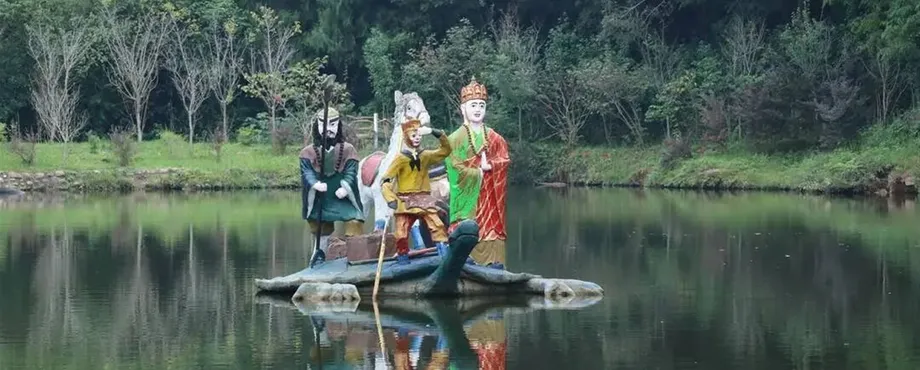
Yi Xiyou Park occupies a valley in Bailong Village, Xinqiao Town, in Mianyang's Youxian District. Its unusually shaped sculptures, from a thin Monkey King to a fox spirit with deliberately awkward hands, have turned it into a social media attraction. More than 1,000 people a day were visiting during the period of its sudden popularity.
At the holiday peak in early October, He said vehicles heading into the hills formed a queue stretching 2 kilometers. Visitors were still arriving from other places on October 9, after the holiday had ended.
He describes the project as 16 years of work. He dates its beginnings to 2010 and opened it to the public in 2022. The park covers nearly 400 mu, a Chinese land measure equivalent to about 27 hectares, or 66 acres.
The attention rests on more than the sculptures. Behind the rough surfaces is a family story involving savings, arguments, outside jobs and a builder who sees the park as his own version of the novel's difficult pilgrimage.
Why the Unusual Figures Draw People In
The park's Water Curtain Cave resembles a stone wall in a rural backyard. Its Monkey King looks as though the long journey has left him short of food. Online visitors have joked about the figures' appearance while also describing the park as fun to explore.
He accepts the divided response. The park's creator used a fruit famous for inspiring both affection and dislike to explain how he views his work:
Those who like it are moved by the feeling behind it. Those who don't can complain that it's ugly. Each takes what they want.
His comparison with a durian has itself become part of the attraction's online identity. Visitors arrive knowing that the park will look different from a polished commercial resort, and the sculptures give them something distinctive to photograph and discuss.
For He, some of the awkwardness is deliberate. He says the figures express ideas drawn from his reading of Journey to the West, the classic Chinese novel about a Buddhist monk's pilgrimage with companions including Sun Wukong, the Monkey King. Here, those characters carry messages about disappointment, loyalty and family life.
A Family Story Written Into the Sculptures
The Bull Demon King, Princess Iron Fan and their son, Red Boy, stand apart from one another in He's arrangement. Princess Iron Fan has a sorrowful expression. He intended the separated figures to convey the value of harmony within a family.
The fox spirit has a graceful body but crude hands. He connects that contrast to the damage caused when someone comes between a married couple. The figures therefore reflect his personal interpretation of the story, rather than simply recreating its characters.
He also says his unconventional approach is intended to encourage people who feel discouraged. As the park's designer, he described the purpose of its deliberate ugliness this way:
encourage people who have lost heart.
That concern with family has a close parallel in the builder's own experience. His wife, Li Shiqiong, strongly opposed the project, while their daughter supported him. The cost of turning the hillside into a park became a recurring source of conflict at home.
The Hillside Helped Shape the Park
He has worked in landscaping for more than 30 years. When he first encountered the site, its natural rock formations caught his attention. He leased the hillside without telling his family, initially intending to open a farm restaurant.
His enthusiasm for Journey to the West gradually changed the plan. The rocks suggested characters and settings, and the restaurant idea grew into a much larger undertaking.
A protruding rock beside a pond became a huge bull's head marking the Bull Demon King's cave. He says he worked with the existing terrain, using the shapes already present in the hillside to develop the scenes.
A visitor helped inspire another feature. A woman noticed that a rock near the water resembled a frog and told He. He inspected the spot, found stone emerging from a mound of earth and spent half a month digging it out to create the giant golden toad.
The grounds also include Lovers' Valley, a farming museum and an area devoted to tung trees. Together with the caves and sculptures, these features connect the literary theme to the rural setting.
He handled the planning and made some of the sculptures himself. When a job was too difficult to complete alone, he hired help. The attraction's handmade reputation reflects his central role across years of construction, with other workers contributing where needed.
Nearly 20 Million Yuan and Years of Sacrifice
He puts his total investment at nearly 20 million yuan, about US$2.8 million. Construction money came mainly from his own resources, including income earned on landscaping projects elsewhere.
For the first decade, he says, he held three jobs at once. Money earned away from the park went back into the hillside, followed by another round of work to fund further building.
During the hardest periods, he recalls taking a little cornmeal up the hill, getting through the day on three steamed buns and wearing old clothes given to him by relatives and friends. Almost all his savings went into the project.
Li, his wife, said the decision put their previous comfortable life at risk. Explaining her opposition, she said:
I didn't support him at all. We had a good life, and he insisted on going off to suffer in the wild hills.
The couple argued repeatedly and discussed divorce. Their daughter continued to back her father, but the family's financial strain lasted for years. The recent holiday income has allowed them to start repaying what they owe; no amount was given for the remaining debt.
From Construction to the Holiday Rush
The park's history stretches across a long building period, a public opening and a much more recent burst of attention. The main milestones are:
- 2010: He says he began developing the hillside that became Yi Xiyou Park.
- 2022: The park opened to the public after He decided its attractions were ready.
- Early October, during the National Day holiday: Photos and videos spread online, and visitors crowded the access road.
- October 9: He discussed the park's construction, finances and admission policy as visitors continued arriving.
Opening the gates in 2022 did not immediately provide the family with a dependable income. Landscaping contracts, together with an orchard and fish ponds at the site, had helped keep the project going.
During the National Day holiday, He invited local folk performers to dress as characters from the novel and interact with guests. The performances added people and movement to a park whose online identity had largely formed around its static sculptures.
The holiday also changed He's encounters with visitors. Some sought him out after walking through the grounds to thank him. He says those responses matter more to him than ticket receipts.
What Visitors Pay For
A 20-yuan ticket covers all the park's attractions. Parking is free, and visitors under 20 do not pay admission. The limited goods available consist of bottled water and a small supply of instant noodles.
He says he has made avoiding extra attraction charges a firm rule. Visitors can therefore know the admission cost before entering, rather than having to pay again to see individual features.
The gap between the construction bill and the ticket price helps explain why his outside work mattered so much. An investment of nearly 20 million yuan is equivalent to roughly one million tickets priced at 20 yuan, before accounting for running costs or free admission.
Daily attendance also includes young people who enter without paying. Ticket income therefore depends on the number of paying visitors, while performers, upkeep and other operating expenses must still be covered.
Free Entry Could Reach More Adults
He says he never built the park with the intention of earning back his investment. His next ambition is to expand free admission, provided the operation becomes steady enough to support it.
The park's creator described his proposed change in these terms:
If things run smoothly in another two or three years, I plan to extend free entry to everyone under 40.
The current exemption remains for visitors under 20. The proposed expansion is conditional, with no fixed implementation date.
For the family, the immediate change is more concrete: the park is bringing in money that can help repay debts. For visitors, its appeal combines an inexpensive outing, an unusual interpretation of a familiar story and the chance to see what one landscaper spent years trying to build.
Key Points
- He Changlin, 58, describes Yi Xiyou Park in Mianyang, Sichuan, as a project spanning 16 years.
- He says construction began in 2010; the park opened to the public in 2022.
- Nearly 20 million yuan went into the attraction, largely financed through his own resources and landscaping work.
- The park drew more than 1,000 visitors a day during its surge in popularity, with He describing a holiday traffic queue stretching 2 kilometers.
- Admission costs 20 yuan, visitors under 20 enter free, and parking is free.
- He hopes to extend free entry to everyone under 40 after another two or three years of smooth operation.