A tiny molecular gate helps mosquitoes sense human skin
A research team in Shenzhen has mapped how a receptor in the malaria mosquito Anopheles stephensi recognizes acids associated with human skin and opens a channel that carries an electrical signal. The work connects the shape of an odor molecule to movements inside a protein, revealing a molecular step in how mosquitoes find people.
Contents
- A tiny molecular gate helps mosquitoes sense human skin
- Which skin chemicals does the receptor recognize?
- Two kinds of protein build one working channel
- Four structural snapshots reveal the moving parts
- Why one extra carbon changes the response
- How binding an odor opens an electrical gate
- A flexible insertion tests the molecular lever
- How this fits into the mosquito's other senses
- What the findings could mean for mosquito control
- Key Points
The study, published in Nature on 14 October 2026, captures the IR8a–IR75k receptor complex in four structural states. These include the complete receptor with its channel closed, the complete receptor with its channel open after binding nonanoic acid, and two views of its outer region holding different acids.
Researchers at the Shenzhen Medical Academy of Research and Translation and Shenzhen Bay Laboratory combined cryo-electron microscopy, electrical measurements and computer simulations. Their findings show how a small change where an odor molecule attaches can travel through the receptor and open a pore in the cell membrane.
The Nature research paper, titled Structural basis of ligand recognition and gating in mosquito IRs, identifies both the pocket that recognizes the chemical and the connections that transmit its signal. These structures give researchers specific places to target when designing compounds that might interfere with mosquito host seeking.
The immediate result is a detailed explanation of one odor detection mechanism. Repellents, attractants and other compounds built around that mechanism are proposed applications, with further development and testing still needed.
Which skin chemicals does the receptor recognize?
Nonanoic acid and octanoic acid are among the carboxylic acids associated with human sweat and skin oils. Such molecules help mosquitoes detect the presence of a nearby host. Differences in the chemicals released from skin contribute to the different odor mixtures that people produce.
Carboxylic acids have a recognizable chemical head attached to a chain of carbon atoms. Nonanoic acid has nine carbon atoms, while octanoic acid has eight. The difference is just one carbon and its attached hydrogen atoms, yet the receptor responds differently to the two molecules.
IR75k is the part of the complex that selects the odor molecule. Its binding pocket recognizes both the acid head and the length and shape of the carbon chain. That gives the receptor a way to distinguish chemicals that are extremely similar.
Skin chemistry, sweating and metabolism are relevant to the odors a person releases. The structural work explains how a receptor reads particular components of that mixture, while mosquito host seeking also draws on other sensory cues.
Two kinds of protein build one working channel
IR8a and IR75k have different jobs. IR8a is a co-receptor, a partner needed to assemble a working channel. IR75k is a tuning receptor, the component that determines which odor molecules the complex recognizes.
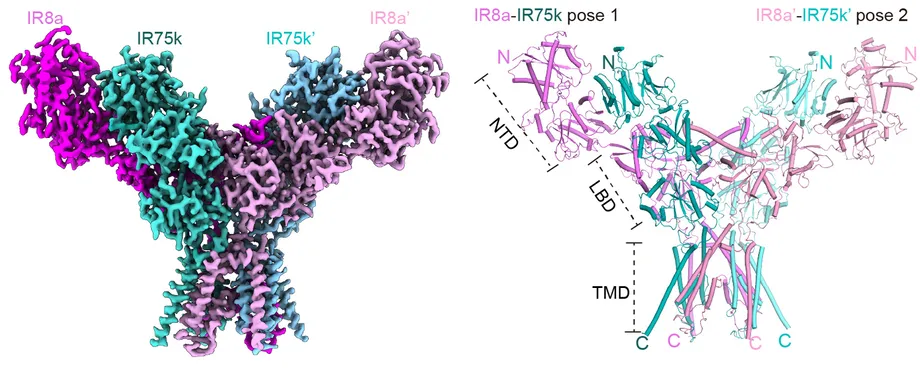
The assembled complex contains four protein subunits: two copies of IR8a and two copies of IR75k. Scientists call this a heterotetramer, meaning a structure made from four parts that are not all identical.
The two IR8a subunits form a central scaffold resembling a Y. The two IR75k subunits sit on either side without directly touching each other. Their positions suggest that the two odor recognition regions can operate relatively independently.
Part of the complex projects outside the cell, where odor molecules can bind. Another part crosses the cell membrane and surrounds the central pore. In the closed structure, that pore is narrowed. Opening it creates a route for charged particles, or ions, to cross the membrane.
Four structural snapshots reveal the moving parts
Cryo-electron microscopy allows researchers to reconstruct the shapes of proteins from images of rapidly frozen samples. Here, comparing several states let the team follow the changes between a receptor waiting for an odor and one with an open channel.
The four structures were the complete receptor without a bound odor molecule, the complete receptor opened by nonanoic acid, and the outer domains bound separately to nonanoic acid and octanoic acid. A molecule that binds to a receptor is called a ligand.
The open structure reached a resolution of 3.33 angstroms, according to the academy research announcement. An angstrom is one ten billionth of a metre, a unit used to describe distances on the scale of atoms.
The academy names Pan Xiaojing, Liu Feng and Huang Kai as joint corresponding authors, with Xu Li, Wang Xin and Quan Xuebo as joint first authors. It says the investigation also used single cell sequencing alongside electrical experiments and molecular dynamics simulations.
Why one extra carbon changes the response
Nonanoic acid sits more stably in the IR75k binding pocket than octanoic acid, according to the academy's explanation. Both fit between two lobes of the receptor's outer binding domain, but their different chain lengths affect the contacts they make.
The acid head of nonanoic acid is held by a network of hydrogen bonds, small attractions between nearby parts of molecules. Its carbon chain is surrounded by protein components that form a pocket favorable to that chain.
Octanoic acid, with its shorter chain, adopts a more bent position. The interactions holding it in place are weaker. This helps explain why the two acids have different abilities to activate the receptor despite their close chemical resemblance.
The team also changed individual amino acids, the building blocks of proteins, to test the pocket's function. Alterations at positions labelled R323 and F318, among others, sharply reduced or nearly eliminated the electrical current triggered by nonanoic acid. Those experiments connected the structural contacts to the receptor's activity.
How binding an odor opens an electrical gate
Nonanoic acid starts the activation process by entering the IR75k pocket. The two lobes of the binding domain then close around it. One lobe rotates, beginning a chain of movements toward the part of the receptor inside the cell membrane.
Mechanical connections at positions including A344, K460 and C603 carry that movement. A particularly short connection near K460 contains only four amino acids. Its stiffness allows it to act like a small lever, transferring motion rather than simply bending.
The transmitted movement shifts and rotates the protein helices that cross the membrane. Helices are coiled sections of protein. As they move outward, the central pore widens and the channel opens.
Ions can then pass through the pore. Because ions carry electrical charge, their movement changes the electrical state of the cell. This is how binding a chemical outside a sensory cell can begin an electrical signal that the nervous system can use.
The sequence gives researchers a continuous mechanism to examine: odor binding, closure of the binding domain, movement through the connecting segments, displacement of the membrane helices and opening of the pore.
A flexible insertion tests the molecular lever
The researchers tested the proposed lever by inserting a flexible sequence called GSGS at a key connection. The letters identify four amino acids: glycine, serine, glycine and serine. Adding flexibility at that point greatly weakened the transfer of movement.
The academy says communication between ligand binding and channel opening was almost severed. The experiment shows why the connection's mechanical properties matter: the movement produced at the binding pocket must reach the membrane gate effectively.
Electrical recordings tested receptor activity, while molecular dynamics simulations examined how the structures behaved over time. In the simulations, sodium ions passed through the open structure bound to nonanoic acid. No corresponding passage was observed through the closed structure without a ligand under the same conditions.
Together, the structural comparisons, altered proteins, electrical measurements and simulations support the same mechanism. Each approach examines a different part of how the receptor changes from a chemical detector into an open ion channel.
How this fits into the mosquito's other senses
Mosquitoes use several receptor systems to detect cues associated with food and hosts. Gustatory receptors, odorant receptors and ionotropic receptors contribute to detecting substances including carbon dioxide, sugars, bitter compounds, carboxylic acids and amines.
A 2025 academic review in the Journal of Insect Science describes ionotropic receptors as a second olfactory system, anatomically separate from pathways using odorant receptors. The nerve cells expressing these receptors occupy dedicated sensory structures and connect to separate processing regions.
The review finds that IR8a is highly conserved across insect orders, meaning related insects retain similar versions of it. Paired with tuning receptors, it primarily supports carboxylic acid detection. The review covers insects relevant to public health and agriculture, including flies, mosquitoes, moths and butterflies.
The Shenzhen team also reports that key recognition positions are conserved across several mosquito species with different host preferences. That makes related receptors useful candidates for further investigation, while the structural experiments focus specifically on Anopheles stephensi.
The research sequence runs from a broader understanding of acid detection to a detailed view of one receptor:
- 2025: The Journal of Insect Science review summarized carboxylic acid sensing and related IR75 receptors across insects.
- 14 October 2026: Nature published the structural and functional study of the Anopheles stephensi IR8a–IR75k complex.
- 15 October 2026: The Shenzhen Medical Academy of Research and Translation published its explanation of the findings.
What the findings could mean for mosquito control
The binding pocket offers one possible target for new compounds. Researchers can use its shape and chemical contacts to investigate molecules that compete with skin odors, activate the receptor differently or interfere with its response.
The mechanical connections offer another target. The GSGS experiment shows that disrupting signal transmission can prevent normal channel opening even when the odor recognition machinery is present. A compound designed to affect that movement would require its own testing.
Attractants are another proposed application. Understanding which molecular features produce receptor activation could help guide the search for chemicals used to draw mosquitoes toward traps. Receptor activity, mosquito behavior and practical trap performance would each need evaluation.
Anopheles stephensi is a malaria vector, so reducing its contact with people is relevant to disease prevention. Wider mosquito control research also seeks to reduce diseases such as dengue, which involves other mosquito vectors. Extending this mechanism to those species requires investigation of their receptors and behavior.
The study provides a molecular map for that work: a chemically selective pocket, specific amino acid contacts and a short mechanical connection controlling an ion pore. No timetable for a repellent, attractant or disease control product was announced.
Key Points
- The Nature study, published on 14 October 2026, maps an odor sensing receptor in the malaria mosquito Anopheles stephensi.
- The receptor contains two IR8a subunits and two IR75k subunits, with IR75k recognizing skin associated carboxylic acids.
- Nonanoic acid and octanoic acid differ by one carbon, which changes how they fit and activate the receptor.
- Odor binding closes an outer domain, moves mechanical connections and opens a pore that allows ions to pass.
- Adding a flexible GSGS sequence at a key connection nearly severed communication between binding and channel opening.
- The structures provide targets for future mosquito control research; practical products still require development and testing.