Morning disruption brings a week of compensation
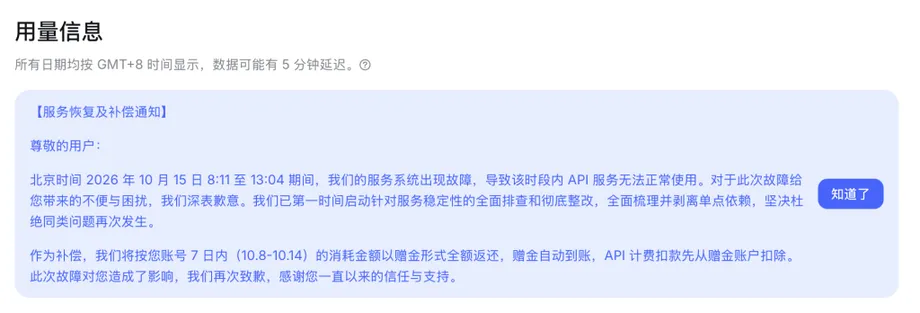
DeepSeek restored its services at 1:04 p.m. Beijing time on October 15, 2026, after a disruption that began at 8:11 a.m. and interrupted its chatbot and the services developers use to connect applications to its AI models. The company later apologized and announced compensation equal to each account's API spending from October 8 through October 14.
Contents
- Morning disruption brings a week of compensation
- How the recovery unfolded
- Chat and connected applications were affected
- How the credits will work
- A repair now, a wider reliability review next
- Earlier incidents put reliability in focus
- A large audience raises the stakes
- What changes for users after restoration
- Key Points
The compensation will arrive automatically as account credit, with future API charges deducted from that balance first. Users who shared their balances on social media showed amounts ranging from fractions of a yuan to more than 1,000 yuan, reflecting how much they had spent during the preceding week.
The disruption affected the web platform, mobile app and applications connected through DeepSeek's application programming interface, or API. An API lets another program send a request to DeepSeek and receive an answer, without someone having to enter the request into its chatbot directly.
DeepSeek said it had identified the cause at 9:06 a.m., implemented a repair by 12:49 p.m. and then monitored the results before declaring service restored. The company did not disclose the technical cause or give a completion date for its wider reliability work.
The incident was among DeepSeek's longest disruptions of the year and stretched across much of China's working morning. For people using the chatbot, the immediate problem was being unable to get answers. For developers and businesses using the API, the interruption also reached software built around DeepSeek's models.
How the recovery unfolded
DeepSeek's service status updates show that nearly four hours passed between its announcement that it had identified the cause and its move to monitoring. All times in the following timeline are Beijing time on October 15.
- 8:11 a.m.: The service incident began, affecting chat and API functions.
- 9:06 a.m.: DeepSeek said the cause had been identified and repairs were underway.
- 12:49 p.m.: The company said a fix had been implemented and it was monitoring the results.
- 1:04 p.m.: DeepSeek marked services as restored.
- That afternoon: The company announced an apology and compensation based on API spending from October 8 through October 14.
DeepSeek's final status update announced the restoration:
service restored
The published start and finish times span four hours and 53 minutes; the incident was also described as lasting four hours and 52 minutes. Both place the interruption just short of five hours.
Chat and connected applications were affected
Users encountered messages saying the server was temporarily unavailable or busy and asking them to try again later. The problems appeared on both the website and app, while the API disruption affected third party applications relying on DeepSeek's models.
Service descriptions included interrupted chat, partial API outages and degraded performance. Degraded performance means a service may still answer some requests but respond more slowly or fail more often. A partial outage means some functions or requests remain available while others fail.
The affected components included the Pro and Flash APIs. Published descriptions varied between V4 Pro and V4.1 Pro, and between V4 Flash and V4.1 Flash. DeepSeek's status updates were described as listing chat alongside Pro and Flash services, with several updates specifically identifying the V4.1 Flash API.
The combination matters because DeepSeek serves two audiences at once. People use its own chat interface directly, while developers connect its models to other products. An API failure can therefore interrupt a tool whose users never open DeepSeek's website.
How the credits will work
DeepSeek based its compensation on the amount each account actually consumed through the API during the seven days from October 8 to October 14. The company said the full amount would be returned as credit and deposited automatically.
For example, an account that spent 100 yuan on API requests during that period would receive 100 yuan in credit under the announced formula. An account that spent 1,000 yuan would receive 1,000 yuan. The amount depends on past consumption, rather than a single payment shared equally across all users.
Future API billing will draw on the credit balance first. The compensation therefore pays for subsequent use of DeepSeek's API rather than arriving as cash in a bank account. The credits were reported to have no expiry date.
Users shared screenshots showing credits of a few tenths of a yuan, several yuan, hundreds of yuan and more than 1,000 yuan. Those amounts fit the spending based formula: people and businesses that made more paid requests in the preceding week received larger balances.
The announced compensation covers API consumption. People affected while using the chat service received the restoration and apology, while the credit calculation was tied specifically to API charges.
A repair now, a wider reliability review next
DeepSeek said it had launched a comprehensive investigation into service stability and corrective work. Its announcement also promised to review and remove single points of dependency to prevent similar failures.
A single point of dependency is a component that other parts of a service rely on without a working alternative. If that component fails, several functions can stop together. Removing that dependence can involve providing another route for requests or a replacement component that can take over.
DeepSeek's statement put this issue at the center of its reliability response. The practical goal is to keep one failure from spreading across services that users expect to work independently, such as chat and API access.
The recovery timeline separates the immediate repair from that broader work. Engineers had a fix in place at 12:49 p.m., followed by 15 minutes of monitoring before the incident was marked resolved. The company then announced a wider examination of service stability alongside the compensation program.
Earlier incidents put reliability in focus
DeepSeek's incident calendar recorded partial interruptions to its website and API on September 2 and September 15, followed by a partial website interruption on October 12. The September 15 disruption lasted about three hours.
The October 15 outage lasted roughly one hour and 53 minutes longer than that September incident, using the published start and recovery times. It also affected both direct chat users and developers during a working morning.
Accounts of the status history counted at least 10 incidents during 2026. More detailed descriptions listed nine episodes of degraded web and API performance since September, alongside the dated partial outages. Another tally listed eight incidents in September and two more between August and October. The counts cover different periods and categories of service trouble.
For users, a slow response and an unavailable service create different problems. Slowness can delay a task; an outage can stop it. DeepSeek's history includes both, making the stability review relevant beyond the single disruption that triggered compensation.
A large audience raises the stakes
DeepSeek had about 129 million monthly active users in June, according to research firm QuestMobile's report on China's market during the first half of the year. It ranked third among China's AI native apps, meaning applications built primarily around artificial intelligence.
Monthly active users measure how many people use a service during a month. DeepSeek's June figure gives a sense of its reach, while the October incident affected users attempting to access the disrupted services during those particular hours.
A report published earlier in October by venture capital firm Andreessen Horowitz ranked DeepSeek 14th among AI apps worldwide and fifth among AI websites by monthly active users. Those rankings describe two different ways people reach AI services: through apps and through browsers.
The Hangzhou company gained international attention in January 2025 with R1, a model known for strong reasoning performance and comparatively low running costs. Its growth has brought more users and developers into contact with the same service infrastructure, increasing the number of activities that can be interrupted when access fails.
What changes for users after restoration
DeepSeek's restoration allowed people to return to its chatbot and developers to resume sending API requests. The automatic credit program also meant eligible accounts did not have to submit individual compensation requests under the announced process.
Developers who received credits can use them to offset future API bills. The value is linked to a full week of earlier spending, even though the outage lasted less than five hours. That makes the compensation more generous than simply returning charges for the hours of disruption, while keeping the benefit inside DeepSeek's platform.
Businesses affected through connected applications have a separate operational concern: the work interrupted during the morning. Account credits reduce future API costs, but a developer still has to deal with any requests that failed and any tasks delayed while the service was unavailable.
DeepSeek's next stated task is the stability investigation and removal of single points of dependency. For its users, the concrete outcome to watch is whether chat and API access remain dependable after the immediate repair, particularly following the earlier interruptions recorded in September and October.
Key Points
- DeepSeek restored services at 1:04 p.m. Beijing time on October 15, 2026, after an incident beginning at 8:11 a.m.
- The disruption affected chat, web and app access, and APIs used by other applications.
- DeepSeek identified the cause at 9:06 a.m. and began monitoring a completed fix at 12:49 p.m.
- Eligible accounts will receive automatic credits equal to their API spending from October 8 through October 14.
- Future API charges will use the credit balance first; some users showed compensation exceeding 1,000 yuan.
- The company apologized and announced a service stability review focused on removing single points of dependency.