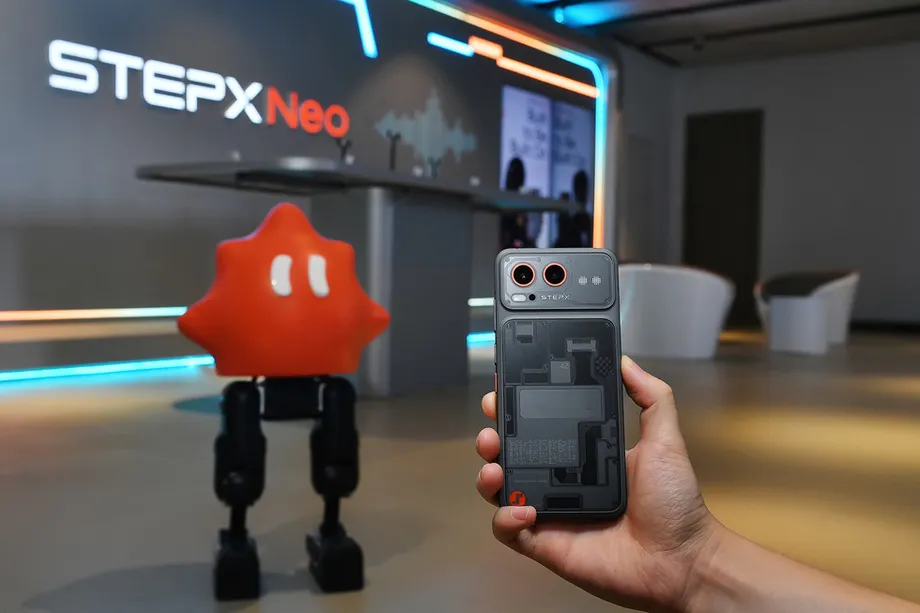
A phone built to carry out requests, not just answer them
StepFun's STEPX Neo puts a personal AI agent on the first screen users see after unlocking their phone. Unveiled in Shanghai on October 13, 2026, the early edition costs 3,999 yuan and bundles the handset, Step AOS software, Step Studio development tools and access to the company's Step models. Buyers also receive 10 billion tokens a month for 12 consecutive months.
Contents
- A phone built to carry out requests, not just answer them
- From July prototype to October sales
- What the price includes, and what happens after a year
- Step AOS changes the layer above Android
- Offline abilities have a defined role
- Alipay opens a route to transactions, while WeChat stays outside
- Doubao faces the same access problem through a different route
- Hardware and development tools serve the agent
- Safety and reliable execution will decide everyday usefulness
- The competition is over who can authorize the next action
- Key Points
The central promise is practical: tell its agent, Amoo, what you want accomplished, and let it coordinate the necessary services. Launch demonstrations included ordering coffee, arranging transport, preparing presentations and editing videos. Instead of making users open several apps, StepFun wants the phone to organize the work around a single request.
An AI agent differs from a chatbot because it can take actions. A chatbot might suggest a hotel. An agent can search for rooms, choose options based on your preferences and move a booking toward payment, within the permissions you grant it.
STEPX Neo also brings a larger contest into focus. Chinese companies are trying to establish this experience through new devices and agreements with service providers. Google and Apple have the advantage of controlling Android and iOS, the platforms on which much of the smartphone world already operates.
The immediate test is smaller and more concrete than deciding who defines the next operating system: can Amoo reliably complete ordinary tasks, with access to the services people actually use, while keeping them in control of their money and personal information?
From July prototype to October sales
StepFun was founded in April 2023 by former Microsoft Vice President Jiang Daxin. Its Step models handle text, images, audio and video, and the company has supplied AI capabilities through partnerships with businesses including OPPO and Geely. STEPX Neo moves the company beyond providing models to other manufacturers and toward controlling the device experience itself.
The phone first appeared in Shanghai on July 13 as a prototype, without a confirmed price or retail launch date. StepFun then set out a period of roughly 100 days to expand its ecosystem and add services. The October event introduced the priced early edition.
- July 13: STEPX Neo was unveiled as a prototype in Shanghai.
- September 16: Nubia introduced the second generation Doubao phone, NaviX Ultra, starting at 5,999 yuan.
- October 13, at 9 p.m.: STEPX Neo presales began at 3,999 yuan.
- October 14: Doubao began gradually expanding screen automation access after its application declaration period ended.
- October 16, at 10:13 a.m.: STEPX Neo was scheduled to begin regular sales.
- October 25: A limited free trial of Step 5 Preview through Tencent WorkBuddy was scheduled to end.
The sequence explains why early descriptions called STEPX Neo an unpriced prototype, while October coverage detailed a handset ready for sale. StepFun markets it as a first of its kind, but the useful distinction is its design: an agent placed at the center of the phone, with services connected to support its actions.
What the price includes, and what happens after a year
STEPX Neo's single announced configuration has 16GB of memory and 256GB of storage. Its 3,999 yuan package includes hardware, models, the operating environment and development tools. Against the Doubao NaviX Ultra's starting price of 5,999 yuan, that is a difference of 2,000 yuan, or about one third of Doubao's price before subsidies.
The package includes a STEPX Token Plan providing 10 billion tokens each month for a year. Tokens are the small units of information an AI model processes or generates. The number of tokens used depends on the model and the task, so the allowance cannot be translated directly into a fixed number of bookings, conversations or finished videos.
Pricing for continued model access after those 12 months has not been announced. That matters because the phone sends more demanding requests to cloud models, which require remote computing resources.
A JD.com promotion offered a 500 yuan subsidy that could bring the purchase price to 3,499 yuan. StepFun also announced a growth program under which the first 10,000 users completing qualifying tasks could receive a free exchange for one future STEPX device within five years, subject to the program's terms.
The combination of development tools, a large initial computing allowance and participation rewards points toward an early audience of developers and people willing to experiment with a new product, rather than buyers interested only in replacing a conventional phone.
Step AOS changes the layer above Android
Step AOS organizes phone functions around what an agent needs to accomplish. Its atomic capability engine divides functions into communication, apps, files and system tools. An atomic capability is a small, specific action, such as creating an alarm or retrieving a file, that the agent can combine with other actions.
The software uses Model Context Protocol, or MCP, to connect models with tools and information. It also supports A2A, meaning communication between agents, so Amoo can work with a specialist agent belonging to another service.
StepFun describes a system built using Android, Linux and real time operating system components. An inspected launch handset ran Step AOS 1.0.3 above Android 15. The product therefore retains Android foundations while introducing an environment designed around agent activity.
Amoo appears immediately after unlocking, while a swipe provides access to the familiar app interface. Users keep conventional phone controls alongside the new interaction method.
The deeper change concerns how tasks reach apps. Rather than finding a button on a screen and pretending to tap it, Amoo can call a function that a partner has deliberately made accessible. That approach makes the service connection central to the experience: the agent needs both the ability to plan a task and permission to execute its steps.
Offline abilities have a defined role
STEPX Neo uses local models for quick, simple requests, including changing system settings and creating alarms. Some of these operations can run without an internet connection. More demanding information searches, transactions and coordination across apps go to cloud models for planning, after which the phone executes the instructions.
Early descriptions presented Amoo as working offline for core tasks. The launch account gives a more specific picture: local processing handles a portion of the work, while complex requests use a connection to remote models.
Travel features include translation of conversations, calls, messages and camera text across 32 languages, including regional dialects. StepFun also describes assistance with customs forms, visa alerts, flight check in reminders and access to saved itineraries. Saved information can remain useful without a signal, while fresh searches and bookings depend on the relevant connected services.
The company says its Step Edge model leads comparable models that run on devices across 29 benchmarks. It has not identified those tests, leaving buyers without the named tasks, competing models and scoring methods needed to examine the comparison.
Amoo's memory system separates user information, experiences and preferences from knowledge and methods accumulated by the agent. Remembering a preferred restaurant or travel choice could reduce repeated instructions. Users also need controls over which details the phone retains and uses when deciding what to do next.
Alipay opens a route to transactions, while WeChat stays outside
StepFun says Amoo has partnerships with nearly 100 companies or products. Named services include Alipay, Ctrip, Didi, Meituan, Amap, WPS and CapCut, alongside Tencent products and partnerships involving Baidu and JD.com.
Alipay supplies one of the most concrete examples. Amoo can access more than 300 services through Alipay's Abao agent after user authorization, covering areas such as food orders, transport, parcel delivery, household repairs and public services.
A coffee demonstration showed Amoo and Abao handling recommendations, an order, payment and redemption inside the conversation window. An observed trial of ticket booking, ride ordering and errands instead moved users into a third party app to complete payment. The payment experience therefore varies by service and integration.
Tencent's first participating products include WorkBuddy, WeCom and WeChat Read. WeChat itself was absent from the initial integrations. For users who spend much of their day chatting, transferring money or using services inside WeChat, that limits how much activity Amoo can take over.
CapCut illustrates another use of the architecture. Amoo can coordinate with its specialist editing assistant through A2A to create a video from a request, suggest ideas and make changes through conversation.
The partnership count gives a sense of reach, but individual functions determine usefulness. Access to a reading app's notes and book search is different from access to messaging, transfers or every service operated by the same corporate group.
Doubao faces the same access problem through a different route
Doubao's second generation phone divides responsibilities between ByteDance and Nubia. ByteDance provides the models and agent capabilities, while Nubia handles hardware, manufacturing, sales and service. StepFun has chosen to combine models, software and its own device brand in one package.
Doubao has also moved toward MCP and A2A connections, but relies on graphical user interface automation for many other apps. This means the agent operates visible screens, performing clicks and swipes much as a person would.
Screen automation can make a service accessible without a dedicated connection. It also has to cope with changing button positions, unexpected prompts and redesigned screens. Direct service interfaces offer a more stable route when providers agree to open them.
Doubao's Screen Automation Execution Protocol introduced a declaration process for applications. After the 30 day period ended on October 14, more than 150 apps appeared on its refusal list, including WeChat, DeepSeek, Taobao, Kuaishou and Meituan.
StepFun's approach depends on negotiated interfaces instead. Both routes bring the same commercial tension into view: an agent that completes a transaction without opening an app may reduce the user's exposure to advertisements, recommendations and other services inside it.
IDC China research manager Guo Tianxiang has identified ecosystem restrictions and weak consumer demand as current limits on agent phones. His assessment also places agreements between participants at the center of progress: service providers need a business arrangement that gives them a reason to cooperate.
Hardware and development tools serve the agent
STEPX Neo uses a Snapdragon 8 Gen 5 processor, a 6.36 inch OLED display with a refresh rate of 120Hz, a 6,260mAh battery and charging at 80W. Its cameras include a main sensor of 50 megapixels and an ultrawide sensor of eight megapixels, without a separate telephoto camera.
StepFun gives more attention to listening and agent status than to camera competition. Six microphones, a dedicated audio sensing chip and its Whisper 1.0 pickup algorithm are intended to recognize requests in difficult sound conditions. The company says the audio chip, operating independently, consumes 1.2% of the battery over 24 hours.
A physical agent button provides quick access to Amoo. An independent MiniLED dot matrix display on the back shows states such as listening, thinking or waiting for the user. The handset comes in carbon black and silicon silver.
Step Studio lets users describe an app, game, agent or skill in ordinary language to generate it. It opens access to sensors, cameras, the rear display and system functions, along with external tools and specialist agents.
Launch demonstrations extended beyond everyday apps. AYU FLYING HUB supported monitoring and decision assistance for a homemade flying board. Another project connected a brain computer interface to a skill intended to help people with communication difficulties express their emotional state. These were demonstrations of possible uses, rather than established consumer or medical services.
STEPX also says it is the first terminal manufacturer connected to Alipay Vibe Pay. Through Step Studio, developers can link application creation, product display and transactions, giving them a route to charge for what they build.
Safety and reliable execution will decide everyday usefulness
StepFun describes controls including action logs, permission management, memory controls and reversal of supported actions. Accounts of its security design include trusted execution, permissions granted when needed and withdrawn afterward, and an undo control. High risk operations require an additional confirmation, and users can pause or revoke authorization.
The company says it worked with the Shanghai AI Laboratory on an agent safety framework. STEPX Neo also passed L3 testing under China's AI terminal grading standards, described at the July unveiling as the highest level then available through open testing. The grading system runs from L1 to L4.
A long task creates a particular reliability problem. Using the illustrative assumption of a 90% success rate at each independent step, a process with five steps succeeds about 59% of the time: 0.9 multiplied by itself five times. That calculation explains why an assistant can appear capable at individual actions yet struggle to deliver a complete result consistently.
Launch demonstrations showed Amoo completing several useful workflows. Ordinary use will demand recovery from unavailable bookings, failed payments, ambiguous requests and interruptions. A reliable phone must tell users what happened, what still needs attention and when it requires their decision.
The commercial setting is also difficult. IDC put Chinese smartphone shipments in the third quarter of 2026 at about 57.9 million, down 15.4% from a year earlier. It nevertheless forecast 147 million new generation AI smartphones for the full year, representing 53% of shipments and growth of 31.6%.
Those figures describe a broad AI smartphone category, including devices with far less autonomy than STEPX Neo. Counterpoint Research forecast that phones with generative AI would reach 45% of global shipments, rising above 50% in 2027. The challenge for StepFun is turning common AI features into a reason to buy its particular phone.
The competition is over who can authorize the next action
Google's AppFunctions approach allows apps to expose functions that AI can discover and call. Integration with Gemini is described as being in private preview. Apple's approach centers on personal context, screen understanding and actions across apps within its controlled software environment.
StepFun is pursuing a similar destination through a new device and service partnerships: users state a goal, and software coordinates the work. Google and Apple can build rules for agent access into platforms already used by developers and consumers. StepFun must assemble those connections while also establishing its hardware brand.
China's competing products show that the divide is not simply national. StepFun favors direct partner interfaces; Doubao combines those connections with screen automation; established handset makers integrate AI into their existing systems.
STEPX Neo's strongest contribution is a concrete package that joins an agent interface, development tools and transaction services. Its next measure of progress is the number of useful tasks it completes reliably, with clear authorization and a manageable continuing cost.
Key Points
- STEPX Neo's early edition costs 3,999 yuan and includes hardware, Step AOS, Step Studio and Step models.
- Presales began on October 13, 2026, with regular sales scheduled for October 16 at 10:13 a.m.
- Buyers receive 10 billion tokens monthly for 12 months; later access pricing has not been announced.
- Simple tasks can run locally, while more demanding requests use cloud models.
- Alipay offers access to more than 300 services; WeChat itself is absent from the first integrations.
- Step AOS runs above Android foundations and favors direct service connections over simulated screen taps.
- Permission controls, task reliability and agreements with app providers will determine how much daily work Amoo can handle.