
A rebuilt gateway opens between Hong Kong and Shenzhen
The rebuilt Huanggang Port opened at 6:30 a.m. on October 12, 2026, with a new clearance system intended to cut the time needed to complete Hong Kong and Shenzhen immigration procedures from about 30 minutes to about five. The crossing provides services around the clock for passengers and passenger vehicles, with an initial design capacity of 200,000 passenger crossings a day.
Contents
- A rebuilt gateway opens between Hong Kong and Shenzhen
- One queue for two immigration procedures
- A larger building with much greater capacity
- Why the longer term traffic figures differ
- From reconstruction to Hong Kong jurisdiction
- Large rehearsals prepared staff and systems
- Health checks are built into the crossing
- New transport links replace the old Huanggang shuttle
- A transport project tied to wider regional plans
- Key Points
The complex combines immigration facilities for both jurisdictions at one location and introduces coordinated checks intended to eliminate repeated queuing and identity verification. It is the first land crossing between Hong Kong and Shenzhen to use the collaborative inspection and joint clearance model.
Its opening follows an October 11 ceremony in the Shenzhen section of the joint inspection building. Hong Kong Chief Executive John Lee attended alongside Huang Chuping, chairman of the Guangdong Provincial People's Congress Standing Committee, Shenzhen Party Secretary Jin Lei and Shenzhen Mayor Li Yun.
The immediate challenge is managing the people expected to arrive to see the building and try the new system. Xue Huaming, head of Division One at the Shenzhen municipal port office, said initial traffic could reach 100,000 to 200,000 passenger crossings, while cautioning that demand could not yet be determined. Authorities have increased staffing and security and introduced measures to direct passenger flows.
The five minute target is therefore a promise about the new process, not a confirmed opening day average. Whether it translates into shorter journeys will also depend on queues, connecting transport and the ability of both sides to manage peaks.
One queue for two immigration procedures
The new arrangements bring together two changes that serve different purposes. Colocation puts the Hong Kong and mainland clearance areas in the same port complex. Collaborative inspection and joint clearance coordinates the steps needed to complete immigration procedures for both jurisdictions.
Lee said passengers using the automated channels would queue once, have their travel documents checked once and have their identities verified once. That shared sequence is intended to complete both sides' entry and exit requirements without making travelers repeat the same process at separate checkpoints.
Descriptions of the automated system specify registered travelers. The opening information does not establish that every passenger can use it, or give a full list of eligibility requirements. The building also has manual counters, so automated processing is not the only route through the crossing.
Reports differ slightly on the expected total clearance time. Lee and Financial Secretary Paul Chan put it at approximately five minutes, while another account describes it as under five minutes. Both compare it with roughly 30 minutes at the old crossing. Using the five minute estimate, that represents a saving of about 25 minutes, or an 83 percent reduction.
A separate estimate says automated clearance can take as little as 20 seconds. That refers to the automated step, rather than the entire journey through the port. It should not be treated as a promise that passengers can arrive, queue and complete all procedures in 20 seconds.
A larger building with much greater capacity
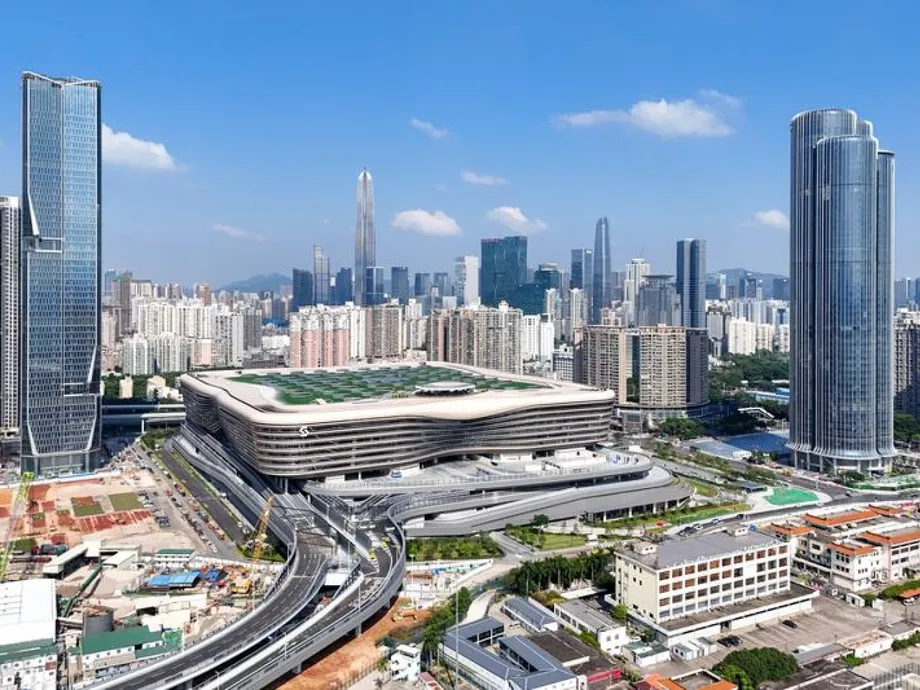
The rebuilt complex has five floors above ground and four below. Its reported area is 689,700 square meters, also given in rounded form as approximately 690,000 square meters. Those figures are consistent descriptions at different levels of precision.
Passenger facilities include 134 automated channels and 68 manual counters, giving a combined total of 202 channels and counters. Passenger vehicles have 28 inspection channels. Pedestrian and vehicle movements are separated across different levels, while Shenzhen Metro Line 7 is directly accessible from the second basement level.
Chan said the initial daily passenger design capacity of 200,000 is five times that of the old port. That comparison implies a previous design capacity of about 40,000 crossings a day. Capacity describes what the facilities are designed to handle, not the number of people who have already used them.
Jin described the rebuilt port as the world's largest land port complex. Another account calls it the world's largest land port contained in a single building. Those descriptions use different categories, and the opening information does not supply a global comparison establishing either ranking.
Why the longer term traffic figures differ
Lee said daily capacity could rise from approximately 200,000 to approximately 300,000 after the MTR Northern Link branch opens. That would add 100,000 passenger crossings a day, a 50 percent increase over the initial design figure. No opening date for the branch is given.
Other descriptions refer to capacity reaching 300,000 at peak times over the longer term. Xue, meanwhile, said longer term traffic could exceed 300,000. These are not interchangeable figures: one is a capacity linked to a future railway connection, another describes a peak capacity, and the third is a forecast of demand.
Xue's initial estimate of 100,000 to 200,000 crossings would equal between half and all of the stated daily design capacity if measured over a day. His reported remarks do not make the measurement period explicit, so the range should not be presented as a confirmed daily forecast.
The distinction matters operationally. A port can have substantial daily capacity and still experience queues when many passengers arrive within a short period. Authorities on both sides say they are preparing for concentrated demand, including visitors arriving primarily to inspect and experience the new facilities.
From reconstruction to Hong Kong jurisdiction
Reconstruction began in 2019 following agreement between Hong Kong and Shenzhen. The physical project was accompanied by legal arrangements allowing Hong Kong to exercise jurisdiction over its designated port area within the rebuilt complex.
Lee said the National People's Congress Standing Committee made an authorization decision in June 2026, followed by State Council approval in July. Hong Kong was authorized to exercise jurisdiction over the Hong Kong port area from midnight on July 31. He described those steps as the legal foundation for colocation.
The main milestones were:
- 2019: Reconstruction began by agreement between Hong Kong and Shenzhen.
- June 2026: The National People's Congress Standing Committee made the authorization decision described by Lee.
- July 2026: The State Council issued its approval.
- July 31, 2026: Hong Kong jurisdiction over its designated port area took effect at midnight.
- October 11, 2026: Officials held the opening ceremony in the Shenzhen port area.
- October 12, 2026: Passenger and passenger vehicle services began at 6:30 a.m.
Shenzhen's municipal government paid the project's design and construction costs, according to Lee. No total project cost is given. The financing arrangement and the separate jurisdictional steps show how the redevelopment required cooperation beyond constructing a larger terminal.
Large rehearsals prepared staff and systems
Secretary for Security Chris Tang said more than 100 tests of systems, procedures and performance under pressure had taken place since the Hong Kong port area was established. He expressed confidence that the opening would provide safe, smooth and efficient clearance.
Secretary for the Civil Service Ingrid Yeung gave more detail about the preparations. Over more than two months, government departments conducted over 100 tests and exercises, including two major pressure tests involving 10,000 and 20,000 civil servants respectively.
Participants acted as users and gave feedback on their experience. Yeung said the work reflected cooperation across government and civil servants' roles both as public employees and as users of public services.
Disciplined services worked on clearance channel hardware and software, signs and other operational arrangements. The Government Property Agency improved and repaired frequently used facilities. These tasks addressed practical details that can affect passenger movement even when the core immigration systems work.
Shenzhen's Xue cited more than 200 exercises conducted by both sides, including emergency response and contingency drills. That figure covers a broader preparation effort than the Hong Kong departments' total of more than 100 tests. The accounts do not explain how exercises were counted, so the two totals should not be added together.
Health checks are built into the crossing
Director of Health Ronald Lam said sufficient personnel had been deployed to keep health quarantine operations orderly and protect public health when the port opened.
In the passenger hall, a collective infrared thermal imaging system measures travelers' temperatures as they move through the area. The system is intended to screen large numbers of people without requiring each traveler to stop for an individual temperature reading.
For vehicles, the joint inspection lanes have integrated information collection equipment. It can collect a driver's temperature, travel document information, facial features and fingerprints in one sequence, reducing the need for separate collection steps.
Lee said vehicle clearance was expected to fall from about 10 minutes to less than two minutes. That would save more than eight minutes, a reduction exceeding 80 percent. As with the passenger estimate, the figure is an expected processing improvement rather than a published measurement of opening day performance.
The health arrangements show how the new workflow combines several checks instead of simply removing them. No details are given about the handling of abnormal temperature readings, retention of biometric information or measured performance during live operations.
New transport links replace the old Huanggang shuttle
The crossing remains the only passenger land boundary control point between Hong Kong and Shenzhen operating around the clock. Its usefulness outside daytime hours depends on connecting services as well as the availability of immigration counters.
Secretary for Transport and Logistics Mable Chan inspected preparations at the port's public transport interchange with Legislative Council President Starry Lee. She also visited the San Tin Public Transport Interchange, where the Transport Department arranged three daytime bus routes, three daytime green minibus routes, one overnight bus service and one further green minibus service linking San Tin and Huanggang Port.
A broader account of the port's connections lists seven franchised bus routes, six minibus routes and five cross boundary shuttle routes operating around the clock, serving Hong Kong Island, Kowloon and the New Territories. These totals describe a wider transport network than the specific San Tin services and should not be treated as competing counts of the same routes.
The change also ends the old Huanggang shuttle's nearly 30 years of operation. Bus enthusiasts and visitors from Shenzhen went to the San Tin interchange on its final day to photograph the buses and mark the end of the service. One visitor, identified as Mr. Yang, said his trip was both his first and last ride; another, Mr. Liu, recalled riding the service as a child.
The old shuttle stop will continue to have a transport role. Mable Chan said three franchised bus routes would serve it from Monday and that its facilities would support shuttle arrangements for tour passengers heading north or south.
The new building does not have an area for tour coaches to pick up and drop off passengers. Discussions with the tourism industry were continuing over those arrangements. The Transport and Logistics Bureau said it would monitor conditions and coordinate responses, while previous tests with operators had examined vehicle flows, pedestrian movements and signs.
A transport project tied to wider regional plans
Lee connected the opening with three priorities: carrying out national planning, introducing new institutional arrangements and increasing movement across the boundary. He said Hong Kong had published its first five year plan in September and was aligning it with the country's 15th Five Year Plan.
Huang linked the port to closer cooperation between Shenzhen and Hong Kong's Northern Metropolis and to development of the Hetao Shenzhen Hong Kong Science and Technology Innovation Cooperation Zone. He said Guangdong would work with Hong Kong to manage the crossing and improve its services.
Jin outlined cooperation in trade, finance, technology, industry, culture and tourism. Li Xiaobing, an expert on Hong Kong, Macao and Taiwan affairs at Nankai University, said the rebuilt crossing met the two cities' economic and social development needs and broadened the practice of one country, two systems.
Paul Chan placed the opening alongside another regional event: the first APEC finance ministers' meeting in Hong Kong, due a little more than a week later. Its stated priorities include fiscal policies supporting people's livelihoods, financing digital infrastructure, inclusive finance and exchanges among young financial professionals. The meeting is separate from the port launch, but forms part of the government's wider agenda for regional connections.
For regular travelers, the immediate test is more concrete: whether shorter immigration procedures, dependable transport and effective crowd management produce a faster journey. No measured opening day clearance average or confirmed traffic total is given. The timing of the Northern Link branch and final tour coach arrangements also remain unspecified.
Key Points
- Huanggang Port opened at 6:30 a.m. on October 12, 2026, with clearance available around the clock for passengers and passenger vehicles.
- Coordinated immigration checks are expected to cut total passenger clearance from about 30 minutes to about five.
- Initial design capacity is 200,000 passenger crossings daily, five times the old port's capacity.
- The complex has 134 automated passenger channels, 68 manual counters and 28 passenger vehicle inspection channels.
- Hong Kong departments conducted more than 100 tests; Shenzhen described more than 200 exercises involving both sides.
- New transport services replace the old Huanggang shuttle, while tour coach arrangements are still being discussed.
- A future Northern Link branch could support capacity of approximately 300,000 crossings daily, but no opening date is specified.