A rug factory built around 5,000 people's daily lives
A textile factory in Rangpur, northern Bangladesh, has won the RIBA International Prize 2026 with a design that gives gardens, ponds, childcare and shared entrances a central place in industrial life. The seven storeys of Green Field Factory accommodate about 5,000 employees, including 4,000 women, according to the Royal Institute of British Architects.
Contents
- A rug factory built around 5,000 people's daily lives
- A Bengali home provides the starting point
- How ponds and four atria move cool air
- One entrance for workers, managers and owners
- Childcare and healthcare beside the production floors
- From construction to international recognition
- Bangladesh supplied half the final shortlist
- A craft business in an industry under scrutiny
- What the jury rewarded
- Key Points
Designed by Bangladesh's Nakshabid Architects for Karupannya Rangpur Limited, the factory was the unanimous choice of a jury chaired by Bijoy Jain, founder of Studio Mumbai. The award was announced at the RIBA Stirling Prize ceremony in London on 15 October 2026.
RIBA's official project assessment identifies the building as the 2026 winner following reassessment after circumstances prevented the grand jury from visiting it for the 2024 prize. Its recognition rewards a working industrial building whose architecture connects production with everyday services, outdoor space and opportunities to spend time with family.
The factory covers 13,450 square metres, or more than 144,000 square feet. Four floors contain textile production areas, while other spaces accommodate packaging and storage. Karupannya makes handmade rugs, doormats and bathmats.
Jain, explaining the jury's response to the building, described the atmosphere in these words:
The jury were witness to a work in quiet humility.
That judgment rested on practical choices: how people enter work, how air moves through production floors, where children receive care and whether workers have comfortable places to rest. RIBA praised the factory as an alternative model for industrial design and operation.
A Bengali home provides the starting point
Nakshabid Architects drew inspiration from traditional Bengali homesteads, where courtyards, ponds, gardens and shaded verandas connect buildings with outdoor life. At Green Field, those familiar elements have been adapted to a large concrete factory in the Robertsongonj area of Rangpur.
Bayejid M. Khondoker, the firm's founder and principal, described the question that guided the project in a statement issued before the award announcement:
We asked a simple question: What if a factory were designed first as a home for the people who work in it? Every courtyard, garden, water body and shaded verandah grew from that question. A factory should not be a machine that consumes human energy. It should be a living place that restores it.
Karupannya founder Shafiqul Alam Selim worked with the architects on the project. A straightforward concrete frame and walls made with locally sourced masonry support a building whose most visible feature is its abundant planting. Landscape designer Saidul Huq Juice is credited by RIBA.
How ponds and four atria move cool air
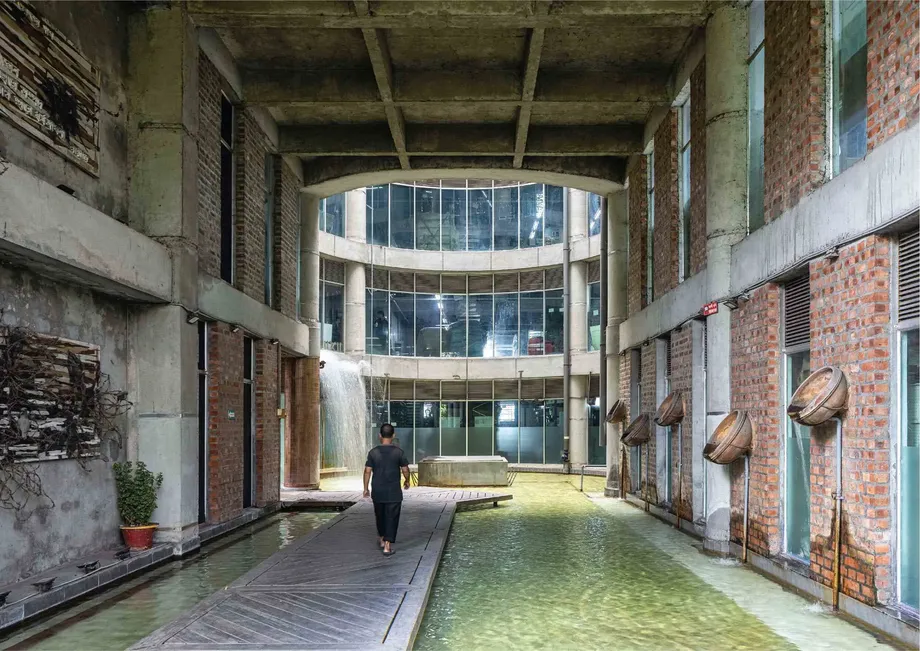
Four atria, tall open spaces running through the building, are central to the ventilation system. Air passes through a screen of plants and across water pools before moving upward through these spaces. Natural light also enters from above, reaching deep into the factory.
RIBA describes this upward movement as the stack effect. Warm air rises and escapes through openings higher in a building, drawing replacement air in below. At Green Field, ponds help cool the incoming air, while deep verandas and vegetation provide shade.
The design combines this movement of air with the concrete structure's ability to absorb heat. An architectural account gives estimated benefits of interiors about 5 degrees Celsius cooler and energy use 40% lower, although it does not specify the comparison building or measurement conditions.
RIBA's own assessment describes reduced reliance on mechanical systems and confirms solar panel installations, use of daylight, rainwater and wind, and LEED Platinum certification for operation and maintenance. LEED is a green building rating system; the operation and maintenance category concerns how an existing building is managed and performs.
One entrance for workers, managers and owners
Workers, managers and owners approach Green Field through the same landscaped arrival area, Nandini Park. Two grand stairways lead to the entrance at first floor level, while a ramp provides an accessible route from the same starting point.
Jain's citation places unusual weight on those stairs. In a setting where factory staff can be separated by rank from the moment they arrive, the shared entrance gives everyone access to the same prominent route. He described the two stairs as an "equanimous shared portal", meaning an entrance that treats people with equal regard.
The landscaped approach continues inside, where walkways cross ponds and lead toward the tall atria. Views from production floors connect employees with the surrounding landscape. Gardens and shaded places to sit make rest and conversation part of the building's layout.
RIBA's assessment links this arrangement to a deliberate effort to reduce social hierarchies. Its praise concerns both the physical entrance and the broader decision to give employees spaces usually associated with homes, parks or community buildings.
Childcare and healthcare beside the production floors
Karupannya has included a rooftop daycare centre, medical centre, grocery shop, prayer room and canteen within the factory. The grocery store offers discounted goods, and an outdoor stage accommodates community performances and events.
For employees with children, childcare at the workplace brings care and employment into the same location. Medical services, meals and shopping are also close at hand. Together, these facilities make the building useful beyond the hours spent making and packing textiles.
Women account for 80% of the workforce, according to RIBA, which gives their number as 4,000 out of about 5,000 employees. A project profile instead describes 4,000 employees in total, with 80% women; the institute's figures provide the basis for the workforce count here.
The Bonolota sculpture, a female figure at the landscaped entrance, was commissioned to represent the "strength of women's empowerment", RIBA says. The institute also records that workers bring friends and family to the factory outside working hours, taking pride in showing them where they work.
From construction to international recognition
Green Field's award follows a lengthy journey from construction to occupation, then through two rounds of international prize consideration. The planting had years to grow before the grand jury's September visit in the winning award cycle.
Construction began in 2013 and the factory opened in 2017, while a project profile records a completion date of 1 December 2018. RIBA's award record confirms that the project received an International Award for Excellence in 2024 before its later reassessment for the top prize.
- 2013: Construction began on the factory.
- 2017: The factory opened, with a project profile listing completion in December 2018.
- June 2024: Green Field was among 22 International Awards for Excellence winners across 14 countries.
- 2024: Circumstances prevented the grand jury from visiting for that year's International Prize consideration.
- 2026: The factory was reassessed and won the International Prize, announced in London on 15 October.
The distinction between the awards matters to the chronology. An International Award for Excellence recognises an individual project within a wider group. The International Prize selects a single winner after further judging, including visits to shortlisted buildings.
Bangladesh supplied half the final shortlist
Green Field competed against three other finalists selected from 34 projects recognised with International Awards for Excellence in the current cycle. Bangladesh supplied two of the four finalists, with WOHA's BRAC University in Dhaka joining the Rangpur factory.
BRAC University's 13 storeys serve 20,000 students on a former landfill site. Nine floors contain teaching facilities, with a publicly accessible park above. Natural ventilation, landscaping and passive cooling, which uses building form and airflow to limit heat, connect its approach with Green Field's response to Bangladesh's climate.
Belgium supplied the other two finalists. Royale Belge in Brussels, redesigned by Caruso St John Architects and Bovenbouw Architectuur with DDS+, transforms a former insurance headquarters into a hotel, shared workplaces and restaurant. Its protected structure and reused materials keep much of the existing building in service.
Z33 in Hasselt, by Francesca Torzo Architetto, extends a museum within a historic enclave of brick buildings and gardens. Galleries, courtyards, local materials and traditional craft connect the new construction with its surroundings. The four finalists offered different ways to make workplaces, educational buildings and cultural spaces more useful to their communities.
A craft business in an industry under scrutiny
Karupannya Rangpur Limited was established in 1991 and grew from an initial group of 15 craftspeople. The company continues the Satranji rug making tradition and uses waste materials from garment and textile production, linking an established local craft with the country's much larger textile economy.
Bangladesh is among the world's largest textile producers, but factory conditions remain a concern for labour rights groups. The 2013 Rana Plaza collapse outside Dhaka killed about 1,100 people after workers' concerns about cracks in the building were ignored and many were forced to return.
Green Field's recognition places employee comfort, access to services and dignity within the discussion of industrial architecture. Its shared entrance, childcare and gardens show specific decisions that an owner and architect can make about the working day. RIBA also points to workers' reported freedom to make decisions about their lives and families.
The prize's recent history shows a similar interest in buildings serving everyday needs. The previous winner, announced in 2024, was a six storey timber social housing project in Barcelona. Green Field is Bangladesh's second winner, following Friendship Hospital in Shyamnagar, designed by Kashef Chowdhury/URBANA.
What the jury rewarded
Green Field became the fifth recipient of the International Prize since its first award in 2016. The prize usually runs every two years, although the COVID-19 pandemic disrupted that schedule.
RIBA's decision brings together two strands of the factory's design: an environmental system built around shade, water and moving air, and a social arrangement built around shared access and practical care. The gardens are part of the cooling strategy; the entrance is part of how the workplace treats rank; the rooftop supports both recreation and childcare.
For the people making rugs in Rangpur, the changes are concrete: daylight on production floors, a place to obtain medical help, children cared for nearby and grounds where families can gather. Those daily uses are at the centre of the building's international recognition.
Key Points
- Green Field Factory in Rangpur won the RIBA International Prize 2026 by unanimous jury decision.
- Nakshabid Architects designed the seven storeys for Karupannya Rangpur Limited.
- RIBA records about 5,000 employees, including 4,000 women.
- Four atria, ponds, planting and shaded verandas support natural cooling and ventilation.
- Facilities include childcare, medical care, a grocery shop, canteen and prayer room.
- The project received an Award for Excellence in 2024 before reassessment for the 2026 prize.
- Bangladesh accounted for two of the four finalists, with BRAC University also shortlisted.