
A 300 taka journey that never reached home
A journey of about eight kilometres to a home in Cumilla's Racecourse area instead ended at an isolated paddy field in Lalmai. Police say a 15 year old seventh grade student hired driver Sumon Mia for 300 taka shortly after midnight, but he drove her at least 30 kilometres away from her intended destination before allegedly raping and killing her.
Contents
- A 300 taka journey that never reached home
- What the court confession establishes
- The route was almost four times the expected distance
- The location message has two reported times
- What cameras and the field show
- Forensic findings are still needed
- The Cox's Bazar stay and the later detention
- A timeline with unresolved date conflicts
- The phone, the abandoned vehicle and passenger safety
- Key Points
Investigators arrested Sumon, 35, in Chattogram on Friday and recovered the girl's iPhone from bushes beside a pond in Bakhrabad after he identified the location. On Saturday evening, he gave a confessional statement before Mominul Haque, a judge of Cumilla Senior Judicial Magistrate Court No. 6. The court ordered him sent to jail at about 8 p.m., according to Court Police Inspector Mohammad Sadekur Rahman.
The investigation subsequently extended to Cox's Bazar. Police there detained hotel employee Riaz Uddin, also known as Raju, in the Kalatali area at about 10:30 p.m. on October 12. Cox's Bazar Sadar Model Police Station chief Sheikh Mohammad Ali confirmed the detention. His precise status in the case and any alleged connection to the killing have not been publicly explained.
These developments do not resolve the central gaps in the police account: what happened during the long drive, when the girl sought help, whether anyone else was involved and what forensic examination will establish. Reports also differ over her age and several times and dates. Most describe her as 15, while initial accounts identify her as 14. No published forensic findings or verdict establish the allegations conclusively.
What the court confession establishes
The court statement came after police described an admission made during questioning. These are separate developments: the first was an account obtained by investigators, while the later statement was recorded before a judicial magistrate. Sumon was sent to Cumilla Central Jail after the court proceeding.
Lalmai Police Station chief Md. Mizanur Rahman subsequently confirmed that Sumon had given a confessional statement in court. He said investigators were examining the recovered phone's call records and other digital evidence, and that a fuller account would be possible after the investigation was completed.
A confession does not mean a trial has concluded or every detail has been independently verified. Police still need to reconcile the statement with the physical evidence, camera footage, phone records and medical findings. The girl's father, Abdul Alim, initially filed a murder case at Lalmai Police Station against unidentified people.
Police described their preliminary findings as pointing to Sumon alone. At the Saturday press conference, however, Additional Superintendent of Police (Crime) Pankaj Barua also said investigators had not yet established whether anyone else was involved. That distinction matters: evidence identifying one suspect is not the same as a completed inquiry excluding all others.
The route was almost four times the expected distance
According to police, the girl was looking for transport near the Tisha bus counter beside Noorjahan Hotel at Padua Bazar Bishwaroad. At about 12:30 a.m., Sumon agreed to take her home for 300 taka. He allegedly told her he would use a shortcut.
Instead of travelling toward Racecourse in Cumilla city, police say he drove toward Bijra Bazar along the Cumilla to Chandpur regional highway, then took the Cumilla to Noakhali highway toward fields near Bhorajagatpur in Lalmai.
The reported route of at least 30 kilometres was 3.75 times the approximately eight kilometre journey home. Barua said the intended trip should have taken no more than half an hour, while the actual drive lasted between one and a half and two hours, three to four times that expected duration.
One account of the police briefing adds that the girl gave Sumon 100 taka shortly after setting off and that he bought bananas and bread. No exact time or location for that purchase has been disclosed. Such a stop could help place the vehicle along the route, but police have not publicly described evidence connecting it to a particular shop.
Vehicles use both highways at night, and people are present in some areas. What the girl could see, whether she understood where she was being taken and whether she had a safe opportunity to seek help remain unknown. Sumon's reported claim that she showed no reaction during the drive is his account, not independent evidence of her condition or choices.
The location message has two reported times
Police said the girl sent her father her live location at 2:58 a.m. He was asleep and did not see it until early morning. He then went looking for her and arrived where police were recovering her body.
Her father's account places the message earlier, at about 1:45 a.m., and says she asked him to come and get her. Those times differ by one hour and 13 minutes, a substantial gap when investigators are reconstructing a journey lasting up to two hours.
Reports also differ on the content and circumstances of the message. One account attributes to police the claim that she feared for her life and pleaded for help. Other accounts of the press conference say investigators did not explain what prompted her to send the location or what happened afterward. The exact message and its verified timestamp have not been made public.
Live location sharing allows a recipient to see a phone's location through a messaging service, sometimes with updates as it moves. Without the original message and related records, it is not possible to establish from the reported times alone where she was when she sent it or how long the location continued to update.
A separate early account says her father spoke to her by phone at around 2 a.m. on Wednesday. That description does not fit neatly with the wider chronology, which places her bus arrival late Wednesday and the discovery of her body on Thursday. It remains an unresolved discrepancy rather than a reliable additional point on the timeline.
What cameras and the field show
Camera footage reportedly shows the girl getting off an Iconic bus outside Noorjahan Hotel at about 11:45 p.m., visiting nearby food and stationery shops, and leaving the hotel area at about 12:15 a.m. At one shop, a man appeared to show her something or give directions. Police say she charged her phone before seeking transport.
Later accounts describe footage near the crime scene showing her seated on the rear left side of the auto rickshaw. Investigators said they had found no evidence of another person's involvement at that stage. The footage described publicly does not provide a continuous record of the entire drive.
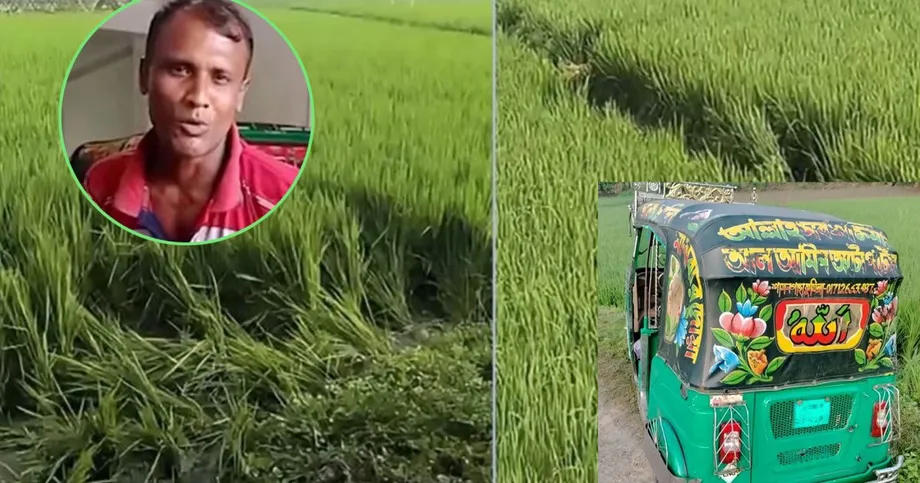
Local resident Ruhul Amin said he found a vanity bag about 20 to 30 yards from the abandoned vehicle, noticed disturbed plants in nearby fields and then discovered the body. He called the national emergency service, 999. Other accounts place the vehicle about 50 yards from the body near the Kachikata to Harishchar Bazar road.
Cumilla Superintendent of Police Anisuzzaman described what investigators found at the scene:
Investigators also found signs of a struggle across at least four to five paddy fields at the scene, suggesting that Tajmin had tried to escape from her attackers.
The disturbed fields support the need to reconstruct a struggle, but they do not by themselves establish how many people were present. Police also recovered clothing and a handbag near the vehicle. A local account says residents moved the auto rickshaw from the field onto the road before its examination; police have not explained publicly how that affected documentation of the scene.
Forensic findings are still needed
Police say Sumon admitted sexually assaulting the girl and killing her. Their account describes an attempted escape, a struggle and a gamcha, a cotton towel, wrapped around her neck. Accounts differ in their descriptions of the final assault, including strangulation and suffocation with her face pressed toward the ground.
Investigators have said a forensic report is needed to establish the rape allegation conclusively. They have also said they could not confirm whether the alleged sexual assault occurred before or after death, despite accounts presenting a definite sequence.
Early in the investigation, Lalmai Police Station chief Mizanur Rahman said the body had been sent for medical examination:
The body was sent to the morgue of Cumilla Medical College Hospital for autopsy to determine the exact cause of death.
An autopsy examines injuries and other medical evidence to help establish how a person died. Here, its findings are central to checking the reported confession and distinguishing between competing descriptions of the killing. No release date for the forensic findings has been announced.
The Cox's Bazar stay and the later detention
Police say the girl left home on October 4, telling her family she was visiting a female friend. Investigators later traced movements to Brahmanbaria, back through Cumilla and onward to Cox's Bazar. The complete itinerary, including whom she met and who accompanied her, has not been disclosed.
A later account says she stayed at Meghla Resort in Kalatali from Tuesday evening until about 11 a.m. Wednesday. Hotel staff claimed Raju helped arrange her stay. Travel agency official Abdullah separately said she visited a ticket counter with a young man called Raju and that he purchased one ticket for a bus leaving Cox's Bazar at noon Wednesday.
Another account identifies a hotel employee as Raju Chowdhury, 20, and gives a different workplace, Dubai Resort. The later detention identifies the man as Riaz Uddin, also known as Raju. Police have not publicly clarified whether these names refer to the same person, or explained the differing hotel details.
The girl's mother, Keya Khatun, said her daughter had told her she was with a female friend but would not disclose the friend's name or parents' identities. She believed questioning that friend could help explain the events. Some reports place this conversation on Wednesday afternoon, while others say Thursday afternoon, after the reported discovery of the body. That timing also requires clarification.
Investigators have not announced evidence linking the female friend to the killing. Raju's detention similarly should not be treated as proof of participation. Teacher Sad Bin Ershad recalled that the girl cared for her younger twin brothers when her mother was ill. Her family lived in rented accommodation in Cumilla because of her father's job.
A timeline with unresolved date conflicts
The broad sequence is consistent across many accounts, but the numbered dates are not. Several reports place the return journey on October 7, while another says October 8. Initial reports date the recovery to October 8 and Sumon's arrest to October 9. A separate account labels the Saturday briefing October 10, while the later Cox's Bazar detention is described as Sunday, October 12. These descriptions do not form one consistent calendar sequence, and no year is specified here.
- October 4: The girl leaves her rented home, saying she will visit a friend.
- Before the return journey: Police trace travel through Brahmanbaria and Cox's Bazar; a later report describes an overnight hotel stay in Kalatali.
- Wednesday night: She returns by bus to Padua Bazar. Most camera accounts place her arrival around 11:45 p.m.; one early account says 10:30 p.m.
- After midnight: Police say she hires Sumon at about 12:30 a.m. Her father places her location message around 1:45 a.m.; police give 2:58 a.m.
- Thursday morning: Residents discover the body and abandoned vehicle. Her father identifies her.
- Friday: Police arrest Sumon in Chattogram and recover the iPhone from Bakhrabad. The girl is buried in Jashore after a funeral prayer at 10 a.m.
- Saturday: Police hold a briefing, and Sumon later gives a statement before a magistrate and is sent to jail.
- October 12: Police detain hotel employee Riaz Uddin, known as Raju, in Cox's Bazar.
Preserving these differences avoids turning uncertain dates into established facts. Phone timestamps, bus records, hotel records and court documentation could provide a more precise chronology, but their full contents have not been released.
The phone, the abandoned vehicle and passenger safety
According to police, Sumon left the auto rickshaw at the scene, took the iPhone, bathed in a pond near Kochikata Mosque and travelled in another auto rickshaw to Bakhrabad. He allegedly hid the phone beside a pond before going to Chattogram, where one account says he stayed at his brother's home.
The phone's recovery gives investigators an object to examine alongside the confession. It does not settle the motive. Police have not explained why Sumon abandoned the vehicle, why he hid the phone rather than keeping or selling it, or whether theft was an initial purpose of the alleged attack. Two close relatives were also reportedly taken into custody for questioning; their later status has not been disclosed.
The case has renewed concern about passengers finding safe transport after leaving buses at night. On April 24, customs official Bullet Boiragi was reportedly robbed and killed after falling into a trap involving an organised auto rickshaw gang. No evidence has been announced connecting that gang to this killing.
At the briefing, Additional Superintendent of Police Pankaj Barua suggested an emergency call might have changed the outcome:
If the girl had called 999 at the crime scene or even before reaching it, perhaps we would not have had to witness such a death.
That is a hypothetical statement, not evidence that she had a safe opportunity to call or that officers could have reached her in time. A resident did use 999 after discovering her body. The wider safety issue concerns patrol coverage and the availability of secure transport, not simply the actions of a child facing an alleged attack.
No further hearing date, forensic publication deadline or confirmed timetable for completing the investigation has been announced. The next substantive findings will need to explain the digital records, medical evidence and the purpose and outcome of questioning people connected to her travels.
Key Points
- Police arrested driver Sumon Mia and recovered the girl's iPhone from a location he identified.
- Sumon gave a confessional statement before a Cumilla magistrate and was sent to jail.
- Police later detained a hotel employee known as Raju in Cox's Bazar; his alleged connection to the killing has not been explained.
- The reported journey covered at least 30 kilometres instead of the approximately eight kilometres home.
- Reports differ on the girl's age, arrival time, location message and several calendar dates.
- Forensic findings remain necessary to establish the sexual assault allegation and clarify the cause and sequence of death.
- Investigators are examining phone records and other digital evidence, with no announced completion deadline.