The Fleet Size Mirage
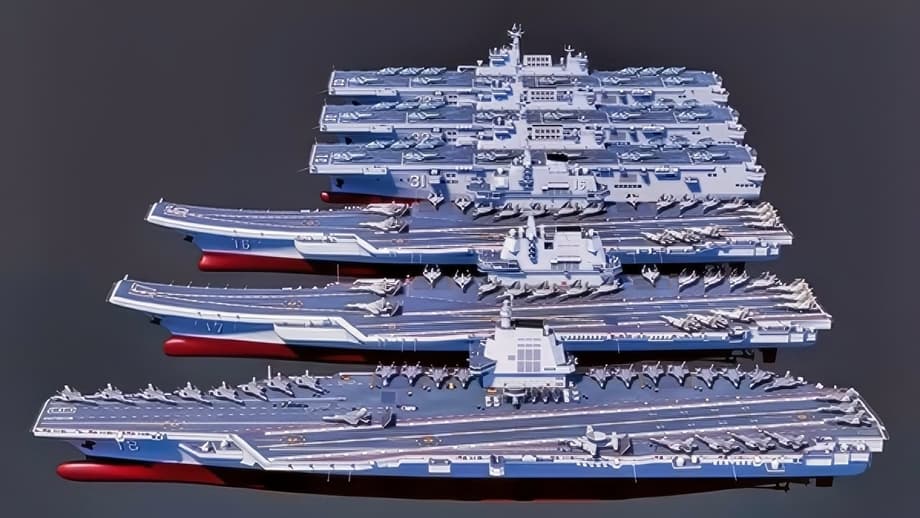
China’s navy now fields more than 370 battle force ships, according to the Congressional Research Service, making it the largest maritime force on Earth by hull count. The United States, by comparison, operates 296 battle force vessels, with projections suggesting the gap will widen to 435 Chinese ships against 294 American vessels by 2030. These figures appear alarming at first glance, and they are frequently cited as evidence of a shifting balance of power in the Indo-Pacific. Yet this numerical milestone obscures a more complex reality that demands closer examination.
The critical question is not which nation owns more hulls, but whether the United States can project effective naval power in the Western Pacific when it matters most. China has achieved what naval strategists call Corbettian sea denial rather than Mahanian sea command. This distinction is crucial. Beijing does not seek to defeat the U.S. Navy in a decisive fleet engagement reminiscent of classic naval warfare theory. Instead, China aims to make American intervention so difficult, costly, and slow that Washington cannot arrive in time to influence the outcome of a crisis. The goal is to create a temporary no go zone that persists long enough to secure political objectives, particularly regarding Taiwan or contested territories in the South China Sea.
This strategy requires neither parity nor superiority in total fleet size. It demands a specific architecture of capabilities designed to detect, track, and threaten American forces as they approach the theater. The raw number of Chinese vessels serves primarily to add mass to this defensive system, complicating U.S. maneuvering within contested waters and increasing the risk calculus for commanders. When viewed through this lens, the fleet size statistic transforms from a measure of dominance into a single component of a broader anti access framework.
The Architecture of Denial
The real challenge confronting American naval planners is Beijing’s anti access and area denial system, commonly abbreviated as A2/AD. This concept describes a layered defensive network combining long range missiles, surveillance systems, electronic warfare tools, and submarine forces. The system operates on a simple principle: preventing an adversary from entering a battlespace or restricting their freedom of movement once inside. For China, this means constructing a defensive bubble extending from the mainland across the South China Sea and toward the first island chain.
At the heart of this strategy lie what defense analysts term sensors and shooters. The sensors include airborne early warning aircraft, over the horizon radars, satellite constellations, and surveillance assets deployed on artificial islands throughout the South China Sea. These platforms work to create a comprehensive maritime domain awareness picture, tracking American surface vessels and aircraft as they transit toward potential flashpoints. The shooters comprise an arsenal of ground launched ballistic and cruise missiles, including the DF-21D and DF-26, which have earned the nickname carrier killers for their ability to threaten large surface combatants at ranges exceeding 1,500 kilometers.
Recent intelligence assessments have revealed an even more concerning development. The Pentagon’s 2025 report on Chinese military power confirmed the operational deployment of the DF-27, a conventional intercontinental ballistic missile with anti ship capabilities. This weapon can strike targets between 5,000 and 8,000 kilometers away, potentially reaching Hawaii, Alaska, or even the continental United States while maintaining the ability to destroy naval vessels at sea. If equipped with a hypersonic glide vehicle, the DF-27 would maneuver unpredictably during flight, complicating missile defense efforts.
China has reinforced this missile architecture by constructing military infrastructure on disputed territories including Woody Island, Fiery Cross Reef, and Mischief Reef. These outposts host airfields, submarine pens, and communication arrays that extend Beijing’s reach deep into maritime Southeast Asia. The combination of fixed island bases and mobile missile batteries creates a flexible defense in depth that American forces would need to penetrate during any regional contingency.
The Undersea Challenge
While surface fleet numbers capture headlines, the undersea domain presents a more immediate tactical threat. Between 2021 and 2025, China launched ten nuclear powered submarines totaling approximately 79,000 tonnes, surpassing the United States’ seven launches during the same period, which totaled 55,500 tonnes. This production surge, centered at the Bohai Shipbuilding Heavy Industry facility in Huludao, has expanded China’s nuclear submarine fleet to roughly 32 vessels, including the Type 094 Jin class ballistic missile submarines and the newer Type 093B guided missile submarines equipped with vertical launch systems.
The Type 093B carries advanced anti ship weapons such as the YJ-19 hypersonic missile, while the Type 094 forms the sea based leg of China’s nuclear deterrent, armed with JL-3 submarine launched ballistic missiles. These developments suggest Beijing is pursuing both conventional sea denial and strategic nuclear survivability simultaneously. Although Western analysts note that Chinese submarines still lag behind American boats in acoustic stealth and sensor fusion, the quantitative shift introduces new complexities for U.S. anti submarine warfare planning.
The danger of underestimating Chinese undersea capabilities was demonstrated starkly in October 2006, when a Chinese Song class diesel electric submarine surfaced within five miles of the USS Kitty Hawk aircraft carrier near Okinawa. Despite being surrounded by a dozen escort vessels and anti submarine helicopters, the carrier group failed to detect the submarine’s approach. The incident revealed dangerous complacency in American anti submarine warfare capabilities and signaled that Chinese submarines could threaten carrier strike groups even without nuclear propulsion.
America’s Evolving Response
Recognizing the density of Chinese defensive systems, the United States has pivoted toward operational concepts designed to complicate enemy targeting and preserve combat effectiveness. The Navy’s Distributed Maritime Operations strategy emphasizes spreading forces across wider geographic areas rather than concentrating them in vulnerable carrier strike groups. This approach makes it harder for Chinese sensors to locate and prioritize targets, while ensuring that the loss of any single asset does not cripple American combat power.
Complementing this naval strategy is the Air Force’s Agile Combat Employment concept, which involves dispersing aircraft across numerous small airfields, highway strips, and allied bases throughout the Pacific. By avoiding concentration at large, vulnerable installations like those on Guam, U.S. forces aim to force China into an expanded targeting problem while maintaining operational resilience.
The U.S. withdrawal from the Intermediate Range Nuclear Forces Treaty in 2019 opened pathways for developing ground launched conventional missiles previously banned under the agreement. Defense planners now advocate deploying theater range missiles throughout the first island chain to threaten Chinese launchers and command nodes. Systems like the Tomahawk and potential future hypersonic weapons could target anti ship missile batteries from standoff distances, creating operational gaps for American air and naval forces to exploit.
However, budgetary constraints complicate these modernization efforts. The Navy recently canceled its Hypersonic Air Launched Offensive Anti Surface Warfare program due to funding limitations, opting instead to rely on the subsonic but stealthy AGM-158C Long Range Anti Ship Missile. Meanwhile, the Army has developed long range fires capabilities intended to strike ships and aircraft from land based positions, adding a joint service dimension to the counter A2/AD campaign.
Fracturing the Kill Chain
The American strategy for defeating Chinese sea denial does not require destroying every missile launcher or radar installation. Instead, planners aim to fracture the kill chain, the sequence of detection, targeting, and engagement that allows A2/AD systems to function. By disrupting any link in this chain, the United States can create temporary windows of access that allow naval and air forces to generate combat effects before defenses can react.
Stealth platforms form the leading edge of this approach. The B-21 Raider, F-35 Lightning II, and existing B-2 Spirit bombers are designed to penetrate heavily defended airspace to strike command centers and radar sites. These operations would blind Chinese surveillance networks, forcing defenders to operate with degraded situational awareness. Submarines provide another critical capability, as their stealth allows them to operate within contested zones with near impunity, conducting strikes against surface vessels or land targets while remaining hidden.
Standoff weapons provide a third vector for cracking the A2/AD bubble. The AGM-158 JASSM-ER, LRASM, and Tomahawk cruise missiles allow American forces to strike critical nodes from outside the densest threat envelopes. Complementing these high end weapons are programs like QUICKSINK, which aims to provide affordable mass, large numbers of lower cost precision munitions capable of swarming Chinese defenses and exhausting missile inventories.
Diplomatic and alliance coordination adds another layer to this strategy. The AUKUS agreement with Australia and the United Kingdom will provide Canberra with nuclear powered submarines, expanding allied undersea capacity. Forward basing mobile missile batteries in the Philippines, Japan, or other partner nations would force China to contend with threats from multiple directions, diluting the effectiveness of its concentrated defenses.
China’s Hidden Vulnerabilities
Despite the impressive scope of Chinese military modernization, Beijing faces significant structural weaknesses that could undermine its sea denial strategy in a prolonged conflict. The most critical vulnerability lies not in the military domain but in the economic and geographic realities of global trade. Approximately eighty percent of China’s energy imports, totaling over $300 billion annually, transit the Strait of Malacca, a narrow chokepoint between Indonesia, Malaysia, and Singapore. This Malacca Dilemma represents a strategic Achilles heel that adversaries could exploit without mounting a direct assault on Chinese territory.
India’s geographic position improves this vulnerability for Beijing’s adversaries. From military installations in the Andaman and Nicobar Islands, particularly the forward air station at Campbell Bay, Indian forces can monitor and potentially interdict traffic through the western approaches to the strait. While a complete blockade would constitute an act of war, India could create uncertainty through surveillance, maritime patrols, and demonstrations of interdiction capability. Such actions would trigger massive increases in war risk insurance premiums and shipping costs, disrupting China’s manufacturing supply chains even without firing a shot.
Military analysts also question the combat effectiveness of China’s untested forces. The People’s Liberation Army has not engaged in major combat operations since 1979, raising doubts about personnel quality, equipment reliability under fire, and the ability to integrate complex joint operations. The failure to fully enforce an Air Defense Identification Zone over the East China Sea suggests limitations in China’s ability to manage maritime domain awareness across wide areas.
Beyond military factors, Beijing’s assertive behavior has generated a trust deficit throughout Southeast Asia. Countries like Vietnam and the Philippines have deepened security cooperation with the United States precisely because of Chinese expansionism. In a crisis, this diplomatic isolation could limit Beijing’s options and provide Washington with essential basing access and coalition support.
The Bottom Line
The expanding size of China’s navy, while statistically significant, does not by itself determine the balance of power in the Indo-Pacific. The decisive factor remains whether Beijing’s integrated anti access system can deny American forces effective entry into contested zones during the critical early phases of a crisis. China has constructed a formidable architecture of missiles, sensors, and submarines designed to create exactly such a delay, but the system faces limitations in sustainability, combat experience, and strategic vulnerability to economic disruption.
- China now operates over 370 battle force ships compared to the U.S. Navy’s 296, with projections showing 435 Chinese vessels by 2030.
- The DF-27 conventional ICBM with anti ship capability extends China’s threat envelope to 8,000 kilometers, potentially threatening Hawaii and Alaska.
- Between 2021 and 2025, China launched ten nuclear submarines (79,000 tonnes) compared to America’s seven (55,500 tonnes).
- The United States responds with Distributed Maritime Operations, Agile Combat Employment, and efforts to fracture Chinese targeting networks.
- China’s dependence on the Strait of Malacca for energy imports and lack of recent combat experience represent critical strategic vulnerabilities.