Four Countries Gather as the War Enters Its Second Month
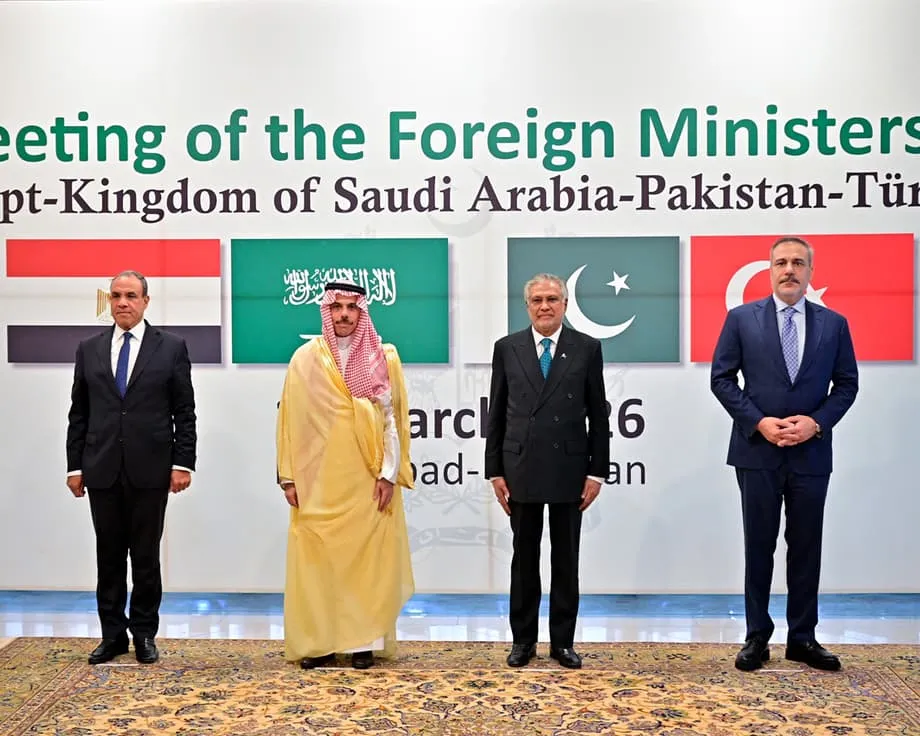
Egypt, Pakistan, Saudi Arabia and Turkey brought their foreign ministers together in Islamabad on March 29, 2026, seeking to stop the war between the United States, Israel and Iran and shape the security arrangements that might follow it. Hosted by Pakistani Deputy Prime Minister and Foreign Minister Ishaq Dar at the Foreign Office, the meeting put Pakistan at the center of an increasingly urgent diplomatic effort.
Contents
- Four Countries Gather as the War Enters Its Second Month
- Why These Four Governments Came Together
- Why Qatar Is Missing From the Table
- Pakistan's Connections Reach Washington and Tehran
- From the Opening Strikes to the Islamabad Meeting
- What Washington Offers and Tehran Demands
- The Energy Shock Gives Pakistan Little Room to Wait
- A Limited Shipping Concession Keeps Contact Open
- The Quartet Looks Beyond an Immediate Ceasefire
- Key Points
By March 31, the American and Israeli military campaign against Iran had entered its second month. Missiles and drones continued to cross the Persian Gulf, the Strait of Hormuz was effectively closed, and global oil prices had risen above $100 per barrel. The four governments were trying to keep communication open between Washington and Tehran while preventing the fighting from spreading further.
The Islamabad gathering developed from a mechanism first outlined in Riyadh earlier in March. Informal coordination had become a distinct diplomatic channel, with the four countries presenting themselves as governments able to speak to opposing sides. Their ambitions reached beyond a ceasefire to a regional security system less dependent on either American protection or Iranian power.
Yasmine Farouk, a Gulf specialist at the International Crisis Group, described why the four countries had intensified their efforts. She pointed to damage to Iranian nuclear facilities and the possibility of troops entering the conflict.
This group of four started becoming very active because this is really a dangerous stage of the war. We've already seen Israel damage nuclear plants inside Iran and the potential deployment of troops. This is the nightmare that could make some of the Gulf countries who so far say they don't want the war to stop to realise that this is getting out of hand.
Why These Four Governments Came Together
Saudi Arabia and Turkey arrived at the same table from different positions. Saudi Arabia had reportedly joined the United Arab Emirates in privately urging Washington to finish off Iran. Turkey had become Iran's most vocal defender among the major Sunni powers, with President Recep Tayyip Erdogan urging Arab governments to stay out of the war against Tehran.
Farouk described Saudi Arabia's position as a difficult choice between competing dangers. Riyadh wants Iran to pay a price for attacks on Gulf shipping and for effectively holding the Strait of Hormuz hostage. Saudi leaders also fear that the United States could leave behind chaos and then depart, forcing the kingdom to face an angry, wounded neighbor alone.
Turkey has invested the most political capital in the group's success. Foreign Minister Hakan Fidan has warned that Israel's objectives extend beyond eliminating Iran's nuclear capability. Turkish intelligence chief Ibrahim Kalin has said the war is intended to prepare the ground for a conflict lasting decades among Turks, Kurds, Arabs and Persians, peoples central to the region's history and political life.
Egypt, usually more focused on its immediate neighborhood, has taken on a mediating role that recalls its earlier position as a leader of the non-aligned world. That tradition involved countries seeking room to act independently of competing major powers.
Pakistan supplies both the venue and connections across the divide. It is a state armed with nuclear weapons, shares a border of about 900 kilometers, or 560 miles, with Iran, and has the world's second-largest Shia population after Iran. Those geographic, cultural and religious ties give Islamabad reasons to maintain contact with Tehran while it also works closely with Washington.
Why Qatar Is Missing From the Table
Qatar's absence was striking because Doha has historically served as a mediator with Tehran. Diplomatic sources said Qatar remained furious over Iranian strikes on the Ras Laffan facility for liquefied natural gas, viewing the attack as a betrayal even though the facility had already been shut down.
Qatar favors ending the war, unlike the UAE, which has reportedly urged escalation. Yet Doha was not willing to act as an active mediator on Iran's behalf. The Islamabad group therefore brought together countries prepared to sustain a diplomatic channel without including every government that wanted the fighting to stop.
The contrast illustrates the pressures facing Gulf governments. A country can favor a ceasefire while being unwilling to carry messages for a government that has attacked its territory or energy infrastructure. For the quartet, keeping its own members engaged is only one part of the task; it must also work amid the anger and different security priorities of neighboring states.
Pakistan's Connections Reach Washington and Tehran
Pakistan's role draws on decades of carrying messages between rival powers. In 1971, President Yahya Khan helped arrange the secret contacts that led to Henry Kissinger's flight to Beijing and, eventually, the normalization of relations between the United States and the People's Republic of China.
During the 1980s, Pakistan was the main conduit for Western support to Afghan mujahideen while also hosting talks connected to the Geneva Accords, which established a framework for the Soviet withdrawal from Afghanistan. More recently, Islamabad helped arrange contacts that led to the 2020 Doha Agreement between the United States and the Taliban.
Pakistan now combines its unavoidable relationship with neighboring Iran with unusually close ties to President Donald Trump's administration. Army Chief Field Marshal Asim Munir has visited the White House twice and maintains regular contact with Vice President JD Vance and Special Envoy Steve Witkoff. Trump has publicly called Munir "my favorite field marshal," reflecting a personal connection that gives Islamabad direct access to senior American decision makers.
Pakistan's large Shia population also creates religious and cultural connections with Iran that states with predominantly Sunni populations cannot reproduce in the same way. Its long border makes instability in Iran an immediate concern rather than a distant foreign policy issue.
Zahid Hussain, a Pakistani political analyst, described the limits of Islamabad's influence. He said Pakistan could pass messages between the two governments but lacked the power to impose a settlement.
Pakistan is currently playing the role of a messenger rather than a mediator, relaying messages between America and Iran. If the war ends following this initiative, it will significantly elevate Islamabad's diplomacy. But if it continues, Pakistan will be one of the countries most harmed.
A messenger carries proposals and replies. A mediator takes a more active role in helping opposing sides negotiate a compromise. Hussain's assessment places Pakistan's immediate contribution in the first category, even as Islamabad hopes its diplomatic role will grow.
From the Opening Strikes to the Islamabad Meeting
The war began on February 28, 2026, when the United States and Israel launched Operation Epic Fury. The opening strikes killed Iranian Supreme Leader Ali Khamenei within seconds and targeted dozens of senior officials. Iran responded with missile attacks on American bases in Bahrain, Kuwait, Qatar and the UAE, alongside the effective closure of the Strait of Hormuz.
The conflict began while nuclear negotiations brokered by Oman were still underway. Those discussions had reportedly brought Washington and Tehran within reach of an agreement. For Iranian leaders, being attacked during negotiations has become a central reason to seek assurances before entering another diplomatic process.
The main steps leading to the Islamabad initiative unfolded over a month:
- February 28, 2026: The United States and Israel launched Operation Epic Fury, killing Ali Khamenei and triggering Iranian retaliation.
- Earlier in March: Egypt, Pakistan, Saudi Arabia and Turkey began outlining their coordination mechanism in Riyadh.
- March 28: Iranian President Masoud Pezeshkian and Pakistani Prime Minister Shehbaz Sharif held a telephone conversation lasting 90 minutes.
- March 29: The four countries' foreign ministers met at Pakistan's Foreign Office in Islamabad.
- Immediately after the March 29 meeting: Ishaq Dar flew to Beijing to brief Chinese officials on the crisis.
Pezeshkian told Sharif during their March 28 conversation that measures to build confidence would be essential before direct talks could proceed. His concern was rooted in Iran's experience of military attacks occurring during earlier negotiations.
What Washington Offers and Tehran Demands
Trump has sent Tehran a proposed ceasefire framework containing 15 points through Pakistani intermediaries. The reported terms include a ceasefire lasting 30 days and the dismantling of Iranian nuclear facilities at Natanz, Isfahan and Fordow.
Washington also seeks the transfer of Iran's enriched uranium stockpiles to the International Atomic Energy Agency, limits on ballistic missile development and an end to Iranian support for regional armed partners such as Hezbollah and the Houthis. Enriched uranium is material processed for nuclear use; the proposal would place Iran's existing stocks with the international nuclear agency.
The American offer includes lifting sanctions related to Iran's nuclear program and providing technical assistance for its civilian nuclear activities. Sanctions are restrictions that governments use to limit trade, finance or other dealings with a country. Removing them would be part of Washington's proposed exchange for Iranian concessions.
Iran has rejected the terms as unfair and weighted toward American demands. Through Pakistani channels, Tehran has presented its own conditions: an end to all American and Israeli military aggression, arrangements to prevent future attacks, and payment for war damage and reparations.
Tehran also wants attacks on its allied groups in Lebanon and Iraq to cease and international recognition of Iranian sovereignty over the Strait of Hormuz. That demand places the waterway itself within the dispute over a settlement, alongside Iran's nuclear program, missiles and regional relationships.
Washington's proposal asks Iran to give up major military and nuclear capabilities in return for economic relief and civilian nuclear assistance. Tehran's response centers on protection from future attacks, compensation and recognition of its authority over the strait. The gap between those positions remains large. No date had been given for direct talks by March 31.
The Energy Shock Gives Pakistan Little Room to Wait
The Strait of Hormuz normally carries approximately 20 percent of global oil and liquefied natural gas supplies. Its effective closure has produced what was described as the worst energy crisis since the 1973 embargo. Liquefied natural gas is gas cooled into liquid form so that ships can transport it.
Oil prices had more than doubled from a benchmark of approximately $65 per barrel before the war, while trading above $100 during the conflict. Pakistan raised domestic fuel prices by roughly 20 percent and declared a work week of four days to conserve energy. The government's response shows how disruption in the Gulf can quickly affect transport costs and daily working arrangements in South Asia.
Pakistan also has approximately five million citizens working in Gulf states. The money they send home, known as remittances, equals the country's total annual export earnings. Islamabad's concern therefore extends beyond the cost of imported fuel to the livelihoods of workers abroad and the income their families receive.
Gulf countries face a further fear: radioactive material leaking into Gulf waters after damage to Iranian nuclear facilities. The feared scenario involves the destruction of desalination plants and coastal cities becoming uninhabitable. Desalination plants remove salt from seawater to produce water people can use, making damage to that infrastructure a threat to everyday life.
Turkish officials have also warned of a prolonged conflict among Muslim nations. They argue that Israel's strategy seeks to create discord and conditions for a long civil war, allowing it to establish new realities through destruction, annexation and occupation. Annexation means claiming territory as one's own; occupation means exercising control over territory through military force.
A Limited Shipping Concession Keeps Contact Open
Iran has agreed to let 20 vessels operating under the Pakistani flag pass through the Strait of Hormuz at a rate of two per day. The arrangement is a modest measure intended to build confidence between the parties while wider diplomatic efforts continue.
The permission applies to 20 vessels in total, with two allowed through each day. It accounts for only a fraction of normal shipping traffic, so its immediate economic reach is limited. Its diplomatic value lies in showing that communication can still produce a practical concession amid the fighting.
The four countries have also established themselves as the main channel for indirect communication between Tehran and Washington. Messages can pass through Islamabad even while the two governments remain far apart on the terms of a ceasefire.
That channel keeps open the possibility of direct talks between American Secretary of State Marco Rubio and Iranian Foreign Minister Abbas Araghchi, potentially in Islamabad. Moving from exchanged messages to a meeting would require the confidence measures sought by Tehran and enough common ground for both sides to participate.
The Quartet Looks Beyond an Immediate Ceasefire
Egypt, Pakistan, Saudi Arabia and Turkey are pursuing a broader security arrangement alongside their effort to stop the war. Their initiative seeks a regional counterweight to both Israeli and Iranian dominance and a middle position between the American security umbrella and Tehran's revolutionary agenda.
Pakistan's foreign minister has indicated ambitions to bring Indonesia and Malaysia into the coalition. Some analysts describe the potential grouping as an "Islamic alliance" that could respond to gaps in regional power created by the conflict. For now, its practical foundation is the coordination among the four governments that met in Islamabad.
China could have a role in supporting a future agreement. Dar's journey to Beijing immediately after the March 29 meeting brought Chinese officials into the diplomatic discussion, and Tehran has suggested that Beijing could serve as a guarantor of a deal. A guarantor would help support the agreement and provide reassurance that its commitments would be honored. Washington would likely view that Chinese role with suspicion.
The initiative reflects growing concern that the region cannot rely indefinitely on an American military presence. The war has deepened doubts among American allies about Washington's security commitments, giving the four countries another reason to consider arrangements in which regional governments take more responsibility.
Continued fighting threatens that ambition. Israel has indicated no intention of reducing its campaign ahead of talks, while Iranian hardliners view negotiations as possible cover for an American ground invasion. Both positions make it difficult to turn diplomatic contact into an accepted ceasefire.
By March 31, the Islamabad process had moved the center of peace efforts away from traditional Western capitals and toward regional governments determined to prevent a wider war. A Pakistani official expressed the limit of that achievement through the image of taking a horse to water: the parties had been brought closer to an opportunity, but the decision to use it remained theirs. The quartet's immediate task is to turn that opportunity into an end to the fighting; its larger ambition is a different regional order afterward.
Key Points
- Egypt, Pakistan, Saudi Arabia and Turkey held foreign minister talks in Islamabad on March 29, 2026, after beginning coordination in Riyadh earlier in March.
- The war began on February 28 with Operation Epic Fury, the killing of Ali Khamenei and Iranian retaliation against American bases in Gulf countries.
- Pakistan is carrying messages between Washington and Tehran, drawing on ties to both governments and its long border with Iran.
- Iran rejected Trump's proposed framework of 15 points and sought protection from future attacks, reparations and recognition of its sovereignty over Hormuz.
- The effective closure of Hormuz has disrupted a route carrying approximately 20 percent of global oil and liquefied natural gas supplies.
- Iran agreed to passage for 20 vessels under the Pakistani flag, at a rate of two per day.
- The quartet is considering wider security cooperation, possible participation by Indonesia and Malaysia, and a potential Chinese role in guaranteeing an agreement.
- No date had been given for direct American and Iranian talks by March 31.