A Midweek Holiday Amid Global Energy Turmoil
Sri Lanka has taken the extraordinary step of declaring every Wednesday a public holiday for all state institutions, schools, and universities, effectively moving to a four day work week as the island nation braces for catastrophic fuel shortages. The measure, which took effect on March 18, represents one of the most visible signs of how the escalating conflict between the United States, Israel, and Iran is disrupting daily life across Asia.
President Anura Kumara Dissanayake announced the decision following an emergency meeting with senior officials on Monday, as global oil prices surged past $100 per barrel and the Strait of Hormuz, the world is most critical oil chokepoint, faced effective closure. “We must prepare for the worst, but hope for the best,” the president told officials, capturing the precarious balance between precaution and panic.
The new schedule applies to government offices, educational institutions, and the judiciary, while essential services including hospitals, ports, water supplies, customs, and immigration remain operational. Officials deliberately selected Wednesday rather than Friday as the additional day off to prevent government offices from closing for three consecutive days, which could paralyze administrative functions.
Commissioner General of Essential Services Prabath Chandrakeerthi explained the scope of the measure, noting that the government expects private sector employers to follow suit. “It would be applicable to schools, universities and the judiciary,” he stated, while emphasizing that critical infrastructure would maintain normal operations. The shift to a midweek break is designed specifically to reduce daily commuting and transportation fuel consumption across the country of 22 million people.
The immediate trigger for Sri Lanka is emergency measures lies 3,000 kilometers away in the Strait of Hormuz, the narrow waterway between Iran and Oman through which approximately 20 million barrels of oil flow daily. Following the US and Israeli bombardment of Iran on February 28, Tehran retaliated with strikes across the Middle East and effectively closed the strait to unauthorized shipping. Nearly 90% of all oil and gas flowing through the strait last year was bound for Asian markets, making the region the world is largest oil importing zone.
Rationing Returns with National Fuel Pass
Alongside the shortened work week, authorities have reinstated a National Fuel Pass system that rations purchases based on vehicle type. Motorcyclists face strict limits of five litres per week, while private car owners are restricted to 15 litres. Public transport operators receive higher allocations to maintain essential mobility services.
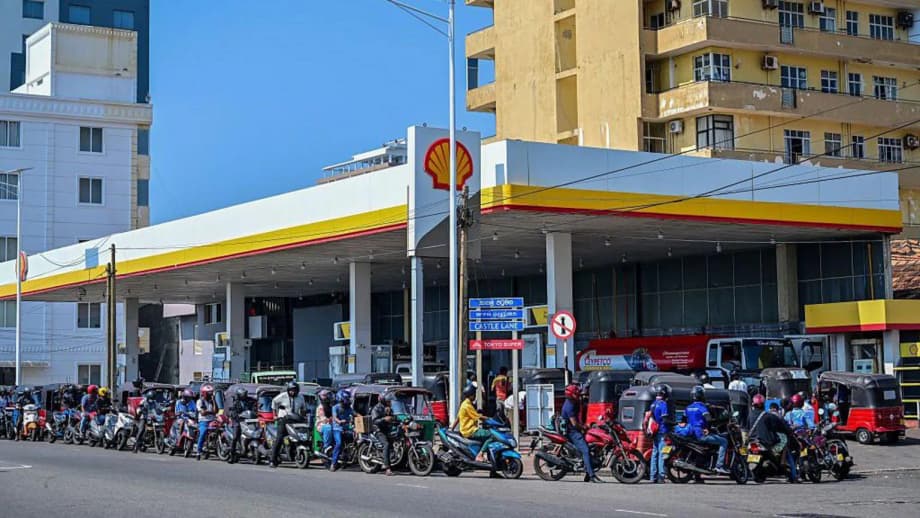
The rationing mechanism has triggered immediate public frustration. Long queues formed at petrol stations across Colombo and other cities as drivers rushed to secure fuel before the restrictions tightened. Some motorists expressed anger at the quotas, arguing that 15 litres is insufficient for weekly needs, while motorcyclists lamented the five litre limit for vehicles with eight litre tanks.
Mohammed Aslem, a three wheeler driver in Colombo, witnessed the panic firsthand. “There is fuel. People are panicking because of the war and they are themselves creating these lines,” he observed. “So, people are just flocking to the stations, but there is enough fuel in Sri Lanka.” Despite such assurances from officials, the psychology of scarcity has taken hold, mirroring the trauma of the 2022 economic collapse.
Police have ordered stations to stop dispensing fuel into cans and have warned of legal action against hoarders. The rationing system was first implemented in 2022 during the country is worst economic crisis, which saw it run out of foreign reserves and unable to import essential items including fuel. Oil prices have soared since the US and Israel started bombarding Iran, and are currently hovering at around $100 a barrel.
Scars of the 2022 Economic Collapse
The current restrictions echo the desperate measures implemented during Sri Lanka is worst economic crisis in 2022, when the country ran out of foreign reserves and could not import essential items including fuel. At that time, similar rationing schemes sparked months of protests that eventually forced the resignation of former president Gotabaya Rajapaksa in July 2022.
During the height of that crisis, fuel shortages rendered transport unavailable or prohibitively expensive, preventing people from accessing healthcare. Healthcare workers reported drawing blood without gloves, while ambulances waited hours in fuel lines. According to Amnesty International, nurses faced dangerous conditions and patients requiring medical supplies were told to purchase them from private pharmacies, which many could not afford.
Before the crisis, I used my personal vehicle. Due to the fuel shortage, this became more challenging. If we use public transport, it is fully crowded nowadays and people like my mother cannot travel in the public transport because she is very old. If we have fever, we are not able to see a doctor. We are using a Panadol for our illness.
Padam, a member of the Malaiyaha Tamil community working in tea estates, described the human cost during the previous shortage to Amnesty researchers. His testimony illustrates how fuel scarcity disproportionately affects vulnerable communities who live far from medical facilities.
The 2022 crisis pushed over 6.2 million people, nearly 28% of the population, into moderate acute food insecurity according to the World Food Programme. Food inflation reached 90.9%, with essentials like lentils rising 183.9% and sugar increasing 151.1%. The country defaulted on $46 billion in foreign debt and remains under a $2.9 billion IMF bailout program that imposes strict fiscal discipline.
Regional Austerity Measures Spread Across Asia
Sri Lanka is Wednesday holiday is merely one node in a widening network of energy conservation across the continent. Each nation has adapted measures to its specific circumstances, creating a patchwork of restrictions that reflects varying levels of vulnerability and administrative capacity.
In Bangladesh, authorities imposed daily limits on fuel sales after panic buying emptied stations. The national oil company restricted motorcyclists to two litres per tank, prompting hour long waits in Dhaka. The country of 170 million imports 95% of its oil and gas needs, and has brought forward Ramadan holidays in universities while implementing planned blackouts nationwide. Ahmad Rush, a station operator in Dhaka, estimated that customer numbers had almost doubled. “We opened at 7:30 this morning and were able to refuel 300 vehicles in three and a half hours,” he reported.
Thailand has taken a behavioral approach, urging citizens to swap formal suits for short sleeved shirts to reduce air conditioning loads, while exploring potential purchases of Russian oil to diversify supplies. Myanmar has restricted private vehicles to operating on alternate days based on license plate numbers, effectively cutting traffic by half.
The Philippines has mandated four day work weeks for government offices and banned non essential public sector travel, while President Ferdinand Marcos Jr announced cash assistance ranging from 3,000 to 5,000 pesos ($50 to $84) for tricycle drivers, farmers, and fishermen. Vietnam encourages cycling, carpooling, and public transport while restricting personal vehicle use.
Pakistan raised petrol and diesel prices by 55 rupees ($0.28) per litre, the largest increase on record, while closing schools for two weeks and shifting universities to online classes. Prime Minister Shehbaz Sharif announced that government departments would face a 50% cut in fuel allowances and 60% of official vehicles would be taken off the road.
Major Economies Deploy Strategic Reserves
Wealthier Asian nations have deployed substantial financial and strategic resources to buffer their economies from the Hormuz disruption. Japan has pledged to release a record 80 million barrels from national reserves, equivalent to roughly 45 days of supply, while requesting that Australia increase liquefied natural gas output. Prime Minister Sanae Takaichi has promised steps to prevent gasoline prices from reaching intolerable levels, potentially funded by reserve tapping.
South Korea has capped domestic fuel prices for the first time in nearly three decades while shifting energy generation toward nuclear and coal. President Lee Jae Myung announced plans to raise nuclear plant utilization to 80% and temporarily lift restrictions on coal fired power generation, alongside a 100 trillion won ($96 billion) market stabilization program. “This is a significant burden on our economy, which is highly dependent on global trade and energy imports from the Middle East,” Lee stated.
China has blocked exports of refined fuels including gasoline, diesel, and jet fuel to protect domestic supply, while India faces one of its worst gas shortages in decades. New Delhi has diverted liquefied petroleum gas from industry to households to ensure cooking fuel availability and has secured limited passage for some vessels through the Hormuz blockade. Indian companies raised liquefied petroleum gas prices by 7%, the first increase in about a year.
Indonesia plans to increase fuel subsidy spending to 381.3 trillion rupiah ($32 billion) and may accelerate implementation of B50 biodiesel, a 50% palm oil blend, to reduce petroleum dependence. Malaysia, a net energy exporter, has sufficient petroleum supplies through at least May but will hold special cabinet meetings to review fiscal positions.
Diplomatic Channels for Survival
Behind the austerity announcements, Sri Lankan officials are pursuing urgent diplomatic efforts to secure alternative fuel supplies. Authorities confirmed ongoing discussions with India and Russia aimed at establishing steady supply lines that bypass the disrupted Hormuz route. These talks represent a critical insurance policy against the depletion of current reserves, which officials estimate will cover national demand for approximately six weeks.
S. Rajakaruna, chairman of the state run Ceylon Petroleum Corporation, has attempted to calm public anxiety by confirming shipments through the end of April. “Sri Lanka does not have enough storage facilities to store fuel beyond the next few weeks, but there are sufficient confirmed shipments till the end of this month,” he stated. The CPC has stepped up distribution, releasing more than five million litres despite public holidays.
Trinh Nguyen, a senior economist at Natixis, assessed the regional situation with concern. “Demand destruction happening. First, Pakistan and Bangladesh. Next, Southeast Asia,” she posted on social media platform X. The prediction appears accurate as governments across the region scramble to implement conservation measures and secure alternative sources from Southeast Asian countries.
Nepal, which depends entirely on imports for fuel needs, has raised petrol and diesel prices sharply and announced chartered flights to evacuate stranded workers from Dubai amid rising regional tensions. Approximately 700,000 Nepali workers live in the United Arab Emirates, where concerns have grown following the death of a Nepali security guard in a drone attack at Dubai is Zayed International Airport.
Human Rights in the Balance
The return of fuel rationing has raised alarms among human rights advocates who documented the devastating impact of the 2022 shortages on healthcare access and food security. Amnesty International has warned that economic reforms and crisis responses must incorporate human rights impact assessments to avoid repeating past mistakes.
Sanhita Ambast, Amnesty International is Researcher on Economic, Social and Cultural Rights, emphasized the stakes. “The economic crisis has led to devastating consequences for the people of Sri Lanka, many of whom are unable to ensure their children have enough food or to access healthcare for sick relatives,” she stated. “In order to convert this near breakdown into a breakthrough, the Sri Lankan authorities must ensure that human rights are placed at the heart of their responses to the crisis.”
Current measures attempt to protect essential services, but advocates worry that extended disruptions could replicate the 2022 trauma. The government has suspended public ceremonies and encouraged work from home arrangements where possible, but for daily wage workers and those in precarious employment, reduced hours and transportation difficulties threaten immediate income loss. The Malaiyaha Tamil community and plantation workers remain particularly vulnerable due to their geographic isolation and limited access to services.
The Bottom Line
- Sri Lanka has declared every Wednesday a public holiday, creating a four day work week for public institutions, schools, and universities to conserve fuel amid potential shortages
- The decision follows the US and Israel is war with Iran, which has effectively closed the Strait of Hormuz, disrupting oil supplies to Asia where nearly 90% of Hormuz shipments are destined
- A National Fuel Pass system rations purchases to 15 litres weekly for private cars and five litres for motorcycles, with long queues forming at stations despite official assurances of adequate reserves
- Essential services including healthcare, ports, water supplies, and customs remain operational, while the government expects private sector adoption of the Wednesday holiday
- Officials are in discussions with India and Russia to secure alternative fuel supplies beyond the current six week reserve estimate
- Multiple Asian countries have implemented emergency measures including fuel rationing in Bangladesh, price caps in South Korea, four day work weeks in the Philippines, and reserve releases in Japan
- The crisis evokes memories of Sri Lanka is 2022 economic collapse, when fuel shortages sparked protests that ousted the previous government and caused widespread healthcare and food access crises