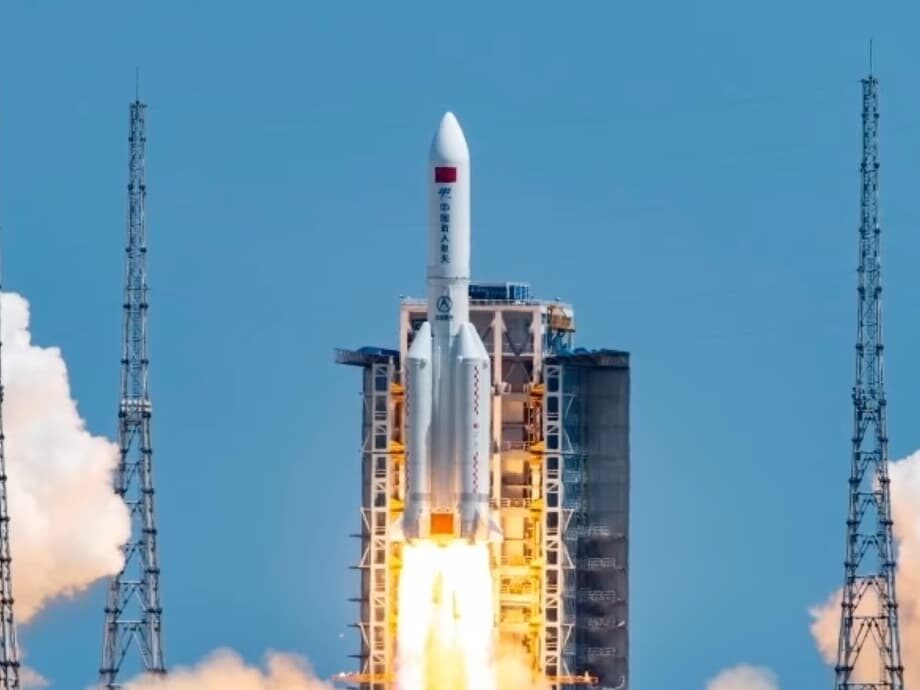
From Ancient Fire Arrows to Lunar Dreams
More than a thousand years ago, during China’s Song Dynasty, military engineers packed black powder into bamboo tubes and launched fire arrows that hissed across battlefields on jets of smoke and flame. Those crude devices were the distant ancestors of every rocket that has ever punched through Earth’s atmosphere. Today, that historical symmetry finds new expression as the China Manned Space Engineering Office prepares for what officials describe as the most ambitious year in the nation’s spacefaring history.
The year 2026 will see Beijing’s space program operating at full capacity, with a schedule that includes multiple crewed missions to the Tiangong space station, the debut of next generation lunar hardware, and scientific expeditions to both the Moon and near Earth asteroids. This surge of activity represents not merely an increase in launch cadence but a strategic acceleration toward a singular goal: placing Chinese astronauts on the lunar surface before 2030.
According to official announcements from the China Manned Space Engineering Office, the 2026 manifest includes the Tianzhou-10 cargo resupply mission, the Shenzhou-22 and Shenzhou-23 crewed flights, and the uncrewed Mengzhou-1 spacecraft test flight. Additionally, the Chang’e-7 lunar south pole mission and the Xuntian space telescope launch will expand China’s robotic exploration capabilities. This combination of human spaceflight and deep space science marks a transition from program development to operational tempo, signaling that China’s space infrastructure has matured sufficiently to support sustained, complex activity.
Pushing Human Limits: The Year-Long Mission
Among the most significant human spaceflight developments scheduled for 2026 is China’s first one year continuous space stay. While NASA and Roscosmos have conducted extended missions aboard the International Space Station, this marks the first time a Chinese astronaut will remain in orbit for twelve consecutive months. The mission, involving a crew member from the Shenzhou-23 mission who will remain aboard Tiangong while colleagues return to Earth, will generate critical data on human health and psychological resilience in microgravity.
The medical and technical challenges of long duration spaceflight are substantial. Over twelve months, the human body experiences muscle atrophy, bone density loss, fluid shifts that affect vision, and the psychological strain of isolation. For China, which aims to send astronauts to the Moon and eventually establish a lunar base, understanding these effects is essential. The data collected will feed directly into mission planning for lunar surface stays and potential future Mars expeditions.
The Shenzhou-23 mission also carries symbolic importance for China’s expanding international partnerships. Following an agreement signed between Beijing and Islamabad in February 2025, a Pakistani astronaut will fly as a payload specialist aboard a Shenzhou mission, likely Shenzhou-24 in late 2026. This astronaut will conduct experiments during a short duration stay, representing the first foreign national to visit the Chinese space station. Additionally, payload specialists selected from Hong Kong and Macau during the fourth round of astronaut recruitment in June 2024 may also fly station missions this year.
Lunar Hardware Takes Shape
While Tiangong operations continue in low Earth orbit, the hardware needed for lunar exploration is advancing through critical testing phases. The Long March-10 rocket, a triple core heavy lift vehicle designed specifically for human lunar missions, has completed static fire tests and low altitude demonstration flights. This rocket represents a significant leap in capability, requiring two separate launches to place the Mengzhou crew spacecraft and the Lanyue lunar lander into orbit around the Moon, where they will rendezvous and dock before the descent to the surface.
The Mengzhou spacecraft has passed brutal safety validations that space agencies demand before entrusting vehicles with human lives. These include zero height abort tests, which simulate emergency escapes from the launch pad, and maximum dynamic pressure escape tests that verify crew survival during the most aerodynamically stressful phase of ascent. Meanwhile, the Lanyue lunar lander has completed landing and takeoff tests on Earth, validating the propulsion and guidance systems needed for the hazardous descent to the Moon’s surface and the critical ascent back to lunar orbit.
China Academy of Launch Vehicle Technology has also unveiled a recovery ship named Linghangzhe, designed to retrieve Long March rocket stages using a net recovery apparatus. This system allows recovered stages to forgo landing legs, potentially reducing weight and complexity. The development of these supporting systems indicates that China is building not just vehicles but an entire operational infrastructure for sustainable lunar access.
Robotic Explorers and Cosmic Surveys
Beyond human spaceflight, 2026 brings major milestones for China’s robotic exploration program. The Chang’e-7 mission, scheduled for August, will target the Moon’s south pole with an orbiter, lander, rover, and a mini hopping probe. This region has attracted intense international interest due to permanently shadowed craters that may harbor water ice, a resource that could support future astronaut bases or be converted into rocket propellant for deeper space missions. The hopping probe will be capable of leaping into these dark craters to search for ice deposits and analyze the geological composition of this scientifically rich region.
In July, the Tianwen-2 probe will reach asteroid 469219 Kamo’oalewa, a quasi satellite of Earth that represents one of the most accessible near Earth objects. The spacecraft will attempt to collect approximately 100 grams of material using multiple sampling methods, with the sample return capsule scheduled to reach Earth in November 2027. This mission will provide pristine material from the early Solar System, offering insights into planetary formation that complement the lunar exploration program.
Perhaps the most ambitious scientific instrument launching in 2026 is the Xuntian space telescope, also known as the Chinese Space Station Telescope. With a two meter primary mirror and a field of view more than 300 times larger than that of the Hubble Space Telescope, Xuntian will conduct large scale sky surveys, hunt for dark matter and dark energy, and map the evolution of cosmic structures over billions of years. Uniquely, the telescope will co orbit with Tiangong, allowing astronauts to perform maintenance and upgrades that could extend the mission life for decades, a capability that distinguishes it from other space observatories.
Opening the Airlock: International Partnerships
The inclusion of a Pakistani astronaut on the 2026 manifest represents a strategic shift in how Beijing approaches international cooperation in space. Unlike the International Space Station, which involves multiple space agencies in construction and operation, Tiangong remains a Chinese national facility that is now opening to foreign participants through bilateral agreements. The selection and training process for the Pakistani payload specialist is progressing smoothly, according to official statements, with the candidate likely flying aboard Shenzhou-24 for a brief stay that includes experimental work and outreach activities.
This partnership model reflects China’s broader Belt and Road Space Information Corridor initiative, which integrates satellite services, ground infrastructure, and navigation cooperation into international development projects. By offering access to Tiangong, Beijing is positioning its space station as an alternative platform for nations that lack independent human spaceflight capabilities or that seek partnerships outside the traditional Western led frameworks.
The potential flights by Hong Kong and Macau astronauts further diversify the human geography of China’s program. Selected in the fourth round of astronaut recruitment completed in June 2024, these candidates represent the special administrative regions’ integration into national space efforts. Their participation would follow the 2023 flight of payload specialist Gui Haichao, who became the first Chinese civilian in space, signaling a gradual expansion of the astronaut corps beyond military test pilots.
The Global Space Race in 2026
China’s accelerated schedule unfolds against a backdrop of renewed international competition in lunar exploration. NASA’s Artemis II mission, planned for April 2026, will send four astronauts on a circumlunar flight, the first human voyage beyond low Earth orbit since Apollo 17 in 1972. While Artemis II will not land on the Moon, it represents the American program’s return to deep space human spaceflight. Meanwhile, India’s Gaganyaan program is preparing for uncrewed test flights that could lead to independent Indian human spaceflight capability.
The commercial sector is also reaching critical milestones in 2026. SpaceX continues Starship testing with an eye toward eventual Mars missions, while Vast plans to launch the Haven-1 commercial space station. These developments suggest that 2026 marks a transition point where government led exploration and private enterprise begin operating in parallel across multiple national programs.
For China, the record of 93 successful launches in 2025 established a new baseline of operational tempo. The ability to sustain high launch rates while simultaneously testing lunar hardware, operating a space station, and preparing for year long medical experiments indicates a program that has moved beyond experimental phases into routine, sustained space utilization. This industrial capacity, combined with the integration of international partners and the steady progress toward the 2030 lunar landing goal, suggests that the global space landscape is entering a new phase of multi polar competition and cooperation.
The Essentials
- China’s 2026 space manifest includes Tianzhou-10 cargo delivery, Shenzhou-22 and Shenzhou-23 crewed missions, and the Mengzhou-1 uncrewed test flight
- One Shenzhou-23 astronaut will complete a one year continuous stay aboard Tiangong, generating medical data for future deep space missions
- A Pakistani astronaut will fly as the first foreign national aboard Tiangong, likely aboard Shenzhou-24 late in the year
- The Long March-10 rocket, Mengzhou crew spacecraft, and Lanyue lunar lander have completed major safety and propulsion tests ahead of planned 2030 crewed lunar landing
- Chang’e-7 will explore the Moon’s south pole in August 2026, searching for water ice in permanently shadowed regions
- The Xuntian space telescope will launch in late 2026 with a field of view 300 times larger than Hubble, co orbiting with Tiangong for potential astronaut servicing
- Tianwen-2 will reach asteroid Kamo’oalewa in July 2026 to collect samples for return to Earth in 2027
- China conducted 93 space launches in 2025, establishing a new national record and demonstrating sustained operational capacity