North Korea’s Naval Gamble: Testing a Destroyer That Threatens US Pacific Bases
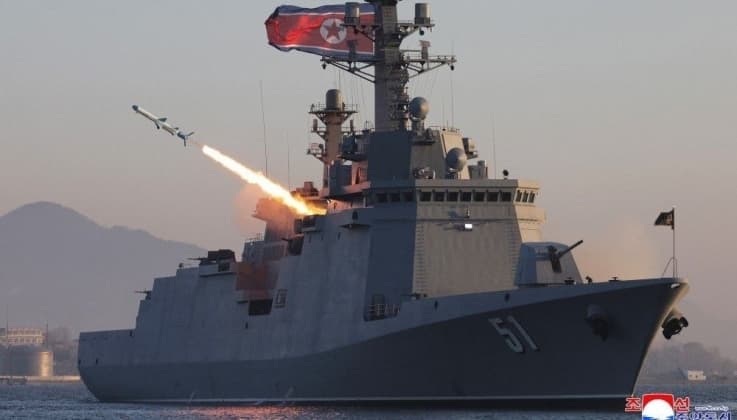
North Korea has conducted a dramatic live-fire demonstration of its most advanced naval weapon system to date, test-firing strategic cruise missiles and anti-ship weapons from the Choe Hyon-class destroyer near the country’s west coast. The April 2026 exercise validated the vessel’s integrated combat systems while showcasing capabilities that threaten to alter the strategic balance in the Pacific, potentially placing American military installations across the region within strike range of nuclear-capable missiles launched from mobile maritime platforms.
The Korean People’s Army Navy staged the coordinated strike scenario to assess both the destroyer’s sophisticated weaponry and crew performance under operational conditions. During the drill, two strategic cruise missiles flew for more than two hours while three anti-ship missiles remained airborne for over 30 minutes, striking their targets with what state media described as ultra-precision accuracy. This demonstration marked a significant milestone in Pyongyang’s ambitious naval modernization program, which aims to transform the historically coastal-focused navy into a blue-water force capable of projecting power far beyond the Korean Peninsula.
A New Class of Warship
The Choe Hyon represents a quantum leap in North Korean naval architecture. At approximately 144 meters in length and displacing an estimated 5,000 tons, this guided-missile destroyer stands as the largest surface combatant ever constructed by Pyongyang’s shipyards. First launched on April 25, 2025, from the Nampo commercial shipping port, the vessel bears superficial similarities to advanced destroyers operated by China, South Korea, and the United States, though analysts caution that actual combat capabilities likely lag behind those of peer nations.
The destroyer’s vertical launch system comprises 74 cells of varying diameters, a configuration that allows the vessel to deploy diverse munitions from a single platform. Analysis from the Center for Strategic and International Studies indicates that 44 cells accommodate surface-to-air missiles while 30 larger cells house cruise missiles and tactical ballistic weapons. This arsenal includes the capacity for hypersonic strategic cruise missiles and tactical ballistic missiles tipped with nuclear warheads, according to statements by North Korean leader Kim Jong Un.
Perhaps most notably, the Choe Hyon incorporates the Russian Pantsir-M air defense system, representing the first deployment of this sophisticated point-defense weapon in North Korean service. The Pantsir is optimized for intercepting helicopters, unmanned aerial vehicles, and cruise missiles, suggesting substantial military-technical cooperation between Pyongyang and Moscow. The destroyer also carries phased array radars, electronic warfare suites, and a 127mm main naval gun, creating a multi-layered defensive and offensive architecture.
General Xavier T. Brunson, commander of United Nations Command, Combined Forces Command, and U.S. Forces Korea, emphasized the defensive nature of allied exercises while acknowledging the changing threat environment.
UFS is a defensive exercise designed to enhance our readiness, stress-test our combined capabilities, and build seamless interoperability with our ally and UNC. There is no substitute for being ready, and our ability to fight tonight and deter aggression is directly grounded in how we train today.
The general made these remarks regarding Ulchi Freedom Shield 25, a major joint drill between the United States and South Korea that ran from August 18 to August 28, 2025, and focused on combined joint operations across all domains.
Dual-Strike Capabilities and Nuclear Integration
The recent test firing demonstrated the destroyer’s ability to conduct simultaneous land-attack and maritime strike missions, a combination rarely seen outside the navies of the United States, United Kingdom, and Russia. Long-range land attack cruise missile capabilities from surface vessels remain relatively uncommon globally, making North Korea’s acquisition of this technology particularly significant for regional security dynamics.
State media specifically highlighted the launch of strategic cruise missiles, a term Pyongyang uses to denote nuclear-capable systems. The missiles reportedly flew for between 7,869 and 7,920 seconds, maintaining low-altitude trajectories designed to evade conventional radar detection through terrain-following flight profiles. These weapons typically employ turbofan engines and inertial navigation systems supplemented by satellite updates, with recent upgrades focusing on anti-jamming capabilities to ensure accuracy in electronically contested environments.
The anti-ship missiles tested alongside the cruise weapons utilize active radar seekers during terminal phases, allowing autonomous target acquisition against moving naval targets. This dual-capability configuration enables the Choe Hyon to switch rapidly between sea-denial operations against enemy fleets and strategic strikes against fixed land targets, including military bases and logistics hubs.
Kim Jong Un has explicitly stated that the destroyer class will carry tactical ballistic missiles with nuclear warheads, with several larger-diameter vertical launch cells specifically designed to accommodate such weapons. This integration creates a sea-based nuclear delivery platform that complicates preemptive strike calculations for potential adversaries. Unlike fixed land-based launchers, mobile maritime platforms offer inherent survivability through mobility, potentially providing North Korea with a second-strike capability that enhances deterrence stability while simultaneously increasing crisis escalation risks.
Expanding the Fleet
North Korea’s naval modernization extends beyond the single vessel currently undergoing trials. Kim Jong Un has publicly committed to constructing two destroyers annually during the current five-year plan, with a target of commissioning ten additional destroyers over the coming years. This production rate would exceed current United States Navy destroyer construction, though questions persist regarding North Korea’s capacity to sustain such ambitious shipbuilding while simultaneously modernizing ground forces and maintaining nuclear programs.
The second vessel of the class, named Kang Kon, suffered damage during a botched launch attempt on May 21, 2025, at the Chongjin Shipyard. After being raised and towed approximately 50 miles north to the Rajin Shipyard, the vessel was successfully relaunched on June 12. A third destroyer is currently under construction at the Nampo shipyard, with state media indicating expected completion by October 2026. Kim has also reviewed plans for a fourth vessel, suggesting a shift from isolated experimental platforms toward the formation of a coordinated destroyer flotilla.
Lim Eul-chul, a professor at Kyungnam University, offered analysis regarding the accelerated production schedule.
The mention of the third and fourth destroyers suggests North Korea is accelerating the formation of a destroyer flotilla rather than fielding isolated platforms. Faster follow-on production typically follows once initial testing is deemed successful.
Perhaps more significantly, Kim confirmed in March 2026 that an even larger 8,000-ton destroyer class is currently under development, alongside the continued pursuit of nuclear-powered submarines. The country unveiled its first nuclear-powered submarine in December 2025, complementing the surface fleet expansion. These programs collectively signal Pyongyang’s determination to establish a credible blue-water navy capable of operating in the Mid and Eastern Pacific, potentially threatening Hawaii and eventually targets on the continental United States.
Strategic Implications for Regional Security
The emergence of nuclear-capable destroyers fundamentally alters the threat matrix facing the United States, South Korea, and Japan. Military analysts have widely assessed the Choe Hyon class as posing serious challenges to American maritime dominance in the Pacific, with the land-attack capabilities specifically threatening U.S. and allied military bases across the region. The vessel’s ability to launch mixed salvoes of ballistic and cruise missiles with both nuclear and conventional warheads creates a complex targeting problem for missile defense architectures.
The mobility of sea-based platforms introduces particular complications for deterrence stability. Unlike silo-based intercontinental ballistic missiles or road-mobile launchers operating within known territorial boundaries, destroyers operating in international waters can approach targets while remaining concealed by radar horizons and geographic features. This elusiveness grants North Korea a second-strike capability that erodes confidence in preemptive strike options, potentially emboldening Pyongyang during crises while increasing the risk of inadvertent escalation through misinterpretation of intent.
Strategic experts note that North Korea appears to be developing an anti-access and area-denial strategy combining land-based ballistic missiles, sea-based cruise missiles, and eventually submarine-launched systems. This diversified arsenal forces adversaries to defend against threats originating from multiple domains simultaneously, straining intelligence, surveillance, and reconnaissance assets while complicating defensive planning.
The academic observed that North Korea appears to be exploiting global strategic distractions, including conflicts in the Middle East, to accelerate weapons development. The rapid succession of tests conducted in April 2026, including back-to-back cruise missile launches on March 11 and the April 12 dual-strike demonstration, suggests intensive operational validation efforts aimed at achieving initial operational capability.
International Cooperation and Technical Origins
The sophistication of the Choe Hyon class has raised questions regarding foreign technical assistance. South Korean officials and independent analysts suspect Russian involvement in the destroyer’s development, particularly given the integration of the Pantsir-M air defense system and Kim Jong Un’s 2023 visit to Vladivostok where he toured Russian Pacific Fleet frigates. The growing military-technical cooperation between Pyongyang and Moscow, evidenced by North Korean weapons shipments to support Russia’s invasion of Ukraine, suggests potential technology transfers that accelerate North Korean naval modernization.
Independent defense analysts have noted design similarities between the Choe Hyon and Chinese Type 055 or Type 052D destroyers, as well as South Korea’s Sejong Daewang class, though direct copying appears unlikely given the technical disparities. Instead, North Korean engineers appear to have synthesized influences from multiple sources while adapting systems to indigenous production capabilities.
The destroyer’s combat systems include identification friend-or-foe systems, electronic support measures, and countermeasure dispensers designed to reduce vulnerability to detection and targeting. A flight deck capable of supporting helicopters or unmanned aerial vehicles extends the vessel’s surveillance reach beyond organic sensor capabilities, potentially enabling targeting for over-the-horizon strikes when integrated with broader reconnaissance networks.
Challenges and Limitations
Despite impressive specifications, significant questions remain regarding the Choe Hyon’s actual combat readiness. The rapid pace of construction and testing, combined with North Korea’s limited history operating complex surface combatants, suggests potential deficiencies in crew training and systems integration. Surface warships remain vulnerable to detection and destruction once hostilities commence, raising doubts about the survivability of these expensive assets in high-intensity conflict.
The resource requirements for maintaining a destroyer fleet also strain North Korea’s limited economy. Simultaneous modernization of the army, navy, and nuclear forces risks creating unsustainable budget pressures, particularly given the technology-intensive nature of naval warfare. Large surface combatants require extensive logistical support, advanced maintenance facilities, and highly trained personnel that Pyongyang may struggle to provide.
However, the political symbolism of operating advanced destroyers may justify these costs from the regime’s perspective. Kim Jong Un approaches his fifteenth year in power with ambitions to establish a legacy rivaling his father and grandfather. Transforming the navy from a coastal defense force into a blue-water capability represents an achievement neither Kim Jong Il nor Kim Il Sung accomplished, providing powerful domestic propaganda value regardless of actual military utility.
What to Know
- North Korea’s Choe Hyon-class destroyer conducted live-fire tests in April 2026, launching strategic cruise missiles and anti-ship weapons in a coordinated strike demonstration
- The 5,000-ton vessel carries 74 vertical launch cells capable of firing hypersonic cruise missiles, tactical ballistic missiles, and potentially nuclear-tipped weapons
- Kim Jong Un has ordered construction of two destroyers annually, aiming for ten additional vessels over five years, plus development of an 8,000-ton successor class
- The destroyer integrates Russian Pantsir-M air defense systems and advanced phased array radars, suggesting foreign technical assistance
- Sea-based nuclear delivery platforms complicate preemptive strike options for adversaries while threatening U.S. Pacific bases with mobile, hard-to-track launchers
- North Korea plans to complement surface destroyers with nuclear-powered submarines, creating a diversified maritime nuclear deterrent