Korean Storage Becomes a Lifeline for Gulf Crude
South Korea has secured commitments for 273 million barrels of crude oil and 2.1 million tons of naphtha through the end of 2026 as the prolonged closure of the Strait of Hormuz pushes Middle Eastern producers to seek storage outside the Persian Gulf. Seoul is also reviewing an expansion of its oil storage capacity from about 140 million barrels to 160 million barrels.
Contents
- Korean Storage Becomes a Lifeline for Gulf Crude
- Why the Hormuz Closure Reaches Far Beyond the Gulf
- A Diplomatic Tour Secures Supplies Through December
- Stranded Ships and Gas Contracts Add to the Pressure
- Strategic Reserves Help Refiners Bridge the Gap
- How Joint Stockpiling Works
- Asian Economies Have Different Supply Buffers
- Electricity Links Return to the Regional Agenda
- Clean Technology Brings Its Own Supply Considerations
- What to Know
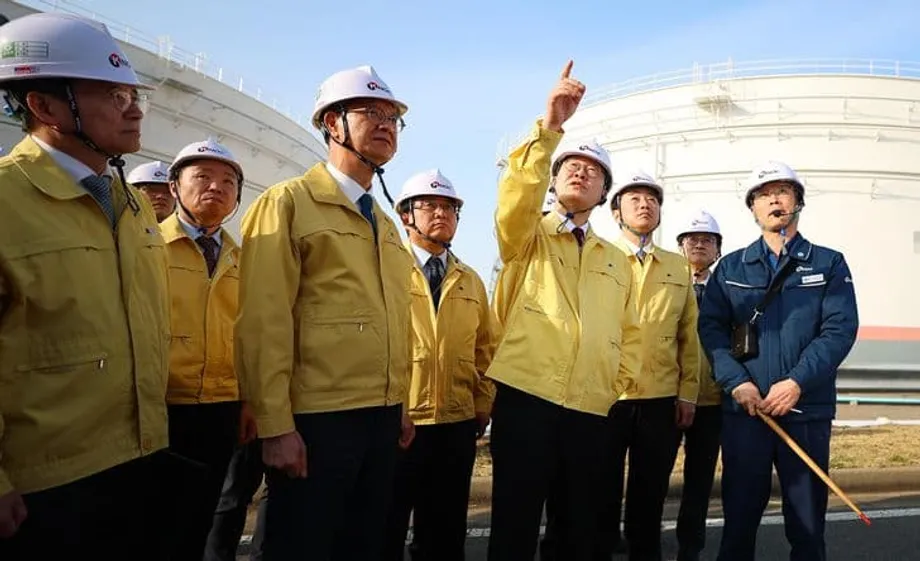
Yang Gi-uk, head of the industrial resource security office at the Ministry of Trade, Industry and Energy, said Tuesday that numerous countries beyond the United Arab Emirates have begun discussions about using Korean facilities. Saudi Arabia, Kuwait and other Gulf producers recognize the benefit of keeping crude outside the strait, where it can remain available to customers even when the shipping route is blocked.
The interest brings together two urgent needs. Gulf countries depend heavily on oil export income and need reliable access to buyers. South Korea needs dependable supplies for its economy while the route that normally carries much of Asia's Middle Eastern crude remains disrupted.
Under Korea's international joint stockpiling program, foreign producers can retain ownership of oil stored in Korean facilities. Seoul receives rental income and preferential rights to buy that oil during an emergency. This creates an accessible reserve outside the troubled shipping passage while allowing producers to keep control of their barrels until a sale.
Yang confirmed that negotiations with multiple parties are active, but said additional countries would be named at appropriate diplomatic intervals. The talks could extend an existing storage partnership model into a larger regional system for holding Gulf crude close to its Asian customers.
Why the Hormuz Closure Reaches Far Beyond the Gulf
The Strait of Hormuz normally handles approximately 78 percent of Middle Eastern crude exports bound for China, Japan, South Korea and Taiwan. Its effective closure amid military conflict involving Iran and retaliatory strikes has interrupted a route on which both exporters and buyers depend.
Saudi Arabia, Kuwait and other Gulf economies face pressure because crude exports provide large portions of their national income. Buyers face a different problem: oil may be available from a producer, yet unable to reach the refinery that needs it. Moving supplies into storage outside the strait in advance reduces exposure to that shipping bottleneck.
International Energy Agency Executive Director Fatih Birol warned in comments published this week that Europe has approximately six weeks of jet fuel remaining. He said shortages could soon interrupt flights between European cities if oil supplies are not restored.
There will be flight cancellations soon if oil supplies are not restored in coming weeks. Europe has maybe 6 weeks or so of jet fuel left.
Birol also warned of higher petrol prices, elevated gas prices and increased electricity costs. He identified Japan, Korea, India, China, Pakistan and Bangladesh as particularly exposed Asian markets. The consequences therefore extend from crude deliveries to transport, household bills and the costs of running businesses.
South Korea has already introduced an alternating day license plate system for public vehicles and parking restrictions to reduce consumption. President Lee Jae Myung has instructed the government to treat prolonged disruption in global energy markets as a given condition, strengthen emergency response systems and quickly deploy supplementary budget resources.
A Diplomatic Tour Secures Supplies Through December
Presidential Chief of Staff Kang Hoon-sik returned from a four-nation diplomatic tour of Kazakhstan, Oman, Saudi Arabia and Qatar with commitments for 273 million barrels of crude and 2.1 million tons of naphtha. Deliveries are scheduled through the end of the year using alternative routes that bypass the blocked strait.
The crude volume would cover more than three months of normal economic operation when measured against South Korea's 2025 consumption baseline. Naphtha is another petroleum product whose availability matters to industry, making the separate commitment part of the wider effort to keep supplies flowing.
Saudi Arabia supplied the largest portion of the commitments. It agreed to ship 50 million barrels of previously allocated crude through alternative Red Sea ports during April and May. From June through December, the kingdom committed to prioritize the allocation and shipment of another 200 million barrels to Korean companies.
The Saudi commitments total 250 million barrels of the 273 million barrels secured during the tour. That leaves 23 million barrels in the total beyond the Saudi allocation, although the breakdown of that remaining volume was not specified.
Kang said import prices would be based on market rates rather than emergency premiums. He described crude and naphtha as commodities that, in the disrupted market, cannot be obtained even with money. Securing an actual shipment has become as pressing as agreeing on its price.
The delivery schedule and other measures place the response across several dates:
- April and May: Saudi Arabia is to ship 50 million barrels of previously allocated crude through Red Sea ports.
- April: Korea National Oil Corporation has allocated 17 million barrels from strategic reserves for delivery to domestic refiners.
- April 16: New electricity rate structures apply to large industrial users.
- April 18: Weekend discounts for electric vehicle charging are scheduled to begin.
- June through December: Saudi Arabia is to prioritize another 200 million barrels for Korean companies.
- Through the end of 2026: The diplomatic commitments cover 273 million barrels of crude and 2.1 million tons of naphtha.
Stranded Ships and Gas Contracts Add to the Pressure
Oman became a key part of the effort to address immediate shipping problems. Kang met Deputy Prime Minister for Economic Affairs Theyazin bin Haitham Al Said and secured active cooperation for the safe passage of 26 Korean vessels stranded near the conflict zone.
Foreign Minister Cho Hyun said information concerning the vessels' safety had been shared with Gulf Cooperation Council countries and the United States to obtain safety assurances. He also ruled out compensation payments to Iran for passage rights.
Qatar was added to Kang's itinerary unexpectedly. There, he received assurances that Korea remains a top priority for uninterrupted liquefied natural gas supply contracts despite regional tensions. Liquefied natural gas, or LNG, is gas cooled into liquid form for shipment, making access to maritime routes part of its supply chain as well.
The visits addressed several parts of the same emergency: obtaining new oil supplies, arranging routes around the strait, protecting vessels already near the conflict and maintaining gas contracts. A supply commitment and a vessel's safe passage are separate tasks, and Seoul's diplomacy covered both.
Strategic Reserves Help Refiners Bridge the Gap
Korea National Oil Corporation, known as KNOC, is lending strategic reserves to SK Energy, GS Caltex, HD Hyundai Oilbank and S-Oil through swap arrangements. The program puts existing stocks to work while the government pursues replacement supplies.
Domestic refiners requested 32 million barrels, and 17 million barrels have been allocated for April delivery. Six contracts totaling 8.38 million barrels are already being delivered, with contracts for an additional 8 million barrels expected within the month.
The figures describe different stages of the process: requests from refiners, volumes allocated for delivery and contracts already moving oil. Together, they show how the government is translating stored reserves into supplies for companies that process crude.
Seoul has also extended credit ceilings of up to $3 billion to KNOC, backed by the Export-Import Bank of Korea and the Korea Development Bank. The financing is intended to support timely crude imports and maintain liquidity during the emergency. Liquidity means having funds available when payments need to be made.
President Lee's instruction to speed the use of supplementary budget resources sits alongside these measures. The response combines financial support, the release of existing supplies and negotiations for deliveries over the rest of the year.
How Joint Stockpiling Works
KNOC operates nine oil storage facilities nationwide, including underground tanks and the world's single largest oil storage base. Their combined current capacity is approximately 140 million barrels. The government is reviewing an additional 20 million barrels of capacity, with design work funded through recent supplementary budget allocations.
Foreign producers lease unused capacity under the international joint stockpiling program. Korea earns rent, while the participating producer keeps ownership of its crude. In return, Seoul receives preferential purchasing rights during a supply emergency, giving it a stronger position to buy oil already stored within the country.
Abu Dhabi National Oil Company currently stores 4 million barrels under the framework, while Kuwait Export Crude maintains similar volumes. Yang explained that these foreign owned barrels are outside South Korea's official strategic reserve count, but effectively add to domestic stockpiles because Korean refiners have active demand for the crude.
Storage capacity, government reserves and foreign owned stocks describe different parts of the system. Capacity measures how much oil facilities can hold. Government reserves are stocks controlled by the state. Jointly stockpiled crude belongs to foreign participants, with purchasing rights available to Korea under the arrangements.
Yang said the offer of storage facilities helped negotiations for replacement supplies from Middle Eastern partners. Existing joint stockpiling agreements with the UAE appear to have made it easier to secure replacement cargoes during the current crisis.
Middle Eastern producers traditionally kept oil in their own territories or supplied consumer countries through direct sales contracts. The crisis has increased interest in a model that keeps producer ownership while locating the crude overseas. Industry officials see permanent storage partnerships as a basis for longer term changes to supply chains, giving exporters a reason to prioritize access to the Korean market during future disruptions.
Asian Economies Have Different Supply Buffers
South Korea has historically operated with tighter reserve margins than some nearby economies. Japan maintains approximately 150 days of import coverage, while Taiwan has statutory requirements for stocks covering 90 days of consumption. Current official reports put South Korea's government controlled reserves at 210 days of supply, with joint stockpiling adding a further practical buffer.
The measures use different reference points, including imports and consumption. They describe the protection each economy has against interrupted supplies, while the Korean storage program adds another route for accessing crude beyond government owned stocks.
China holds approximately 1.2 billion barrels in onshore stockpiles, according to Kpler data, providing roughly 108 days of import cover. It also produces 4.3 million barrels of oil daily and receives pipeline imports from Russia and Central Asia.
China's combination of stored crude, domestic production and pipeline access gives it more ways to sustain supplies during maritime disruption. The crisis still brings real economic pain to China, but its position could strengthen relative to Japan, South Korea and Taiwan, which are heavily exposed to interrupted Middle Eastern shipments.
Korea's approach addresses that exposure through several channels at once. New deliveries help meet demand over the coming months, strategic reserve arrangements support refiners now, and foreign storage partnerships could keep more crude available within reach during future emergencies.
Electricity Links Return to the Regional Agenda
Southeast Asian policymakers are reviving previously inactive proposals for the ASEAN Power Grid as the crisis renews attention to dependence on fossil fuel imports from unstable regions. The proposed system would connect electricity networks across national borders, allowing countries to draw more supply from their neighbors.
Dr. Mirza Huda of ODI Global argued during recent discussions in Hanoi that regional grid integration would allow nations to depend on neighboring countries for energy security instead of remaining exposed to distant geopolitical conflicts. Electricity connections would create another form of regional support alongside fuel storage and shipping arrangements.
The 43rd ASEAN Ministers on Energy Meeting identified subsea power cables as key building blocks for this integration. The Brunei Darussalam-Indonesia-Malaysia-Philippines Power Integration Project combines connections over land and under the sea, reflecting the region's need to link both mainland areas and islands.
South Korea is also changing how electricity demand is priced across seasons and times of day. The energy ministry announced revised rates intended to shift industrial demand away from evening peak hours and toward midday, when solar generation peaks.
New rate structures for large industrial users apply from April 16. Weekend discounts for electric vehicle charging are scheduled to begin April 18. The measures aim to reduce demand for electricity derived from oil while supporting domestic renewable generation capacity.
Clean Technology Brings Its Own Supply Considerations
Energy transition advocates argue that the current volatility strengthens the case for electrification and renewable deployment. Korea's pricing changes connect that argument to a practical measure: encouraging electricity use at times when solar generation is strongest.
China holds dominant positions in solar panel production, the processing of battery materials and electric vehicle supply chains. Those positions give it structural advantages in the energy transition regardless of volatility in oil markets.
The United States, Europe, South Korea and Japan retain competitive strengths in advanced semiconductors, software systems and sophisticated clean technology innovation. Those strengths point toward a transition with capabilities distributed across several economies rather than concentrated entirely in one.
South Korea's immediate task remains maintaining fuel supplies through the Hormuz disruption. Its storage negotiations, reserve lending, shipping diplomacy and electricity measures show how that task is already reaching beyond emergency oil purchases into decisions about where energy is kept, how it moves and when it is consumed.
What to Know
- Multiple Middle Eastern countries are discussing the use of Korean oil storage facilities as the Strait of Hormuz remains effectively closed.
- The strait normally carries about 78 percent of Middle Eastern crude exports bound for China, Japan, South Korea and Taiwan.
- Kang Hoon-sik secured commitments for 273 million barrels of crude and 2.1 million tons of naphtha through the end of 2026.
- Saudi Arabia committed 50 million barrels through Red Sea ports in April and May, followed by another 200 million barrels from June through December.
- KNOC operates nine facilities with about 140 million barrels of storage capacity; Seoul is reviewing an expansion of 20 million barrels.
- Foreign producers retain ownership under joint stockpiling agreements, while Korea receives rent and preferential purchasing rights during emergencies.
- Official reports put Korea's government controlled reserves at 210 days of supply. China's onshore stockpiles total about 1.2 billion barrels.
- Fatih Birol warned that Europe has about six weeks of jet fuel remaining and could face flight cancellations if supplies are not restored.
- Regional responses include renewed ASEAN electricity grid discussions and Korean electricity pricing changes on April 16 and April 18.