Two launch methods put North Korea's naval weapons in focus
North Korea tested two types of submarine launched strategic cruise missiles in the Sea of Japan on October 14, while South Korea's military said it tracked the weapons from before launch through their flight and termination. Seoul assessed that one missile was fired vertically and the other through a torpedo tube, pointing to two different ways of deploying weapons from underwater.
Contents
- Two launch methods put North Korea's naval weapons in focus
- What North Korea said it was testing
- Why the two launch angles matter
- A submarine launched in 2023 returns to attention
- What cruise missiles add to the arsenal
- How South Korea monitored the exercise
- A busy October for missile testing
- Border tensions and the next scheduled drills
- Key Points
The Korean Central News Agency (KCNA) announced the exercise on October 15, saying the Missile General Bureau had tested the readiness of underwater combat systems and helped naval crews practise strategic missions. The waters are also known as the East Sea in South Korea.
North Korea described the launches as a demonstration of the reliability and capability of its war deterrence. South Korean analysts focused on the submarine pictured in the announcement, identifying it as likely to be the Kim Kun Ok Hero, a vessel launched in September 2023 that Pyongyang describes as a tactical nuclear attack submarine.
The exercise brings together two parts of North Korea's military programme: developing missiles that can fly low towards their targets and preparing submarines to carry and launch them. For South Korea and Japan, that combination creates a surveillance challenge because both the underwater launch location and the approaching missile can be difficult to track.
Pyongyang did not disclose the missiles' flight distances, flight times or warhead configurations, and the submarine's identity remains an analyst assessment. Those details would help explain how far the weapons could reach and how close the vessel is to regular military service.
What North Korea said it was testing
KCNA presented the launch as both an equipment test and a training exercise. Its stated purpose was to examine the current readiness of underwater combat systems and improve the navy's ability to perform strategic missions.
The KCNA announcement read in full:
DPRK Missile Administration Test-fires Submarine-launched Strategic Cruise Missiles
Pyongyang, October 15 (KCNA) -- The Missile Administration of the Democratic People's Republic of Korea test-fired two kinds of submarine-launched strategic cruise missiles in the East Sea of Korea on October 14.
Full General Kim Jong Sik, member of the Central Military Commission of the Workers' Party of Korea and first vice department director of the WPK Central Committee, Full General Jang Chang Ha, general director of the Missile Administration of the DPRK, and underwater weapon system engineers of the Navy of the Korean People's Army oversaw the test-fire.
The test-fire aimed to examine the current mobilized posture of the underwater combat systems and contributed to getting the Navy skilled in performing its strategic missions and showcasing high reliability, trustworthiness and ability of the war deterrents of the DPRK.
It did not have any adverse impact on the security of neighboring countries. -0-
Readiness means more than whether a missile can leave its launch tube. A submarine crew must operate the vessel, prepare the weapon and coordinate the launch. North Korea's description placed attention on those operating skills as well as the missiles themselves.
Kim Jong-sik, a member of the ruling Workers' Party's Central Military Commission and a first vice department director, observed the exercise alongside Jang Chang-ha, head of the Missile General Bureau. Navy engineers responsible for underwater weapons systems also attended.
Kim Jong Un was not mentioned among those present. The announcement appeared through KCNA rather than Rodong Sinmun, the Workers' Party newspaper widely read inside North Korea. That gave the test public visibility through the country's external news service without the same coverage in its main domestic newspaper.
KCNA also said the launches had no adverse impact on neighbouring countries' security. That was Pyongyang's assessment of the exercise, which it portrayed as a successful display of deterrence, meaning military strength intended to discourage an opponent from attacking.
Why the two launch angles matter
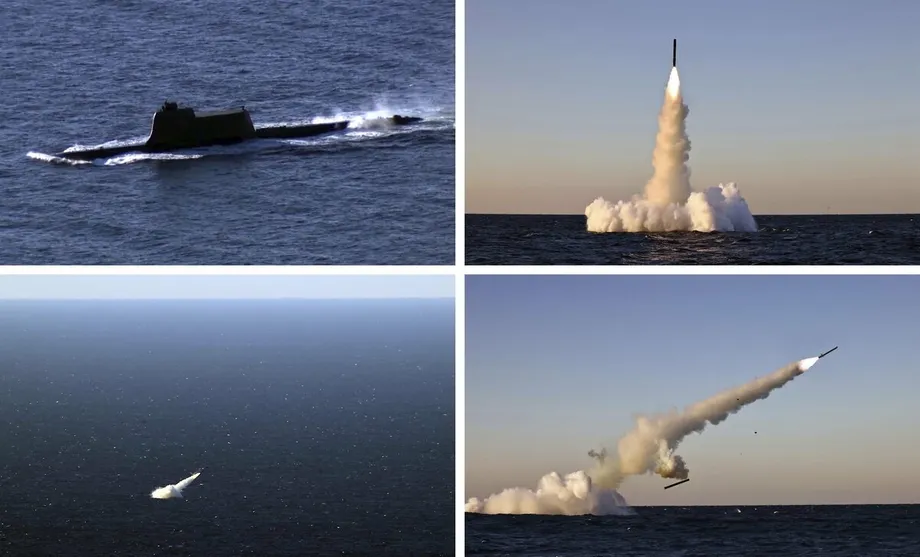
South Korea's Joint Chiefs of Staff assessed that the two missiles used different launch arrangements: a vertical launch tube for one and a torpedo tube for the other. Images released by KCNA showed one missile rising vertically from the sea and another emerging at an apparent angle of about 45 degrees.
A vertical tube sends a missile upwards from the submarine. A torpedo tube normally opens towards the front of the vessel and provides a different route into the water before the missile rises and begins powered flight.
Hong Min, a researcher at the Korea Institute for National Unification, said the different launch methods had tactical purposes. Explaining the potential benefit of the angled method, he said:
Angled launches, on the other hand, allow missiles to fly at lower altitudes from the outset, making them harder for missile defence systems to detect and intercept.
Hong also assessed that launching different cruise missiles at different times could increase the workload for air defences. If the weapons approach from different directions, at different speeds or with different ranges, defenders may have to deal with several kinds of threat at once.
The immediate military interest is therefore in the combination of launch systems and flight profiles. A submarine able to use both arrangements would give its operators more options when planning an attack.
A submarine launched in 2023 returns to attention
Shin Jong-woo, secretary general of the Korea Defense and Security Forum, identified the exercise as the first publicly disclosed weapons test from the Kim Kun Ok Hero. Analysts placed the submarine in the class of vessels weighing about 3,000 tonnes and identified it from the released photographs.
North Korea launched the Kim Kun Ok Hero in September 2023, describing it as its first tactical nuclear attack submarine. Photographs accompanying the latest announcement included a submarine travelling on the surface, as well as missiles emerging from the water and flying over the sea.
Shin assessed that North Korea was conducting combat system trials to prepare the submarine for service. He also predicted that submarine launched ballistic missile tests could follow. That was an analyst's forecast; Pyongyang announced no date for another submarine weapons test.
North Korea is not generally believed to have a modern missile submarine in full operational service. The latest exercise is therefore relevant to the work of bringing the submarine, its launch equipment, its missiles and its crew into use together.
A separate construction programme also shows the scale of Kim Jong Un's naval ambitions. During a submarine facility visit described as taking place the previous year, state media showed an 8,700 tonne submarine powered by a nuclear reactor under construction. Kim criticised a United States and South Korea nuclear submarine deal during that visit, calling it a threat to stability on the peninsula.
What cruise missiles add to the arsenal
Cruise missiles usually use jet propulsion and remain within the atmosphere, flying more like aircraft than ballistic missiles. Ballistic missiles are generally powered during an initial stage and then follow a high arcing trajectory before descending towards their targets.
Low flight can make a cruise missile harder for radar to see at long distances because the Earth's curve and terrain can obstruct the radar's view. Launching from underwater also makes the starting point less predictable than a fixed launch installation on land.
North Korea's use of the word strategic signals an intended role against important targets and is widely interpreted as suggesting the possibility of carrying a nuclear warhead. The October 14 announcement concentrated on readiness and deterrence rather than describing the payloads used in the exercise.
KCNA was reported to have identified one weapon as a Pulhwasal-3-31, a type North Korea had also said it tested from land the previous week. South Korean analysis also raised the possibility that the pair included a Hwasal-2 and a Pulhwasal-3-31. The missile names therefore remain less firmly established than the two launch methods described by Seoul.
Submarines matter to deterrence because a vessel that survives an initial attack may still be able to retaliate. This is called a second strike capability. Achieving it requires a submarine that can operate reliably and remain difficult to find, alongside dependable weapons and communications.
How South Korea monitored the exercise
South Korea's Joint Chiefs of Staff said it continuously tracked the cruise missile activity using various means, covering the period before launch, the flight and its termination. Spokesperson Jang Do-young said the military does not publicly announce every North Korean missile movement it detects.
Seoul had issued no separate media notice on the day of the cruise missile launches. Its usual practice is to announce detected North Korean ballistic missile launches promptly, while cruise missile activity is often confirmed after Pyongyang makes it public.
American surveillance aircraft were also active around the peninsula. Flight tracking data showed a United States Navy MQ-4C Triton repeatedly flying over the central Korean Peninsula and the East Sea for about nine hours on October 14.
The Triton is an unmanned aircraft designed to monitor large areas of sea and coastline for extended periods. A United States Army ARES reconnaissance and electronic warfare aircraft had also recently flown across the peninsula between the eastern and western seas. Such aircraft can collect information from communications and radar signals.
The purpose of those particular American flights was not publicly confirmed. South Korea's tracking statement was the direct military account of surveillance associated with the missile exercise.
A busy October for missile testing
The submarine exercise followed several other missile launches during a period of worsening relations between the two Koreas. North Korea had fired tactical ballistic missiles from the Pyongyang area towards the East Sea on October 12, describing that test as work to verify an upgrade to an important technological component.
North Korea also said it tested an intermediate range hypersonic missile on October 3, describing it as assisted by artificial intelligence. South Korea subsequently tested its first domestically developed hypersonic glide vehicle, with President Lee Jae Myung overseeing the firing.
Hypersonic refers to speeds of at least five times the speed of sound. A glide vehicle can also manoeuvre during part of its flight, making its route harder to predict. Lee's office said South Korea's weapon, once fully developed, would improve its ability to strike key targets by surprise.
The sequence places the submarine launch within a broader competition involving weapons launched from land and sea:
- September 2023: North Korea launched the Kim Kun Ok Hero submarine.
- October 3: North Korea said it tested an intermediate range hypersonic missile.
- The week before October 15: South Korea tested its first domestically developed hypersonic glide vehicle.
- October 12: North Korea fired tactical ballistic missiles from the Pyongyang area.
- October 14: North Korea conducted the submarine cruise missile exercise.
- October 15: KCNA announced the submarine test, and Seoul described its tracking and launch assessments.
Border tensions and the next scheduled drills
Three South Korean soldiers were wounded in a landmine explosion in September in the portion of the Demilitarized Zone controlled by Seoul. A joint South Korean and United Nations investigation concluded that two mines that exploded there had been planted by North Korean forces about a year earlier. Seoul demanded an official apology.
North Korea has also accelerated military fortification along the border under Kim Jong Un's policy of treating the two Koreas as hostile states. The policy, launched in 2023, seeks to permanently sever ties with the South.
South Korea's Joint Chiefs of Staff announced that its 2026 Hoguk exercise would run from October 19 to 30. The annual field manoeuvres bring together army, navy and air force units, with the military saying it would practise integrating operations across land, sea and air.
Two of seven combined field training exercises postponed following a reduction in the August Ulchi Freedom Shield exercise were scheduled to take place alongside Hoguk. The other five were planned before the end of the year.
Diplomatic talks have made little progress since negotiations between Washington and Pyongyang collapsed in 2019. Against that backdrop, the October 14 launch adds a concrete naval development to the peninsula's tensions: two cruise missile types tested through different underwater launch arrangements, with South Korea monitoring their operation.
Key Points
- North Korea said it tested two types of submarine launched strategic cruise missiles on October 14.
- South Korea assessed that one used a vertical launch tube and the other a torpedo tube.
- Seoul said it tracked the activity from before launch through the end of the missiles' flights.
- Analysts identified the likely submarine as the Kim Kun Ok Hero, launched in September 2023.
- Pyongyang described the exercise as a readiness and naval training test but released no flight distances or times.
- South Korea scheduled its Hoguk military exercise for October 19 to 30.