A Spring Outing Becomes an Engineering Assignment
At Chungbuk National University, an Engineering Mathematics assignment asks students to do something far removed from differential equations and linear algebra: visit a cherry blossom viewing spot, take photographs and submit them for course credit. Professor Kang Dong-woo has set the task every spring since 2021, making 2026 its sixth consecutive year.
Contents
- A Spring Outing Becomes an Engineering Assignment
- Why Kang Wanted Students to Leave the Library
- What Students Must Photograph and Submit
- The Pressure Behind the Spring Break
- Why Cherry Blossoms Fit the Assignment
- A Photograph Requires Students to Pay Attention
- Six Springs and Full Participation
- Online Praise Brings a Wider Message
- Key Points
The assignment notice spread across Instagram, Threads and other online communities, gathering more than 20,000 likes within days. Its appeal came from a simple idea: students worried about employment, qualifications and their futures should spend at least one day enjoying spring instead of staying buried in textbooks.
Kang's instructions require more than a quick photograph of the nearest flowering tree. During the April blooming season, students must visit a well-known cherry blossom destination in Cheongju or the area where they live. Photographs taken just outside their homes or on campus do not qualify.
The notice originated from the Department of Engineering Chemistry, where Kang has taught for years. As screenshots circulated, online commenters praised the assignment for bringing romance and humanity into a subject usually associated with technical precision. Some described Kang as a true mentor.
For the professor, the exercise is part of a continuing effort to care for students whose emotional lives can become overshadowed by academic and career preparation. He wants them to leave their usual study spaces, experience the warmth of April and return with a record of a day spent outside.
As of April 14, 2026, Kang reports that every student assigned the task since it began has completed it. That gives the exercise a participation rate of 100 percent over six consecutive years, turning an unusual piece of coursework into a regular feature of his teaching.
Why Kang Wanted Students to Leave the Library
Kang publicly confirmed that he was the professor behind the assignment in an Instagram post on April 3. He explained that watching students struggle with job anxiety, the pressure to collect credentials and uncertainty about the future had prompted him to act.
The young people he saw appeared less lively and upbeat than students had once seemed. Their worries were taking up space that might otherwise have belonged to friendships, enjoyment and the everyday experiences of university life.
Kang, the Engineering Mathematics professor who designed the task, described his motivation in his Instagram post:
My heart ached seeing young students worn down by job anxiety, the pressure to build their résumés and the broader uncertainty surrounding their future. They looked so different from the lively and upbeat students they used to be, and that is why I came up with the assignment.
In a subsequent interview, Kang explained that the pattern often begins in the first year of university. Students spend their time in libraries preparing for employment, while opportunities to enjoy being young slip past.
Kang said he regarded the early twenties as a particularly valuable period of life and wanted the assignment to create a reason to step outside:
From the very first year at university, students are so busy building their resumes in the library that they neglect to enjoy themselves. Frankly, the early twenties are the prime of one's youth, so I assigned this task to force them to go outside and enjoy it.
The compulsory nature of the task is central to his approach. A suggestion to take a break can be postponed when examinations or job preparation feel urgent. An assignment carrying course credit gives students a concrete reason to make time for an outing.
What Students Must Photograph and Submit
Students must seek out destinations known for their cherry blossom displays, either in Cheongju or near their place of residence. The requirement makes the outing a deliberate excursion, rather than something completed between ordinary errands or on the way into class.
Kang explicitly rules out photographs of convenient campus trees or blossoms immediately outside students' homes. His aim is to interrupt their usual routines and send them somewhere they have chosen specifically to experience spring.
The photographs must include EXIF metadata confirming when and where they were taken. EXIF metadata is information stored with a digital photograph, such as its capture date and location. For this assignment, those details allow Kang to check that students visited an appropriate destination during the blooming season.
The date and GPS location requirements also prevent students from submitting old photographs or passing off a quick picture from campus as a visit to a recognized viewing spot. Although the subject is flowers, the submission still requires documentation, much as a technical exercise would.
Students can submit solo compositions or group photographs. That flexibility allows them to undertake the outing alone or share it with others, depending on their preferences. They send their images by email, giving Kang a digital collection of spring moments accumulated across six years of teaching the course.
The journey is part of the task. Visiting a destination requires planning, time and physical presence away from familiar study spaces. Students may need to use public transportation, navigate crowds or find their way around an unfamiliar area before taking their photographs.
Those practical demands support Kang's purpose: students cannot finish the assignment without making a real interruption to their normal academic routine. The photograph records the visit, while the trip itself provides the break he wants them to take.
The Pressure Behind the Spring Break
South Korean university students in science, technology, engineering and mathematics face strong pressure to prepare for employment in a competitive job market. Engineering students combine demanding courses with expectations to gain certifications, internships and research experience that can help their résumés stand out.
Career preparation can begin as soon as students enter university. Time that might have gone toward socializing, discovering personal interests or simply resting becomes another opportunity to improve grades or collect qualifications.
Kang's concern is rooted in the students he sees. He describes engineering students' sensibilities as parched and withered, a poetic way of expressing his worry that constant technical and professional demands can leave little room for emotional experience.
The blossom assignment creates a pause in that schedule. Students must stop working toward their next academic or career target long enough to travel, look at their surroundings and make a photograph.
Kang's approach places mental health and emotional resilience alongside mathematical proficiency and laboratory skills as parts of students' longer term development. Emotional resilience means being able to manage pressure and recover from difficult experiences, qualities students will need beyond an examination room.
The educational concern extends to creativity, emotional intelligence and stress management. A university career focused entirely on grades and credentials can leave students with strong technical abilities while giving them fewer opportunities to develop these other capacities.
The assignment therefore challenges an approach that treats university chiefly as preparation for a job. Kang is making room within a technical course for personal growth and enjoyment, while maintaining clear requirements for completing the work.
Why Cherry Blossoms Fit the Assignment
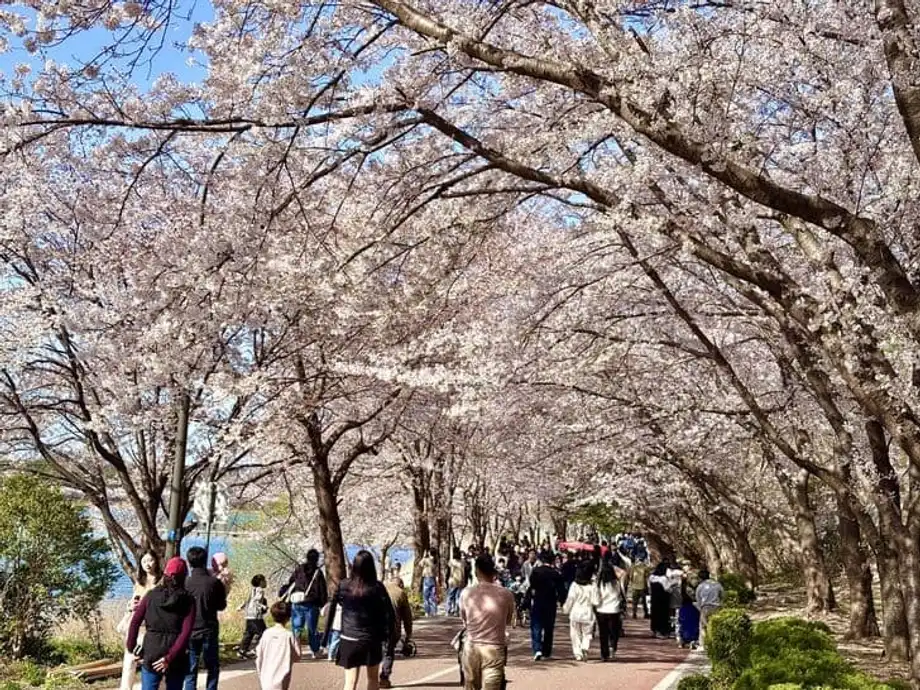
Cherry blossom viewing gives Kang's task a familiar seasonal setting. In South Korea, pink and white blossoms mark the arrival of spring, transforming city streets, mountain slopes and other landscapes for a brief period.
The practice is known as hanami in Japanese and beotkkot yeohaeng in Korean contexts. Across East Asian traditions, the flowers carry associations with the temporary nature of beauty and life. Their short season gives people a reason to stop and notice something that will soon disappear.
South Korea's largest cherry blossom festival takes place in Jinhae, where more than 340,000 cherry trees form displays along streets, streams and mountainsides. Peak bloom typically comes in early April, drawing millions of visitors.
Visitors can face long queues and crowded conditions, yet many still travel to stand beneath the flowering branches. Wind moving through the petals creates an atmosphere that witnesses often describe as magical, offering a temporary escape from urban routines.
Kang's requirement to visit a recognized viewing destination connects students with this shared experience. They are taking part in a seasonal practice of pausing to appreciate nature, rather than simply producing an image of any available tree.
The outing also links their university lives with a tradition that predates the pressures of modern academic and career preparation. Its value lies partly in doing something people have made time for over generations: looking at a brief display of natural beauty.
Cherry blossom season is also a time for renewal and reflection in Korean society. Companies, schools and families organize outings to see the flowers, recognizing the psychological benefits of spending time with nature and noticing seasonal change.
Kang brings that practice into the structure of a university course. By awarding credit for the outing, he gives students permission to treat enjoyment and emotional restoration as worthwhile parts of their education.
A Photograph Requires Students to Pay Attention
Photography gives students a task to carry out once they reach the blossoms. They must choose a viewpoint, compose an image and look closely enough to decide what they want to capture.
That process can become a form of active meditation. Instead of letting the scenery pass by, students direct their attention toward branches, flowers, light and the scene around them. The camera gives them a reason to observe.
Kang's detailed rules support an otherwise open goal. Students choose their destination and the photographs they make, but they must show that the visit happened in the right place and during the right season.
The balance between freedom and documentation reflects the setting in which the assignment is given. Students accustomed to mathematical problem sets and laboratory reports are asked to take an emotional and aesthetic experience seriously enough to plan it and record it properly.
The restrictions also address the possibility that students might put minimal effort into an activity they regard as peripheral to engineering. Requiring a genuine journey makes the experience harder to reduce to a quick submission.
A trip planned around the blossoms can leave room for more than the moment needed to press a camera button. Students who have already made the journey may spend hours walking beneath the trees before returning to their desks. The strict requirements create time and space in which they can enjoy themselves.
Six Springs and Full Participation
Kang began the assignment in 2021 and continued it through the social restrictions of the pandemic and into 2026. Its six consecutive years show that the exercise was established well before the recent attention on social media.
The sequence places the viral moment within a longer teaching practice:
- 2021: Kang introduced the cherry blossom photography assignment in his Engineering Mathematics course.
- 2021 to 2026: He repeated the spring assignment for six consecutive years and collected students' photographs by email.
- April 3, 2026: Kang confirmed on Instagram that he was the professor behind the widely shared notice and explained his concern about student stress.
- April 14, 2026: The assignment had drawn more than 20,000 likes within days of spreading online, and Kang reported that every student had completed it since its introduction.
Kang follows completion rates with the attention he gives examination scores. His reported participation rate is 100 percent, despite pressures that could make an outing seem difficult to fit into the semester.
Midterm examinations and certification deadlines can make students reluctant to spend time away from studying. Some may initially be skeptical of photographing flowers as part of a mathematics course. Even so, Kang says none have ultimately declined to complete the task.
The repeated assignment has become a defining feature of his teaching. It reflects a sustained commitment to students' wellbeing rather than an activity created for a brief period of public attention.
Online Praise Brings a Wider Message
Instagram and Threads helped carry the assignment beyond Kang's classroom. Screenshots spread through online communities, where commenters responded to the idea of a professor using coursework to protect some space for enjoyment.
The notice's language helped explain the public response. It spoke of nourishing the souls of engineering students worn down emotionally and encouraged them to enjoy spring's warmth for at least one day.
Kang has expressed gratitude for the supportive comments. He also sees the attention as a reason to keep refining his teaching and as an added responsibility to be both a capable technical instructor and a mentor attentive to students' emotional welfare.
Working adults have recognized a familiar problem in the story: career pressures can crowd out opportunities to pause and appreciate the season. That connection has helped the assignment appeal to people beyond universities.
Kang hopes the idea reaches further than his own course. He encourages people to enjoy spring during a commute or a walk and to fill their days with happy memories, whatever their academic or professional circumstances.
For his students, that broad message takes a concrete form. They have a destination to choose, an April outing to make and photographs to submit. A small piece of coursework gives them time that might otherwise have disappeared into another day of study.
Key Points
- Chungbuk National University professor Kang Dong-woo assigns cherry blossom photography in Engineering Mathematics to give stressed students a break.
- The task began in 2021 and has continued for six consecutive years through 2026.
- Students must visit recognized viewing spots in Cheongju or their residential areas, rather than photograph convenient trees at home or on campus.
- Submissions require EXIF date and GPS location information and are sent by email.
- The assignment spread on Instagram, Threads and other online communities, attracting more than 20,000 likes within days.
- Kang confirmed his authorship on April 3 and explained his concern about employment anxiety, résumé preparation and uncertain futures.
- Kang reports a 100 percent completion rate since the assignment began.
- He hopes students and working adults alike make time to enjoy spring and build happy memories.