The Expanding Regulatory Net
The Indian government has proposed amendments to the Information Technology (Intermediary Guidelines and Digital Media Ethics Code) Rules, 2021, that would fundamentally alter how social media platforms operate within the world’s largest democracy. Released by the Ministry of Electronics and Information Technology (MeitY) on March 30, the draft amendments seek to extend regulatory oversight beyond traditional news publishers to encompass individual users, influencers, and podcasters who share content related to news and current affairs on platforms including Facebook, YouTube, and X. The proposed framework would bring these creators under the same regulatory scrutiny currently reserved for established media organizations, representing a significant shift in how the state approaches digital expression.
- The Expanding Regulatory Net
- From 36 Hours to Three: The Accelerated Takedown Regime
- The Safe Harbour Compromise
- Creators Under Pressure: Voices from the Digital Frontline
- Constitutional and Legal Challenges
- Government Defenses and Official Response
- A Pattern of Control: Regional and Global Context
- Key Points
Under the proposed changes, the Ministry of Information and Broadcasting would gain the authority to issue takedown notices directly to individual users, not just registered news outlets. This represents a significant expansion of the current framework, which since 2021 has governed digital media publishers and over-the-top (OTT) platforms through a three-tier grievance mechanism. The amendments would bring “users who are not publishers” under the same Code of Ethics that currently applies to established media organizations, effectively blurring the distinction between professional journalism and citizen commentary while subjecting individual speakers to compliance burdens designed for corporate entities.
Digital rights advocates argue this expansion creates what activist Nikhil Pahwa describes as an infrastructure for mass censorship, referring to the cumulative effect of successive regulatory amendments since 2021. The Internet Freedom Foundation, co-founded by Pahwa and Apar Gupta, has warned that the changes would enable government agencies to target critics and clamp down on dissent through a mechanism that offers limited transparency and procedural safeguards. The proposed rules would also empower the Inter-Departmental Committee to take up matters on its own initiative rather than waiting for formal complaints, signaling a shift toward proactive content monitoring rather than reactive grievance redressal. The regulatory push comes amid increasing scrutiny of online content in India and growing concerns about executive overreach into digital spaces.
The recent United States government report noted that since 2021, American social media firms operating in India have faced an increasing number of takedown requests for content and user accounts related to issues that appear politically motivated. Meta alone restricted more than 28,000 pieces of content in India during the first six months of 2025 following government requests, according to transparency reports reviewed by researchers. This volume of restriction suggests an already active enforcement environment that critics say will only intensify under the new amendments.
From 36 Hours to Three: The Accelerated Takedown Regime
Perhaps the most technically challenging aspect of the evolving regulatory framework involves the compression of compliance timelines. In February 2026, MeitY introduced amendments that reduced the window for social media platforms to comply with government blocking orders from 36 hours to just three hours, a change that took effect on February 20. This radical shortening of response time severely limits the scope for legal review or meaningful human assessment of contested content before removal decisions must be implemented.
Legal experts question the feasibility of such rapid compliance. Akash Karmakar, a partner at Indian law firm Panag & Babu specializing in technology law, told Reuters that the three-hour window assumes no application of mind or real-world ability to resist compliance. The Internet Freedom Foundation has characterized this compressed timeline as transforming platforms into rapid fire censors, forcing automated over-removal because human review becomes practically impossible within such constrained timeframes.
The accelerated timeline applies to various categories of unlawful content, including intimate imagery, impersonation, and morphed content. However, critics argue that the broad definition of what constitutes unlawful material under Indian law creates a chilling effect where platforms will prefer to remove first and question later. Categories affecting public order, national security, and communal harmony provide wide discretion for government intervention. Anushka Jain, a research associate at the Digital Futures Lab, warned the BBC that complete automation of content review carries a high risk of censoring legitimate expression, as companies struggle to maintain human oversight within the three-hour deadline.
The Safe Harbour Compromise
At the legal core of these amendments lies the concept of safe harbour protection under Section 79 of the Information Technology Act, 2000. This provision grants intermediaries immunity from civil and criminal liability for content posted by users, provided they observe prescribed due diligence and remove unlawful content when properly notified. Without this shield, platforms could theoretically be sued every time a user posts defamatory or controversial material, creating an impossible burden that would likely force comprehensive pre-screening of all uploads.
The March 30 draft proposes a fundamental alteration to this conditional immunity. The amendment to Rule 3(4) would require every intermediary to comply not only with formal blocking orders but also with the Ministry’s clarifications, advisories, orders, directions, standard operating procedures, codes of practice, and guidelines. Failure to comply with any of these seven categories of executive instrument would place the intermediary outside the safe harbour protection and expose it to liability for user content.
This distinction between hard law and soft law troubles constitutional experts. In ordinary legal understanding, clarifications and advisories function as guidance without the force of law. They can be issued overnight, without public consultation, parliamentary scrutiny, or the procedural discipline required for subordinate legislation. The amendment would lend these informal instruments the operative weight of binding rules, effectively allowing the executive to create binding obligations without following the legislative process.
The Supreme Court of India previously addressed similar concerns in Shreya Singhal v. Union of India (2015), where it held that intermediaries face takedown obligations only on court orders or government notifications citing specific constitutional grounds. The court ruled that vagueness and overbreadth in speech regulation are constitutionally fatal. Legal scholars note that the proposed Rule 3(4) sits uncomfortably with this precedent, potentially creating what Yale law professor Jack Balkin terms collateral censorship, where speech regulation aimed at intermediaries produces over-removal because platforms bear the cost of liability without the speaker’s stake in expression.
Creators Under Pressure: Voices from the Digital Frontline
The human impact of these regulatory changes manifests most clearly in the experiences of independent content creators who have already faced government action. Akash Banerjee, whose YouTube channel The Deshbhakt boasts more than six million subscribers, warns that the proposed rules could create a climate of fear, pushing many creators toward self-censorship.
Interestingly, despite the many laws regulating online content, hate speech and fake news have not reduced in the country. Meanwhile, posts that are critical of the government, even if they are satirical, are increasingly being blocked or removed.
Kumar Nayan, operating the X account @Nehr_who? with approximately 242,000 followers, experienced this enforcement directly. Last month, X blocked his account along with about a dozen others, many known for satirical posts about the government, acting on orders issued under Section 69A of India’s IT Act. Nayan received neither prior notice nor explanation for the block. Although a court order restored his account this week, ten posts remain blocked in India pending review by a government-appointed panel. The posts in question mock Prime Minister Narendra Modi or criticize his Bharatiya Janata Party government, including humorous commentary on the Prime Minister receiving Israel’s Knesset medal alongside imagery referencing domestic gas shortages.
Nayan addressed the disproportionate response to his satirical content.
No reasonable person will say that these posts threaten the nation’s security or disturb communal harmony. They are just funny posts, so why does the government want them taken down?
The legal challenge required Nayan to reveal his identity, stripping away the anonymity that social media platforms provide to whistleblowers and critics.
I have lost the anonymity offered by social media, which is a double-edged sword but also shields whistleblowers and critics from threats and harassment.
Following the disclosure, Nayan moved home due to safety concerns.
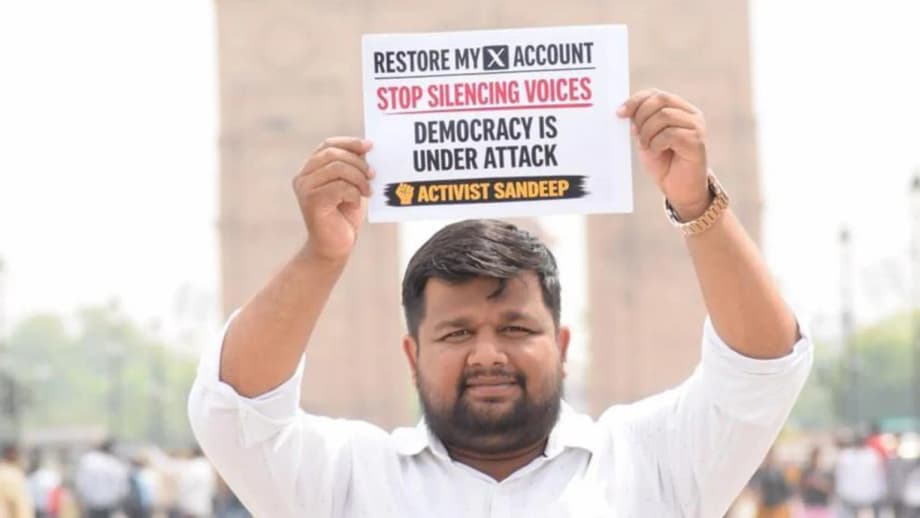
Sandeep Singh, whose X account @ActivistSandeep maintains over 100,000 followers, remains blocked in India at the time of reporting. Singh began posting critical views after feeling mainstream media was biased in favor of the ruling Bharatiya Janata Party.
I stand for the truth and blocking my accounts or posts will not stop me from continuing speaking truth to power.
His case illustrates the asymmetric burden these regulations place on speakers, who must navigate complex legal processes to restore content while platforms face immediate liability for non-compliance.
Constitutional and Legal Challenges
The legal architecture of the proposed amendments faces scrutiny on multiple constitutional fronts. The Press Club of India, in a resolution dated April 11, demanded the complete withdrawal of the draft Information Technology Second Amendment Rules, 2026, citing the creation of a chilling effect where independent creators may self-censor to avoid algorithmic misidentification. The body noted that the compliance framework proves financially terminal for solo podcasters, newsletter writers, and YouTube creators who lack the legal resources of established media houses.
The constitutional challenge centers on the delegation of powers and the dilution of procedural safeguards. The Bombay High Court addressed similar issues in Kunal Kamra v. Union of India (September 2024), striking down a 2023 amendment that empowered a government fact-check unit to flag content about the Central government as fake, false, or misleading. The 2:1 majority held this amendment ultra vires Articles 14, 19(1)(a), and 19(1)(g) of the Constitution, which guarantee equality before law, freedom of speech and expression, and the right to practice any profession. The Union’s appeal remains before the Supreme Court, with notice issued in March 2026.
Legal analysts observe that the proposed Rule 3(4) reproduces the operative logic of the struck-down rule, broadening the trigger from one fact-check unit to an indefinite class of executive communications. The Code of Ethics in Part III was designed for publishers who exercise editorial control and employ journalists, yet the amendments would extend these obligations to ordinary users discussing monetary policy, constitutional cases, or electoral commentary. None possess the resources to defend Code of Ethics complaints before an Inter-Departmental Committee in Delhi, creating a compliance asymmetry that favors silence over speech.
Government Defenses and Official Response
MeitY Secretary S. Krishnan has mounted a vigorous defense of the proposed framework, characterizing the amendments as clarificatory rather than expansionary. In press briefings and public statements, Krishnan has emphasized that the guidelines issued by his ministry remain consistent with the Constitution and existing law. He argues that there needed to be a common policy or common framework to govern news and current affairs content as such content is no longer shared only by news publishers but also ordinary citizens.
Addressing concerns about treating users as publishers, Krishnan indicated that this interpretation was unintentional and that the government remains open to revising or even repealing specific clauses if stakeholder feedback warrants such action. Following a roundtable meeting with industry representatives, civil society advocates, and media organizations at Electronics Niketan, Krishnan acknowledged that stakeholders have requested clarity on differentiating between intermediaries, registered news publishers, and individual users. The government has extended the consultation deadline from April 14 to April 29 to accommodate these concerns.
However, civil society representatives remain skeptical. Apar Gupta, founding director of the Internet Freedom Foundation, stated that modifications indicated at the meeting do not fundamentally alter the illegality or the censorial impact of the proposed changes.
We grounded this position in the framework of the IT Act, 2000, and in the existing patterns of opaque censorship under the Rules that operate without any meaningful adherence to the principles of natural justice.
Krishnan disputed this characterization, claiming the amendment was not contrary to natural justice principles.
A Pattern of Control: Regional and Global Context
India’s regulatory trajectory does not exist in isolation. The country joins a broader South Asian trend toward what legal scholars describe as micro-internets, where national governments exert increasing control over digital infrastructure, creating splintered cyberspaces that hinder regional communication. Bangladesh’s Digital Security Act, 2018, Pakistan’s Online Content Blocking Rules under the Prevention of Electronic Crimes Act, and Nepal’s Online Media Directives all share similar features: vague prohibitions on false information, excessive executive discretion, and limited judicial oversight.
These regulations often employ censorship by proxy, coercing private platforms to perform content moderation that governments would find politically or technically difficult to execute directly. The Sahyog portal functions as a centralized platform allowing multiple agencies to issue takedown notices with limited transparency. This mechanism operates parallel to the formal blocking powers under Section 69A, creating overlapping jurisdictions that confuse compliance obligations while maximizing government leverage.
The international effects extend beyond regional neighbors. The United States government has noted the increasing politicization of takedown requests, while digital rights organizations warn that India’s regulatory model could export to other developing democracies, including Mauritius, which has already cited India’s 2021 rules in attempts to regulate social media. As platforms like Meta, Google, and X navigate compliance in a market of over one billion internet users, their accommodation of local requirements risks normalizing standards that would be unacceptable in Western democracies, creating a race to the bottom for global digital rights.
Key Points
- The Indian government proposes extending IT Rules to cover individual users sharing news and current affairs content, not just registered publishers.
- Social media platforms must now comply with informal advisories and clarifications to maintain safe harbour legal immunity under Section 79.
- New amendments require platforms to remove flagged content within three hours, reduced from the previous 36-hour window.
- Digital rights activists warn the rules create an infrastructure for mass censorship and collateral censorship through platform over-removal.
- Creators including Akash Banerjee, Kumar Nayan, and Sandeep Singh report increased blocking of satirical and critical content.
- The Bombay High Court previously struck down similar fact-checking provisions in 2024, citing constitutional violations of free speech.
- MeitY Secretary S. Krishnan defends the rules as clarificatory and open to revision following extended public consultation until April 29.
- The Press Club of India has demanded complete withdrawal of the draft amendments, citing financial and legal burdens on independent creators.