The Demographic Emergency Driving a Robot Revolution
Japan is confronting an economic reality no advanced nation has faced on this scale. With the population declining for a 14th consecutive year in 2024 and the working age cohort projected to shrink by nearly 15 million over the next two decades, the country is turning to an unlikely savior: artificial intelligence embodied in physical machines. The Ministry of Economy, Trade and Industry announced in March 2026 that it aims to build a domestic physical AI sector capable of capturing 30% of the global market by 2040, backed by approximately $6.3 billion in government support under Prime Minister Sanae Takaichi. This represents a fundamental shift from viewing robots as efficiency tools to seeing them as essential infrastructure for economic survival.
The statistics paint a stark picture. Japan’s birth rate stands at roughly 1.4 children per woman, well below the 2.1 needed to maintain population stability. Deaths now outnumber births by approximately 1,000 people daily. By 2050, nearly 40% of Japanese citizens will be over 65, up from about 28% today. This demographic shift has created what economists call a structural labor shortage, where the economy simply lacks sufficient workers to maintain current output levels, regardless of wage increases. The International Monetary Fund projects that Japan’s domestic labor force will drop by some 24 million between now and 2050, a decline that immigration is unlikely to offset.
The immediate pressure manifests in what industry observers call the 2024 Problem.
New overtime regulations for truck drivers implemented in 2024 strictly limited working hours, creating immediate logistics bottlenecks throughout the supply chain. According to the International Federation of Robotics, mobile robot solutions in transportation can save drivers up to 25% of working time by automating loading and unloading tasks, directly addressing the regulatory constraints while maintaining freight movement.
From Factory Floors to Nursing Homes
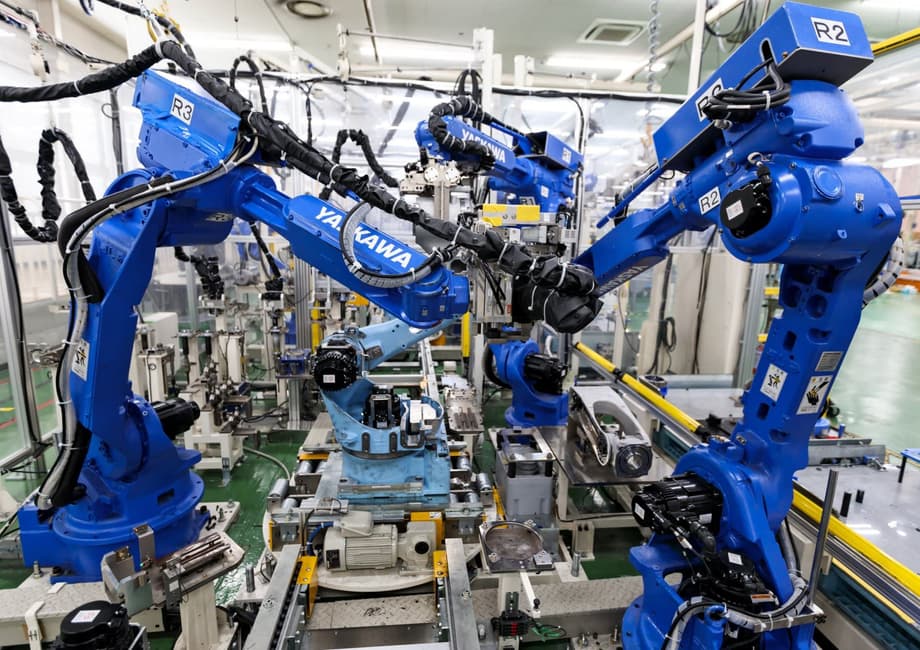
While Japan installed its first industrial robots in the late 1960s and currently controls approximately 70% of the global industrial robotics market, the new wave of automation extends far beyond automotive manufacturing. The current focus targets what venture capitalist Ally Warson, a partner at UP.Partners, calls the jobs no one wants.
Warson has been telling investors for years that Japan’s labor shortage exemplifies where physical AI becomes essential rather than optional.
There are something like 600,000 unfilled jobs in the industrial space. No one’s raising their hand and signing up for it.
These unwanted roles include dangerous construction tasks, window washing on skyscrapers hundreds of feet in the air, tunnel boring in hazardous conditions, and increasingly, care for the elderly. In 2025, data from Japan’s Ministry of Health, Labor and Welfare revealed a critical imbalance in elderly care: only one candidate applied for every 4.25 positions in the sector, creating an unsustainable pressure on hospitals, nursing homes, and home care services.
The physical risks involved in these occupations make them prime targets for automation. Warson emphasizes that the most compelling case for physical AI has never been simple efficiency or cost cutting, but rather keeping people alive. Tasks such as walking through construction sites at midnight where nails protrude from the ground, or responding to leaks at offshore oil and gas facilities, expose workers to risks that generate million dollar insurance claims alongside human tragedy. Replacing these roles with machines addresses both safety and labor scarcity simultaneously.
Real World Deployment Accelerates
The response is already visible across Japanese industry, moving rapidly from experimental pilots to paid deployments. At Waseda University, researchers developed AIREC (Artificial Intelligence Robot for Elderly Care), a 150 kilogram humanoid capable of turning bedridden patients, changing diapers, and repositioning bodies to prevent injuries. These tasks, essential yet physically exhausting, represent exactly the type of work humans are increasingly unwilling to perform in a tightening labor market.
In construction, automation technology from ABB Ltd recently helped build Japan’s first 3D printed railway station, assembled overnight between the last evening train and the first morning service. The project, completed with Serendix and West Japan Railway Company, demonstrates how robotic construction reduces both labor requirements and disruption to infrastructure operations. Traditional railway station construction can take several months, but robotic automation and off site manufacturing allowed completion in hours.
The construction industry has been severely impacted by rising labor and material costs, as well as a shortage of skilled workers. Our 3D printer based construction approach can reduce labor costs and produce all building materials from mortar.
The speaker, Mr. Sato, COO of Serendix, highlights how robotic construction addresses multiple pressures simultaneously. By cutting both labor and material expenses while improving precision, these technologies offer a viable path forward for industries struggling to find workers willing to perform physically demanding tasks.
Record Investment and Global Competition
The economic momentum is measurable and accelerating. The Japan Robot Association reported that orders for industrial robots reached ¥324.5 billion ($2.2 billion) in the first quarter of 2025, a 14.2% annual increase and the strongest quarter since record keeping began in the 1980s. Export orders, comprising roughly 70% of shipments, are surging from China, South Korea, the United States, and Germany as those nations face their own demographic pressures.
International technology giants are positioning for this transformation. Microsoft announced a $10 billion investment in Japan through 2029, expanding AI infrastructure, cybersecurity cooperation, and training for one million engineers by 2030. The company is partnering with SoftBank and Sakura Internet to ensure sensitive data remains within Japan while accessing high performance computing capabilities. This comes as government estimates suggest Japan could face a shortage of more than three million AI and robotics workers by 2040.
Microsoft’s Vice Chair Brad Smith framed the investment as supporting Japan’s digital transformation while strengthening economic security. The initiative focuses on expanding cloud computing capacity, enabling domestic processing of sensitive data while tapping global AI models. By combining domestic computing resources with Azure cloud platforms, organizations can deploy AI systems while meeting strict governance requirements.
The Hybrid Ecosystem Strategy
Japan’s approach differs significantly from American and Chinese strategies. While the United States leads in software and market development, and China dominates in manufacturing scale and cost efficiency, Japan maintains particular strength in high precision components such as actuators, sensors, and motion control systems. These represent the critical physical interface between AI algorithms and the real world.
Sho Yamanaka, principal at Salesforce Ventures, explains that the driver has shifted from simple efficiency to industrial survival. Japan faces a physical supply constraint where essential services cannot be sustained due to a lack of labor. Given the shrinking working age population, physical AI is a matter of national urgency to maintain industrial standards and social services.
The industry structure reflects this urgency. Large incumbents including Toyota Motor Corporation, Mitsubishi Electric, and Honda Motor provide manufacturing scale, customer relationships, and deployment capabilities built over decades. Meanwhile, startups drive innovation in orchestration software, perception systems, and workflow automation. This hybrid ecosystem differs from winner take all technology models, instead featuring mutual collaboration between established corporations and emerging companies.
Ro Gupta, managing director at Woven Capital, identifies several factors driving adoption: cultural acceptance of robotics, labor shortages driven by demographic pressures, and deep industrial strength in mechatronics and hardware supply chains. Hogil Doh, general partner at Global Brain, describes physical AI as a continuity tool: How do you keep factories, warehouses, infrastructure, and service operations running with fewer people?
Startups like Mujin exemplify this specialized approach by developing robotics control platforms that enable existing hardware to perform logistics tasks autonomously. WHILL combines electric vehicles with cloud based fleet management for autonomous transport, leveraging Japan for hardware refinement and the United States for software development. Terra Drone applies AI driven systems that integrate operational data to support autonomous functionality in defense and infrastructure applications.
Economic Evidence and Social Adaptation
Academic research supports the correlation between labor shortages and robot adoption. A peer reviewed study examining Japan’s early robotization period from 1978 to 1991 found that shortages of unskilled factory workers strongly predicted subsequent robot adoption, while skilled worker shortages had the opposite effect, suggesting robots complement rather than replace specialized human labor. The research, published using newly digitized industry level data, demonstrates that labor shortage effects on automation hinge on occupation characteristics.
The International Monetary Fund has noted that Japan’s experience may differ significantly from other advanced economies. With literally disappearing labor and limited immigration, automation can boost wages and economic growth rather than simply displacing workers. IMF staff calculations using prefectural level data found that increased robot density in Japanese manufacturing correlated with local gains in employment and wages, results opposite to similar studies in the United States.
Financial infrastructure is adapting to support adoption. Mizuho Leasing reports surging demand for robotics in hotels, restaurants, and convenience stores over the past two years, with applications now spreading to logistics centers and factories. The company views Japan as a real world testing ground for demographic challenges other nations will soon face, including China and South Korea, which are already experiencing similar contractions.
Despite the momentum, obstacles remain. Technical challenges include ensuring absolute precision in patient care, adapting to unstructured environments, and reducing the high costs of humanoid robots. Social questions persist about the emotional aspects of care that machines cannot replicate. However, cultural acceptance of robotics in Japan runs deeper than in many Western nations. The concept of monozukuri
(craftsmanship) extends to robotic systems, and decades of exposure to automation in manufacturing have normalized human robot collaboration.
Global Implications for an Aging World
Japan’s experiment carries urgent lessons for the world. South Korea’s fertility rate fell to 0.72 in 2024, the lowest of any major economy. Germany’s industrial workforce is projected to shrink by 7 million by 2035. The International Labour Organization estimates that 14 of the world’s 20 largest economies will face significant manufacturing and logistics labor shortages by 2030. For countries like Japan, South Korea, and Germany, robotics adoption is less a strategic choice than a survival mechanism.
The Bank of America recently predicted that people may soon own more humanoid robots than cars by 2060, a statistic that sounds futuristic but reflects current demographic trajectories. The question is no longer whether robots will replace certain jobs, but whether there will be enough humans available to perform essential work in the first place.
Issei Takino, CEO of Mujin, emphasizes that physical AI requires deep understanding of the physical characteristics of hardware. This requires not only software capabilities, but also highly specialized control technologies, which take significant time to develop and involve high costs of failure. This technical reality means that early movers with strong hardware foundations, like Japan, maintain advantages even as software capabilities proliferate globally.
As Global Brain general partner Hogil Doh noted, the signal of market maturity is visible in specific metrics: paid deployments rather than vendor funded trials, reliable operation across full shifts, and measurable performance indicators such as uptime, human intervention rates, and productivity impact. By these measures, Japan’s physical AI sector is transitioning from experimentation to industrial standard.
The Bottom Line
- Japan’s working age population is projected to shrink by 15 million over the next two decades, driving unprecedented automation adoption across manufacturing, logistics, and care sectors.
- The government targets 30% of the global physical AI market by 2040, supported by $6.3 billion in domestic investment and Microsoft’s $10 billion AI infrastructure commitment through 2029.
- Robots are increasingly deployed for unwanted jobs including elderly care, dangerous construction work, and logistics, filling an estimated 600,000 unfilled industrial positions.
- Industrial robot orders hit record highs in early 2025, with Japanese manufacturers currently controlling 70% of the global industrial robotics market and facing growing competition from Chinese firms.
- Research indicates that in Japan’s specific demographic context, robot adoption correlates with employment and wage growth rather than displacement, suggesting automation can fill labor gaps without destroying jobs.