The No-Limits Partnership Emerges
The global security landscape is undergoing its most significant transformation in decades as China and Russia consolidate a partnership that explicitly seeks to dismantle the Western-led international order. What began as tentative cooperation following the Cold War has crystallized into a comprehensive alignment that Australian strategic planners now recognize as a coordinated trans-Eurasian threat, the likes of which have not been seen for at least half a century.
In February 2022, just weeks before Russian forces crossed into Ukraine, Presidents Vladimir Putin and Xi Jinping formally declared a no-limits partnership characterized by friendship that knows no boundaries and cooperation without forbidden areas. This declaration merely acknowledged what had been developing for three decades. While Western nations concentrated on economic prosperity and anticipated a peace dividend after the Cold War, Moscow and Beijing systematically set aside historical differences to preserve their authoritarian systems against the perceived threat of liberal democratic values.
The partnership operates through multiple dimensions simultaneously. Beijing provides Moscow with an economic lifeline that has helped Russia withstand Western sanctions, while Russian defense technology and operational experience have accelerated China’s military modernization programs. This cooperation extends beyond bilateral arrangements to encompass joint propaganda efforts, coordinated diplomatic positioning at the United Nations, and increasingly complex military exercises that test interoperability across multiple domains.
Military Convergence and Modernisation
The depth of Sino-Russian military cooperation has reached unprecedented levels, creating capabilities that directly challenge Australian defense planners preparing the upcoming National Defence Strategy. Joint exercises between the two militaries have surged from one or two annually in the early 2000s to fourteen separate events in 2024, even as Russia maintains its war effort in Ukraine. This ability to sustain multiple lines of effort simultaneously represents a defining difference from the capacity constraints faced by Western allies until recently.
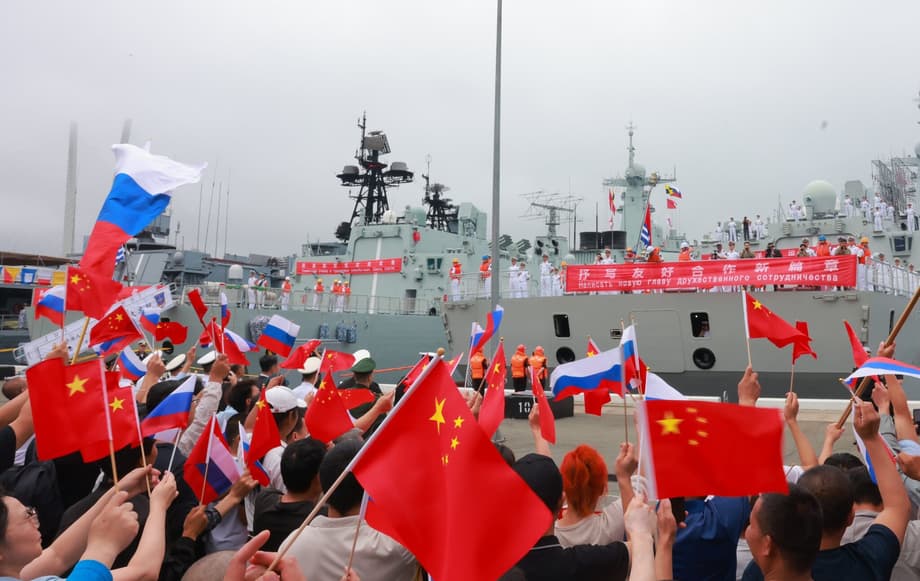
Recent developments include joint missile defense exercises, coordinated naval patrols extending from the Sea of Japan to the South China Sea, and sophisticated military-technical cooperation. In August 2025, Moscow and Beijing conducted comprehensive joint naval drills involving artillery, anti-submarine warfare, and air defense operations. These activities represent structured testing of capabilities and practical training in coordinated operations rather than mere diplomatic signaling.
The technological exchange benefits Beijing substantially. Despite China’s massive defense budget growth from $7.7 billion in 1995 to approximately $250 billion in 2025, its last major military engagement occurred in 1979 against Vietnam with subpar results. Russia’s mastery of modern warfare, gained through sustained combat operations, provides China with lessons that simulations cannot replicate. Moscow has supplied Beijing with advanced S-400 missile defense systems, Su-35 fighter technology, and critical components such as high-performance turbofan engines that remain challenging for Chinese manufacturers to produce indigenously.
ASPI analysis indicates that this military convergence creates the foundation for a real alternative to Western military alliances. The two countries are gradually standardizing command-and-control procedures, data-sharing models, and real-time missile tracking systems. Former US Secretary of Defense Robert Gates warned that never before has the United States faced four allied antagonists simultaneously (Russia, China, North Korea, and Iran), whose collective nuclear arsenal could soon double the size of America’s own.
Economic Enablement and Sanctions Evasion
Bilateral trade between China and Russia reached a record high of $240 billion in 2023, representing a 26.3 percent increase from the previous year. This economic relationship has evolved from simple commodity exchange into a sophisticated system that sustains Russia’s war economy despite comprehensive Western sanctions. Chinese exports to Russia now substitute for previously available European and American goods, with Beijing becoming the platform for Russian imports of Western dual-use technologies.
The trade in sensitive components presents particular concerns for global security. According to estimates based on customs data, China exports more than $300 million monthly in dual-use products identified by Western governments as high-priority items for weapons production. These include machine tools used for manufacturing ballistic missiles, semiconductors employed in military optics, and drone engines that propel Russian unmanned aerial vehicles. Up to 90 percent of Russia’s microelectronics imports now originate from China, including components used in tanks, armored vehicles, and aircraft.
Financial cooperation has similarly deepened. Russian Foreign Minister Sergei Lavrov announced in April 2024 that the two countries had almost completely replaced the US dollar in bilateral trade using their national currencies. The renminbi has become the top foreign currency in Russian deposits, with cash holdings doubling to $68.7 billion equivalent in 2023. This financial integration helps Moscow circumvent Western sanctions while advancing Beijing’s goal of establishing alternative payment systems that reduce global dependence on American financial infrastructure.
European policy analysts note that Beijing’s assistance has transformed China from merely an economic competitor into a security threat requiring containment. By providing the economic and technological foundation that allows Russia to continue its aggression against Ukraine, China has become a decisive enabler of European instability. This support occurs despite repeated warnings from Western leaders, including European Commission President Ursula von der Leyen and US Secretary of State Antony Blinken, that such assistance affects fundamental relationships.
Implications for Australian Defence Planning
The Sino-Russian partnership directly shapes Canberra’s strategic thinking as defense planners finalize the National Defence Strategy. The alignment challenges the post-1945 global order that has underpinned Australian prosperity and sovereignty, creating a contested environment requiring significant adjustments to defense posture and international partnerships. Economic coercion, defense cooperation, and joint information operations by the two powers necessitate increased funding commitments that extend beyond the traditional four-year budget estimates.
Australia’s response involves expanding networks of security partnerships rather than relying solely on the United States alliance. The recent Australia-European Union Security and Defence Partnership exemplifies this diversification, building connections with like-minded nations facing similar challenges. However, analysts emphasize that these supplementary relationships cannot replace the United States, which remains Australia’s most significant security ally despite concerns about Washington’s strategic bandwidth and commitment reliability.
The threat environment requires Australian policymakers to hold multiple truths simultaneously. China functions simultaneously as an important economic power and a strategic adversary. The authoritarian alignment operates across defense, trade, and ideology in both Europe and the Indo-Pacific. Beijing serves as the primary enabler keeping Moscow’s war effort viable, while both governments seek to impose authoritarian values globally through information operations and diplomatic pressure.
Defense planners must account for the possibility that the Sino-Russian axis could eventually expand to include formal military coordination in conflict scenarios. While current cooperation stops short of a mutual defense treaty, the trajectory suggests deeper integration involving combined operations, shared logistics, and coordinated strategic signaling. The partnership has also become an anchor for a broader authoritarian grouping including Iran and North Korea, creating a multi-nuclear alliance with China as its strongest element and Russia as its most disruptive.
Regional Responses and Strategic Friction
While the Sino-Russian partnership presents a coordinated challenge, regional actors across the Indo-Pacific are creating strategic friction that complicates deeper alignment. India maintains a posture of strategic autonomy that prevents trilateral cooperation with China and Russia despite its historical defense ties with Moscow. New Delhi’s participation in the Quadrilateral Security Dialogue and its resistance to bloc politics introduce constraints on how closely Beijing and Moscow can coordinate their regional strategies.
Indonesia employs calibrated ambiguity through its bebas dan aktif (free and active) foreign policy doctrine, engaging with both powers while avoiding entanglement. Jakarta recently rejected a Russian request to establish a long-range aircraft base in Papua, reaffirming its preference for regional balance. Similarly, littoral states in the South China Sea including Vietnam and the Philippines assert sovereignty through legal mechanisms and diversified defense partnerships that fragment great power coherence in contested waters.
Japan faces particularly acute pressures from the northern and western axes simultaneously. Tokyo confronts Russian military aircraft intrusions into its airspace and the unresolved Kuril Islands dispute alongside Chinese maritime expansion. The no-limits alliance eliminates the strategic advantage Japan previously enjoyed from historical Sino-Russian mistrust, forcing Tokyo to reconsider its pacifist constitutional constraints and significantly increase defense spending. Japan’s three-pronged strategy involves reinforcing the US alliance, intensifying cooperation with Australia and India through the Quad framework, and pursuing proactive engagement toward Beijing and Moscow.
These regional dynamics suggest that while the Sino-Russian partnership appears formidable from a distance, its practical implementation faces fragmentation when filtered through local agency. Regional states shape the conditions under which external powers must operate, raising the costs and lowering the coherence of coordinated positions. This friction creates opportunities for Australian diplomacy to reinforce existing resistance patterns through legal capacity-building, maritime awareness programs, and defense partnerships that promote diversification rather than dependence.
Global Information Warfare and Authoritarian Alignment
Beyond conventional military and economic cooperation, the Sino-Russian partnership operates extensively in the information domain to undermine democratic institutions and Western cohesion. The two governments coordinate narratives blaming NATO expansion for Russian aggression, promoting the concept of Western imperialism, and amplifying grievances about colonialism in the Global South. This coordinated messaging has encouraged many non-Western nations to refuse condemnation of Russia’s invasion, significantly complicating diplomatic efforts to isolate Moscow.
Cyber and intelligence cooperation between Beijing and Moscow has intensified markedly. Both countries conduct industrial espionage, political influence operations, and cyber-attacks against Western targets including Australian networks. Chinese and Russian intelligence operations intersect in Europe, where they have penetrated extreme political parties on both the far right and far left to spread doubts about democracy and create social divisions. Finnish security services have explicitly warned that the two countries share common goals that they jointly promote when such promotion serves their interests.
The authoritarian alignment extends to support for pariah states that threaten regional stability. Both Moscow and Beijing have fully supported North Korea’s nuclear diplomacy, openly violating international sanctions that they themselves supported in the Security Council. Russia provides Pyongyang with hydrocarbons and potentially dual-use missile technology, while China offers diplomatic cover and economic sustenance. This cooperation has degraded chances for peaceful resolution of the Korean crisis and added to threats ringing American allies in Northeast Asia.
Stephen Kotkin of the Hoover Institution notes that the partnership reflects a fundamental reality: Russia and China may not agree on what they stand for, but they are united on what they oppose. This opposition targets the Western liberal international order, its emphasis on universal human rights, and its institutional mechanisms for collective security. For authoritarian regimes, the threat of liberal democratic ideas is just as threatening as military power, driving their cooperation in information control, internet governance, and propaganda techniques that restrict civic participation and free expression.
The Bottom Line
The Sino-Russian no-limits partnership represents a structural transformation in global politics that demands urgent attention from Australian defense planners and policymakers. The alignment has evolved from a tentative post-Cold War rapprochement into a comprehensive challenge to the rules-based international order.
- The partnership provides Russia with economic sustenance and China with military modernization, creating a feedback loop that strengthens both authoritarian regimes against Western pressure.
- Joint military exercises have increased from sporadic events to fourteen annual coordinated operations, including missile defense drills and naval patrols across the Indo-Pacific.
- China exports over $300 million monthly in dual-use goods to Russia, enabling the continued production of ballistic missiles, drones, and armored vehicles despite Western sanctions.
- The authoritarian axis anchors a broader coalition including Iran and North Korea, presenting a multi-nuclear threat complex that complicates deterrence calculations for Australia and its allies.
- Regional actors including India, Indonesia, and South China Sea littoral states create strategic friction that limits Sino-Russian coherence, offering opportunities for Australian partnership expansion.
- The upcoming National Defence Strategy must account for this trans-Eurasian threat through increased funding, diversified partnerships, and capabilities that address both European and Indo-Pacific security challenges simultaneously.