A Diplomatic Hub Emerges in South Asia
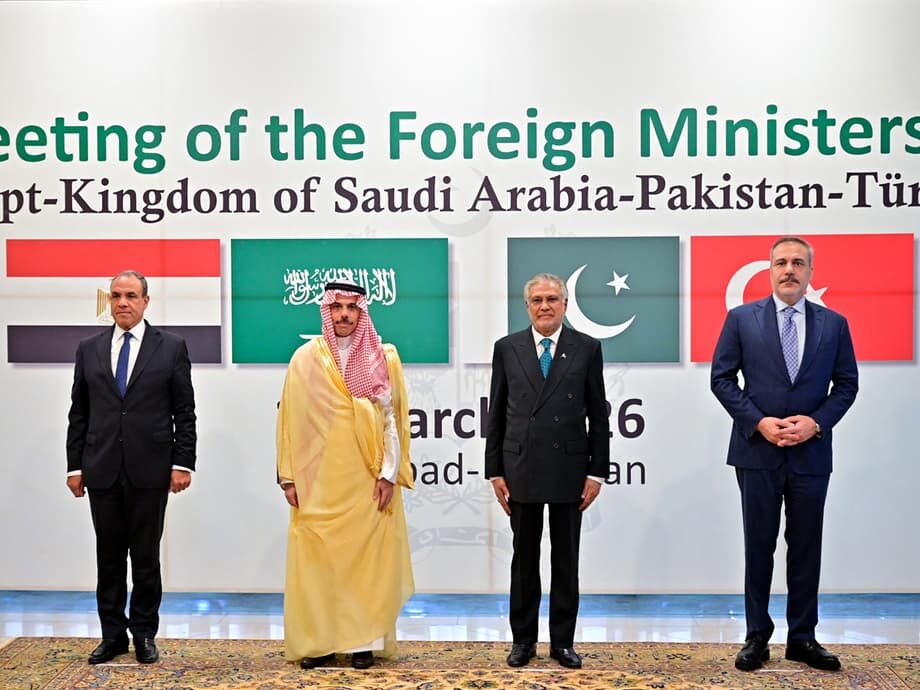
As the United States and Israel pressed their military campaign against Iran into its second month, the center of gravity for peace efforts shifted unexpectedly to Islamabad. On March 29, 2026, foreign ministers from Egypt, Pakistan, Saudi Arabia, and Turkey convened for a high-stakes quadrilateral meeting designed not only to halt the escalating violence but to lay the groundwork for a new regional security architecture. The gathering marked the most coordinated diplomatic attempt yet to bridge the chasm between Washington and Tehran, even as missiles and drones continued to fly across the Persian Gulf.
The talks, hosted by Pakistani Deputy Prime Minister Ishaq Dar at the Foreign Office, represented the evolution of a mechanism first sketched out in Riyadh earlier in the month. What began as informal coordination has hardened into a distinct diplomatic track, with these four nations positioning themselves as the primary interlocutors capable of speaking to all sides in a conflict that has shuttered the Strait of Hormuz, sent global oil prices surging past $100 per barrel, and raised fears of a broader regional conflagration. Yasmine Farouk, a Gulf specialist at the International Crisis Group, described the initiative as a response to a genuinely dangerous moment.
This group of four started becoming very active because this is really a dangerous stage of the war. We’ve already seen Israel damage nuclear plants inside Iran and the potential deployment of troops. This is the nightmare that could make some of the Gulf countries who so far say they don’t want the war to stop to realise that this is getting out of hand.
The Quartet’s Composition and Strategic Calculus
At first glance, the membership of this emerging bloc appears surprising. Saudi Arabia, which had reportedly joined the United Arab Emirates in privately urging Washington to finish off Iran, now sits at the same table as Turkey, which has positioned itself as Iran’s most vocal defender among the major Sunni powers. Egypt, traditionally focused on its own immediate neighborhood, has stepped into a mediating role that recalls its historical position as a leader of the non-aligned world. Pakistan, a nuclear-armed state with a 900-kilometer border with Iran and the world’s second-largest Shia population after Tehran, provides the physical venue and the diplomatic glue.
Farouk explained the Saudi positioning as a reflection of Riyadh’s impossible choices. The kingdom wants to see Iran pay a cost for attacks on Gulf shipping and for effectively holding the Strait of Hormuz hostage. Yet Saudi leaders cannot be certain that the United States would finish the job without creating chaos and then departing, leaving Riyadh to face a vengeful, wounded neighbor alone. Turkey, meanwhile, has invested the most political capital in the group’s success. President Recep Tayyip Erdogan has urged Arab countries not to join the war against Iran, while his foreign minister, Hakan Fidan, has warned that Israel’s true objective extends beyond eliminating Iran’s nuclear capability. Turkish intelligence chief Ibrahim Kalin stated that the war aims to lay groundwork for a conflict that could last decades among the region’s foundational nations: Turks, Kurds, Arabs, and Persians.
Notably absent from the Islamabad table was Qatar, despite its historical role as a mediator with Tehran. Diplomatic sources suggested that Doha remains furious over Iranian strikes on the Ras Laffan liquid natural gas facility, viewing the attack as a betrayal even though the facility had already been shut down. Unlike the UAE, which has reportedly urged escalation, Qatar advocates for an end to the war but is not currently willing to serve as an active mediator on Iran’s behalf.
Pakistan’s Historical Role as Messenger
Pakistan’s emergence as the central node in this crisis draws on a long history of serving as a backchannel between rival powers. In 1971, Pakistani President Yahya Khan facilitated the secret contacts that led to Henry Kissinger’s historic flight to Beijing and the eventual normalization of relations between Washington and the People’s Republic of China. During the 1980s, Pakistan served as the primary conduit for Western support to Afghan mujahideen while simultaneously hosting the Geneva Accords talks that established the framework for Soviet withdrawal from Afghanistan. More recently, Islamabad facilitated the contacts that led to the 2020 Doha Agreement between the United States and the Taliban.
Today, Pakistan possesses a unique cluster of assets that make it acceptable to both Washington and Tehran. Its 560-mile border with Iran creates unavoidable geographic interdependence, while its large Shia population provides cultural and religious linkages that purely Sunni states cannot replicate. Simultaneously, Pakistan has cultivated an unusually close relationship with the Trump administration. Army Chief Field Marshal Asim Munir, whom Trump has publicly described as “my favorite field marshal,” has visited the White House twice and maintains regular contact with Vice President JD Vance and Special Envoy Steve Witkoff. This personal rapport gives Islamabad direct access to decision-makers that other regional powers lack.
Yet Pakistani analysts caution that their country remains a messenger rather than a mediator in the formal sense. Political analyst Zahid Hussain noted that Islamabad lacks the clout to impose solutions.
Pakistan is currently playing the role of a messenger rather than a mediator, relaying messages between America and Iran. If the war ends following this initiative, it will significantly elevate Islamabad’s diplomacy. But if it continues, Pakistan will be one of the countries most harmed.
The Impasse Between Washington and Tehran
The diplomatic activity in Islamabad unfolds against the backdrop of a war that began on February 28, 2026, when the United States and Israel launched Operation Epic Fury. The strikes killed Iranian Supreme Leader Ali Khamenei within seconds and targeted dozens of senior officials, triggering an immediate Iranian response that included missile attacks on American bases in Bahrain, Kuwait, Qatar, and the UAE, as well as the effective closure of the Strait of Hormuz. The conflict erupted despite ongoing nuclear negotiations brokered by Oman, which had reportedly brought the two sides within reach of an agreement.
President Donald Trump has transmitted a 15-point ceasefire framework to Tehran through Pakistani intermediaries. The proposal reportedly includes a 30-day ceasefire, the dismantling of Iranian nuclear facilities at Natanz, Isfahan, and Fordow, the surrender of enriched uranium stockpiles to the International Atomic Energy Agency, limits on ballistic missile development, and the cessation of support for regional proxies such as Hezbollah and the Houthis. In exchange, Washington offers the lifting of nuclear-related sanctions and technical assistance for Iran’s civilian nuclear program.
Iran has rejected these terms as one-sided and unfair. Through Pakistani channels, Tehran has transmitted its own counter-demands: an end to all American and Israeli military aggression, the establishment of mechanisms to prevent future attacks, payment of war damages and reparations, cessation of attacks on Iranian proxies in Lebanon and Iraq, and international recognition of Iranian sovereignty over the Strait of Hormuz. Iranian President Masoud Pezeshkian underscored to Prime Minister Shehbaz Sharif during a 90-minute phone call on March 28 that confidence-building measures would be essential before any direct talks could proceed, citing Iran’s experience of being attacked during previous negotiations.
Regional Fears and Economic Imperatives
The economic costs of the conflict provide the primary urgency behind the Islamabad initiative. The closure of the Strait of Hormuz, through which approximately 20 percent of global oil and liquefied natural gas supplies transit, has created the worst energy crisis since the 1973 embargo. Oil prices have more than doubled from their pre-war benchmark of approximately $65 per barrel, forcing Pakistan to raise domestic fuel prices by roughly 20 percent and declare a four-day work week to conserve energy. For Pakistan, the stakes extend beyond immediate energy security to the welfare of approximately five million citizens working in Gulf states, whose remittances equal the country’s total annual export earnings.
The participating nations fear that continued escalation could transform a limited conflict into a civilizational rupture. Turkish officials have warned that Israel’s strategy aims to sow discord among Muslim nations, creating conditions for a prolonged civil war that would allow Tel Aviv to establish new facts on the ground through destruction, annexation, and occupation. Gulf states face the specific nightmare scenario of a nuclear leak in Gulf waters from damaged Iranian facilities, which would destroy desalination plants and render coastal cities uninhabitable.
As a modest confidence-building measure, Iran has agreed to allow 20 vessels operating under the Pakistani flag to transit the Strait of Hormuz at a rate of two per day. While symbolically significant, this concession represents a fraction of normal traffic and serves primarily to demonstrate that diplomatic channels remain functional. More substantively, the four-nation group has established itself as the primary channel for indirect communication between Tehran and Washington, keeping alive the possibility of direct talks between Secretary of State Marco Rubio and Iranian Foreign Minister Abbas Araghchi, potentially hosted in Islamabad.
A Vision for Post-War Order
Beyond the immediate goal of a ceasefire, the Islamabad quartet envisions a broader transformation of Middle Eastern security arrangements. The group represents an attempt to create a regional counterweight to both Israeli and Iranian dominance, establishing a middle ground between the American security umbrella and Tehran’s revolutionary agenda. Pakistan’s foreign minister has indicated ambitions to expand this coalition to include Indonesia and Malaysia, creating what some analysts term an “Islamic alliance” capable of addressing geopolitical vacuums created by the current conflict.
China has emerged as a potential guarantor of any eventual agreement, with Deputy Prime Minister Dar flying to Beijing immediately after the March 29 meeting to brief Chinese officials on the crisis. Tehran has suggested that Beijing could serve as a guarantor of any deal, a role that Washington would likely view with suspicion. The involvement of these four middle powers reflects a growing consensus that the region cannot rely indefinitely on American military presence, particularly as the war has deepened doubts among US allies regarding the reliability of Washington’s security commitments.
Whether this diplomatic initiative can survive the weight of mistrust and continued fighting remains uncertain. Israel has indicated no intention of scaling back its campaign ahead of any talks, while Iranian hardliners view negotiations as potential cover for an American ground invasion. Yet the Islamabad process has already achieved one significant outcome: it has shifted the diplomatic center of gravity away from traditional Western capitals and toward a coalition of regional powers determined to prevent the conflict from engulfing the entire Middle East. As one Pakistani official noted, they have taken the horse to water; whether it drinks will determine if this represents the beginning of a new regional order or merely a pause before wider war.
Key Points
- Foreign ministers from Pakistan, Saudi Arabia, Turkey, and Egypt convened in Islamabad on March 29, 2026, forming a new quadrilateral diplomatic bloc
- The group aims to mediate between the US, Israel, and Iran while establishing a framework for post-war regional security
- Pakistan serves as the primary messenger between Washington and Tehran, leveraging its unique ties to both capitals and its border with Iran
- Iran has rejected a US 15-point ceasefire plan as one-sided, demanding reparations, security guarantees, and recognition of its sovereignty over the Strait of Hormuz
- The war, which began February 28 with the killing of Supreme Leader Ali Khamenei, has closed the Strait of Hormuz and caused the worst global energy crisis since 1973
- As a confidence-building measure, Iran agreed to allow 20 Pakistani-flagged ships to transit Hormuz daily
- The four nations hope to expand their coalition to include Indonesia and Malaysia, potentially creating a broader Islamic diplomatic alliance