Russian Submarine Docks in Jakarta Amid Shifting Indo-Pacific Dynamics
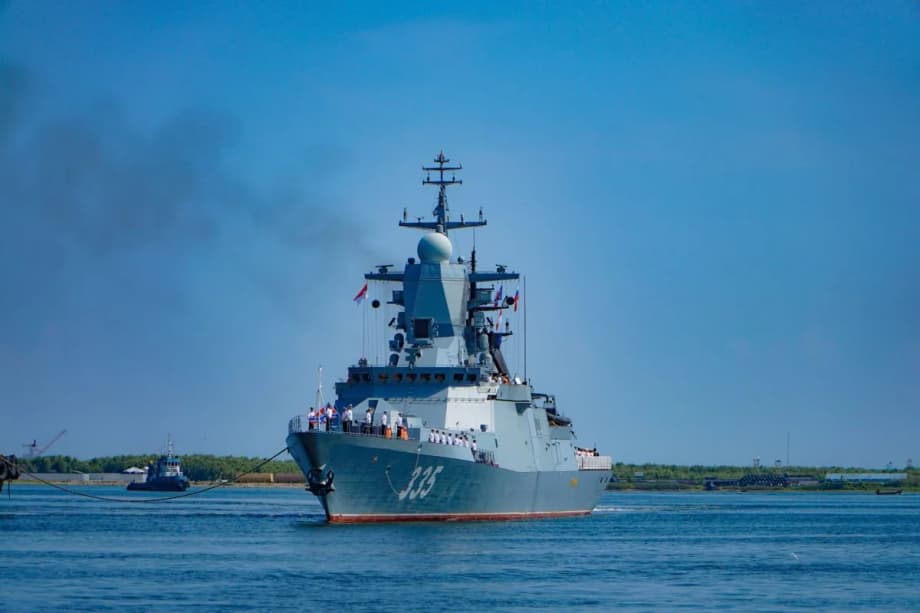
A detachment from Russia’s Pacific Fleet arrived at Tanjung Priok Port in North Jakarta on March 29, 2026, bringing a rare combination of surface and undersea combat capabilities to one of Southeast Asia’s most strategically vital maritime hubs. The arrival of the corvette Gromky, the submarine Petropavlovsk-Kamchatsky, and the fleet tug Andrey Stepanov marks the latest chapter in an expanding pattern of naval cooperation between Moscow and Jakarta that has accelerated since President Prabowo Subianto took office in October 2025.
- Russian Submarine Docks in Jakarta Amid Shifting Indo-Pacific Dynamics
- Long-Range Deployment Showcases Russian Naval Reach
- Building on Previous Engagements in Surabaya and Beyond
- Non-Alignment in Practice: Jakarta’s Multi-Vector Approach
- Australian Perspectives and Regional Security Concerns
- Undersea Competition Reshapes Maritime Security Calculations
- Maneuver Drills and Port Diplomacy Define the Engagement
- Moscow Sustains Pacific Presence Amid Global Pressures
- Key Points
The Russian Embassy in Jakarta confirmed that the visiting crews will participate in joint drills focused on maneuver and communication protocols, along with ceremonial activities, work meetings, and friendly sports competitions. While these exercises may appear modest in scope compared to major multinational war games, the presence of a diesel-electric submarine in Indonesian waters carries weight disproportionate to the tactical training itself. Submarines represent stealth, sea denial potential, and intelligence collection capabilities that automatically elevate the strategic significance of any port visit, particularly in a region where undersea warfare competition is intensifying.
For Indonesia, hosting the Russian submarine serves multiple diplomatic objectives simultaneously. Jakarta maintains a long-standing policy of non-alignment, seeking to engage with multiple major powers without binding itself to any single security architecture. By welcoming Russian naval assets while simultaneously deepening ties with Western partners, Indonesia reinforces its image as a sovereign maritime actor capable of managing diverse international relationships. The visit also provides Indonesian Navy personnel with opportunities to observe Russian undersea technology and operational procedures, contributing to Jakarta’s broader understanding of regional naval capabilities.
The timing of this visit reflects broader shifts in the Indo-Pacific security landscape. Russia has sustained its Pacific Fleet operations despite ongoing strategic pressures elsewhere, while China expands its seabed mapping activities and submarine deployments across the region. Against this backdrop, even limited naval engagements attract heightened scrutiny from regional capitals and external powers monitoring shifts in alignment and access patterns.
Long-Range Deployment Showcases Russian Naval Reach
The Russian detachment that entered Jakarta represents a carefully selected mix of combat and support vessels designed to demonstrate sustained operational capability far from home waters. The corvette Gromky (335) serves as the surface combatant centerpiece, while the Kilo-class submarine Petropavlovsk-Kamchatsky (B-274) provides the undersea warfare element that transforms this from a routine diplomatic call into a serious military engagement. The inclusion of the fleet tug Andrey Stepanov signals that this is not merely a ceremonial appearance but part of an extended deployment requiring logistical self-sufficiency.
This task group departed Vladivostok in February 2026 as part of what Russian officials describe as a long-range Asia-Pacific mission. Such deployments require complex planning for fuel, provisions, and maintenance support, demonstrating that Moscow retains the capacity to project naval power into Southeast Asian waters despite resource constraints and competing demands. The ability to sustain a submarine on extended patrol thousands of kilometers from its home base sends a clear message about Russian technical competence and strategic priorities.
Submarines like the Petropavlovsk-Kamchatsky possess capabilities that make them particularly significant in regional security calculations. Diesel-electric submarines operating in littoral waters can threaten surface shipping, conduct intelligence collection, and complicate adversary planning through their inherent stealth characteristics. For regional navies, the presence of any foreign submarine in nearby waters necessitates adjustments to anti-submarine warfare postures and surveillance routines, regardless of whether the vessel is conducting active operations or participating in cooperative exercises.
Building on Previous Engagements in Surabaya and Beyond
The Jakarta visit follows a pattern of intensifying naval contact that began well before the current deployment. In November 2024, the Indonesian and Russian navies conducted their first bilateral exercise, Orruda 2024, in the Java Sea near Surabaya. That engagement involved Russian corvettes Gromky and Aldar Tsydenzhapov, the frigate Rezkiy, and the tanker Pechenga, alongside Indonesian frigates and anti-submarine helicopters. During that exercise, the Russian Navy also deployed the submarine B-588 Ufa to Surabaya for a port visit, establishing precedent for the current submarine presence in Jakarta.
Colonel Widyo Sasongko, head of the Indonesian Navy’s Information Office for the 2nd Fleet Command, characterized the Orruda exercise as a symbol of appreciation and solidarity between the two navies. Russian officers paid respects at the Nanggala Monument, commemorating Indonesian sailors lost in the 2021 KRI Nanggala-402 submarine disaster, signaling professional respect between undersea warfare communities. These gestures build institutional familiarity that facilitates future cooperation, even when exercises remain limited in tactical complexity.
The joint training became a symbol of appreciation and solidarity from the Russian Navy to the Indonesian Navy, as well as strengthening the friendship of our two navies.
Earlier in 2025, Russian Pacific Fleet ships returned to Indonesia for a port visit tied to the seventy-fifth anniversary of diplomatic relations. The corvettes Aldar Tsydenzhapov and Rezkiy, accompanied by the tanker Pechenga, participated in that engagement, which also included Indonesia’s first hosting of the Komodo multilateral naval exercise involving Russia alongside the United States, Japan, and China. These repeated appearances suggest that Russian-Indonesian naval cooperation is evolving from episodic gestures into a more structured relationship, even if it remains far smaller in scale than Indonesia’s exercises with Western partners.
Non-Alignment in Practice: Jakarta’s Multi-Vector Approach
Indonesia’s welcoming of Russian naval assets occurs within a broader foreign policy framework that emphasizes strategic flexibility over bloc alignment. President Prabowo Subianto has moved quickly to assert Indonesia’s independence on the world stage, including announcing Indonesia’s desire to join BRICS in October 2025 and cultivating defense relationships across the geopolitical spectrum. This approach allows Jakarta to maximize diplomatic options while avoiding dependence on any single external power, a posture particularly important for a nation commanding critical sea lanes including the Malacca and Sunda straits.
The scale of the Russian engagement highlights the difference between Jakarta’s cooperative activities with various partners. Super Garuda Shield, the annual exercise involving Indonesia, the United States, and numerous allied nations, deployed approximately 5,500 troops over a month in 2025, involving complex combined arms operations. By comparison, the Orruda exercises and the current Jakarta drills involve hundreds of personnel at most, focused on basic communication and maneuvering protocols. As one defense analyst noted regarding the 2024 exercises, comparing Orruda to Garuda Shield is like offering spare change after dining at an expensive restaurant.
However, symbolic value does not equate to strategic insignificance. By maintaining active channels with Russian military forces, Indonesia preserves its credentials as a genuinely non-aligned power while gaining insight into Russian naval capabilities and doctrine. This hedging strategy serves Jakarta’s long-term interest in ensuring that no single power dominates Southeast Asian maritime spaces. Prabowo’s philosophy, often summarized by his quotation of the proverb that a thousand friends is too few while one enemy is too many, drives a foreign policy designed to avoid alarming neighbors while maximizing Indonesia’s international leverage.
Australian Perspectives and Regional Security Concerns
The arrival of Russian warships in Jakarta has prompted particular attention in Australia, where strategic analysts have monitored indications of deepening Russia-Indonesia defense ties with growing interest. Recent reports suggesting Russian interest in potential basing arrangements in Indonesia sparked heated political debate during Australia’s 2025 election campaign, with both major parties scrutinizing the implications for regional security. While Indonesian officials have consistently maintained that permanent foreign basing contradicts their constitutional principles of non-alignment, the pattern of increasing naval cooperation has raised questions in Canberra about long-term strategic trajectories.
Ian Storey, a close observer of Russia’s activities in Southeast Asia, noted that Russia’s interest in basing in Indonesia was at least somewhat plausible given Moscow’s isolated international position and its drive to seek niche forms of cooperation in the region. Russian Security Council Secretary Sergei Shoigu visited Indonesia and Malaysia in February 2025, receiving high-level receptions that suggested substantive discussions beyond ceremonial diplomacy. For Australia, which maintains close defense ties with Indonesia including the significant August 2025 defense pact signed under Prabowo’s watch as defense minister, any expansion of Russian military access represents an unpalatable complication in an increasingly contested region.
The comparison between Russian port visits and the United States’ rotational presence in Australia highlights the complexity of regional access politics. Australian officials have noted that while they host American forces, they maintain that such arrangements differ fundamentally from potential Russian access to Indonesian facilities, given the divergent strategic intentions and alliance structures involved. Canberra’s primary tool for influencing Indonesian foreign policy remains the bilateral relationship itself, which has stabilized significantly in recent years after historical disputes over cattle exports, spying allegations, and people smuggling.
Undersea Competition Reshapes Maritime Security Calculations
The presence of the Petropavlovsk-Kamchatsky in Jakarta occurs against a backdrop of intensifying undersea competition across the Indo-Pacific. Recent investigations have revealed extensive Chinese seabed mapping operations throughout the Pacific, Indian, and Arctic oceans, activities that naval experts say directly support submarine warfare capabilities. Research vessels operated by Chinese state entities have conducted detailed surveys near Guam, Hawaii, Taiwan, and the approaches to the Malacca Strait, gathering data on underwater terrain, temperature gradients, and acoustic conditions that determine submarine detection ranges and stealth effectiveness.
Former submarine commanders and anti-submarine warfare specialists emphasize that understanding the undersea environment proves crucial for both concealing friendly submarines and detecting adversary vessels. Sound propagation changes dramatically based on seafloor topography, water temperature, and salinity levels. The data China collects through its transparent ocean sensor networks and seabed mapping enables more effective deployment of its own submarine forces while complicating American and allied undersea operations.
The scale of what they are doing is about more than just resources. If you look at the sheer extent of it, it is very clear that they intend to have an expeditionary blue-water naval capability that also is built around submarine operations.
Simultaneously, regional submarine infrastructure is expanding. Singapore recently established a submarine maintenance hub with German manufacturer TKMS to service its Invincible-class boats and allied vessels, reflecting growing undersea capabilities among Southeast Asian navies. Indonesia itself operates a submarine force, though it suffered the tragic loss of KRI Nanggala-402 in 2021. The technical exchanges facilitated by hosting Russian submarines may contribute to Indonesia’s undersea warfare knowledge, even if direct technology transfer remains limited by international sanctions and policy constraints.
Maneuver Drills and Port Diplomacy Define the Engagement
The specific activities planned during the Russian visit reveal the limited but practical nature of the cooperation. The joint drill on maneuver and communication focuses on core naval competencies that enable safe interaction between vessels operating in close proximity. These exercises establish common procedural languages, test command coordination rhythms, and build the familiarity necessary for future encounters, whether in cooperative exercises or crisis situations requiring deconfliction.
Beyond the tactical training, the visit includes significant public diplomacy components. An open ship program scheduled for March 31 allows Indonesian citizens and Navy personnel to tour the Russian vessels, providing transparency and reducing the mystery that often surrounds foreign military presences. Ceremonial activities, work meetings between commanders, and friendly sports matches serve to build personal relationships between officer corps that can facilitate communication during future contingencies.
The Russian Embassy has emphasized that both nations reaffirmed their commitment to strengthening mutual interaction to preserve peace and stability in the Asia-Pacific. This framing allows both governments to present the engagement as stabilizing rather than provocative, even as regional observers note the strategic signaling inherent in the deployment. For Russia, the ability to dock a submarine in a major Southeast Asian port demonstrates that it remains a maritime actor with interests extending into the Indo-Pacific, countering narratives that Moscow’s strategic focus has narrowed exclusively to Europe and the Arctic.
Moscow Sustains Pacific Presence Amid Global Pressures
The Jakarta deployment forms part of a broader Russian effort to maintain visibility in the Asia-Pacific despite the strategic and resource pressures of the ongoing conflict in Ukraine. Concurrent with the Indonesian visit, Russian forces have conducted joint exercises with China as part of Joint Sea-2025, involving submarine rescue operations and anti-submarine warfare training near Vladivostok. Russian surveillance ships and maritime patrol aircraft have also maintained active operations near Japan, tracking through the Tsugaru Strait and Sea of Okhotsk.
These activities serve multiple audiences simultaneously. For domestic constituencies, they demonstrate that Russia retains global military reach. For regional partners like Indonesia, they offer an alternative security relationship outside Western-centric frameworks. For competitor navies, they signal that Russian forces remain active in maritime chokepoints and strategic waterways. The Pacific Fleet’s ability to sustain long-range deployments, even with limited numbers of vessels, preserves Moscow’s credentials as a stakeholder in Asian security affairs.
The pattern of regular port visits to Indonesia, combined with participation in multilateral exercises like Komodo, suggests that Russia seeks to normalize its presence in Southeast Asian security conversations. While these engagements cannot alter the fundamental balance of naval power in the region, which remains dominated by the United States and its allies alongside growing Chinese capabilities, they do complicate strategic planning for all actors by adding another variable to alliance calculations and maritime domain awareness requirements.
Key Points
- The Russian Pacific Fleet detachment including submarine Petropavlovsk-Kamchatsky and corvette Gromky arrived at Jakarta’s Tanjung Priok Port on March 29, 2026.
- Joint drills will focus on maneuver and communication protocols, representing limited tactical scope but significant strategic signaling.
- The visit follows previous engagements including the November 2024 Orruda exercise in Surabaya and a May 2025 port call, indicating patterned rather than isolated cooperation.
- Indonesia maintains its non-alignment policy by engaging simultaneously with Russia, Western allies, and regional partners without exclusive security commitments.
- Regional powers including Australia monitor these developments closely, though permanent Russian basing in Indonesia remains unlikely given Jakarta’s constitutional constraints.
- The deployment occurs amid intensifying undersea competition, with China conducting extensive seabed mapping and regional nations expanding submarine capabilities.
- Russia seeks to demonstrate sustained maritime reach and preserve its status as an Indo-Pacific security stakeholder despite strategic pressures elsewhere.