A generation enters work on weaker financial ground
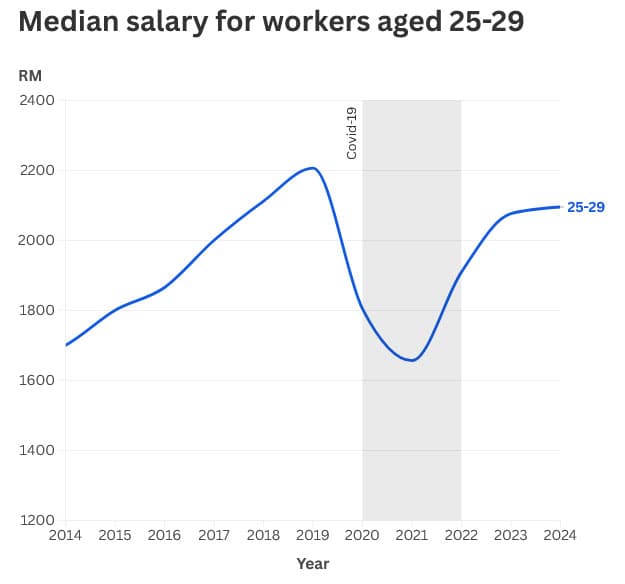
Young Malaysians are entering the workforce with qualifications that promise better earnings, yet the latest figures show that many are starting their careers from a weaker position than workers of the same age before the pandemic. The median monthly salary for workers aged 25 to 29 was RM2,095 in 2024, compared with RM2,206 in 2019, according to the Department of Statistics Malaysia. The decline is about 5% in nominal terms, and this age group was the only one whose median pay had not returned to its 2019 level.
- A generation enters work on weaker financial ground
- What is wage compression?
- Why are qualified workers struggling to find better jobs?
- How low pay affects wealth and housing
- Why job hopping is often a response to poor job quality
- Is self employment a solution?
- What can employers and policymakers do?
- Why company productivity matters to pay
- Key Points
The figures point to more than a temporary setback. Many workers in this group are recent graduates who are beginning to repay education costs, support their families, build savings and consider home ownership. A low first salary can affect each of those decisions because future raises are often calculated as a percentage of existing pay.
The pressure is also being felt through the cost of housing and daily necessities. While wages have been slow to recover, rent, transport, food and loan payments have continued to absorb a large share of household income. The result is a growing gap between having a job and being able to build financial security from that job.
Bank Negara Malaysia data show that the real starting salary of diploma graduates fell from RM1,458 in 2010 to RM1,376 in 2018 after adjustment for inflation. The figures suggest that the purchasing power of entry level pay has weakened even before the disruption caused by Covid 19.
What is wage compression?
Bank Negara Malaysia deputy governor Datuk Marzunisham Omar recently described the situation as wage compression. In practical terms, this means that the difference between the pay of new workers and the minimum wage has become unusually small, even for employees with recognised qualifications.
Malaysia raised the minimum wage to RM1,700 last year and introduced the Progressive Wage Policy in 2024. Those measures create a floor for earnings and encourage employers to link pay increases to skills and productivity. They do not, by themselves, guarantee that graduates will move quickly into jobs that match their education.
Speaking at the BNM Sasana Symposium 2026, Marzunisham said Malaysia still did not have enough jobs requiring advanced skills. He also said that about 35% to 36% of workers were employed in roles requiring qualifications below those they possessed.
This situation is known as skill related underemployment. It differs from unemployment because the person has a job, yet the job does not use the full level of knowledge or training that the worker has acquired. A graduate working in a role designed for a much lower qualification level may receive less pay, gain fewer relevant skills and face slower career growth.
Research from the World Bank found that more than 44% of tertiary educated Malaysians aged 25 to 29 were working below their skill level. Among tertiary educated workers, those in lower skill roles faced a wage penalty of about 49.3% compared with workers in jobs that matched their qualifications.
Why are qualified workers struggling to find better jobs?
The problem has two sides. Malaysia has expanded access to tertiary education, with the share of workers holding tertiary qualifications rising from 30.2% in 2015 to about 36.1% in 2024. The supply of educated workers has grown quickly, while the creation of high productivity jobs has not kept the same pace.
High productivity jobs generally produce more value through advanced technology, specialist knowledge, research, management or complex services. They tend to pay more because workers in these positions contribute more to company revenue. When economic growth produces many lower productivity roles instead, graduates may accept jobs that provide immediate income but limited professional development.
Education and training gaps also contribute. Some graduates leave institutions without the technical, digital or communication skills employers need. Employers, meanwhile, may struggle to describe their requirements accurately or invest enough in training new staff. Mismatches between fields of study and available vacancies can leave workers overqualified on paper but poorly matched to actual roles.
The mismatch is uneven across the country. The World Bank research found higher levels of skill related underemployment in states such as Kelantan, where more than half of tertiary educated workers were in jobs below their qualification level. The rate was about 40% in Terengganu, Pahang and Perlis. More industrialised and knowledge focused areas, including Kuala Lumpur and Penang, generally recorded lower rates.
Malaysia also loses part of its skilled workforce to overseas markets. More than half of the 1.86 million Malaysians living abroad work in skilled or semi skilled jobs, especially in Singapore, Australia, the United Kingdom and the United States. This suggests that Malaysia is producing capable workers, yet domestic firms are not always creating enough jobs to retain or properly reward them.
How low pay affects wealth and housing
Dr Wan Arnidawati Wan Abdullah, head of the Laboratory of Social Gerontology at the Malaysian Research Institute on Ageing, said graduate starting salaries commonly range from RM2,000 to RM3,000. She said the central concern was the decline in their real value, meaning what those salaries can actually buy.
She warned that workers who begin with lower pay may struggle to catch up because later increments are often based on their current salary. For example, a worker receiving a 5% raise on RM2,200 gains less than a worker receiving the same percentage on RM3,000. The difference can continue to grow through each promotion and job change.
Wan Arnidawati also linked the wage gap to property ownership. Malaysia has a house price to income ratio of about 4.7, above the affordability benchmark of 3.0. A ratio of 4.7 means a typical home costs roughly 4.7 times annual household income, before taking account of interest, taxes, maintenance and other expenses.
She said many workers now aged 35 to 44 bought homes before the sharpest price increases. Younger workers may spend years paying rent without building an asset that can support them later in life.
Young people entering the workforce today may not have the same opportunity.
Housing is only one part of the calculation. Delayed savings can also affect retirement contributions, emergency funds, marriage, family support and the ability to start a business. A worker who uses nearly all monthly income for essential expenses has little capacity to absorb a medical bill, a period of unemployment or a sudden rise in rent.
Why job hopping is often a response to poor job quality
Frequent job changes among young Malaysians are often presented as evidence of weak loyalty or impatience. Research from the PNB Research Institute points to a different explanation. Low pay, unclear career progression and work that does not match qualifications are major reasons young employees leave.
In the third quarter of 2025, 74.3% of workers aged 15 to 24 were in roles below their qualification level, compared with a national average of 35.5%. The rate among workers aged 25 to 34 was still about 41%. Underemployment tends to fall as people gain experience, yet remaining in a poorly matched role for several years can reduce the quality of that experience.
Entry level wages have also declined in real terms over a longer period. The PNB Research Institute reported that real entry wages fell by 10% for degree holders and 28% for master degree holders between 1997 and 2022. It also found that 66.3% of degree holders and 93.1% of diploma holders earned less than RM3,000, while 30.6% of degree holders and 66.3% of diploma holders earned below RM2,000.
The estimated monthly cost of living for a single person in Kuala Lumpur is about RM2,400. Some government linked companies use RM3,100 as a living wage benchmark. When graduate pay falls below basic living costs, changing employers can become a rational way to search for stability rather than a sign of poor work habits.
Digital recruitment platforms and professional networks have made these moves easier. They also make salary comparisons more accessible, allowing workers to identify firms that pay more or provide clearer promotion structures.
Is self employment a solution?
Entrepreneurship and freelance work can provide another route to higher income. HELP University economist Prof Dr Chung Tin Fah said younger workers could use entrepreneurship skills to create income outside traditional employment. Under the life cycle theory of earnings, wages usually rise with age and experience and reach a peak around 40 to 45. Public sector earnings may peak later because seniority plays a larger role.
Malaysia has already seen a sharp rise in youth self employment. Data from the DOSM MyLabourHub portal show that the number of own account workers in their early 20s grew from 128,000 in 2013 to 286,000 in 2025. Among those aged 20 to 24, the number rose 123%. The number of own account workers aged 25 to 29 increased by 34%.
These workers include freelancers, e hailing drivers, delivery riders and people running small businesses without paid employees. Digital platforms have also opened opportunities in areas such as coding, writing, design, childcare and online services.
Self employment can provide flexibility, yet it can also transfer business risks from companies to individuals. Income may change sharply from month to month, and workers may lack paid leave, employer retirement contributions, health coverage or protection against injury. Khazanah Research Institute Associate Director Dr Rachel Gong said many graduates eventually move into standard employment because stable income and stronger job security remain attractive.
Better protection for independent workers will become more important if this segment continues to grow. Possible measures include wider access to Employees Provident Fund and Social Security Organisation contributions, clearer employment status, affordable insurance and stronger representation in discussions with digital platforms.
What can employers and policymakers do?
Dr Wan Arnidawati said employers should move beyond promotions based only on tenure. Skills based salary progression would allow workers to earn more when they gain capabilities that help the business. Structured training, mentoring and alternative career routes could also reduce the need to change employers simply to obtain a meaningful pay increase.
Universiti Malaya economist Prof Dr Mohd Nazari Ismail said companies need stronger revenue growth if they are to pay more. Expanding into overseas markets can give firms greater room to raise wages, especially when exports are tied to specialised products and services. Higher salaries alone will not solve financial pressure if food, housing and other prices rise faster than pay.
Government policy can support this process by helping firms move into higher value activities, improving job matching and expanding work based learning. Technical and vocational education can give young people practical skills while allowing employers to shape training around real vacancies.
The Ministry of Human Resources has said its MyMahir ecosystem, including the Future Skills Talent Council, the Critical Occupations List and the AI Readiness Index, is being strengthened to align training with changing industry needs. Better labour market information can help students choose fields with stronger demand and help companies identify suitable candidates.
Artificial intelligence adds a new layer to the challenge. A 2025 PwC survey of nearly 50,000 workers across 48 economies found that 54% had used AI for work in the previous year, while only 14% used generative AI daily. Entry level workers were among the most concerned about the effect of AI on their careers. Employers that provide training and transparent information can help young staff use technology to improve productivity rather than leaving them to face disruption without support.
The United Nations has also called for a balanced mix of technical, digital, AI, environmental, social and civic skills. Training needs to be linked to decent work, recognised qualifications and real opportunities for advancement. Skills programmes that produce certificates without improving job quality will have limited value.
Why company productivity matters to pay
Wages cannot rise sustainably if businesses have little capacity to support higher payroll costs. That is why the debate must include productivity, market access and business investment. Firms that remain concentrated in low margin activities may rely on low wages to compete, while firms that develop new products, use technology well and reach overseas customers can often pay more.
Trade policy can also affect job creation. World Bank research from South Asia found that sectors with lower trade barriers generated a large share of employment growth and tended to pay more than average. While Malaysia has a different economic structure, the lesson is relevant: access to international markets and affordable inputs can help companies expand, hire younger workers and create more skilled positions.
At the same time, workers need support when industries change. Retraining, career counselling and easier movement between sectors can reduce the time people spend trapped in low paying work. The aim should be a labour market where a first job is a starting point for skill growth, rather than a wage level that follows workers for years.
Key Points
- Workers aged 25 to 29 had a median monthly salary of RM2,095 in 2024, below RM2,206 in 2019.
- About 35% to 36% of Malaysian workers are in jobs below their qualification level.
- More than 44% of tertiary educated workers aged 25 to 29 are underemployed by skill level.
- Skill mismatch can reduce pay for tertiary educated workers by about 49.3% compared with matched roles.
- Malaysia’s house price to income ratio is about 4.7, above the affordability benchmark of 3.0.
- Youth self employment more than doubled among workers in their early 20s between 2013 and 2025.
- Long term progress will require better job matching, stronger productivity and salary growth linked to skills.