
Smoke crosses borders as respiratory cases rise
Indonesia recorded 50,891 acute respiratory infection cases linked to land and forest fires during July and August, including more than 12,000 children under five, as wildfire smoke spread across Southeast Asia. As of September 9, 2026, fires burning for weeks in Sumatra and Kalimantan, the Indonesian part of Borneo, were disrupting classrooms, transport and daily life while exposing millions of people to dangerous air pollution.
Contents
- Smoke crosses borders as respiratory cases rise
- How the haze reaches neighboring countries
- El Niño dries the land, while human activity starts fires
- Peat can keep burning beneath the surface
- Children and clinics face the growing health burden
- School closures, water shortages and wildlife losses
- Earlier fire seasons show the scale of the danger
- Firefighting expands as September brings peak conditions
- The Bottom Line
Pollution in some affected areas has exceeded 15 times the World Health Organization guideline. Monitoring stations in countries reached by the smoke, including Malaysia, Singapore and the Philippines, have recorded unhealthy, very unhealthy or hazardous conditions. Prolonged drought associated with a powerful El Niño has left forests, plantations and peatlands vulnerable to fires that can grow quickly and remain difficult to extinguish.
Indonesia's education disruption is already extensive: more than 1.4 million students have moved to remote learning, and about 12,800 schools across Sumatra and Borneo have remained closed while authorities monitor pollution. Children, older people and residents with asthma or other breathing conditions face the greatest health risks, according to health officials and aid agencies.
The emergency combines several pressures. Dry weather helps flames spread, land clearing supplies many of the ignition points, and drained peat can keep burning beneath the ground. Winds then carry the smoke beyond the communities where the fires began. The crisis is expected to remain serious while dry conditions continue through the peak fire season.
Forecasters have described the El Niño event as unusually powerful, with conditions expected to persist into early 2027. Indonesia's Meteorology, Climatology, and Geophysics Agency has forecast a dry season from July to September, while fire conditions can extend into October if rainfall remains limited.
How the haze reaches neighboring countries
Sumatra and Kalimantan are the main fire zones. Seasonal winds can move smoke across the Malacca Strait and the South China Sea, taking pollution from individual burning areas to communities hundreds of kilometers away. The spread means that decisions about schools and public health are being made far beyond Indonesia's borders.
Malaysia's Sarawak state, which shares Borneo with Indonesia and Brunei, declared an emergency in one district after pollution rose sharply. Nearly 650 schools were ordered to close across the state. Kuching, the state capital, ranked among the world's most polluted major cities during the worst days of the haze.
Singapore's National Environment Agency warned that smoke could affect the city state as regional fire activity increased and rainfall remained low. Air quality in Singapore's central region reached unhealthy levels.
The Philippines has also experienced haze in parts of Luzon, the Visayas and Mindanao. Manila and other areas recorded very unhealthy or severely unhealthy levels of PM2.5. Residents reported itchy eyes, sore throats and headaches even in places more than 800 kilometers from the main fire zones.
PM2.5 means microscopic particles less than 2.5 micrometers wide. These particles can travel deep into the lungs and enter the bloodstream, increasing the risk of breathing problems, heart disease and other serious conditions. Their small size helps explain why smoke can harm people even when the fires themselves are far away.
Ordinary cloth masks offer limited protection against such small particles. During severe pollution, staying indoors, closing windows and using properly fitted particulate filters are more effective measures. Residents in Indonesia have nevertheless described smoke entering their homes even when doors and windows are shut, showing how difficult avoiding exposure can become.
El Niño dries the land, while human activity starts fires
El Niño is a recurring climate pattern in which surface waters in the central and eastern Pacific Ocean become unusually warm. It can change rainfall across much of the world. In Indonesia, a strong event usually brings a longer, drier season, taking moisture from vegetation and drying wetlands that would normally help slow fire.
Many of the current blazes are believed to have begun during land clearing, including burning to prepare areas for plantations, farms and roads. Dry conditions allow those fires to escape and spread across a much larger area.
David Gaveau, founder of the Nusantara Atlas monitoring project, explained how human ignition and the climate pattern work together:
El Niño does not ignite fires. It creates the dry conditions that allow human started fires to escape and become very large.
Environmental groups and researchers have found that fires often return to the same areas, including oil palm and timber concessions. Satellite monitoring recorded more than 210,000 hotspots in Indonesian peatland areas between January and August. Another monitoring platform detected more than 444,200 possible fire sites across the archipelago by early September.
Indonesia's fire season has developed over several months, with health impacts mounting before the expected peak of dry conditions:
- January to August: satellite monitoring recorded more than 210,000 hotspots in Indonesian peatland areas.
- July and August: the Health Ministry recorded 50,891 acute respiratory infection cases linked to land and forest fires.
- August: 72 people were arrested on suspicion of starting forest fires.
- Early September: another monitoring platform had detected more than 444,200 possible fire sites across Indonesia.
- September: authorities expected the peak of dry conditions, with fire conditions potentially continuing into October if rain remained limited.
- Early 2027: forecasters expected the powerful El Niño conditions to persist into this period.
Peat can keep burning beneath the surface
Peatlands are wetlands made from layers of partially decomposed plants. Water slows the breakdown of this plant material, allowing carbon to accumulate over thousands of years. Some peat deposits in Kalimantan are more than 20 meters deep and can hold thousands of tonnes of carbon per hectare.
Draining these wetlands for plantations or other development changes how they behave during a fire. The peat dries and becomes combustible. Flames can spread beneath the surface, sometimes several meters underground, even after visible fire has disappeared. A location that seems extinguished can begin producing smoke again days later.
Dr Nisa Novita, a peatland researcher with Yayasan Konservasi Alam Nusantara, described both the value of these wetlands and the danger when they are damaged:
Peatlands are incredibly effective carbon stores because their waterlogged conditions slow decomposition, allowing carbon to accumulate underground for thousands of years. This also means they can become a carbon bomb when they are drained or burned, because that carbon can be rapidly released into the atmosphere.
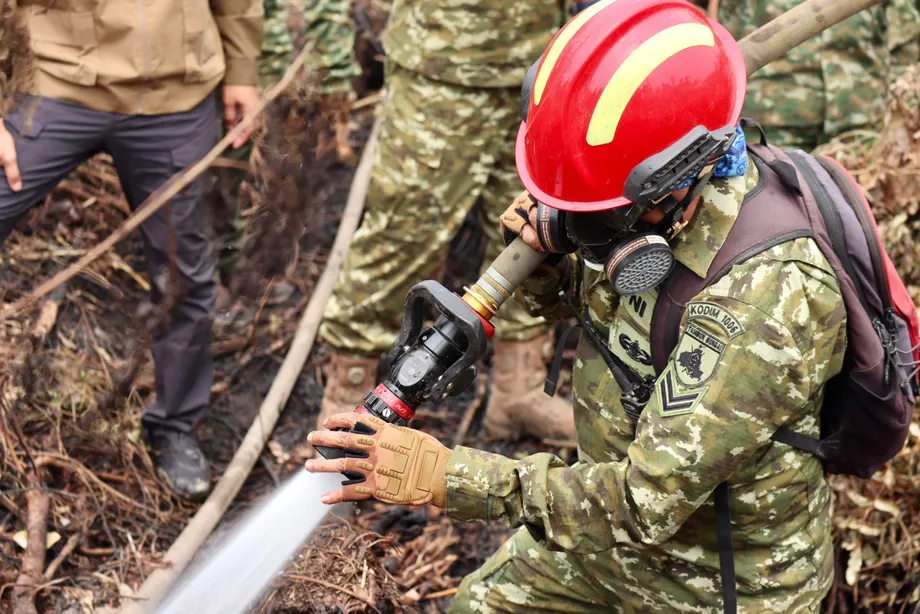
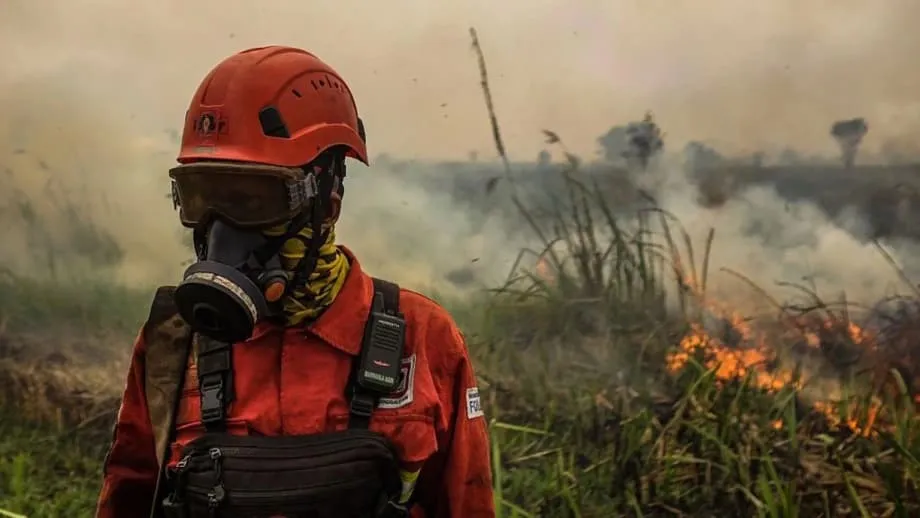
Fire crews must pump water into the ground, patrol burned areas and check for new outbreaks. Drying rivers and reservoirs make that work harder because firefighters need water to reach the burning material beneath the surface.
Andri Susanto, a firefighter with Indonesia's Manggala Agni service, said some areas had gone more than 60 days without meaningful rain. He also warned that underground embers could reignite after crews brought surface flames under control. The continued smoke, limited water and possibility of renewed burning make peat fires a prolonged challenge.
Children and clinics face the growing health burden
Rizma Nur Fatimah, a teaching assistant aged 19 in South Kalimantan, said smoke made visibility in her classroom so poor that people could not see their own feet. Residents had become accustomed to annual haze, she said, yet this season felt worse.
In nearby Pengayuan village, a mother said her daughter, aged three, developed a cough, sore throat and runny nose. At a clinic in Pontianak, physician Muhammad Arief Tri Hapsoro reported patients with coughs, shortness of breath, sore throats, fever, diarrhea and vomiting. He said patient numbers were roughly double the previous year's level.
Indonesia's Health Ministry figures show that children under five accounted for more than 12,000 of the 50,891 respiratory infection cases recorded in July and August. That is more than 23 percent of the recorded cases, or nearly one in four, calculated from the ministry's figures.
Children's lungs and immune systems are still developing, and they breathe more air relative to their body size than adults. Repeated smoke exposure can affect lung growth and worsen asthma. Closing schools can reduce exposure, but studying at home becomes difficult when families lack reliable internet, electricity or a quiet place to work.
Malaysia has reported increases in asthma and conjunctivitis, an eye condition. Its Health Ministry said asthma cases rose by 259 percent in the final week of August, while upper respiratory infections increased by 124 percent in one week.
Save the Children has distributed 8,500 masks to children and families in three districts of Kalimantan. Arshad Malik, the organisation's regional director, said the smoke crisis was also a child rights issue because it affected health, education and emotional wellbeing.
School closures, water shortages and wildlife losses
Palembang in South Sumatra ordered online classes for more than 250,000 students at 1,030 schools. Officials said they would review the decision as air quality changed and asked teachers to avoid placing excessive demands on children during remote learning.
The Palembang closures form part of the wider disruption affecting more than 1.4 million Indonesian students. Keeping children away from polluted classrooms addresses one immediate danger, while families must manage the practical demands of continuing lessons at home.
Pontianak residents have queued for treated water after household supplies ran dry. Some families collect rainwater, but dust from the smoke settled on roofs and turned the collected water black. Months without rain have placed pressure on communities near the burned areas, farmers and firefighters.
Firefighters have found dead snakes and pangolins as flames spread through rainforest and plantation landscapes. An orangutan rescued from an oil palm plantation in West Kalimantan later died, reportedly after inhaling smoke.
Borneo is home to many rare species, including orangutans whose habitat has already been reduced by logging, plantations and road construction. The fires and haze add to those pressures, affecting animals both through direct burning and through smoke exposure.
Earlier fire seasons show the scale of the danger
Indonesia has experienced major fire and haze seasons for decades. Much of the current land use pattern took shape during the Suharto era, when extensive rainforest and peatlands were opened for logging, plantations and development. Burning can be an inexpensive way to clear land, but it becomes extremely dangerous when peat has been drained and the weather turns dry.
The 2015 fire season remains the most recent benchmark. Government figures said about 2.6 million hectares burned between June and October that year, 24 people died, and millions of people across Southeast Asia were exposed to smoke for weeks.
Fires also spread during the El Niño years of 2019 and 2023, although damage was less extensive than in 2015. Professor Bambang Hero Saharjo, a forest fire forensics expert at Institut Pertanian Bogor University, said last year's fires burned about 359,000 hectares even without El Niño conditions.
Bambang has warned that the current season could burn between 10 million and 11 million hectares if dry weather and fires intensify, a scale comparable to the worst seasons of the late 1990s. His projected range is roughly four times the 2.6 million hectares recorded in 2015.
Estimates of land already burned this year range from more than 200,000 hectares to nearly 300,000 hectares, depending on the measurement period and method. The season is continuing, and measuring fires across remote peatlands and plantations is difficult, so the final area burned is not yet known.
Firefighting expands as September brings peak conditions
Indonesia has expanded firefighting operations and received aircraft and other assistance from Japan, the United States, Russia, Australia, Canada and Ukraine. Authorities have also investigated suspected deliberate burning, with 72 people arrested in August on suspicion of starting forest fires.
Forestry Minister Raja Juli Antoni said September brought the most difficult period of the season as dry conditions reached their peak:
Our problems are not over. September is the peak of El Niño. September is the main fight for us.
Malaysia has considered cloud seeding in Sarawak. The method requires suitable clouds and enough moisture; it cannot produce rain from a clear, exceptionally dry sky. Its usefulness therefore depends on weather conditions at the time.
The ASEAN Specialised Meteorological Centre has activated its highest alert for transboundary haze in southern Southeast Asia. Agencies are tracking hotspots, wind direction, rainfall and PM2.5 readings to follow where fires are developing and where their smoke may travel.
Fire crews face the immediate task of containing flames and soaking burning peat, while government enforcement addresses where fires begin. Protecting peatlands, restoring water levels, monitoring plantation concessions and prosecuting illegal burning can reduce the chance that small fires become a regional disaster.
Cooperation across borders is also needed because smoke travels beyond national boundaries. September's peak dry conditions, the possibility of fire weather continuing into October and forecasts of El Niño lasting into early 2027 keep attention on both emergency protection and the land use practices that allow fires to spread.
The Bottom Line
- Fires in Sumatra and Indonesian Borneo are sending dangerous haze into Malaysia, Singapore and the Philippines.
- Indonesia recorded 50,891 respiratory infection cases linked to fires during July and August, including more than 12,000 children under five.
- More than 1.4 million Indonesian students have moved to remote learning, with about 12,800 schools closed across affected areas.
- A powerful El Niño is drying vegetation and wetlands, while land clearing and drained peat help fires spread.
- Peat fires can burn underground, restart after surface flames are controlled and release carbon stored for thousands of years.
- Indonesia has expanded firefighting, Malaysia has considered cloud seeding, and regional agencies are monitoring smoke and fire conditions.
- September is the expected peak of dry conditions; fire conditions may continue into October if rainfall remains limited.