Red Carpet Welcome Masks Narrow Results
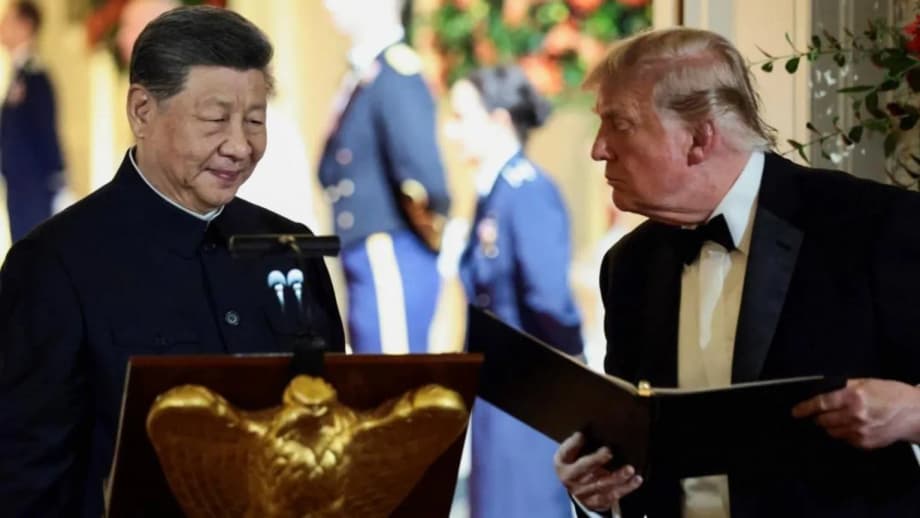
Washington offered Chinese President Xi Jinping a welcome designed to impress. President Donald Trump met his guest in person on the tarmac, ordered a ceremony with music and drills by 479 military personnel, and closed the display with a flyover by a B2 stealth bomber escorted by four F22 fighters. In the evening the two leaders sat for a state banquet featuring sesame crusted sea bass and braised baby bok choy. The setting was meant to match the lavish reception Trump received in Beijing in May, when the two presidents began a burst of face to face diplomacy that could bring four meetings in a single year.
- Red Carpet Welcome Masks Narrow Results
- Why A Short Trade Truce Matters Now
- Rare Earths Chips and Farm Goods At Center of Bargaining
- Taiwan Moves From Background To Front Line
- Artificial Intelligence Tests Cooperation And Rivalry
- Iran Ukraine And The Wider Global Divide
- Pageantry Pandas And Power Politics
- The Bottom Line
Trump spoke repeatedly of friendship and respect. He told reporters it was his honor and great honor to host Xi, while Xi answered more briefly that he was glad to be in Washington. Trump later described the bond as a truly great friendship and said the two countries could build ties based on mutual respect and the vital interests of their people. Xi called the talks sincere and in depth and said they had provided new strategic guidance for relations at another historical juncture. The language was warm. The substance behind it was far thinner.
The most concrete economic result had been settled before the leaders sat down. Negotiators meeting on September 20 agreed to extend a pause in tariff escalation that was due to expire on November 10. The leaders also pointed to limited deals on farm goods and a shared interest in talking about artificial intelligence (AI). Two giant pandas bound for Atlanta drew as much attention as any policy line. For Beijing the optics alone counted as a win, even as core disputes stayed open.
Why A Short Trade Truce Matters Now
The trade pause traces back to Busan in South Korea in October 2025. There Washington agreed to lift some controls on high end technology exports and to reduce triple digit tariffs on Chinese goods. Beijing in return agreed to pause enforcement of export controls on certain critical minerals and rare earths. That arrangement was meant to last a year. It created breathing room for exporters, importers and farmers on both sides while leaving deeper conflicts untouched.
The new extension runs only to January 10. It adds about two months rather than the year or more Beijing had sought as Xi looks to ride out the rest of the Trump presidency. United States Trade Representative Jamieson Greer said the sides agreed to exempt some key goods, including agricultural products and medical devices sold to China and consumer and non sensitive goods bought by the United States. Full details were expected the following Monday. Trump said tremendous strides had been made and that American farmers would be happy with expanded access to the Chinese market for farm and ranch products.
Speaking to reporters after the meeting, Trump framed the economic talks as a success for producers:
We have made tremendous strides on the issues facing our two countries. Our farmers are going to be happy.
Officials on the United States side said a longer pause will depend on delivery. Treasury Secretary Scott Bessent said Beijing needed to make good on its promises before Washington would consider lasting relief. Both sides have discussed a Board of Trade to review non sensitive business between the two economies, though how broad and lasting that body would be stays vague. A separate Board of Investment stays on the drawing board. The short extension keeps pressure on negotiators through two more high level gatherings, one at the Asia Pacific Economic Cooperation forum in Shenzhen from November 18 to 19 and another at the Group of 20 summit in Miami from December 14 to 15.
Weak Spending At Home Raises Stakes For Beijing
Xi arrived with domestic strains that make foreign markets more vital. China sells a record volume of goods around the world, yet shoppers at home hold back. Youth joblessness stays stubbornly high and home prices have slumped in a country where about 80 percent of households own their homes. Trade helps support growth, so shielding exports from punishing tariffs imposed last year matters a great deal in Beijing. A brief truce helps. It does not remove the risk of a fresh escalation early next year.
Rare Earths Chips and Farm Goods At Center of Bargaining
Two supply chains explain why talks keep stalling. China holds dominant weight in rare earth mining and processing, materials used in electric vehicles, wind turbines, phones and defense systems. That weight has become bargaining power when Washington presses Beijing on other fronts. The United States in turn limits Chinese access to advanced semiconductors and chip making tools, citing national security. Beijing sees those limits as an effort to contain its rise as a superpower, above all in trade, technology and Taiwan.
Agriculture offered the easiest place to show movement. Greer pointed to exemptions for farm products and medical devices heading to China. Trump stressed wider market opening for American farmers and ranchers. Consumer and non sensitive goods heading to the United States would also face less friction under the limited arrangement. Business groups welcomed any relief, though they asked how comprehensive and durable the exemptions will prove once lawyers publish the text.
The guest list at the state dinner showed where Washington sees future growth. OpenAI chief Sam Altman, Nvidia chief Jensen Huang, Apple chief Tim Cook, Amazon founder Jeff Bezos, Meta chief Mark Zuckerberg, Google chief Sundar Pichai and Tesla chief Elon Musk all attended. Xi brought no matching group of Chinese chief executives, a contrast with the business delegation Trump took to Beijing. Emily Kilcrease of the Center for a New American Security described the absence as a depressing mark of how strained commercial ties have become. Chinese officials had floated bringing major chief executives to match the American names, with the final choice tied to which sectors Beijing expects to grow fastest in the near term.
Taiwan Moves From Background To Front Line
Taiwan produced the sharpest exchange. Beijing treats the island as a core sovereignty matter and says outside support for its separate status crosses a red line. Xi pressed Trump to follow what Chinese state media called the correct position of opposing Taiwan independence and to handle the question with prudence. Chinese accounts said prudent handling would lay a solid foundation for strategic cooperation between the two countries. The wording goes further than the traditional United States line that Washington does not support Taiwan independence. It also blurs the line between the island ruling party and what Beijing labels independence forces.
According to the official Chinese account, Xi linked careful management of the island to the wider relationship:
Handling the Taiwan question with prudence will lay a solid foundation for strategic cooperation between China and the United States.
Trump offered no public shift. He did not mention Taiwan in his formal remarks and the White House issued no detailed readout explaining his answer. The silence mattered because Trump had delayed approval of a 14 billion dollar arms package for Taiwan, calling it a very good negotiating chip with Beijing. A separate 11 billion dollar package was approved in December. United States law requires Washington to provide Taiwan with means to defend itself, even though Washington holds no formal diplomatic ties with Taipei. Bipartisan voices in Congress continue to press for steady support.
Election Calendar And Military Buildup Shape Calculations
Neither side expects Taiwan voters or military trends to stand still. The island holds a presidential election in January 2028 that could prove more decisive than any communique in Washington. A win by the more China friendly Kuomintang or a turn toward isolationism in the United States presidential vote later that year would alter the picture. Beijing keeps expanding the naval power of the Peoples Liberation Army (PLA) to keep a military option available, while stressing economic incentives, coercion, diplomatic squeeze and hopes for fading American interest in the western Pacific. Washington still speaks of strategic ambiguity rather than a firm pledge to defend the island, a stance Trump has kept.
Veterans of past arms debates see a familiar pattern. Rupert Hammond Chambers, president of the United States Taiwan Business Council, called the present pause the fourth Taiwan arms sale freeze after two under former President George W Bush from 2005 to 2007 and 2007 to 2008 and one under former President Barack Obama from 2011 to 2015. He argued that past freezes only encouraged more pressure from Beijing. In a recent statement he warned that signaling sensitivity to Beijing on arms had let politics enter decisions on defensive sales. No movement on the delayed package was announced during the visit.
Artificial Intelligence Tests Cooperation And Rivalry
Technology gave the summit added urgency. When the two leaders met in May, regulation of artificial intelligence surfaced in a way few had expected during the first year of the Trump administration. Both sides said talks in principle could help as systems grew more capable and less predictable. On September 20 officials floated an emergency hotline to notify each other of grave national security incidents tied to artificial intelligence. Voter unease about data centers, job losses and the power of private model builders added pressure in the United States. In China state coverage sounds less hostile, pointing to gains in health care and consumer services, while private worries focus on whether troubled job markets will truly gain.
Xi struck a cautious note. He said China and the United States stand as leading nations in artificial intelligence with both the capability and the responsibility to guide it for good. He called for continued dialogue, exchange of views on risks and benefits and joint work to guard against misuse and abuse. His central line was that development must stay under human control. The message fits a leader shaped by disorder in his youth, including rural exile after his father fell from favor before the upheaval of the Cultural Revolution, and by a political system built around tight control.
Outlining his stance at the talks, Xi said the two powers had a shared duty to keep the technology supervised:
We have both the capability and the responsibility to develop and manage artificial intelligence for good and ensure that the development of artificial intelligence is always under human control.
Trump took a different line centered on speed. Before the summit he wrote that super intelligence would be a big topic but that he wanted to leave it exactly where it is, adding that China held the same view. He rejected calls for fresh guardrails and pointed to law enforcement as sufficient. His remarks contrasted with warnings from some American builders, including an essay by Anthropic chief Dario Amodei urging slower and safer development and a warning by a top safety researcher that the chance of catastrophic harm could exceed 10 percent. Trump has dismissed talk of human extinction tied to the technology as a hoax. Neither government shows willingness to accept limits that could hand an edge to the other side, and trust on chips, data and model weights stays low. Direct talks about talks may be the most that public diplomacy can deliver for now, with more sensitive exchanges kept discreet.
Iran Ukraine And The Wider Global Divide
Global conflicts underlined the gap. Xi urged Washington and Tehran to settle differences through negotiation as soon as possible. Beijing presents itself as favoring talks to end the war involving Iran that began with an American led campaign in February. United States Ambassador to China David Perdue said Trump told Xi that any direct or indirect Chinese support for Iran was totally unacceptable and that Beijing gave assurances it would offer no such backing. China rejects claims it aids Tehran leadership. Asked about Iran during a visit to the National Archives, Trump answered briefly that the topic had been covered and that he thought the effort would do great.
Energy and sanctions add another layer. Washington has passed new rules allowing penalties on buyers of Russian oil, and China stands as the largest purchaser. After the May meeting Trump had secured language that China opposes Iranian development of nuclear weapons and supports free flow of energy through the Strait of Hormuz. This time official summaries noted an exchange of views on the Middle East, the Ukraine crisis and the Korean Peninsula with no sign of alignment. Each side restated old positions while seeking to avoid a wider escalation that would rattle markets and supply lines.
Outside assessments stress continuity over breakthrough. Tom Christensen, a geopolitics specialist at the Center for Strategic and International Studies, said he expects considerable trouble in the relationship a year from now even on the economic front. Ambassador Perdue said the best result of the visit may have been to keep the conversation going. Xi spoke of a constructive relationship of strategic stability based on respect, fairness and reciprocity, where competition stays within bounds as a race to catch up rather than a wrestle with a single winner. Trump said the two countries could keep building ties that promote prosperity and security for future generations. Both leaders said confrontation would leave both sides worse off and urged continued dialogue on trade, finance and foreign affairs to seek common ground while setting aside differences.
Pageantry Pandas And Power Politics
For viewers in China the staging mattered almost as much as the text. State coverage highlighted the airport greeting, the troops, the bomber flyover and the banquet as proof that Xi stands as an equal. Memes shared widely on Chinese social media contrasted a grimacing Trump under roaring jets with an impassive Xi. One awkward moment when Xi appeared to decline a handshake during the final day only fed debate about the limits of warmth. After tea at the White House the two men toured the National Archives to view the Declaration of Independence, the Constitution and the Bill of Rights, images meant to signal history and continuity.
Panda diplomacy supplied the lightest headline. The gift of Ping Ping and Fu Shuang to Atlanta, first heralded in April, will now arrive within days as China restarts animal loans paused during colder ties. Announcements of this kind soften coverage at home and abroad without touching hard interests. The two sides also confirmed they expect to meet again in China in November during the Asia Pacific Economic Cooperation forum and in Miami in December for the Group of 20. Four leader meetings in just over half a year would mark an unusually dense calendar. Officials argue that steady contact alone has value when refusal to meet would look far more worrying.
Beneath the spectacle rivalry stays fierce. Xi links his goal of great rejuvenation of the Chinese nation with the Trump slogan of making America great again, arguing the two drives can support each other. Trump speaks of friendship. Beijing speaks of status, seeking recognition of China as a peer superpower that Washington should not block on trade, technology or Taiwan. Pandas, pageantry and warm words can smooth the tone. They do not settle who sets rules for chips, minerals, data, arms or shipping lanes. That contest will run through the January deadline and well beyond.
The Bottom Line
- Trump hosted Xi at the White House on September 24 with airport greeting, military ceremony, bomber flyover and state banquet.
- Trade truce from Busan in October 2025 was extended only to January 10, short of the year Beijing wanted.
- Limited exemptions cover farm goods, medical devices and non sensitive consumer goods, with details due after summit.
- Rare earths and advanced chips stay unresolved and central to future bargaining.
- Xi pressed Washington to oppose Taiwan independence, Trump gave no public shift and kept 14 billion dollar arms package on hold.
- On AI, Xi urged human control and dialogue, Trump favored speed with no new guardrails, hotline idea was floated.
- On Iran, Russian oil, Ukraine and Korea the sides exchanged views with no alignment.
- Pandas Ping Ping and Fu Shuang head to Atlanta soon, next meetings eyed in Shenzhen in November and Miami in December.