Smoke That Will Not Lift
Indonesia is living through one of its worst haze seasons in recent years, with health officials reporting about 175,000 cases of acute respiratory infection in districts affected by smoke since mid August. The cumulative tally covers 63 districts in six provinces from August 18 to September 21 and includes 40,363 cases in children younger than five. Doctors describe clinics crowded with patients suffering cough, sore throat, irritated eyes, bronchitis and pneumonia. Behind each case count is a family keeping children indoors, a classroom left empty, a health worker on extended duty.
Smoke from forest and land fires in Sumatra, Kalimantan and Papua has settled over cities, towns and farming villages for weeks. Air quality indexes in several areas have moved into unhealthy territory, forcing many residents to wear masks outdoors and keep windows shut at home. Health officials said more than 12.5 million people had been exposed to haze across seven provinces by early September. Case numbers climbed with speed, from 50,891 on September 1 to 113,336 on September 9 and then to 174,694 by September 21, according to reports presented by the health ministry.
Much of the harm comes from very fine particles in wildfire smoke. Then Suyanti, a health ministry official, told a press conference in Jakarta that the smog contains particulate matter (PM 2.5), particles far smaller than the width of a human hair. When inhaled, these particles can irritate the nose and throat, infect the lungs, trigger asthma attacks and worsen heart and lung disease. Small children, older adults and people with existing illness face higher risk. The ministry has dispatched oxygen concentrators, oxygen canisters, masks and mobile medical teams to affected regions, and advised the public to reduce outdoor activity, use masks and maintain hydration.
Why Peatlands Drought and El Nino Made Fires Explosive
Indonesia contends with fires every dry season, which normally runs from July through October. This year, dry conditions have been far more intense because of a powerful El Nino that shifts rain away from much of Southeast Asia. The event is known as a Godzilla El Nino, expected to rank among the strongest in four decades of comparable records. With little rain since June in many districts, vegetation, leaf litter and drained soils dried to a point where a single spark can spread for days.
Peat soils explain why these fires resist control. Peatlands are thick, water soaked soils formed over thousands of years from fallen leaves and wood in swamp forests. Left wet, they rarely burn. Drained by canals for timber estates and palm oil plantations, they lose moisture and become fuel that can smolder underground. Firefighters say flames can travel beneath the surface, hide under ash and return after crews leave. That pattern has turned converted bogs in Borneo and Sumatra into vast tinder zones.
Satellite data underline the scale. Nusantara Atlas, an independent forest monitoring platform, detected about 734,000 hotspots across the country as of late September, more than 30 percent higher than the total seen in 2019, one of the worst fire years on record. Since January, at least 895,657 hectares have burned, an area nearly six times the size of Greater London. In West Kalimantan alone, tens of thousands of acres have burned, with deep peat areas around Kubu Raya among the most damaged.
A Night of Fire in West Kalimantan
In Kubu Raya regency in West Kalimantan, Trovimus Akoi, a 38 year old farmer, watched a routine afternoon turn into a fight to save his home. He was feeding his chickens in late August when he saw smoke rising about half a mile away. Wind pushed the blaze over dry ground at speed that surprised even longtime residents. With ponds and canals empty from drought, Akoi and his neighbors gathered hoses, buckets and hand pumps. When those sources ran dry, they dug holes 10 feet deep to find groundwater.
Akoi spoke last week about pain in his chest, burning eyes and the decision to keep working through the night alongside neighbors until help arrived. He described walls of flame that lit the sky and smoke so dense that breathing felt raw. His account captures the mix of fear and resolve felt in many villages near the fire line.
The flames were about 10 meters high, and all we could see was red. The smoke was so thick and wind was so strong. Our lungs hurt, our eyes burned, but we had to keep going.
Crews later helped the village hold its ground and no homes were lost on his street, but the charred land behind his house remains. Akoi pointed to blackened stumps and ash where gardens once grew. His story reflects a wider pattern across Kalimantan, where years of land clearing for cash crops, including timber and palm oil, have dried natural buffers and left communities close to flammable ground. What looks from afar as a natural disaster is in large part shaped by land use choices made over decades.
Tens of Thousands on the Fire Line
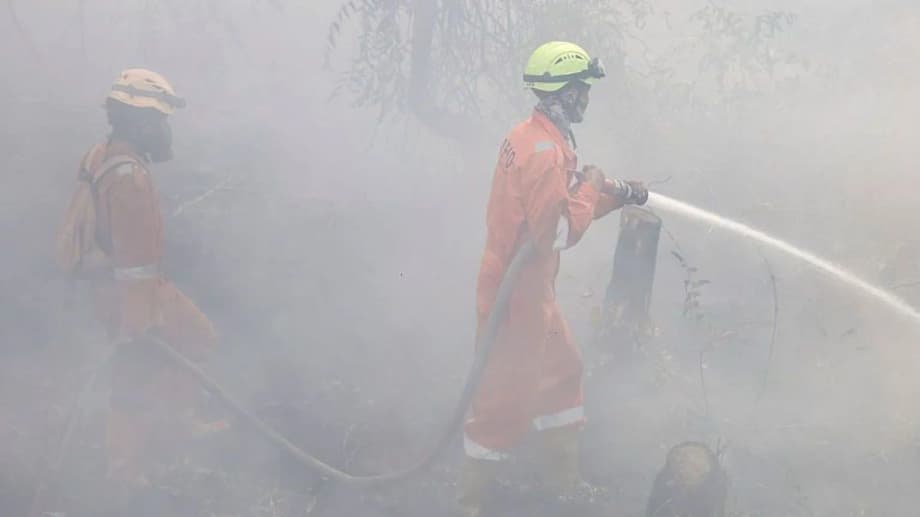
Indonesia has mounted a large operation across Borneo and Sumatra. Authorities report 54,394 personnel deployed since August, supported by 64 aircraft used for water bombing and surveillance. From the air, helicopters and planes drop water on hot edges and smoldering peat. On the ground, teams cut fire breaks, flood canals where possible and patrol at night when winds ease. Teddy Indra Wijaya, Cabinet Secretary of Indonesia, said all available forces remain in motion.
From the air to the ground, all forces continue to move. Everything is being done to extinguish the fires, reduce the impact of the smoke, and, most importantly, protect the public from the threat of forest and land fires.
The operation faces limits imposed by terrain and weather. Peat fires spread over large areas, often far from roads and water sources. Aircraft must shuttle over long distances to refill, while ground crews work in heat and dense smoke with limited visibility. Officials say these conditions explain why progress in one district can be undone by new ignitions in another, even as sortie numbers rise.
International help has joined the effort. Japan dispatched three Chinook helicopters and about 180 military personnel, including crews and support staff, to assist with water bombing in Kalimantan. The assets arrived aboard the vessel JS Kunisaki, which later moved off Ketapang to allow operations from two locations. Indonesia has also run several rounds of cloud seeding, a technique that introduces salt crystals or silver iodide into suitable clouds to encourage rain. Meteorologists hold mixed views on how well the method works when clouds are thin and dry air dominates, but officials continue to use it in hopes of wetting peat and filling reservoirs.
Clinics Fill as Schools Close
Hospitals and community clinics in haze zones report a steady rise in visits for acute respiratory infection (ARI), a group of illnesses that affect the nose, throat, airways and lungs. The national tally of 175,000 cases includes coughs that ease in days alongside bronchitis and pneumonia that require oxygen and hospital care. More than 40,000 cases involve toddlers, whose small airways and rapid breathing make them prone to irritation. Parents describe sleepless nights, nebulizer treatments and return visits when smoke thickens.
Education has been disrupted. Several districts ordered school closures when air indexes reached levels judged unsafe for children, shifting lessons online or suspending classes until skies improve. In South Kalimantan, officials evacuated 167 psychiatric patients from a hospital surrounded by dense smoke and prepared an off site facility in case conditions failed to improve. Health workers distributed masks door to door in some villages and advised families to seal gaps under doors, run air purifiers where available and seek care early for fever, fast breathing or chest pain.
Berton Panjaitan, spokesperson of the health ministry, said cumulative cases of acute respiratory infection reached 175,000 across affected districts from August 18 to September 21. The ministry has mobilized aid including oxygen concentrators, face masks and oxygen canisters. Public guidance stresses reduced outdoor activity during poor air periods, consistent mask use and steady hydration. For households without filtration, officials suggest limiting cooking smoke inside, keeping medications for asthma on hand and checking daily air readings before planning travel or outdoor work.
Smoke Across Borders
The haze has not stayed within Indonesia. Fires in Kalimantan, Sumatra and Papua have sent smoke over neighboring Malaysia and Singapore, where air indexes fell into unhealthy ranges on several days. In Sarawak, the Malaysian state on Borneo that borders West Kalimantan, authorities started a five day cloud seeding operation earlier this month. Douglas Uggah Embas, deputy premier of Sarawak, said the effort aimed to ease haze and raise water levels at hydropower dams before a severe dry spell expected in October.
October might be hotter and drier. We want to increase the water levels as much as possible while we still can.
In Singapore, agencies began issuing daily haze advisories with guidance on outdoor exercise and protection for vulnerable groups. In parts of the Philippines, local officials urged residents to stay indoors as much as possible when smoke drifted over border areas. Shipping, aviation and tourism operators across the region tracked visibility reports, while clinics in border towns prepared for more respiratory complaints. The regional spread has renewed debate over shared responsibility for fire prevention and early warning.
Demands for Accountability
Anger is rising in the provinces most exposed to repeated haze. Indigenous and civil society groups in West Kalimantan filed a class action suit last week against central and local administrations, accusing them of negligence for failing to prevent and control fires that return nearly every year. The filing argues that officials knew the risks from drained peat, land clearing and prolonged drought yet did not act with enough force. The groups seek stronger prevention, faster response and restoration of damaged peatlands.
Glorio Sanen, lawyer for the group that filed the suit, said the yearly return of smoke shows authorities understood the danger and still left communities exposed. He framed the case as a demand for protection rather than compensation alone.
This is a disaster that occurs every year. This recurring pattern proves our view that the defendants knew about the potential haze disaster and the risks of disaster from forest and land fires.
Wildlife has also suffered. Conservation workers shared footage late last month of an orangutan found writhing on the ground on a palm oil plantation in West Kalimantan. A farmer discovered the great ape, already weak, and alerted rescuers. The animal received emergency treatment for hypoxia, a lack of oxygen in body tissues, but later died. Orangutans rank among the most endangered primates, and smoke adds to pressures from habitat loss and fragmentation in Borneo and Sumatra.
The Bottom Line
- Health ministry recorded about 175,000 acute respiratory cases from August 18 to September 21 across 63 districts in six provinces.
- More than 40,000 cases involve children younger than five.
- More than 12.5 million people were exposed to haze across seven provinces by early September.
- Nusantara Atlas detected about 734,000 hotspots, more than 30 percent above 2019 levels, with at least 895,657 hectares burned since January.
- Indonesia deployed 54,394 personnel and 64 aircraft for water bombing, with Japan sending three Chinook helicopters and about 180 personnel.
- Smoke spread to Malaysia, Singapore and parts of the Philippines, with Sarawak running a five day cloud seeding operation to ease haze and raise dam water.
- Schools closed in several districts and 167 psychiatric patients were evacuated from a hospital in South Kalimantan.
- A class action suit in West Kalimantan alleges negligence over recurring fires, while an orangutan rescued in the province later died from hypoxia.