Seoul faces a difficult choice
South Korea is under growing pressure to provide Ukraine with air defense systems, a request that would test Seoul’s limits on arms transfers and its already strained relationship with Moscow. Ukrainian President Volodymyr Zelensky has appealed directly for defensive weapons, warning that North Korea’s military support for Russia is giving Pyongyang battlefield experience and access to advanced technology.
South Korea has supported Ukraine through humanitarian assistance, sanctions against Russia and selected forms of nonlethal military aid. Supplying a major missile defense system would represent a much more direct role in the war. Seoul would also need to consider its own defense requirements, since North Korea remains its primary military threat and South Korean stocks are built around protecting the Korean Peninsula.
Zelensky said Ukraine could share drone technology with South Korea in return for air defense equipment. His proposal reflects the practical value of Ukraine’s wartime experience, especially in the use of drones for surveillance, targeting and attacks on military infrastructure.
In a social media statement, Zelensky also claimed that 30,000 to 50,000 North Korean troops had been assigned for deployment on Russian territory. He gave no supporting details in the statement, while earlier estimates had put the number at about 30,000.
He argued that Seoul and Kyiv should cooperate more closely because North Korean forces are learning from modern combat while receiving military and economic benefits from Russia.
We would very much like to receive support from South Korea in the form of what we lack, air defence systems.
The appeal puts South Korea in a narrow diplomatic space. Air defense is presented as a defensive capability, yet transferring it to Ukraine would still amount to direct military support for a country engaged in active war.
Why Ukraine wants South Korea’s missile shield
Ukraine faces sustained attacks involving cruise missiles, ballistic missiles and large numbers of drones. Its air defense network relies on a mix of Soviet era systems and equipment supplied by the United States and European countries. The most capable systems are in short supply, and their interceptors are expensive and difficult to replace quickly.
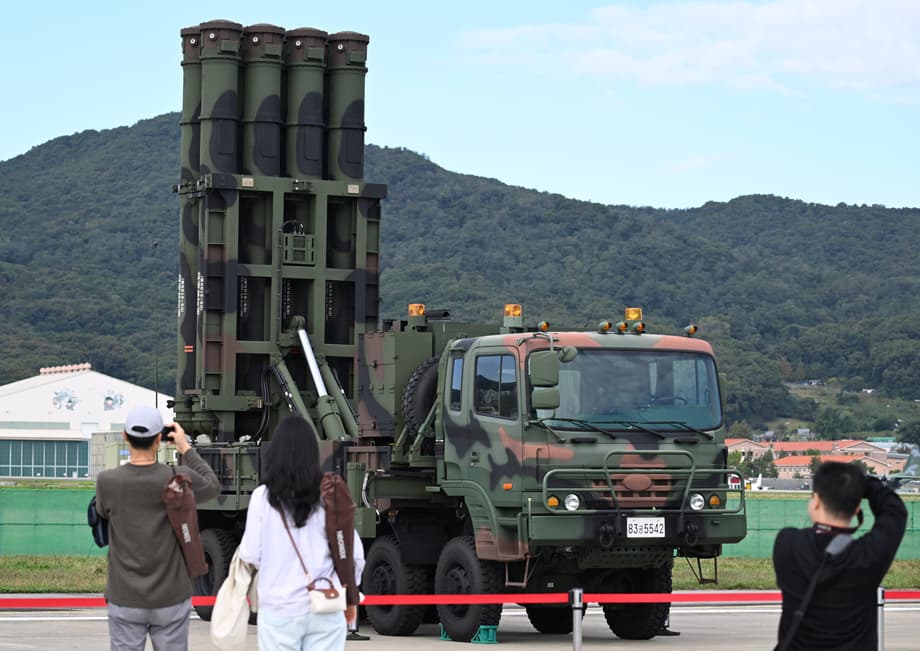
South Korea’s KM SAM II, also known as Cheongung II, is designed to intercept aircraft and incoming missiles at medium range. It was developed for a country that must defend valuable cities, military bases and infrastructure against a large missile arsenal. The system uses mobile launchers, radar and command units, allowing it to move and operate as part of a wider defense network.
Ukraine has sought the system since Russia’s full scale invasion began. Its need has grown as Moscow has combined missile attacks with waves of relatively cheap drones. A layered defense network uses different weapons for different threats, reserving high end interceptors for ballistic missiles and using less expensive systems against drones where possible.
Recent battlefield reports have also pointed to renewed use of North Korean ballistic missiles by Russia. Ukrainian officials have said that a North Korean missile struck a village near Kryvyi Rih, killing members of a family. Military analysts cited in reports said radar tracks were consistent with KN 23 or KN 24 missiles, although a final assessment would require examination of recovered fragments.
North Korea has supplied Russia with artillery ammunition and missiles, while its troops have reportedly supported Russian forces. Kyiv’s argument is that South Korea is already facing a security challenge linked to the war, even if the fighting is taking place thousands of kilometers away.
The legal and political limits on an arms transfer
South Korea has traditionally restricted weapons exports to countries involved in active hostilities. The policy is intended to limit the chance that South Korean weapons will draw the country into foreign conflicts or create diplomatic retaliation. Seoul has used humanitarian aid and nonlethal equipment as ways to support Ukraine without crossing that line.
The government has not announced a decision to send KM SAM II systems. South Korean officials have repeatedly stressed that support for Ukraine remains focused on humanitarian assistance and other nonlethal military supplies. That position leaves room for financial contributions, medical aid, demining equipment and protective gear, while excluding direct deliveries of major weapon systems.
Critics of the restriction point to South Korea’s defense exports to countries facing missile and drone attacks. The United Arab Emirates operates the KM SAM II, and reports have said Seoul supplied interceptor missiles from its own stocks as military assistance. The UAE has faced attacks linked to regional conflicts, although its circumstances differ from Ukraine’s direct war with Russia.
Those cases create a political argument for flexibility, yet they do not remove the risks. A transfer to Ukraine would be seen in Moscow as a hostile act. Russia could respond through diplomatic pressure, limits on trade or closer military cooperation with North Korea. Seoul is especially concerned that Moscow might provide Pyongyang with technology useful for missiles, satellites, aircraft or air defense.
The KM SAM II also has a technical connection to Russia. Early development involved cooperation with the Russian Almaz Antey organization and drew on technology associated with the 9M96 missile family. That history may make South Korean authorities more cautious about sending the system into a conflict involving Russian forces and sensitive weapons technology.
North Korean troops raise the stakes
North Korea’s involvement has altered the way Seoul views the war. Pyongyang’s support for Moscow gives its soldiers experience in battlefield coordination, drone threats, artillery operations and modern surveillance. Even limited combat experience could help North Korea improve its planning and training.
South Korean officials have also warned that Russia may reward North Korea with military assistance. Possible benefits could include satellite capabilities, missile guidance, air defense knowledge and help with conventional weapons production. Seoul sees that exchange as a direct security concern because North Korea could adapt lessons from the Ukraine war to its own military plans.
The reported use of North Korean missiles in Ukraine adds another layer to the issue. The KN 23 and KN 24 are short range ballistic missiles designed to maneuver during flight and strike targets at distances that can threaten military facilities and cities. Their reported warhead size and range make them a serious challenge, even though questions remain about their accuracy and reliability.
Ukraine says its air defense shortage is acute. Some Russian ballistic missiles can be intercepted only by highly capable systems such as Patriot, while other threats require different defenses. Sending KM SAM II would not solve the entire problem, yet it could protect selected sites and reduce pressure on systems already in service.
Seoul considers indirect support through NATO
South Korea is also reviewing whether to join a NATO backed mechanism known as the Prioritized Ukraine Requirements List, or PURL. The program allows participating countries to contribute money to pooled purchases of United States weapons and equipment for Ukraine. It is designed to speed delivery by using established American supply channels.
South Korea’s foreign ministry has confirmed discussions with NATO about several ways to support Ukraine. An official said Seoul’s position remained centered on humanitarian aid and nonlethal military equipment, without stating whether the country would join PURL.
NATO has said that PURL financing has covered much of the Patriot equipment and other air defense missiles delivered to Ukraine. Such a contribution would let Seoul assist Ukraine without handing over a South Korean missile system directly. Moscow, however, would likely still view the move as military support for Kyiv.
For Seoul, PURL could also strengthen ties with European governments that buy South Korean weapons. South Korea has become a major defense exporter, selling tanks, artillery systems, aircraft and missile systems to countries seeking faster deliveries. Closer cooperation with NATO members could support future commercial deals, including major naval procurement programs.
Doo Jin Ho, head of the Eurasia Center at the Korea Institute for Defense Analyses, described participation as a practical strategic choice. He also warned that indirect assistance would still affect relations with Russia.
Although the mechanism is structured as indirect support to Ukraine, it would be difficult to say there would be no impact on South Korea Russia relations.
South Korea has already lost a major submarine competition in Europe and is competing for other large contracts. The government must weigh whether closer defense ties with NATO could help its industry while avoiding a response from Russia that might harm security or trade interests.
Air defense is becoming a global supply problem
The debate comes as wars in Europe and the Middle East put pressure on missile inventories. The United States and its partners have used Patriot, THAAD and other interceptors at a high rate to defend against missiles and drones. Ukraine’s experience has shown that a modern defense network can consume large quantities of ammunition during a single attack.
High cost is another concern. Using a sophisticated interceptor against a cheap drone can protect lives and infrastructure, yet it may not be financially sustainable when attacks arrive in large waves. Military planners are seeking lower cost missiles, electronic warfare tools, guns and directed energy weapons to handle smaller targets while preserving advanced interceptors for the most dangerous threats.
South Korea must make the same calculation at home. Its forces need enough interceptors to protect Seoul, command centers, air bases and industrial facilities. The country also faces the possibility of a sudden crisis with North Korea, making large transfers from domestic stocks difficult.
Production capacity adds another constraint. Even if Seoul approved a sale, manufacturing launchers, radar units and interceptors would take time. Ukraine needs immediate reinforcement, while South Korea’s export customers in the Middle East are reportedly seeking the same system. Qatar and Kuwait have been linked to possible KM SAM II contracts, while Saudi Arabia and Iraq have also been discussed as potential users.
What decision could come next?
Seoul has several choices. It could maintain its current ban on lethal weapons transfers, join PURL, provide additional nonlethal equipment or approve a limited transfer of air defense components. Each option carries a different balance of military value, diplomatic cost and commercial opportunity.
A direct delivery would answer Ukraine’s most urgent request and demonstrate that South Korea views North Korea’s support for Russia as a threat to its own security. It could also give Ukrainian forces access to a system designed for dense missile threats. The price would be greater tension with Moscow and the possibility of retaliation against South Korean interests.
Indirect funding would be less visible and could make use of American production lines, although it would still be interpreted as support for Ukraine. Continuing humanitarian assistance would protect Seoul’s existing policy position, yet Kyiv could regard it as inadequate against the growing missile threat.
The decision will also be shaped by South Korea’s defense industry. Seoul wants to be seen as a reliable supplier to Europe and the Middle East. Refusing Ukraine while signing contracts with states facing regional attacks may invite criticism, even if South Korean officials argue that each case is legally and strategically different.
The Bottom Line
- Ukraine is asking South Korea for KM SAM II air defense systems.
- Seoul restricts weapons exports to countries engaged in active war.
- North Korean troops, missiles and ammunition supplied to Russia have increased South Korea’s security concerns.
- South Korea is reviewing possible participation in NATO’s PURL funding mechanism.
- A direct transfer could aid Ukraine while worsening relations with Moscow and reducing South Korean stocks.
- Growing demand for interceptors is affecting military supplies across Europe, Asia and the Middle East.