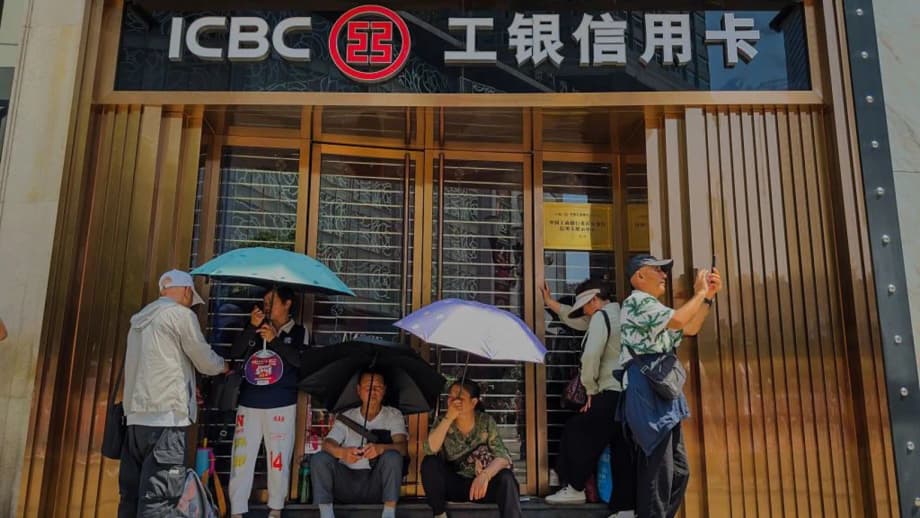
Beijing turns to financial firepower
China is preparing a 360 billion yuan ($53.6 billion) capital injection into eight state owned banks and insurance companies as policymakers seek to protect the financial system and revive a slowing economy.
- Beijing turns to financial firepower
- Which institutions will receive the money?
- Why is Beijing recapitalizing banks now?
- How will the recapitalization work?
- What does the economy need from the banks?
- Growth has fallen below Beijing’s target
- Can a stronger financial system revive demand?
- A broader test for China’s economic model
- The Bottom Line
The program, led by the Ministry of Finance, will provide fresh capital to three lenders and five insurers. The money is intended to improve their ability to absorb losses, maintain lending and support businesses at a time when loan demand is weak and economic growth is losing momentum.
The move comes as China faces several pressures at once. Domestic consumption remains soft, the property market has endured a prolonged slump, the workforce is shrinking and trade and technology tensions with the United States and other Western countries continue. Higher oil prices linked to the Iran war have added another burden for an economy that remains heavily dependent on industrial activity and energy imports.
China’s leaders have long treated financial stability as a matter of national security. The new package shows that Beijing is willing to use state resources to reinforce institutions seen as essential to economic control.
Which institutions will receive the money?
The plan covers some of China’s largest and most influential financial groups. The banking recipients include Industrial and Commercial Bank of China, Agricultural Bank of China and Export Import Bank of China.
The insurance recipients include China Life Insurance, China Taiping Insurance Group, People’s Insurance Company of China, China Export and Credit Insurance Corporation and China Reinsurance Group. Together, these organizations play a major role in directing savings, financing trade and supporting government economic priorities.
China Life, the country’s largest life insurer, will receive 35 billion yuan. China Taiping is due to receive 7 billion yuan. People’s Insurance Company of China plans to raise up to 15 billion yuan through a private placement of domestic A shares to the Ministry of Finance.
Among the banks, Agricultural Bank of China plans to raise up to 160 billion yuan, while Industrial and Commercial Bank of China plans to raise up to 100 billion yuan. The proceeds are expected to replenish their core Tier 1 capital, the highest quality form of bank capital used to absorb losses and support continued lending.
Why is Beijing recapitalizing banks now?
China’s banks remain large and closely linked to the state, yet they face pressure from weak credit demand and lower profitability. Companies and households have been cautious about borrowing, reflecting uncertainty around property prices, employment and future sales. When fewer customers seek loans, banks have more difficulty generating income and supporting economic activity through traditional lending.
Insurers face a different set of problems. Persistently low interest rates have reduced investment returns, while weaker financial conditions have affected profitability and solvency ratios at smaller and mid sized companies. Solvency ratios measure whether an insurer has enough capital to meet claims and other obligations. Stronger capital at major state insurers could give regulators more room to manage weaker firms and prevent problems from spreading.
The finance ministry’s contribution is also designed to help state institutions absorb external shocks. A better capital base can allow banks to keep lending during a downturn rather than rapidly reducing credit to protect their own balance sheets.
Xinhua, China’s state news agency, said the injection would strengthen the institutions’ operating capacity, risk resistance and ability to serve the real economy. In official Chinese policy language, the real economy generally means businesses, factories, households and infrastructure projects outside financial trading itself.
The move will help further enhance their sound operating capabilities, risk resistance capabilities, and ability to serve the real economy.
How will the recapitalization work?
The package combines direct government funding with private placements of shares. In a private placement, new shares are sold to selected investors rather than offered broadly on the public market. Here, the Ministry of Finance and state linked investors, including China National Tobacco Corporation and its subsidiaries, are expected to provide much of the new capital.
Three state lenders will receive a combined 290 billion yuan. Export Import Bank of China, one of the country’s main policy banks, will receive 30 billion yuan from the finance ministry. Policy banks fund areas such as trade, infrastructure and strategic industries that commercial lenders may regard as too risky or too long term.
The funds are expected to be placed into core capital rather than used as a short term spending program. That distinction matters. A capital injection does not automatically put the same amount of money into consumers’ pockets or guarantee that businesses will take out new loans. It gives financial institutions more room to lend and invest while maintaining regulatory capital requirements.
China has used similar recapitalization tools before. The current plan was first presented at the annual parliamentary meeting in March, extending a method that had already been used to strengthen several large state banks in the previous year.
What does the economy need from the banks?
Beijing is asking state lenders to support economic activity while private demand remains subdued. The preferred targets include manufacturing, technology, trade, infrastructure and other sectors that fit national development priorities. Fresh capital can help banks extend loans without weakening their capital ratios, although it cannot by itself solve the lack of demand for credit.
Insurers are also being encouraged to direct more long term funds toward the stock market and other parts of the economy. Their large pools of premiums can provide a relatively stable source of investment capital. Authorities have urged major insurers to support equity markets with patient funds, which could help reduce the influence of short term trading.
China Life said the injection would strengthen its ability to withstand risk and serve the economy. China Taiping said the funds would improve its solvency and related financial measures.
The injection is an important step by the country to strengthen the financial sector’s ability to serve the real economy and promote the high quality development of the financial and insurance industries.
That policy goal reflects Beijing’s effort to redirect finance toward productive activity rather than another round of speculative property investment. The approach could support selected companies, though it may also keep capital flowing toward state favored industries even when market demand is limited.
Growth has fallen below Beijing’s target
Official figures released in July showed that China’s gross domestic product grew 4.3% in the second quarter, down from 5% in the first three months of the year. The result was below the government’s annual growth target of 4.5% to 5%, which was set in March.
The target was China’s lowest annual expansion goal since 1991. Some analysts viewed the lower range as a sign that policymakers were allowing more room to recognize existing weakness rather than promising a return to the rapid growth rates seen in earlier decades.
Exports have remained a source of strength, yet they have not been enough to offset weak domestic demand. The property downturn has reduced construction and household confidence, while an aging population and a shrinking workforce are limiting the supply of labor and placing more pressure on public finances.
Trade restrictions and technology controls have added uncertainty for exporters and manufacturers. Energy costs linked to geopolitical tensions have created another source of pressure. Against that background, reinforcing banks and insurers is a defensive measure as well as an attempt to support growth.
Can a stronger financial system revive demand?
Recapitalization can prevent a credit squeeze, protect confidence and keep major lenders operating through a period of stress. It can also support government programs that rely on banks to finance infrastructure, industrial investment and trade.
The limits are just as important. If households remain worried about jobs and housing, they may not borrow more simply because banks have extra capital. Businesses may also avoid new loans if they cannot see enough demand for their products. In that situation, more lending capacity does not necessarily become more lending.
There is also a risk that state support delays the recognition of bad loans. Banks that continue financing weak property developers or unprofitable companies may preserve short term stability while building future losses. Regulators therefore face the task of directing funds toward viable borrowers while limiting support for businesses that cannot recover.
Financial markets gave a restrained response to the announcement. The package was presented as a major support measure, yet it did not produce a broad surge in Chinese shares. That reaction suggests investors may want evidence that the new capital will translate into stronger earnings, healthier lending and improved consumer confidence.
A broader test for China’s economic model
The plan illustrates the advantages and costs of China’s state directed financial system. Because the government controls major banks, insurers and large institutional investors, it can mobilize capital quickly and coordinate several institutions at once. That structure can reduce the chance of a sudden financial panic.
State control also means that financial institutions may be asked to pursue public policy goals alongside commercial returns. They may lend to strategic industries, support stock markets or assist weaker parts of the financial system. Those duties can help stabilize the economy, though they may place pressure on future profits and make it harder to measure the true health of borrowers.
For Beijing, the package is one part of a larger effort to shift the economy away from property led expansion and toward manufacturing, technology, services and domestic demand. Stronger balance sheets can give banks and insurers time to support that transition.
The capital injection cannot reverse demographic change, restore the property market by itself or remove trade tensions. It can, however, give China’s financial institutions a larger buffer while policymakers try to manage those pressures without allowing weakness in one sector to spread across the wider economy.
The Bottom Line
- China will inject 360 billion yuan, about $53.6 billion, into eight state owned banks and insurers.
- Three lenders will receive a combined 290 billion yuan to replenish core capital.
- China Life Insurance will receive 35 billion yuan and China Taiping 7 billion yuan.
- The plan aims to support lending, stock market investment and financial stability.
- China’s economy grew 4.3% in the second quarter, below the annual target of 4.5% to 5%.
- Weak domestic demand, property problems, demographic change and trade tensions continue to weigh on growth.