
Five young apes found beside a possible trafficking route
Five infant orangutans, three males and two females believed to be between six months and one year old, are under veterinary observation after being rescued from a casuarina forest in Odisha on September 8, 2026. Their discovery near a highway and the West Bengal border has prompted an investigation into suspected international wildlife trafficking.
Contents
- Five young apes found beside a possible trafficking route
- A black SUV becomes an investigative lead
- Road, coastal and border routes under examination
- Why separation from their mothers matters
- Quarantine and frequent feeding at Nandankanan
- A former orangutan enclosure and a pending decision
- Earlier rescues show a recurring concern
- Protected animals from a shrinking natural range
- The rescue could require years of care
- The Bottom Line
Local residents found the animals in the Udayapur and Talsari forest area of Balasore district that morning. Some were clinging to trees; others were sitting together on the forest floor. Video later showed some of the young apes eating bananas as people gathered nearby.
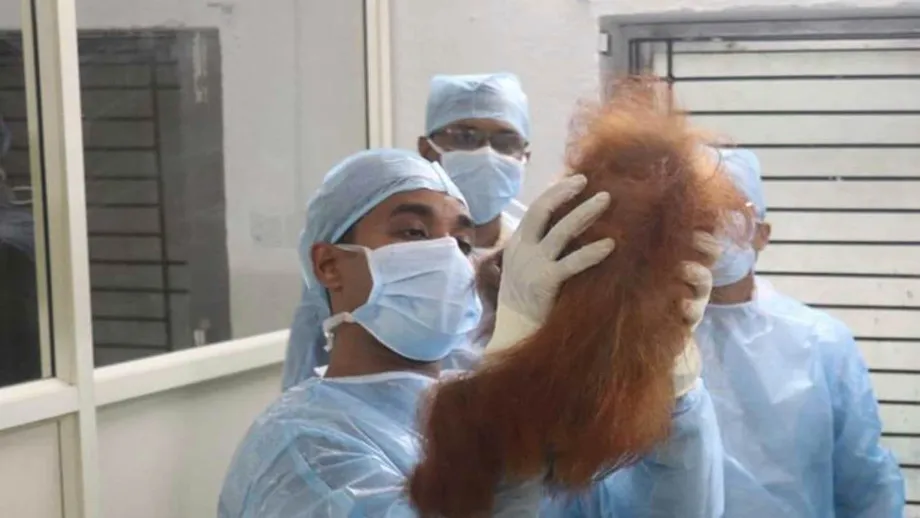
Forest officials responded after residents raised the alarm, provided first aid and transported the animals to Nandankanan Zoological Park in Bhubaneswar, Odisha's capital. As of September 9, the five were in quarantine, with veterinarians monitoring them around the clock. Officials described their condition as stable.
India has no wild orangutans. The three living species, the Bornean, Sumatran and Tapanuli orangutan, occur naturally in parts of Indonesia and Malaysia, thousands of kilometres from Odisha. Forest officials said there is no natural forest corridor connecting those habitats with the rescue site, making a natural journey impossible.
Pratik Prakash Indalkar, the Balasore district forest officer, said investigators believe the animals may have arrived by road. He described the location where they were found:
The five animals were found in Ranakata, a proposed reserve forest in Bhogarai block, near the West Bengal border. The area is covered mainly by casuarina trees and is not a dense forest. It is also close to a state highway.
Officials believe the orangutans had been there for only two or three days. Searches nearby found no adults, no additional young orangutans and no obvious signs explaining how the group arrived. The absence of mothers has made the rescue an urgent animal welfare concern as well as a criminal inquiry.
A black SUV becomes an investigative lead
A black SUV seen near the forest on the night before the rescue is among the leads investigators are examining. Residents reportedly saw the vehicle on a nearby road, and CCTV footage appears to show a vehicle matching that description. Some accounts identified it as a black Thar SUV.
Police are working to identify the vehicle and locate its owner. Investigators need to establish whether it carried the animals, using footage, travel records and witness accounts to reconstruct its movements.
The Odisha Police Special Task Force has sent a team to Balasore. Forest officials, local police and the Wildlife Crime Control Bureau, the central agency dealing with wildlife offences, are working together. They are gathering information from residents and reviewing footage from roads, railway stations, airports and ports.
Kanwar Vishal Singh, Deputy Inspector General of the Odisha Police Special Task Force, said officers were collecting local evidence and consulting central wildlife authorities. He described the stage of the inquiry:
We are at the preliminary stage of investigation and presently collecting data and facts available locally. We are in contact with the central government wildlife authorities and seeking to know whether a similar incident has ever happened in any part of the country.
Authorities have not confirmed the animals' country of origin, exact route or intended destination. No person has been publicly identified or charged, and officials have cautioned against naming suspects before the evidence is complete.
Road, coastal and border routes under examination
Investigators are considering several possible journeys: movement by road after entry through a land border, transport through a port, arrival through a neighbouring country or entry by another means. The Indian Coast Guard has reportedly been contacted as authorities examine possible coastal routes.
Zoos across India have also been asked whether any orangutans are missing from their collections. Checking those records is part of the effort to establish where the five animals came from before their appearance in Balasore.
The regional chief conservator of forests said the group may have been abandoned after a transit operation went wrong. The nearby highway has directed attention to the possibility that the animals were passing through Odisha when a transport plan failed or changed.
The forest department has deployed a separate team to gather information around Badapai, Ranakatha and neighbouring villages. Coastal divisions have been alerted and instructed to search for any other animals that might have been abandoned. No additional orangutans have been found.
State Forest and Environment Minister Ganesh Ram Singhkhuntia estimated that each orangutan could be worth about 2 million to 2.5 million rupees in international markets. At that estimate, the five together would be worth about 10 million to 12.5 million rupees. The figure has increased concern that they may have been intended for private collectors or the exotic pet trade.
Singhkhuntia said the investigation would seek to establish how the animals reached Balasore and who was responsible. The Special Task Force said its inquiry would cover possible interstate connections and any wider network involved:
We will examine all aspects, including the interstate network, the origin and intended destination of the orangutans, the groups involved and the individuals behind such activities.
Why separation from their mothers matters
The five orangutans are estimated to stand about one to one and a half feet tall. At six months to one year old, they are at an age when orangutans normally rely heavily on their mothers for nourishment, protection and learning.
Orangutan infants stay with their mothers for several years. During that time, they learn to climb, find food, build sleeping nests and move safely through the forest canopy. Separation removes both their main protector and the animal that teaches them how to survive.
Research on orangutan development shows that nursing can continue for many years, especially when fruit is scarce. Mothers also guide their young as they learn which fruits, leaves, bark and insects are safe to eat. The infants acquire that knowledge gradually by watching and practising.
Wildlife rescuer Sagnik Sengupta said infant orangutans may depend on their mothers for food, protection, movement and learning for six to eight years. Rescued infants often need intensive medical attention, surrogate caregivers, carefully managed nutrition and lengthy rehabilitation before they can develop independent behaviour.
Five infants together without an adult nearby have raised concern about capture from the wild for illegal trade. Investigators are still examining how the separation happened, including whether the mothers were killed, left behind or separated from the young during capture.
Infant orangutans attract illegal traders because they are small and easier to handle than adults. Capturing a baby from the wild often means removing it from its mother, and the mother can be killed during that process. Orangutans reproduce slowly, so the loss of even one adult or infant can affect a population already under pressure.
Quarantine and frequent feeding at Nandankanan
Nandankanan Zoological Park is keeping the five orangutans in a secure quarantine enclosure. Veterinarians and keepers are monitoring them in shifts, with sanitation and biosecurity procedures intended to reduce disease risks. Biosecurity means measures that help prevent infections from entering or spreading between animals.
The animals were initially offered bananas and apples. Younger individuals have also received mashed food, milk, dry fruits and oral rehydration support. Zoo officials said the youngest is being given liquidised food at frequent intervals.
Care teams are watching for dehydration, infections, injuries, poor nutrition and unusual behaviour. Quarantine allows staff to observe the newcomers' health while protecting other animals at the zoo from possible infections.
The group appears closely bonded, and keeping the five together may help reduce stress. Their care also requires attention to the amount and nature of human contact, so that treatment and feeding support the development of natural skills.
Capture, transport and separation from their familiar environment can all cause stress. The immediate task is to keep the infants healthy and settled while investigators reconstruct their journey.
A former orangutan enclosure and a pending decision
Nandankanan has experience caring for orangutans. Its orangutan enclosure had remained empty after Bini, a female aged 41, died in 2019 from health problems associated with age. She arrived from Pune Zoo in 2003 and lived at Nandankanan for almost 16 years.
Odisha officials have asked the Central Zoo Authority for permission to keep the rescued animals at Nandankanan. A decision about public display has not been made. Any display would require approval from the national authority and would depend on the orangutans' health and welfare.
Care over the coming years would involve much more than feeding and shelter. Orangutans are highly arboreal, meaning they spend most of their lives in trees. Their long arms, grasping hands and feet, and powerful bodies allow them to move through a complex forest canopy.
A suitable rehabilitation setting would need climbing structures, space, varied food and opportunities to develop natural behaviour. The infants would need to learn skills that wild orangutans normally acquire through years spent alongside their mothers.
Earlier rescues show a recurring concern
Young orangutans have appeared unexpectedly in India before. In 2022, two baby orangutans were found abandoned at a checkpoint near the border between Assam and Mizoram. Officials then suspected that the animals had entered India through neighbouring Myanmar.
Other orangutans have reportedly been rescued in Maharashtra, Assam and Mizoram in cases recorded after 2020. Those incidents have drawn attention to the movement of rare animals through South and Southeast Asia, where traffickers may use roads, ports and informal border crossings.
The known sequence places the Balasore rescue alongside earlier discoveries:
- After 2020, orangutan rescue cases were recorded in Maharashtra, Assam and Mizoram.
- In 2022, two baby orangutans were found abandoned at a checkpoint near the Assam and Mizoram border.
- On the night before September 8, 2026, residents reportedly saw a black SUV near the Odisha forest.
- On the morning of September 8, residents found five infant orangutans in Balasore, and forest officials rescued them.
- By September 9, the animals were in quarantine at Nandankanan while police and wildlife authorities pursued the investigation.
The Wildlife Crime Control Bureau's involvement and the Special Task Force's contact with central authorities reflect the possible reach of the investigation across state and national boundaries. Establishing the animals' origin will require connecting evidence about their identity with evidence about their transport.
Protected animals from a shrinking natural range
International commercial trade in orangutans is prohibited under the Convention on International Trade in Endangered Species of Wild Fauna and Flora, commonly called CITES. Indian wildlife laws also protect the animals. Their intelligence, unusual appearance and rarity nevertheless make them targets for illegal collectors.
All three recognised orangutan species are classified as critically endangered by the International Union for Conservation of Nature. Their populations have declined because of deforestation, logging, forest fires, agricultural expansion, hunting and the conversion of land to plantations, including those producing palm oil.
Orangutans are the only great apes found naturally in Asia. They live mainly on Borneo and Sumatra, with the Tapanuli orangutan confined to a small area of northern Sumatra. Great apes, unlike monkeys, have no tails. Orangutans are also among the largest mammals that spend most of their lives in trees.
Their limited natural range gives investigators a starting point for tracing their origin, although a trafficking journey can cross several jurisdictions. DNA testing, veterinary records, transport evidence and cooperation between countries may all be needed to determine where the five infants came from.
Investigators must determine which of the three species the rescued animals belong to. Their species, age and genetic origin could help identify their home region. Officials may also compare records with those held by zoos and rescue centres in India and neighbouring countries.
The rescue could require years of care
The five infants now face a lengthy process of recovery and learning. Orangutans growing up without their mothers can struggle to acquire the climbing, feeding and other survival skills needed for independent life in a forest.
A safe return to the wild would require suitable habitat, preparation for independent survival and protection against renewed contact with traffickers. If that cannot be achieved, the animals may need years of specialised care.
Odisha's response therefore has two connected tasks: protecting the young apes now and establishing how they reached a casuarina forest beside a highway. Their journey may have started in a Southeast Asian rainforest, while the immediate work is taking place in a quarantine enclosure in Bhubaneswar and along the transport routes investigators are checking.
The outcome will depend on both the animals' health and the evidence gathered about their movement. Veterinary care continues while forest officials, police and central wildlife authorities work to identify their origin and those responsible for bringing them to Balasore.
The Bottom Line
- Five infant orangutans were rescued in Balasore, Odisha, on September 8, 2026.
- The three males and two females are believed to be between six months and one year old, and officials describe their condition as stable.
- They are quarantined at Nandankanan Zoological Park under veterinary observation around the clock.
- Orangutans are native to parts of Indonesia and Malaysia, and no wild populations occur in India.
- Odisha Police, forest officials and the Wildlife Crime Control Bureau are investigating suspected trafficking.
- A black SUV seen near the forest is an investigative lead, while road, border and coastal routes are being examined.
- The infants normally depend on their mothers for years and may require lengthy rehabilitation.
- Their origin, route, intended destination and the people responsible remain unknown; no person has been publicly identified or charged.
- Officials have sought Central Zoo Authority permission to keep the animals at Nandankanan, and no public display decision has been made.