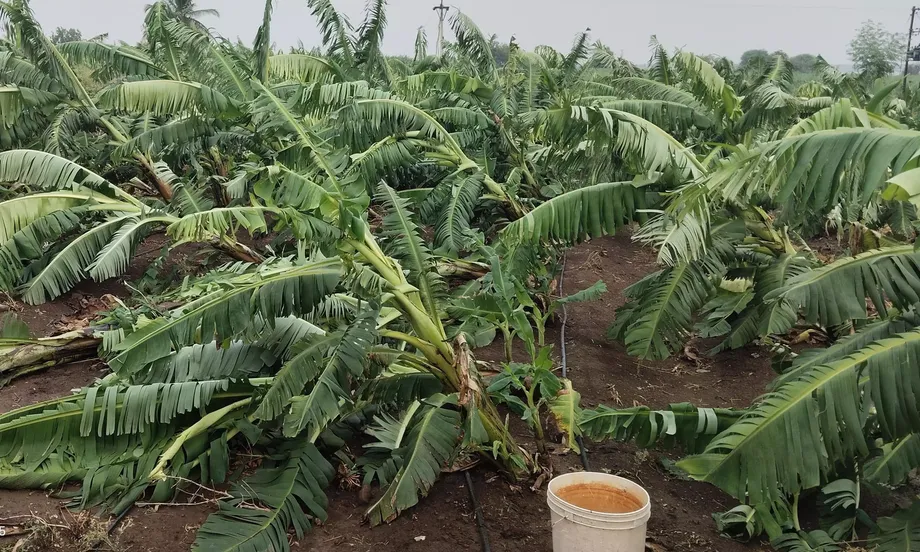
Heat in the fields, a shortfall in the funds
Andhra Pradesh farmer Sambi Reddy Vuyyuru describes banana growth and yields falling nearly 50 per cent as unusually high temperatures continue to affect crops beyond peak summer. Fruit is smaller, vegetable seeds are struggling to germinate, and severe pest attacks are adding to losses. He says the problems have persisted for two to three months.
Contents
- Heat in the fields, a shortfall in the funds
- What farmers are losing
- Why a forecast needs an action plan
- A global funding gap that is growing
- Why Indian states carry much of the burden
- India's national plan and the scale of its needs
- Why the type of finance matters
- What India wants from COP31
- The dates connecting plans, money and farms
- Key Points
The financial response is moving much more slowly than the weather. The United Nations Environment Programme (UNEP), in its Adaptation Gap Report 2025, puts international public adaptation finance reaching developing countries at $26 billion in 2023, down from $28 billion in 2022. Estimated annual needs by 2035 are $310 billion to $365 billion.
India's first Adaptation Communication, submitted to the United Nations climate process in December 2023, estimated cumulative adaptation expenditure needs of Rs 56.68 trillion by 2030. Across Indian states, responsibility for protecting farms, water supplies and communities is pressing against borrowing limits and competing demands on public budgets.
Adaptation means preparing for climate impacts that communities already face or can expect. In agriculture, that can mean choosing crops suited to available water, changing planting schedules, improving irrigation or acting on weather warnings before damage occurs. Mitigation, the other main branch of climate action, means reducing the emissions that cause warming.
India's challenge connects all these levels: a forecast must reach a farmer in time, the farmer must have a practical response, and someone must pay for it. A warning about heat or scarce rain has limited practical value when a household cannot afford irrigation or replacement seeds.
What farmers are losing
Vuyyuru says he is harvesting only four to five banana bunches where he would usually harvest six or seven. Alongside smaller fruit, he describes poor germination in vegetables and pest damage affecting okra, leafy vegetables and gourds.
His experience shows how weather stress can affect several stages of production. Seeds that fail to sprout reduce the crop before it is established. Poor growth then limits the harvest, while pest attacks create another source of loss. For a farming household, the pressure continues even after temperatures begin to ease.
Climate scientist Roxy Mathew Koll says India's rice and wheat stocks may provide some protection against supply pressures, while pulses, oilseeds and vegetables remain vulnerable. A reported rainfall deficit of 40 per cent in June delayed farming, with possible effects on production and subsequent seasons.
Saransh Bajpai of WRI India says the Agriculture Ministry lowered its foodgrain production estimate for the financial year by 2.63 million tonnes. Small farmers without irrigation or enough money to change seeds face particularly difficult choices when planting conditions change.
Why a forecast needs an action plan
Ben Churchill, the World Meteorological Organization's regional director for Asia and the Pacific, has called for governments to give greater priority to forecasting extreme weather and to invest in national meteorological and hydrological services. Those services monitor the atmosphere and water systems, using observations to produce warnings and forecasts.
Churchill's call includes support for equipment that collects data. Reliable observations help forecasters identify developing risks, but the response also depends on agricultural agencies, state governments and farming communities being ready to act.
India is asking states and farmers in areas dependent on rainfall and facing drought conditions to consider crops requiring less water, including suitable pulses and oilseeds. The government is also encouraging cropping plans based on local water budgets.
A water budget compares the water a place can expect to have with the water its crops and other users will need. It makes crop selection a local decision rather than a uniform instruction. Pulses and oilseeds remain exposed to weather damage, as Koll notes, even where particular varieties offer a better fit for limited water.
The practical question is whether advice arrives before planting and whether farmers have the seeds, credit and water access to follow it. India's expansion of rural credit, insurance and technology can help, but changing a crop plan still requires resources at the farm.
A global funding gap that is growing
UNEP calculates developing countries' annual adaptation needs in 2035 in two ways. Economic modelling produces an estimate of $310 billion. Extending the needs recorded in national climate commitments and adaptation plans produces the higher estimate of $365 billion.
Both estimates are far above the $26 billion in international public adaptation finance recorded for 2023, the latest year with reliable figures in the report. Future annual needs are about 12 to 14 times that flow. Funding also moved in the wrong direction between 2022 and 2023, falling by $2 billion, or roughly 7 per cent.
UNEP warns that, if current trends continue, the Glasgow Climate Pact goal of doubling international public adaptation finance from 2019 levels by 2025 will not be achieved. The report also concludes that the newer global climate finance goal is insufficient to close the adaptation gap.
Some implementation is advancing. Countries reported more than 1,600 completed adaptation actions, mainly concerning biodiversity, agriculture, water and infrastructure. Support from climate funds for new adaptation projects increased in 2024. Most countries also have at least one national adaptation policy, strategy or plan.
These developments show that planning and projects are progressing while funding remains far below projected needs. For agriculture, the pressure is especially immediate because planting and harvesting follow seasonal deadlines, while investment decisions can take much longer.
Why Indian states carry much of the burden
Climate Policy Initiative's Financing Adaptation in India, published on February 21, 2024, estimates that six states alone require collective annual adaptation investment of Rs 444.7 billion, equivalent to $5.5 billion, from 2021 to 2030.
The study, by Aanandita Sikka, Labanya Prakash Jena, Malini Chakravarty and Uma Pal, places states at the centre of adaptation because many responses depend on local conditions. It finds that state policies and schemes vary in both their progress and priorities.
State finances have faced pressure from the economic slowdown in 2019–20, the COVID-19 pandemic, borrowing restrictions and existing debt. Governments responsible for local adaptation therefore have limited room to increase spending, even as risks grow.
CPI also identifies a measurement problem: India lacks a common framework for assessing climate risk and a systematic method for judging how far development programmes address vulnerability. Without consistent assessment, governments have a harder task comparing priorities and tracking whether expenditure reduces exposure to damage.
The study recommends bringing adaptation into Finance Commission discussions about funding for states, considering temporary borrowing limits linked to climate needs, improving green finance data, and using partnerships between public bodies and businesses where appropriate. These proposals address both the amount of money available and the ability to direct it effectively.
India's national plan and the scale of its needs
India began preparing its first National Adaptation Plan to bring climate resilience into policies, programmes and development planning. At a consultation held on February 10–11, 2025, officials described work across nine sectors, with the environment ministry conducting vulnerability studies to identify priority regions and resource requirements.
Ruchika Drall, deputy secretary for climate change at the Ministry of Environment, Forest and Climate Change, described the intended timetable during the preparation process.
"Environment ministry is the nodal ministry for developing India's National Adaptation Plan, which should be ready by the end of this year, before COP30," said Drall.
For disaster risk reduction, the National Disaster Management Authority was designated the lead body, with the Integrated Centre for Adaptation to Climate Change, Disaster Risk Reduction and Sustainability as the anchor institute. Officials also called for disaster planning to reach village level and for ecosystem protection to be integrated into adaptation.
The published financial estimates have different scopes and levels of detail. India's 2023 Adaptation Communication put cumulative needs through 2030 at Rs 56.68 trillion; Bajpai says needs could rise to $854 billion as impacts intensify. Drall separately cited about $73 trillion during the consultation, without a calculation or time horizon accompanying that figure. The preparation timetable also gave a target for completing the national plan, rather than confirmation of its subsequent submission.
National planning has become increasingly widespread. United Nations climate figures cited during the consultation showed 142 developing countries undertaking measures to formulate and implement adaptation plans, with 60 having submitted plans by October 2024. As of November 2023, the Green Climate Fund had approved 83 adaptation projects for 44 countries, involving $18.6 billion in total financing, including $5.3 billion directly from the fund.
Why the type of finance matters
Bajpai is calling for more grants, concessional finance, private investment and easier access to funding. A grant does not need repayment. Concessional finance generally offers more favourable terms than ordinary commercial borrowing, such as lower interest rates or longer repayment periods.
Those differences matter when a project protects livelihoods but generates little direct income. Weather observation equipment, local risk mapping and protection for vulnerable communities can deliver public benefits without producing a straightforward revenue stream to repay a commercial loan.
UNEP estimates that private investors could provide around $50 billion annually for adaptation if governments introduce targeted policies and blended finance. Blended finance combines public or concessional money with private capital, often by sharing risks that would otherwise discourage investment.
Even that potential $50 billion would equal only about 14 to 16 per cent of UNEP's estimated annual needs of $310 billion to $365 billion in 2035. Public finance therefore remains central. UNEP also calls for care to avoid increasing the proportion of debt instruments used by vulnerable countries.
Measures proposed in the debate ahead of COP31 include stronger involvement by multilateral development banks, longer repayment periods, risk sharing and support for preparing projects. Project preparation pays for work such as feasibility studies and risk assessments, helping turn a national priority into a proposal that a fund can evaluate.
What India wants from COP31
COP31 is scheduled for November 9–20 in Antalya, Türkiye, with food security and agriculture among the areas drawing attention. India's position connects stronger climate commitments with finance, technology transfer and the institutional capacity needed to carry them out.
At preparatory talks in Fiji, Environment Minister Bhupender Yadav called for flexibility and respect for implementation paths chosen according to national circumstances. He said including Article 9.1 of the Paris Agreement on the provisional agenda created an opportunity to align finance with countries' needs.
Article 9.1 requires developed countries to provide financial resources to assist developing countries with mitigation and adaptation. Yadav also called for using cooperation under Article 6, which provides for countries to work together on climate action, including through carbon market mechanisms.
The negotiations follow two major commitments. At COP29, countries agreed that developed countries should take the lead in mobilising at least $300 billion annually for developing countries by 2035, alongside efforts to scale total public and private climate finance to $1.3 trillion a year. COP30 adopted a goal to triple adaptation finance by 2035.
The broader climate finance commitments cover emissions reduction as well as adaptation. India's push for balance between the two puts attention on how much support reaches activities such as protecting crops, managing water and improving early warnings, and on whether that support arrives as grants, affordable loans or ordinary debt.
The dates connecting plans, money and farms
India's farm losses sit within a longer sequence of national planning and international commitments. The main milestones show the distance between recognising adaptation needs and financing action.
- December 2023: India submitted its first Adaptation Communication, estimating cumulative adaptation expenditure needs of Rs 56.68 trillion by 2030.
- February 21, 2024: CPI published its study identifying annual adaptation investment needs of Rs 444.7 billion across six states.
- February 10–11, 2025: A consultation discussed India's first National Adaptation Plan and work across nine sectors.
- 2025: UNEP's Adaptation Gap Report put developing countries' annual needs in 2035 at $310 billion to $365 billion, compared with $26 billion in international public finance in 2023.
- November 9–20, 2026: COP31 is scheduled to take place in Antalya.
- 2035: The international commitments to mobilise at least $300 billion annually in climate finance and to triple adaptation finance have this target year.
For farmers, the operational timetable is shorter: access to suitable seeds before sowing, a water plan before shortages develop, and warnings early enough to change a decision. The central financing challenge is making national plans and international commitments useful within those seasonal windows.
Key Points
- Andhra Pradesh farmer Sambi Reddy Vuyyuru describes banana growth and yields falling nearly 50 per cent, alongside vegetable germination problems and pest damage.
- International public adaptation finance for developing countries fell from $28 billion in 2022 to $26 billion in 2023.
- UNEP estimates annual adaptation needs of $310 billion to $365 billion in 2035, about 12 to 14 times current flows.
- Six Indian states alone need Rs 444.7 billion annually for adaptation, according to CPI, while state budgets face borrowing and debt constraints.
- India is pressing for finance, technology and implementation support ahead of COP31 in Antalya on November 9–20.
- Grants, affordable financing and timely local action are central to translating forecasts into protection for farms and livelihoods.