A factory revolution hidden in plain sight
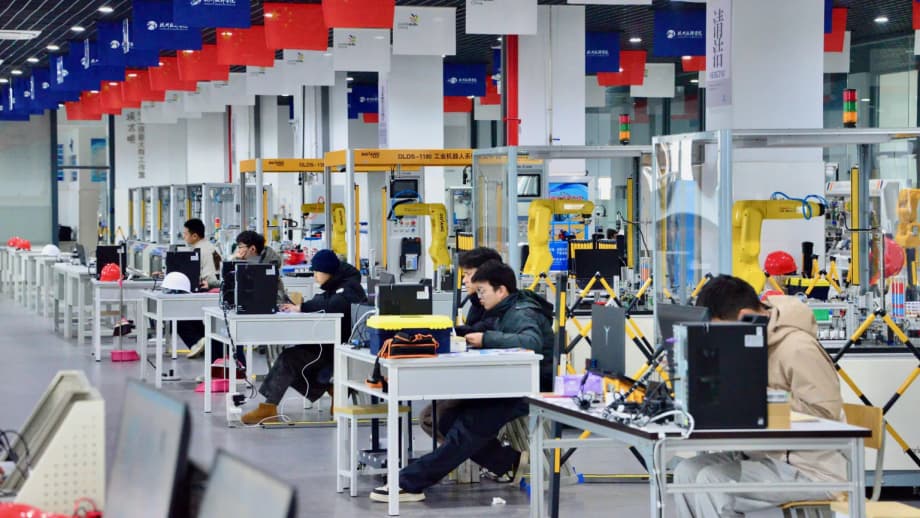
In classrooms, factories and research centers across China, robots are moving from demonstration platforms into the daily machinery of the economy. They weld car bodies, paint components, lift heavy parts, inspect products and assemble the machines that will automate even more production.
- A factory revolution hidden in plain sight
- Why China is moving so quickly
- From robot arms to factories with few people
- What happens to the 120 million manufacturing workers?
- The demographic argument for automation
- Training a new technical workforce
- Beijing faces a difficult policy balance
- Global consequences of China’s automated factories
- Key Points
China now has more than two million industrial robots operating in its factories, the largest installed base in the world. Chinese manufacturers also produce more than half of the world’s industrial robots, according to figures cited by the International Federation of Robotics (IFR). The scale of this expansion reflects a national strategy that links advanced manufacturing, artificial intelligence and economic security.
The transformation is being driven by a $20 billion government plan to place China at the front of innovation and strengthen its competition with the United States. It is also a response to a demographic problem. China’s population is shrinking, its workforce is ageing and the number of people available for factory jobs is expected to fall sharply over the next decade.
For Beijing, automation promises higher productivity and continued industrial strength. For millions of workers, it brings a more uncertain question: will robots fill vacant jobs as the population declines, or will they remove existing work before people can move into new roles?
That tension is visible in Hangzhou, Chengdu and other manufacturing centers where people and machines are still working side by side. It is also visible in schools preparing teenagers for jobs that may not yet exist.
Why China is moving so quickly
China has advantages that make large scale robotics easier to deploy. Its factories already produce the motors, batteries, sensors, gears, electronics and other parts required to build industrial machines. In cities such as Shenzhen, companies can often source components within hours because suppliers, engineers and assembly plants are concentrated nearby.
Susanne Bieller, general secretary of the International Federation of Robotics, has described China’s approach as a combination of industrial capacity and long term planning. She said the country sets national goals and then passes them down to provinces, cities and industrial parks.
China also has an idea. It has a plan. They know where they want to be in five years,
China’s manufacturing base gives it another advantage. A robot built for a Chinese factory can be tested and refined close to the supply chain that will use it. The same ecosystem supports electric vehicles, solar equipment, electronics and wind turbines, all sectors that depend heavily on automated production.
The country was the world’s largest market for industrial robots for the 12th consecutive year in 2024. Domestic sales reached about 302,000 units, while China accounted for a large share of global robotics purchases and patent applications. Robots are now used across dozens of major industries, from car production and electronics to warehousing, medical rehabilitation and elderly care.
China’s progress is less uniform in the software that controls machines. US companies still hold an advantage in advanced AI models and the computing systems used to train them. Chinese firms are narrowing that gap through open source development, in which researchers and startups share code and build on one another’s work. The next contest will depend on how well AI can be placed inside millions of useful machines, rather than on which country produces the most impressive laboratory demonstration.
From robot arms to factories with few people
At a plant operated by CRP Technology in Chengdu, around 30 middle aged workers assemble, drill and polish robotic arms. Nearby, young engineers work on a prototype designed to perform tasks involved in building other robots.
The prototype remains limited. It can carry out simple movements, such as scanning a QR code, while engineers test how to make it more accurate and versatile. The slow pace illustrates the difference between a robot that looks impressive on a stage and one that can safely perform complex work for thousands of hours.
Pang Kai, a 31 year old research and development engineer at the company, said the team hopes its machines will eventually show more independent judgment.
We want our new robot to be like human beings. We hope it can think by itself. We need these kinds of robots because maybe in 10 years, we won’t have enough workers in China.
CRP Technology employs about 300 people and has produced robotic arms for nine years. The company says one arm can be programmed to perform more than 90 percent of repetitive tasks. Such machines can be adapted for factories producing cars, electronics or energy equipment.
The Leapmotor electric vehicle plant in Hangzhou shows how automation is already changing established production lines. Robots assist with stamping, welding and painting, while people remain involved in supervision, maintenance and final inspections. The company employs more than 25,000 workers, with hundreds still checking vehicles as they leave the assembly line.
Cao Li, a Leapmotor vice president, said machines can work continuously, although they still need maintenance, inspection and repair. Some sections of the plant have reached almost complete automation, making the remaining human roles more specialized.
It’s entirely possible that the workers in these areas may no longer be needed, and it may come relatively quickly.
What happens to the 120 million manufacturing workers?
China’s manufacturing sector still employs roughly 120 million people. That figure makes the labor question much larger than the familiar debate over whether a few factories will reduce their headcount. A rapid shift could affect migrant workers, older employees and people with limited access to technical education.
The IFR says robots usually replace particular tasks rather than entire occupations. Machines can take over dirty, dangerous, repetitive or physically demanding work, while people remain responsible for planning, quality control, repairs and decisions that require flexibility. Productivity gains can also allow companies to expand production, creating new jobs elsewhere in the economy.
That pattern is possible, yet it does not guarantee a smooth transition. A worker who has spent years assembling parts may need months or years of training before becoming a robot technician. New jobs may be located in different cities, require stronger mathematics or computer skills, or pay less during the transition.
Evidence from China shows why anxiety is growing. An analysis of official employment data cited in public discussions found that the average number of workers in the secondary sector declined between the periods before and after large scale industrial robot adoption. Urban unemployment also rose between those periods. The figures do not prove that robots caused the entire change, since the property crisis, weak demand, restructuring and the pandemic also affected employment. They do show that automation is arriving during a fragile labor market.
The risks extend beyond factory floors. Robotaxis have reduced earnings for some taxi drivers, while delivery robots and automated warehouses threaten work in the large platform economy. Programmers, translators, scriptwriters and other office workers are also using AI under pressure, as employers seek to produce more with smaller teams.
Some workers are adapting by using AI themselves. A translator in Chengdu began training language models and found temporary new work, although pay in the sector has fallen sharply. A former scriptwriter started an independent studio producing illustrated children’s books after his company cut its creative staff. These examples show how AI can become a tool for earning income, while also reducing the value of established skills.
The demographic argument for automation
China’s leaders are pursuing robotics partly because the country is running out of workers. Official estimates indicate that more than one third of the population could be over 60 by 2035. Some projections suggest China will lose nearly 60 million people during the next decade.
That change will affect factories, logistics, hospitals and care services. Fewer working age adults will have to support more retirees, placing pressure on public finances and families. Automation can keep production running when companies cannot recruit enough people for unpleasant or physically demanding jobs.
The demographic case is strongest when robots assist workers instead of removing them. A machine can lift heavy components, monitor dangerous equipment or perform repetitive movements while a person manages exceptions and quality. This approach may also improve working conditions and extend the working lives of older employees.
Humanoid robots remain far from ready to replace people across the economy. Industry leaders say current machines are expensive, slow to learn new tasks and less reliable than humans in unfamiliar situations. Reaching a very high completion rate is especially difficult when a robot operates in changing environments. For many companies, a traditional robotic arm or mobile machine is still more practical than a humanoid.
Training a new technical workforce
China is pairing investment in machines with investment in vocational education. At the Hangzhou Technician Institute, students can begin training from age 15. They study robotics, coding, engines, aerospace, medical devices and rare earth processing, areas that Beijing considers central to industrial competition.
Chen Tianyu, a 28 year old teacher of AI and robotics, visits factories so he can bring current industrial problems into the classroom. His students program robot arms and design medical instruments while learning that technical skills must change as quickly as the machines around them.
If you are not needed by the world of AI and robotics, then you’ll definitely be among those eliminated.
Chen said companies are eager to hire students from the institute, with some receiving job offers before graduation. His view is that young people should find roles within the technological shift rather than wait for older forms of employment to return.
My students ask me what will happen in the future. I say I don’t know. Technology is changing so fast. But we can’t just stand still and sleep here. We have to move forward to see what we are capable of doing.
Vocational schools can help, yet training alone cannot solve every employment problem. Older workers may have little time or money for retraining. Rural migrants can face restrictions linked to the household registration system, which can limit access to public services in the cities where they work. Women may also face greater exposure to automation in sectors such as electronics assembly, while remaining underrepresented in engineering and computer science.
Beijing faces a difficult policy balance
China wants AI to raise productivity and support its position as a global manufacturing power. It also needs employment to protect household incomes, consumer confidence and social stability. Those goals can conflict when companies gain a financial reason to reduce staff.
Government advisers and lawmakers have proposed measures including special unemployment insurance for AI related layoffs, free technical training for low income workers, a six to 12 month delay before some layoffs and systems to monitor employment risks. Other proposals would require companies to spend part of their savings from automation on retraining or limit the share of workers who can be replaced in a single job category.
A Beijing labor arbitration decision has also indicated that adopting AI by itself may not provide a lawful reason to dismiss an employee. Employers may first need to consider changing the contract, retraining the worker or transferring them to another position. The reach of such decisions is uncertain, especially when companies can rely on short term contracts, attrition or labor dispatch arrangements.
Local governments face another constraint. Many are burdened by debt and weaker land revenues, limiting their ability to subsidize training, support state owned enterprises or attract new employers. State firms may absorb some graduates and displaced workers, yet they cannot provide stable jobs for everyone in a country of more than a billion people.
Global consequences of China’s automated factories
China’s robotics drive will affect more than Chinese workers. Lower production costs could make Chinese electric vehicles, machinery, batteries and consumer goods more competitive in overseas markets. Manufacturers in Europe, North America and Asia may face greater pressure to automate, reduce costs or move production closer to customers.
That pressure could create a new cycle of industrial competition. Earlier globalization moved many factories to China because labor was cheaper. Automation now allows China to retain and upgrade production even as wages rise and the population shrinks. If Chinese factories produce more with fewer people, other countries may respond with their own investments in robots, AI and technical training.
The result will depend on whether productivity gains reach households. If companies expand output and create new services, automation may support higher incomes and help offset population decline. If profits remain concentrated among large firms while displaced workers move into insecure gig work, the same technology could widen the gap between industrial success and household prosperity.
China’s quiet robotics revolution is therefore more than a contest between machines and people. It is a test of whether a state can modernize production while giving workers a realistic way to adapt. The factories are changing quickly. Education, labor protections and income support will determine who benefits from that change.
Key Points
- China has more than two million industrial robots, the largest installed base in the world.
- More than half of the world’s industrial robots are made in China.
- Automation is helping address an ageing population and a shrinking workforce.
- About 120 million people still work in China’s manufacturing sector.
- Robots usually replace tasks, though workers can still lose jobs when businesses restructure.
- Vocational schools are training students in AI, robotics and advanced manufacturing.
- Robotaxis, delivery machines and generative AI are also affecting service and office work.
- Beijing is considering retraining, unemployment support and new rules for AI related layoffs.