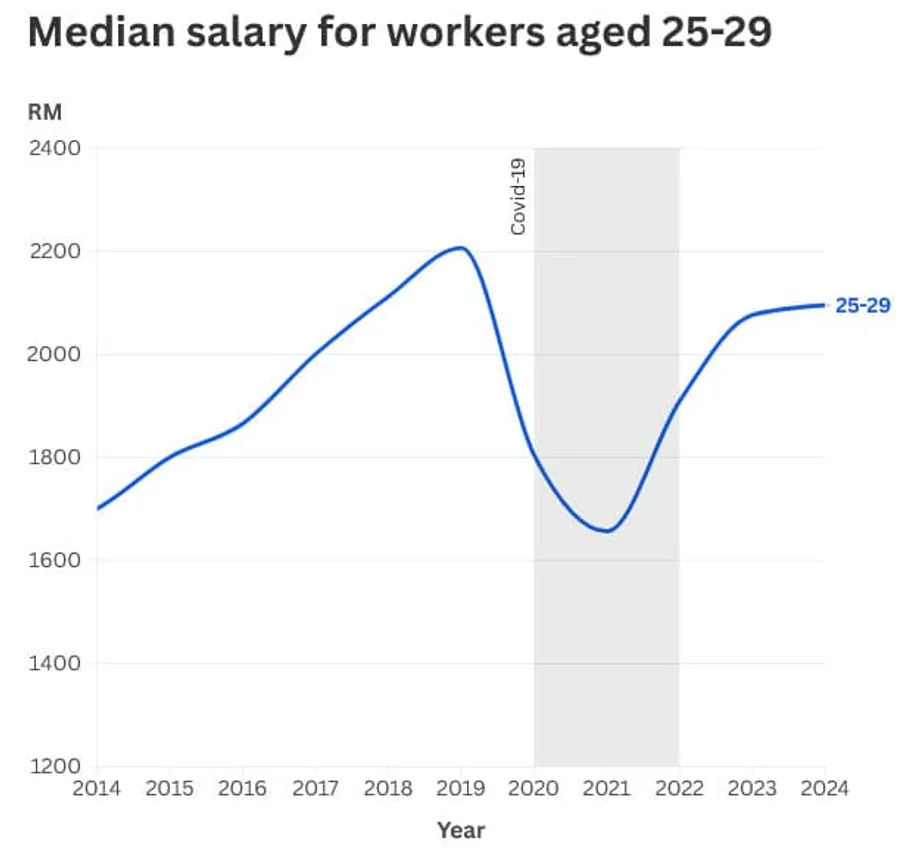
Young workers earn less than their peers did before the pandemic
Malaysian workers aged 25 to 29 earned a median monthly salary of RM2,095 in 2024, below the RM2,206 earned by the same age group in 2019, according to the Department of Statistics Malaysia (DOSM). The fall of about 5% made them the only age group whose median pay had not recovered to its level before the pandemic.
Contents
- Young workers earn less than their peers did before the pandemic
- Why qualifications are not bringing a large pay advantage
- More educated workers, too few suitable jobs
- How a low first salary can delay housing and savings
- Why young employees change jobs
- Self employment offers another route, with different risks
- What employers and training policies can change
- AI training needs to connect with decent work
- Better pay also depends on stronger businesses
- Key Points
Median pay is the middle point in the wage distribution: half of workers earn less and half earn more. The decline was in nominal terms, meaning the salary figures themselves fell before any adjustment for changes in prices. For young people beginning their careers, that leaves less income to repay education costs, support family members, save and consider buying a home.
Rent, transport, food and loan payments continue to take up a large share of household income. Having a job therefore does not necessarily give a young worker enough money to build financial security. A low starting salary can also affect earnings later, because employers often calculate raises as a percentage of existing pay.
Bank Negara Malaysia (BNM) figures show that this pressure began before COVID-19. After adjustment for inflation, the starting salary of diploma graduates fell from RM1,458 in 2010 to RM1,376 in 2018. An inflation adjustment compares what money can buy, rather than just the number printed on a payslip. Those figures show that the purchasing power of starting pay was already weakening.
Malaysia's challenge is therefore bigger than restoring wages after the pandemic. More people have qualifications, yet many cannot find work that makes full use of their education. Low initial pay, jobs below their skill level and rising living costs can combine to slow their progress toward savings, housing and a more secure working life.
Why qualifications are not bringing a large pay advantage
BNM deputy governor Datuk Marzunisham Omar recently described the situation as wage compression. In this case, it means the gap between the pay of new workers and the minimum wage has become unusually small, even when those workers hold recognised qualifications.
Malaysia raised its minimum wage to RM1,700 in 2025 and introduced the Progressive Wage Policy in 2024. The minimum wage creates a floor for earnings, while the progressive policy encourages employers to connect pay increases with skills and productivity. Graduates still need access to suitable jobs if their qualifications are to translate into higher earnings.
Marzunisham, speaking at the BNM Sasana Symposium 2026, said Malaysia did not have enough jobs requiring advanced skills. He also said about 35% to 36% of workers held roles requiring qualifications below those they possessed.
Skill related underemployment describes that mismatch. A person is employed, but the job does not use the full level of knowledge or training they have acquired. A graduate in a role designed for someone with a much lower qualification may receive less pay, develop fewer relevant skills and move more slowly through their career.
World Bank research found that more than 44% of tertiary educated Malaysians aged 25 to 29 worked below their skill level. Among workers with tertiary education, those in roles requiring fewer skills faced a wage penalty of about 49.3% compared with workers whose jobs matched their qualifications. Tertiary education includes qualifications obtained beyond secondary school, such as diplomas and degrees.
The figures describe different groups: Marzunisham's estimate covers workers more broadly, while the World Bank finding focuses on young people with tertiary qualifications. Together, they show why the problem is particularly pressing for graduates expecting their education to improve their earning power.
More educated workers, too few suitable jobs
Malaysia's workforce has become more qualified. The share of workers with tertiary qualifications rose from 30.2% in 2015 to about 36.1% in 2024. The creation of jobs with high productivity has not kept pace with that growing supply of educated workers.
Jobs with high productivity generally produce more value through advanced technology, specialist knowledge, research, management or complex services. They tend to offer better pay because the work contributes more to company revenue. When growth instead creates many roles with lower productivity, graduates may accept them for immediate income while gaining limited professional development.
Education and training gaps also play a part. Some graduates leave institutions without the technical, digital or communication skills employers need. Employers may struggle to explain their requirements accurately or may invest too little in training new staff. A mismatch between fields of study and vacancies can leave someone well qualified on paper but poorly matched to the work available.
Kelantan illustrates how location affects opportunity. World Bank research found that more than half of its tertiary educated workers held jobs below their qualification level. The rate was about 40% in Terengganu, Pahang and Perlis. More industrialised areas and places with greater concentrations of work requiring specialist knowledge, including Kuala Lumpur and Penang, generally had lower rates.
Malaysia also loses some skilled workers to overseas markets. More than half of the 1.86 million Malaysians living abroad work in skilled or semi skilled jobs, especially in Singapore, Australia, the United Kingdom and the United States. Malaysia is producing capable workers, but domestic firms are not always creating enough positions to retain them or reward their skills properly.
Graduates consequently face a problem involving both the supply of skills and demand for them. Better training can help people fill vacancies, while the economy also needs more employers offering work that requires advanced qualifications.
How a low first salary can delay housing and savings
Dr Wan Arnidawati Wan Abdullah, head of the Laboratory of Social Gerontology at the Malaysian Research Institute on Ageing, said graduate starting salaries commonly range from RM2,000 to RM3,000. Her central concern was their declining real value, or what those salaries can actually buy.
Wan Arnidawati warned that workers beginning on lower pay may struggle to catch up because later increments are often based on their current salary. A 5% raise gives a worker earning RM2,200 less additional income than it gives someone earning RM3,000. Repeated percentage increases can allow the difference to grow through promotions and job changes.
Housing adds another layer of pressure. Malaysia's house price to income ratio is about 4.7, above the affordability benchmark of 3.0. A ratio of 4.7 means a typical home costs roughly 4.7 times annual household income. Interest, taxes, maintenance and other expenses come on top of that purchase price.
Wan Arnidawati said many workers now aged 35 to 44 bought homes before the sharpest price increases. Younger workers may spend years paying rent without building an asset that could support them later in life. Describing the difference in opportunities between generations, she said:
Young people entering the workforce today may not have the same opportunity.
Delayed saving affects more than a housing deposit. Retirement contributions, emergency funds, marriage, support for relatives and plans to start a business all compete for the same limited income. Someone spending nearly all their monthly earnings on essentials has little room to handle a medical bill, unemployment or a sudden rent increase.
A salary squeeze can therefore carry forward across several stages of life. The immediate difficulty is meeting expenses; the longer difficulty is accumulating savings and assets while earnings remain low.
Why young employees change jobs
Frequent job changes among young Malaysians are often presented as weak loyalty or impatience. Research from the PNB Research Institute points instead to low pay, unclear career progression and work that does not match qualifications as major reasons employees leave.
In the third quarter of 2025, 74.3% of workers aged 15 to 24 held roles below their qualification level, compared with a national average of 35.5%. Among workers aged 25 to 34, the rate was still about 41%. Underemployment tends to fall as people gain experience, but years in a poorly matched job can limit the relevance of the experience they acquire.
The institute also reported that real entry wages fell by 10% for degree holders and 28% for holders of master's degrees between 1997 and 2022. It found that 66.3% of degree holders and 93.1% of diploma holders earned less than RM3,000. Below the RM2,000 threshold were 30.6% of degree holders and 66.3% of diploma holders.
The estimated monthly cost of living for a single person in Kuala Lumpur is about RM2,400. Some government linked companies use RM3,100 as a living wage benchmark. A living wage is intended to reflect the income needed to meet living costs, rather than simply the legal minimum an employer must pay.
When graduate earnings fall below basic expenses, moving to another employer can be a practical search for stability. A worker may be seeking enough income to cover necessities, a clearer promotion structure or a position that uses their training.
Digital recruitment platforms and professional networks make those moves easier. They also give workers greater access to salary comparisons, helping them identify firms offering better pay or more visible routes to advancement. Retaining young staff therefore depends partly on the quality of the job they are being asked to stay in.
Self employment offers another route, with different risks
HELP University economist Prof Dr Chung Tin Fah said younger workers could use entrepreneurship skills to generate income outside traditional employment. Entrepreneurship and freelance work can provide another route to higher earnings when suitable salaried work is difficult to find.
Chung also referred to the life cycle theory of earnings. This describes how wages usually rise with age and experience, reaching a peak around 40 to 45. Public sector earnings may peak later because seniority plays a larger role. The theory helps explain why early earnings are often lower, while the quality of early work still matters for later development.
DOSM's MyLabourHub portal shows a sharp increase in youth self employment. The number of own account workers in their early 20s rose from 128,000 in 2013 to 286,000 in 2025. Among those aged 20 to 24, the increase was 123%. The number aged 25 to 29 rose by 34%.
Own account workers run their own activity without paid employees. They include freelancers, drivers providing rides through apps, delivery riders and people operating small businesses. Digital platforms have also opened opportunities in coding, writing, design, childcare and online services.
Self employment offers flexibility, but it can transfer business risks from companies to individuals. Income may vary sharply from month to month. Workers may also lack paid leave, employer retirement contributions, health coverage and protection against injury.
Khazanah Research Institute Associate Director Dr Rachel Gong said many graduates eventually move into standard employment because stable income and stronger job security remain attractive. Flexibility alone may not meet a worker's needs when regular expenses require predictable earnings.
Protection for independent workers will become more important if their numbers keep growing. Possible measures include wider access to Employees Provident Fund and Social Security Organisation contributions, clearer employment status, affordable insurance and stronger representation in discussions with digital platforms.
What employers and training policies can change
Wan Arnidawati said employers should move beyond promotions based only on tenure. Salary progression tied to skills would let workers earn more as they gain capabilities that help the business. Structured training, mentoring and alternative career routes could reduce the need to change employers simply to secure a meaningful raise.
Universiti Malaya economist Prof Dr Mohd Nazari Ismail said companies need stronger revenue growth to pay more. Expansion into overseas markets can create greater room for wage increases, especially when exports involve specialised products and services. Higher salaries alone will not ease financial pressure if food, housing and other prices rise faster than pay.
Government policy can support firms moving into activities that generate more value, improve job matching and expand learning through work. Technical and vocational education can give young people practical skills while allowing employers to shape training around actual vacancies.
The Ministry of Human Resources has said it is strengthening the MyMahir ecosystem to align training with changing industry needs. Its components include the Future Skills Talent Council, the Critical Occupations List and the AI Readiness Index. Better labour market information can help students choose fields with stronger demand and help companies find suitable candidates.
Malaysia's wage and employment figures cover several periods. The sequence shows that the pressure on starting pay predates the pandemic, while recent policies have sought to improve earnings and connections between skills and jobs:
- 1997 to 2022: Real entry wages fell by 10% for degree holders and 28% for holders of master's degrees, according to PNB Research Institute findings.
- 2010 to 2018: Real starting pay for diploma graduates fell from RM1,458 to RM1,376 in BNM figures.
- 2019 to 2024: Median monthly pay for workers aged 25 to 29 fell from RM2,206 to RM2,095.
- 2024: Malaysia introduced the Progressive Wage Policy.
- 2025: Malaysia raised the minimum wage to RM1,700.
- 2026: Marzunisham discussed wage compression and the shortage of jobs requiring advanced skills at the BNM Sasana Symposium.
AI training needs to connect with decent work
Artificial intelligence adds another challenge for young workers. A 2025 PwC survey of nearly 50,000 workers across 48 economies found that 54% had used AI for work in the previous year, while only 14% used generative AI daily.
Generative AI is technology that can produce material such as text or images in response to instructions. Entry level workers were among those most concerned about AI's effect on their careers. Employers providing training and transparent information can help young staff use the technology to improve productivity rather than face disruption without support.
The United Nations has called for a balanced mix of technical, digital, AI, environmental, social and civic skills. Training needs to connect with decent work, recognised qualifications and genuine opportunities for advancement. Programmes that produce certificates without improving job quality will have limited value.
Malaysia's existing mismatch makes that connection especially important. Workers need the skills employers seek, and employers need positions in which those skills are used and rewarded. A training programme has greater practical value when it helps a person obtain suitable work, develop within a role or qualify for better pay.
No timetable was given for the next steps in strengthening the MyMahir ecosystem. The stated direction is to bring training closer to changing industry needs, alongside wider efforts to improve job matching and create work with higher productivity.
Better pay also depends on stronger businesses
Companies need the capacity to support higher payroll costs if wage increases are to last. Productivity, access to markets and business investment therefore belong in the same discussion as graduate pay. Firms concentrated in activities with low profit margins may rely on low wages to compete.
Businesses that develop new products, use technology effectively and reach overseas customers can often pay more. This connects Mohd Nazari's argument about revenue growth with the shortage of suitable graduate jobs: stronger businesses can have more room both to hire skilled workers and to reward them.
World Bank research from South Asia found that sectors with lower trade barriers generated a large share of employment growth and tended to pay more than average. Malaysia has a different economic structure, but the finding offers a relevant lesson about how international markets and affordable inputs can help companies expand, hire younger workers and create more skilled positions.
Workers also need support when industries change. Retraining, career counselling and easier movement between sectors can reduce the time people spend trapped in work with low pay. Better opportunities need to reach both new graduates and people whose first jobs have left them with limited relevant experience.
Malaysia's young workers face several connected pressures: weaker starting pay, insufficient jobs matching their education and expenses that leave little room to save. Minimum wages, training and entrepreneurship each address part of the problem. Lasting progress requires stronger businesses, better job matching and salary growth that rewards the skills workers actually develop.
Key Points
- Median monthly pay for workers aged 25 to 29 was RM2,095 in 2024, about 5% below RM2,206 in 2019.
- About 35% to 36% of workers held jobs requiring qualifications below those they possessed.
- More than 44% of tertiary educated workers aged 25 to 29 worked below their skill level, according to World Bank research.
- Tertiary educated workers in roles requiring fewer skills faced a wage penalty of about 49.3% compared with those in matched jobs.
- Malaysia's house price to income ratio was about 4.7, above the affordability benchmark of 3.0.
- Own account workers in their early 20s increased from 128,000 in 2013 to 286,000 in 2025.
- Better job matching, protection for independent workers, stronger productivity and pay progression tied to skills are central to improving young workers' prospects.