A stronger alliance faces its hardest question
The Philippines and the United States are marking 75 years of their Mutual Defense Treaty with a military cooperation plan for 2027, new investment in Philippine facilities and exercises involving seven countries. The expansion comes as confrontations in the South China Sea give an old commitment a more immediate purpose: protecting Philippine forces and public vessels from an armed attack.
Contents
- A stronger alliance faces its hardest question
- What the treaty promises
- How training and access are expanding
- Why incidents at sea could become a treaty test
- What Washington has pledged beyond assurances
- Why officials are reviewing an agreement from 1951
- Energy, infrastructure and people also support the alliance
- Philippine critics focus on civilian risks and control
- A wider network brings support and more decisions
- The Bottom Line
Admiral Samuel Paparo, commander of the United States Pacific Command, and General Antonio G. Nafarrete, chief of staff of the Armed Forces of the Philippines, met in Quezon City on August 7. They reaffirmed their commitment to the 1951 treaty, signed an eight star memorandum and approved the 2027 plan of activities.
The schedule is expected to cover large military exercises, specialist exchanges, maritime security, disaster response training and projects that help Filipino and American forces operate together. Manila is also taking a more active role in regional security discussions as tensions at sea intensify.
Washington's central promise is to act against an armed attack covered by the treaty. The difficult question is whether American leaders would accept the risks of defending the Philippines if doing so threatened a major confrontation with China. Exercises and equipment help prepare a response; political leaders must still decide what that response will be.
The anniversary therefore brings two developments into view. Military cooperation is becoming more extensive, while the decision at the heart of the alliance remains a matter for governments in a crisis. As of August 20, 2026, the partners have set out more activities and repeated their assurances, while Philippine officials say any decision to revise the treaty belongs to policy makers in both capitals.
What the treaty promises
The Mutual Defense Treaty was signed on August 30, 1951, during the early years of the Cold War. It commits the Philippines and the United States to act against an armed attack on either party in the Pacific. It leaves the precise response to political decisions in Washington and Manila.
The agreement gives the two countries a lasting defence commitment without prescribing the exact military action for every possible incident. During a crisis, their governments would need to determine what happened and decide how to respond.
Washington has stated that its commitments cover attacks on Philippine armed forces, aircraft and public vessels, including coast guard vessels, anywhere in the Pacific. A joint statement following the countries' Bilateral Strategic Dialogue in February said the treaty applies to the South China Sea.
That clarification matters because Philippine coast guard ships are among the vessels involved in confrontations in disputed waters. By stating that public vessels fall within the commitment, the governments are trying to discourage attacks through the prospect of a costly response.
The alliance's development stretches across several decades, with the latest plans extending into 2027:
- August 30, 1951: The Philippines and the United States signed the Mutual Defense Treaty.
- 1958: The Mutual Defense Board was created to coordinate defence cooperation.
- 2006: The Security Engagement Board was established.
- February 2026: The Bilateral Strategic Dialogue produced commitments on military cooperation and reiterated the treaty's application to the South China Sea.
- April 20 to May 8, 2026: The largest edition of Exercise Balikatan brought together about 17,000 troops from seven countries.
- August 7, 2026: Paparo and Nafarrete approved the 2027 activity plan in Quezon City.
- August 30, 2026: The treaty reaches its 75th anniversary.
How training and access are expanding
The Mutual Defense Board and Security Engagement Board provide the main framework for organising cooperation under the treaty. Military planners and officials use them to set exercise schedules, training priorities and other joint activities. The 2027 plan builds on a year in which the partners held their largest Balikatan exercise.
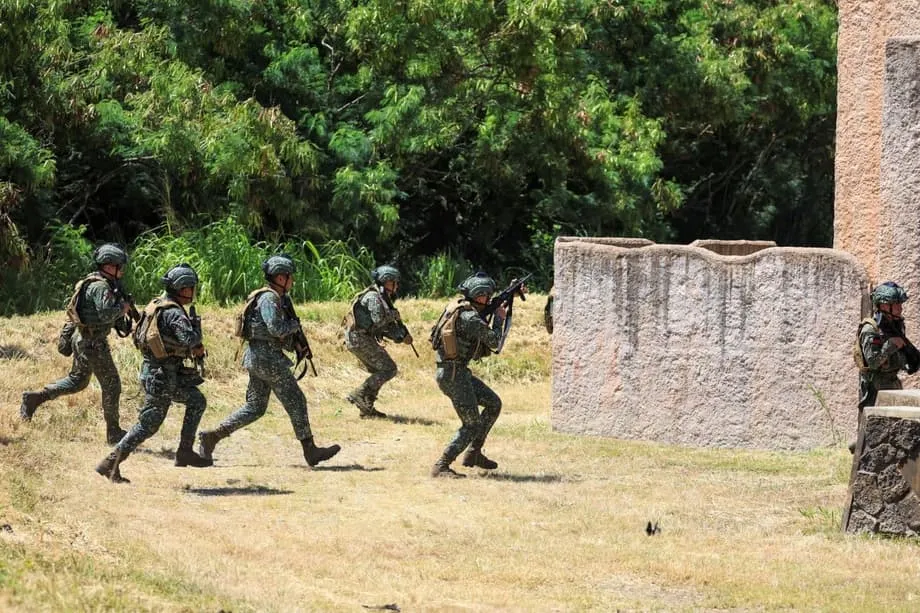
About 17,000 troops from the Philippines, the United States, Australia, Japan, Canada, France and New Zealand took part in Balikatan from April 20 to May 8, 2026. Its name means shoulder to shoulder in Filipino. What began as an exercise between two countries has grown into a multinational event covering land, sea, air, cyber and space activities.
The training prepares forces for several tasks: defending Philippine territory, monitoring activity at sea, responding to natural disasters and supporting civilian authorities during emergencies. Participants also practise using communications systems, planning methods and operating procedures together. In practical terms, forces must be able to share information and coordinate their actions if they are to work effectively during an emergency.
The United States and the Philippines are also expanding access to Philippine military locations through the Enhanced Defense Cooperation Agreement. American forces can rotate through selected sites and store equipment there, while Philippine authorities retain ownership of the facilities.
Washington approved an additional $144 million in 2026 for infrastructure at those locations, according to a joint statement from the two governments. The funding connects the alliance's plans with the facilities needed to support them. Training develops skills, while infrastructure provides places to accommodate forces and equipment.
The combination makes cooperation more active and more visible. It also means that American personnel, forces and equipment could be exposed during a regional crisis, increasing the stakes for decisions in Washington as well as Manila.
Why incidents at sea could become a treaty test
The Philippines has repeatedly accused China of using coast guard and maritime militia vessels to pressure Filipino ships in areas claimed by Manila. Beijing rejects the Philippine position and maintains broad claims over much of the South China Sea. Confrontations around Second Thomas Shoal and other contested features have made the treaty's maritime coverage more urgent.
A collision, a water cannon incident or a dangerous manoeuvre may fall below the threshold of an armed attack. A deliberate strike on a vessel could demand a much more serious response. The two governments would still have to establish the facts of an incident and decide how to act.
Deterrence is the effort to prevent an attack by making its possible cost clear. Washington's repeated assurances are intended to serve that purpose. For the promise to carry weight, potential opponents must believe that the partners have both the military ability and the political willingness to respond.
The Philippines also occupies a strategically valuable position near routes connecting the South China Sea, the Philippine Sea and the wider Pacific. Its location close to Taiwan and the northern approaches to the South China Sea gives Philippine bases considerable military value.
The alliance forms part of a wider American effort to keep sea lanes open and preserve freedom of navigation and overflight. Those goals concern the ability of ships and aircraft to travel through the region. For Manila, the immediate concern is stronger protection against pressure in its waters, alongside the need to avoid being drawn into a conflict beyond its control.
What Washington has pledged beyond assurances
Secretary of State Marco Rubio used his message marking Philippine Independence Day to reaffirm the United States' commitment to its mutual defence obligations. He also connected the military alliance with economic ties, diplomatic cooperation and relationships between people in the two countries.
The February strategic dialogue set out a broader programme of practical commitments. The governments agreed on more realistic exercises, faster delivery of defence assistance, increased deployments of missile and unmanned systems, stronger cyber defence and better Philippine monitoring of illegal maritime activity.
Manila and Washington also agreed to hold additional maritime and ministerial talks with Japan. Together, those commitments show planning that reaches beyond an anniversary celebration, linking military readiness with maritime awareness and cooperation among partners.
Analysts have questioned whether the United States would sustain its current engagement if a confrontation threatened to draw it into a major war with China. The issue is political will when fulfilling a treaty promise carries its greatest cost, rather than simply the number of exercises held.
More visible cooperation can make an attack seem more costly. At the same time, the presence of American forces and equipment creates further exposure in a crisis. The alliance's credibility depends on military capability and a shared belief that leaders will use it when required.
Why officials are reviewing an agreement from 1951
Retired Admiral Roy Vincent Trinidad, an AFP spokesperson, has said the Mutual Defense Treaty undergoes regular review to keep it relevant to current conditions. Philippine officials say policy makers in Manila and Washington must decide whether to revise it. No upgrade has been approved.
The agreement was written before modern coast guards, cyber attacks, unmanned aircraft, precision missiles and satellites became central to security planning. It also predates the current South China Sea disputes and the complex network of American agreements with Japan, Australia and other partners.
A revision could set out more precisely how the treaty applies to coast guard ships, maritime law enforcement vessels, cyber attacks and attacks on facilities used by American forces. It could also explain consultation procedures, how decisions are made and the role Philippine authorities would have during a crisis.
More detailed wording could reassure Manila by making the partners' responsibilities easier to understand. American policy makers, however, may want to retain flexibility over their response. That creates a political balance between greater certainty and room to judge the circumstances of an incident.
Beijing could view a treaty change as a sharper military signal. Critics in the Philippines could see it as giving Washington greater influence over national security decisions. Reviewing the agreement therefore involves questions about Philippine sovereignty and regional tensions as well as the equipment and threats it should cover.
Energy, infrastructure and people also support the alliance
The relationship now extends into economic security, energy supplies, technology, health security and disaster relief. The governments are developing the Luzon Economic Corridor, including a freight rail project connecting Subic and Clark, and are seeking investment in transport, logistics, energy, semiconductors and data infrastructure.
The Philippines and the United States have also agreed to cooperate on critical minerals and civil nuclear technology. Washington plans to provide $1.5 million through its FIRST programme for a small modular reactor control room simulator in the Philippines. The project is intended to support training and safety standards while Manila studies possible nuclear power options.
A control room simulator provides a setting for training rather than generating electricity. The planned project places preparation and safety alongside the Philippines' consideration of nuclear power, connecting technical cooperation with its energy choices.
Reliable transport, energy and communications can support civilian growth while helping the Philippines respond to disasters and maintain military readiness. Supply chains that depend less on a single country can also reduce the pressure that country might exert during a crisis.
Rubio said more than four million Filipino Americans live in the United States, while more than 750,000 Americans live in the Philippines. Those communities give the relationship a social foundation extending beyond governments and armed forces. Economic projects and personal connections help explain why the alliance is broader than a defence arrangement alone.
Philippine critics focus on civilian risks and control
Progressive groups and some Philippine lawmakers have warned that expanded exercises and American access to military facilities could make the country a target in a conflict between Washington and Beijing. Their concerns include the placement of weapons, effects on nearby communities and who controls decisions about military activity.
During Balikatan 2026, a United States Tomahawk missile was launched from an airport in Tacloban and struck a designated target area in Laur, Nueva Ecija. Critics said the activity brought live fire and systems capable of striking distant targets closer to civilian communities.
Temporary zones closed to sailing also affected fishing communities. Government agencies provided food and financial assistance to hundreds of affected fisherfolk, while critics objected to the restrictions on their access to the sea.
Defence Secretary Gilberto Teodoro Jr. rejected claims that the exercises placed the country under military control. He said the activities were conducted under civilian authority and in an open manner. Supporters argue that the training improves the Philippines' ability to protect its waters and respond to emergencies.
Critics argue that the same cooperation can pull Manila into a conflict it cannot control. The disagreement reflects a longstanding sovereignty concern: the Philippines seeks stronger protection against coercion at sea, yet many Filipinos do not want their territory used for offensive operations against China.
Clear rules, public oversight and confidence that Philippine interests guide military decisions are central to managing that balance. Civilian authority must address both the security goals of the exercises and the concerns of communities affected by them.
A wider network brings support and more decisions
Japan and Australia have joined military exercises with the Philippines and the United States. Canada, France and New Zealand also participated in Balikatan 2026. These countries have different treaty obligations but share an interest in open sea lanes and the peaceful resolution of disputes.
Officials from the Philippines, the United States, Japan and Australia have held defence meetings, while Manila and Washington plan further talks with Tokyo involving all three countries. The Philippines also assumed the chair of ASEAN in 2026, giving it a larger diplomatic role in discussions about maritime security and regional stability.
Cooperation with several partners can provide Manila with more political support and improve coordination during disasters or emergencies. When several governments become involved in an incident, however, managing the response can become more complicated. Regular communication, careful signals about intentions and a clear distinction between deterrence and preparations for offensive war are essential parts of that cooperation.
Manila will judge the next phase by whether promised funding reaches its armed forces and coast guard units, whether equipment arrives on schedule and whether American officials continue to affirm coverage for Philippine public vessels in the South China Sea. Washington will expect better Philippine defence planning, investment in infrastructure and forces that can operate more effectively with partners.
Philippine leaders must manage those expectations alongside public concerns about foreign troops, live fire exercises and escalation. China's conduct will also influence the relationship. Continued pressure on Philippine vessels could bring Manila closer to Washington and other partners; a less confrontational period could leave more room for diplomacy and economic cooperation.
Seventy five years after its signing, the treaty is more active than at many points in its history. Its value will depend on whether stronger preparations prevent conflict without encouraging actions that make conflict more likely, and whether the two governments share the political commitment to respond if deterrence fails.
The Bottom Line
- The Mutual Defense Treaty reaches its 75th anniversary on August 30, 2026.
- Paparo and Nafarrete approved a 2027 plan covering exercises, maritime security, disaster response, specialist exchanges and defence capability development.
- Balikatan 2026 involved about 17,000 troops from seven countries between April 20 and May 8.
- Washington approved an additional $144 million in 2026 for infrastructure at Philippine sites covered by the Enhanced Defense Cooperation Agreement.
- The governments say the treaty covers attacks on Philippine armed forces, aircraft and public vessels, including coast guard vessels, in the Pacific and South China Sea.
- The treaty leaves the exact response to an armed attack to political decisions in Washington and Manila.
- Officials regularly review the agreement, but no treaty upgrade has been approved.
- Critics warn about civilian disruption, sovereignty and exposure to a conflict with China; officials say exercises remain under civilian authority.
- Cooperation also covers infrastructure, energy, critical minerals, nuclear technology, cyber defence, health security and disaster relief.