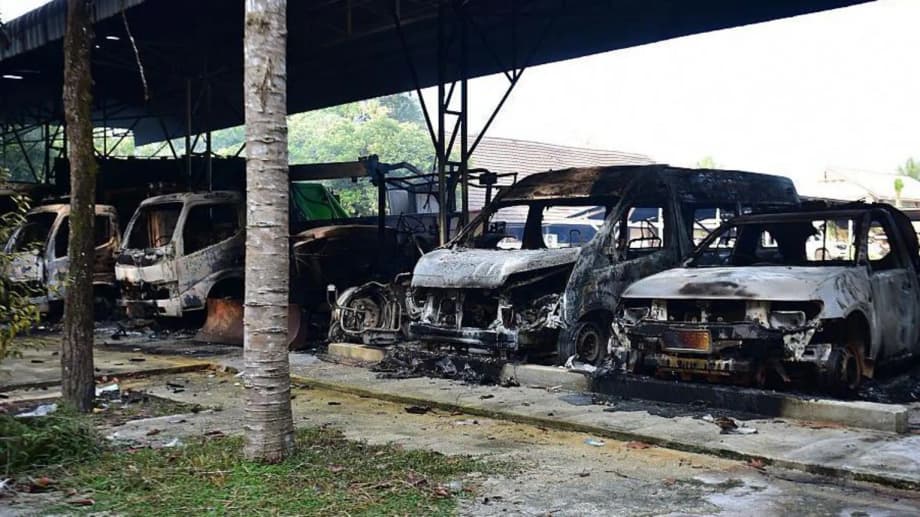
More than 50 attacks reported across three provinces
Thailand’s southern border region was hit by a wave of coordinated arson, bomb and sabotage attacks late Saturday, with authorities reporting 51 incidents across Narathiwat, Yala and Pattani. The attacks took place between about 20:00 and midnight local time on 22 August, in an area that has faced a separatist insurgency for more than two decades.
Thailand’s Internal Security Operations Command, known as ISOC, said the incidents appeared to be aimed at creating unrest. Local government offices, vehicles, a convenience store, telecommunications towers, power poles and railway infrastructure were among the reported targets.
Most of the incidents occurred in Narathiwat, the province closest to Malaysia. Other attacks were recorded in Yala and Pattani, the two provinces that, along with Narathiwat, form the main center of Thailand’s long running southern conflict.
There was no immediate claim of responsibility. The authorities have not publicly identified suspects or confirmed whether a single organization directed all of the attacks.
Reports differed slightly on the number of people injured. Thai military statements initially said at least two people were hurt, while another account reported three civilians wounded. The injured people were taken to hospital and were described as being in stable condition.
What happened during the night?
The attacks combined fires with explosions and other forms of disruption. Two women were reportedly injured when a bomb exploded in Muang district in Narathiwat. In another incident, a vehicle was taken from a subdistrict administrative organization office before the building was set on fire. The burned pickup truck was later found abandoned on a road.
Several local government buildings were damaged or destroyed. A convenience store was also set ablaze, while burning tires were left in the middle of a road. Authorities reported damage near telecommunications towers and electrical poles, raising concerns about the effect on communications and basic services.
Railway operations were temporarily interrupted in part of Narathiwat after officials found damage to tracks caused by what ISOC described as a disruptive bombing incident. Railway lines are a frequent target in the southern provinces because disruption can affect travel, trade and the movement of security personnel.
Footage broadcast by Thai PBS showed firefighters tackling flames inside a 7 Eleven store and extinguishing burning tires on a roadway. Police carried out vehicle checks as residents faced a heightened security presence across the affected districts.
One regional account gave a breakdown of 22 incidents in Narathiwat, 18 in Yala and 11 in Pattani. Another report referred to more than 70 coordinated attacks, although the military’s widely cited figure was 51. The differing counts may reflect the inclusion of separate fires, explosions, road obstructions and damage discovered during later inspections.
How did authorities respond?
Narathiwat authorities imposed an overnight curfew from late Saturday until 06:00 on Sunday. Residents were told to seek permission from local military, police or administrative officials before leaving their homes for urgent reasons.
The curfew was lifted on Sunday morning, and officials said no further attacks had been reported by that point. Security teams continued inspecting government buildings, roads, railway tracks, communication sites and other locations for unexploded devices or suspicious objects.
Security officials warned members of the public not to touch unfamiliar packages or other objects found near attack sites. Such warnings are routine after coordinated bomb and arson incidents because some devices may be designed to injure people who approach after the initial explosion.
Thailand’s Fourth Army Region, which oversees security operations in the south, urged residents to remain alert. Border security was also increased in parts of neighboring Malaysia, although Malaysian authorities reported no militant incursions into the northeastern state of Kelantan.
Thailand and Malaysia cooperate through a Regional Border Committee that deals with security along their shared frontier. The border is difficult to police completely because communities, roads and trading routes cross a landscape that includes rural villages, plantations and forested areas.
Why is the south vulnerable to attacks?
The southernmost provinces are home to a Muslim majority that is largely ethnic Malay, while Thailand as a whole is predominantly Buddhist. The area was once linked to the independent Malay sultanate of Patani before being incorporated into the modern Thai state.
The current phase of the insurgency began in 2004. Armed groups have demanded greater autonomy, stronger recognition of local identity and changes to the way Bangkok governs the region. More than 7,000 people have been killed in the conflict, including civilians, soldiers, police officers, government workers and suspected militants.
The violence has generally remained concentrated in Pattani, Yala and Narathiwat, though occasional incidents have occurred in nearby provinces. Attacks have included shootings, roadside bombs, arson, attacks on checkpoints and sabotage of public infrastructure.
The main separatist organization identified in the conflict is the Barisan Revolusi Nasional, often shortened to BRN. The group has been involved in peace discussions, although the absence of a claim after Saturday’s violence leaves open the question of who organized the latest attacks.
Local government offices are especially sensitive targets. They represent the presence of the Thai state in villages and districts, so attacks against them can damage records, public services and residents’ confidence in the ability of authorities to protect them.
What does the timing suggest?
The scale and near simultaneous timing of the incidents indicate a high level of planning, according to the military’s description. Setting fires at many locations within a four hour period can force authorities to divide their response teams and stretch firefighting and emergency services.
Targets linked to communications, electricity and transport can also create confusion without causing mass casualties. Burning towers or power poles may interrupt networks and make it harder for residents, officials and security forces to communicate during an emergency.
Southern insurgents have previously targeted security personnel and government property before visits by senior officials. Last month, five soldiers were killed in a gun and bomb attack at a checkpoint in Narathiwat. That assault led authorities to postpone a planned round of peace discussions.
Thai regional army commander Norathip Poinok said officials had received intelligence for about two months indicating that local offices could be attacked. He said warnings had been sent to security agencies, although officials did not know the exact date or locations of the planned incidents.
Multiple coordinated incidents aimed at creating unrest occurred in various locations across the southern border provinces, the Internal Security Operations Command said.
The statement describes the authorities’ assessment rather than a confirmed declaration by the attackers. Investigators will need to establish whether the incidents were directed by the BRN, by local cells acting independently or by more than one network.
What is happening with peace talks?
Malaysia has helped facilitate negotiations between Thailand and representatives of the southern insurgency since 2013. The talks have repeatedly stalled as governments in Bangkok changed and disagreements persisted among both state officials and separatist factions.
Key disputes include the degree of self government that could be granted, the role of Thai security forces, political representation and the legal status of people involved in the rebellion. Trust has also been weakened by continued attacks and arrests.
Formal discussions with the BRN were expected to resume after a rise in violence, though the July checkpoint attack caused the authorities to delay the process. Thanut Suvarnananda, head of Thailand’s National Intelligence Agency and the government’s peace process representative, has said he wants to move away from a narrow exchange of demands.
His stated approach is to treat the BRN as a possible partner in addressing complaints from communities in Pattani, Yala and Narathiwat. That would require negotiations to deal with practical issues such as education, local administration, language rights, economic opportunities and security, rather than focusing only on military operations or formal autonomy.
Large attacks make that work more difficult. They increase pressure on the government to respond with security measures, while separatist factions may view disruption as a way to show that the state cannot fully control the region.
How could the attacks affect the government visit?
Prime Minister Anutin Charnvirakul and cabinet members are scheduled to visit Hat Yai in neighboring Songkhla province next week. The two day visit is expected to focus on investment, flood prevention and security.
Hat Yai is a major commercial center and transport hub in the south, although it is outside the three provinces most affected by the insurgency. The latest incidents are likely to place security at the center of the visit, alongside the government’s economic plans.
Investment in the region depends on reliable roads, railways, communications and public administration. Repeated attacks can raise insurance costs, interrupt commerce and discourage businesses from expanding, especially in rural districts where public services are already harder to provide.
The government must also balance security with daily life. Curfews and checkpoints can reduce immediate risks, yet extended restrictions may deepen residents’ sense that the region is being governed primarily through military controls.
Officials have not reported a continuation of the attacks since Sunday morning. Investigations, evidence gathering and further security checks are expected to continue across the three provinces.
What happens next?
Investigators will examine the burned buildings, damaged infrastructure, explosive remnants and abandoned vehicle for evidence. The timing of the attacks, the choice of targets and the methods used may help authorities determine whether the incidents were part of a single operation.
The lack of a public claim makes attribution more difficult. In southern Thailand, attacks are sometimes followed by statements from insurgent groups, while other incidents are left unattributed. Authorities must also avoid assigning blame before forensic and intelligence assessments are complete.
For residents, the immediate concerns are access to transport, communications and public offices, as well as the risk of unexploded devices. The curfew has ended, though the military’s warnings indicate that security precautions remain in place.
The attacks come at a delicate moment for negotiations. A return to dialogue would require the government and the BRN to maintain contact despite the violence, while also addressing the fears of civilians who have lived through years of killings and disruption.
Key Points
- Authorities recorded 51 coordinated arson and incendiary incidents on 22 August.
- The attacks affected Narathiwat, Yala and Pattani, with Narathiwat suffering the largest number.
- Local government offices, vehicles, a convenience store, communication towers, power poles and railway tracks were damaged.
- Reports put the number of injured civilians at two or three, with those hospitalized described as stable.
- Narathiwat imposed an overnight curfew that ended on Sunday morning.
- No group has claimed responsibility.
- The violence follows the killing of five soldiers in a July checkpoint attack and comes as peace talks face further strain.
- Prime Minister Anutin Charnvirakul is scheduled to visit nearby Hat Yai next week for discussions on investment, flooding and security.