A widening nuclear production network
North Korea has built a new two storey uranium enrichment facility at its main Yongbyon nuclear complex, a development the International Atomic Energy Agency has described as a cause for serious concern. The building could accommodate as many as 28 centrifuge cascades, according to an IAEA assessment based on satellite imagery and photographs released by North Korean state media.
- A widening nuclear production network
- What the IAEA found at Yongbyon
- Why 28 cascades matter
- Kangson adds a second concern
- How the agency monitors North Korea
- A programme accelerated under Kim Jong Un
- Why sanctions have not stopped construction
- Seoul has proposed talks
- What the new facilities mean
- The Bottom Line
The agency has also identified signs that an expanded annex at the Kangson enrichment site near Pyongyang began operating in January. Taken together, the activity suggests that North Korea is increasing its ability to produce highly enriched uranium at more than one location, making its nuclear programme harder to monitor and restrain.
IAEA Director General Rafael Grossi said the continued operation and expansion of enrichment facilities violated United Nations Security Council resolutions. The findings come as North Korean leader Kim Jong Un continues to present nuclear weapons as central to the country’s security policy and national identity.
What the IAEA found at Yongbyon
Yongbyon is North Korea’s best known nuclear complex. It has long been associated with the production of plutonium and enriched uranium, two materials that can be used in nuclear weapons. The newly identified building is believed to be the site’s second uranium enrichment facility.
Construction began in December 2024, according to the IAEA assessment. External work was completed several months later, followed by the installation of electrical equipment, emergency generators and cooling systems. Satellite images also showed at least one cooling unit operating earlier this year.
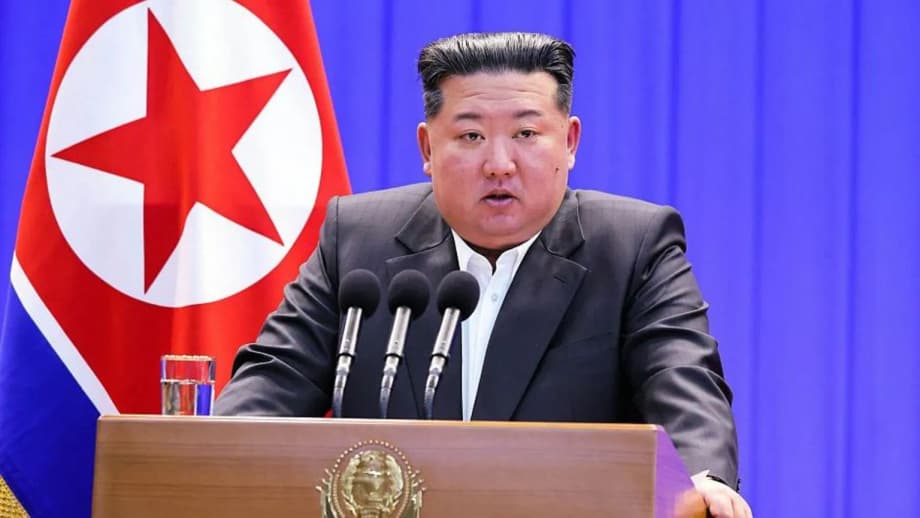
Photographs from Kim’s visit to the facility on 3 June showed centrifuge cascades on both floors of the building. A cascade is a group of centrifuges connected in stages. Each centrifuge increases the concentration of the uranium isotope needed for weapons production by separating it from other forms of uranium.
The IAEA has not been able to confirm how many centrifuges are installed, how efficiently they operate or whether every cascade is running. Its estimate of 28 cascades refers to the building’s potential capacity rather than a verified production total.
Why 28 cascades matter
The size of the facility gives outside analysts an indication of the possible increase in North Korea’s production capacity. A study cited in the research estimates that 28 cascades could contain about 4,592 centrifuges and produce roughly 85 kilograms of weapons grade highly enriched uranium each year if operated at expected levels.
That amount could be enough for approximately three or four additional nuclear warheads annually, based on an estimate of about 20 kilograms of highly enriched uranium for one warhead. The figure is an estimate, not a confirmed North Korean production rate. The result would depend on the design and performance of the centrifuges, the quality of the feed material, the operating schedule and the amount of uranium required for each weapon.
Other estimates cited in the research put North Korea’s existing annual highly enriched uranium output at roughly 215 to 232 kilograms. If the new Yongbyon facility reaches its potential capacity, the country’s annual output could rise above 300 kilograms. Such calculations remain uncertain because the country restricts access and conceals much of its nuclear infrastructure.
The meaning of the development is wider than the possible number of new warheads. More enrichment capacity gives Pyongyang greater flexibility to maintain an existing arsenal, replace material used in weapons and expand its stockpile without relying on a single site.
Kangson adds a second concern
The IAEA’s assessment also points to activity at Kangson, an enrichment complex near the North Korean capital. An annex was built beside the existing facility in 2024, and the agency found signs that operations began there in January this year.
The agency could not determine whether highly enriched uranium is being produced inside the annex. It said, however, that the site has been described by North Korea as a base for producing weapons grade nuclear material, and that the possibility of weapons material production could not be excluded.
Satellite observations also indicated that the original uranium enrichment facility at Yongbyon remained active during the reporting period. The IAEA reported signs that the reprocessing of spent nuclear fuel to extract plutonium may have been completed as well. Plutonium and highly enriched uranium are different materials, yet both can support the production of nuclear weapons.
The activity at two separate sites matters for monitoring and security. Facilities spread across different areas can reduce the effect of any disruption at one location and make it harder for outside governments to establish a complete picture of production. Oxford lecturer Edward Howell described concealed sites as a central concern in assessing North Korea’s nuclear programme.
What makes North Korea’s nuclear programme so concerning is that many of its facilities are unknown, concealed, and thus difficult to target.
Howell also pointed to facilities beyond Yongbyon, including Kangson, and said North Korea’s nuclear doctrine is closely connected to both its foreign and domestic policies. That assessment reflects the limits facing governments that rely on remote observation rather than direct inspection.
How the agency monitors North Korea
The IAEA has had no inspectors inside North Korea since Pyongyang expelled them in 2009. The agency now relies on satellite imagery, publicly available information and photographs released by North Korean authorities. This method can reveal construction, changes in buildings, vehicle movements, power use and cooling activity, yet it cannot provide the same certainty as physical inspections.
In this case, the agency compared images from Kim’s June visit with commercial satellite photographs taken during construction. The comparison allowed it to identify the building’s location and likely purpose. The state media photographs also showed centrifuge cascades installed on both floors.
Several details remain unknown. The IAEA cannot verify the exact number of machines, their technical specifications, the operating rate or the amount of enriched uranium produced. It also cannot inspect storage areas or confirm whether material has been transferred to other locations.
These gaps make public estimates ranges rather than precise counts. North Korea’s closed political system and record of hiding nuclear facilities add to the difficulty. The agency can identify signs of activity, yet it cannot independently account for all nuclear material or establish the full size of the country’s arsenal.
A programme accelerated under Kim Jong Un
North Korea’s nuclear activity has expanded under Kim Jong Un, who has overseen a large number of missile tests and repeated calls for a stronger nuclear force. The country has tested intercontinental ballistic missiles since 2017, giving it a potential delivery system designed to reach targets far beyond the Korean Peninsula.
Pyongyang has conducted six nuclear weapons tests. The most recent took place in September 2017. North Korea declared itself a nuclear weapons state in 2022 and said its status was irreversible. It has also stated that it will not give up its nuclear weapons.
North Korean officials reject the IAEA’s authority. In a statement cited in the research, the country’s mission to the United Nations in Vienna argued that the agency had no legal right to interfere in the internal affairs of a nuclear weapons state outside the Non Proliferation Treaty. North Korea withdrew from the treaty in 2003 after years of disputes with the United States and international inspectors.
The IAEA and the United Nations do not accept North Korea’s position as a basis for ignoring Security Council resolutions. Those resolutions prohibit the country from conducting nuclear tests and developing nuclear weapons related technology, including uranium enrichment and ballistic missile programmes.
Why sanctions have not stopped construction
North Korea has faced extensive international sanctions for its nuclear and missile programmes. The measures restrict trade, financial activity, technology transfers and access to equipment that could support weapons production. They have raised the cost of the programme, yet they have not stopped construction or research inside the country.
Enrichment equipment can be difficult to track because centrifuge components are relatively compact and may be produced or assembled through concealed networks. Buildings can also be presented as civilian industrial facilities. North Korea’s ability to construct new sites while limiting outside access shows why sanctions enforcement depends on intelligence sharing, inspections and cooperation among neighbouring countries.
The nuclear programme also receives priority in a country with severe economic challenges. A 2022 estimate from a nuclear non proliferation research group placed North Korea’s annual spending on its nuclear arsenal at about $640 million. The precise figure is difficult to verify, yet the spending illustrates the resources Pyongyang continues to direct toward weapons development.
For South Korea, Japan and the United States, a larger stockpile can affect military planning and diplomatic calculations. It may also increase the risk of miscalculation during a crisis, especially when missile tests, military exercises or political tensions are taking place at the same time.
Seoul has proposed talks
South Korean President Lee Jae Myung proposed talks with North Korea in August on formally ending the war between the two countries. The Korean War ended in 1953 with an armistice rather than a peace treaty, leaving the two sides technically at war.
Lee said discussions on a formal end to the conflict could also address ways to halt the advancement of North Korea’s nuclear capabilities. Pyongyang has not responded to the proposal. North Korea has previously rejected negotiations when it believed talks were aimed at forcing it to abandon its arsenal.
Lee has also said he would support an agreement between Kim and US President Donald Trump that froze North Korea’s nuclear production. A production freeze would fall short of complete disarmament, yet it could limit the growth of the arsenal if inspectors were allowed to verify the terms.
The latest IAEA findings make such a freeze more difficult to negotiate. New buildings and expanded facilities create fresh questions about what would need to be included, how existing material would be counted and whether undeclared sites could be found and monitored.
What the new facilities mean
The Yongbyon building and the Kangson annex do not by themselves establish the exact number of nuclear weapons North Korea possesses. Estimates generally suggest that the country has dozens of warheads, while assessments of annual production vary widely. The new evidence does show that Pyongyang continues to invest in the infrastructure needed to increase that number.
Grossi said the agency’s findings represented a continuing violation of Security Council resolutions. His warning also reflects a wider problem: without inspectors on the ground, the international community may discover expansion only after buildings are complete and equipment is installed.
North Korea’s decision to display parts of the facility during Kim’s visit may have served several purposes. It could demonstrate technical progress to domestic audiences, signal strength to foreign governments and support Kim’s claim that the country can expand its nuclear forces despite sanctions. The photographs also gave analysts valuable evidence that would otherwise have been unavailable.
The IAEA is expected to keep the North Korean issue on its agenda at its General Conference in Vienna. Its assessments cannot halt construction, yet they provide a public record of activity and help governments measure the scale and direction of Pyongyang’s programme.
The Bottom Line
- North Korea has built a two storey uranium enrichment facility at Yongbyon.
- The building could accommodate up to 28 centrifuge cascades, although the exact number operating is unknown.
- The IAEA has found signs that an expanded annex at Kangson began operating in January.
- Satellite imagery and state media photographs are being used because IAEA inspectors have been absent since 2009.
- Analysts estimate the new Yongbyon facility could produce enough highly enriched uranium for about three or four warheads each year.
- North Korea says its nuclear weapons status is irreversible, while the IAEA says its nuclear expansion violates United Nations Security Council resolutions.
- South Korea has proposed talks that could include measures to halt the growth of North Korea’s nuclear production.