Seoul Talks Put Industrial and Energy Security First
South Korean President Lee Jae Myung called for closer cooperation with Japan on advanced industry supply chains on Oct. 23, as business leaders from both countries backed a broader agenda covering emergency energy supplies, critical minerals, technology and trade rules.
Contents
- Seoul Talks Put Industrial and Energy Security First
- What the Business Leaders Agreed to Pursue
- Emergency Gas Exchanges Offer a Concrete Starting Point
- Minerals and Hydrogen Bring Different Supply Challenges
- Businesses Support South Korea's CPTPP Effort
- A Joint Voice on North American and European Rules
- Technology Cooperation Extends to AI and Talent
- Record Exchanges Feed a Regional Economic Agenda
- Diplomacy and Business Follow Parallel Tracks
- Key Points
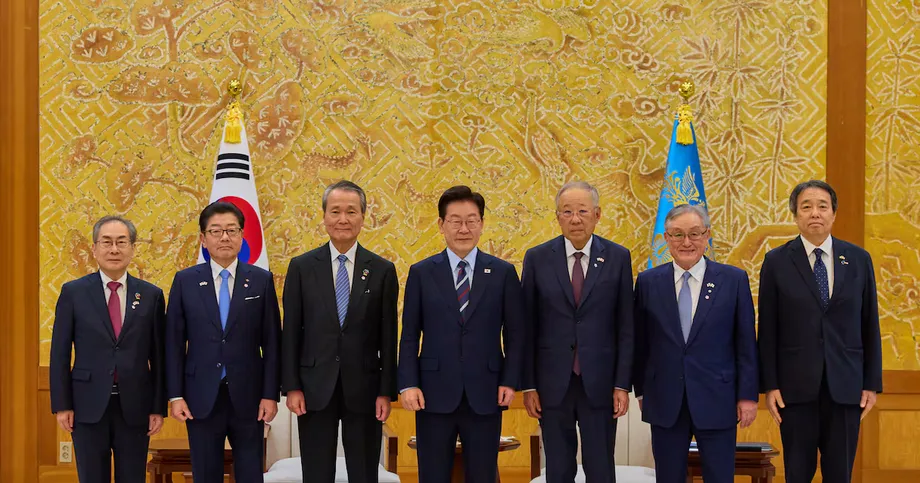
Lee met Yoshinobu Tsutsui, chairman of the Japan Business Federation, known as Keidanren, at Cheong Wa Dae in Seoul. The delegation was visiting for the 33rd Korea-Japan Business Conference, where the two countries' main business organisations adopted a joint statement supporting South Korea's efforts to join a major Pacific trade agreement.
Presidential spokesperson Kim Sung-wan said Lee described industrial cooperation as essential and thanked business leaders for their contribution to economic growth. Lee told the delegation:
South Korea and Japan are important countries for which cooperation is essential in supply chains for advanced industries.
The business conference gave that appeal a practical focus. Participants discussed emergency exchanges of liquefied natural gas, cooperation on mineral stockpiles, common hydrogen standards and closer coordination on trade regulations in the United States and European Union.
For companies, a supply chain is the connected network that delivers materials, components and equipment needed to make a product. The agenda in Seoul addressed several parts of that network at once: access to fuel and raw materials, cooperation on technology, and the rules governing sales and investment across borders.
What the Business Leaders Agreed to Pursue
The Federation of Korean Industries (FKI) and Keidanren held their conference at FKI Tower in Yeouido, Seoul. FKI Chairman Ryu Jin identified three priorities: trade policy and economic security, supply chains and energy security, and shared social challenges such as low birthrates and shrinking regional populations.
Ryu called for the two countries to combine their industrial strengths to develop new industries and markets. The joint statement supported mutual investment, assistance for companies entering the other country's market and cooperation in markets beyond South Korea and Japan.
Participants included Keiichi Iwata, chairman of Sumitomo Chemical, and Toshiaki Higashihara, executive chair of Hitachi. Both also attended Lee's meeting with Tsutsui and Ryu, bringing senior corporate representatives into the discussions with the president.
The conference, established in 1983, is the highest level gathering organised by the two countries' private business communities. Its next meeting will be held in Tokyo next year. The plans outlined in Seoul have different stages of development: the joint statement sets shared priorities, while several energy and resource arrangements remain proposals for further work.
Emergency Gas Exchanges Offer a Concrete Starting Point
Korea Gas Corporation and Japanese energy company JERA were central to discussions about emergency exchanges of liquefied natural gas, or LNG. Participants reviewed a plan for exchanging volumes during emergencies and considered extending cooperation to transactions involving third countries.
LNG is natural gas cooled into liquid so it can be transported by ship. An exchange arrangement could give participating companies another way to respond when supplies become tight, depending on the fuel available and the terms they agree.
The joint statement also called for flexible LNG cooperation reflecting supply and demand in each country. Business leaders discussed stable supplies of crude oil and petroleum products, alongside possible coordination during emergencies.
Those discussions build on issues addressed by Lee and Japanese Prime Minister Sanae Takaichi at their May 19 summit in Andong. The leaders agreed to expand LNG cooperation and strengthen channels for sharing information about crude oil supplies and stockpiling. Takaichi said they would consider a bilateral swap arrangement covering crude oil, petroleum products and LNG.
Minerals and Hydrogen Bring Different Supply Challenges
Critical minerals were another priority in Seoul. These are materials important to industry whose availability can be vulnerable to disruption. Participants proposed stockpiling cooperation through the Korea-Japan Supply Chain Partnership, alongside efforts to diversify where major resources come from.
The business organisations also pointed to POWERR Asia, a partnership proposed by Japan to strengthen the resilience of energy and resource supplies in Asia. They intend to explore projects in third countries using their industrial capabilities, technology and finance.
Hydrogen and ammonia cooperation focused on expanding supply and use, as well as developing certification, technical standards and safety criteria. Certification gives buyers a way to check whether a product meets agreed requirements. Shared standards can make it easier for suppliers and customers in different countries to work together.
The resource agenda therefore combines two tasks: preparing for immediate shortages through emergency support and stockpiles, and developing more supply options through investment and common rules.
Businesses Support South Korea's CPTPP Effort
FKI and Keidanren's joint statement supported South Korea's efforts to join the Comprehensive and Progressive Agreement for Trans-Pacific Partnership, or CPTPP. The organisations said they hoped domestic discussions in South Korea would advance and committed to continuing efforts toward membership.
CPTPP is a trade agreement that sets rules for commerce and investment among its members. The business groups argued that South Korean membership would strengthen regional supply chain connections and create more opportunities for bilateral trade, investment and cooperation in other markets. Membership would require a separate accession process involving governments.
The organisations also supported maintaining and strengthening an international economic order based on World Trade Organization agreements and free trade agreements. Their statement stressed predictable rules and market access as foundations for a stable, open trading environment.
Tsutsui called for WTO reform and deeper multilateral economic partnerships, including the Regional Comprehensive Economic Partnership. His position linked the bilateral business agenda to wider trade arrangements: companies want cooperation between Seoul and Tokyo alongside dependable rules across the markets where they operate.
A Joint Voice on North American and European Rules
The business organisations agreed to convey joint views to the parties reviewing the United States-Mexico-Canada Agreement, known as USMCA. They want the agreement to continue providing a stable, transparent and effective framework for trade.
Participants also planned to restart the Korea-U.S.-Japan Business Dialogue promptly. The forum would help coordinate business positions on economic security, supply chains and regulations affecting advanced industries in the United States and European Union.
The proposed dialogue would give the Korean and Japanese business communities a channel to present shared positions to the U.S. government and Congress. For companies operating across several countries, changes in trade and industrial rules can affect where they invest, source components and sell finished products.
Trade policy and supply security are closely connected in this agenda. Access to a material or component depends on production and transport, while the conditions for buying, financing or using it across borders also depend on regulation.
Technology Cooperation Extends to AI and Talent
Artificial intelligence, semiconductors, space and biotechnology were named as areas for technology cooperation and exchanges of skilled people. The organisations also backed mutual investment and collaboration in international discussions about standards for emerging industries.
Standards define shared technical requirements so products and systems can work together. Cooperation at that stage can matter to businesses developing new technology because it helps shape the conditions under which their products will be used and traded.
South Korean Minister of Trade, Industry and Energy Kim Jung-kwan called for a strategic alliance between the two countries in his keynote speech. He said the government would support cooperation in advanced fields, including physical artificial intelligence, drawing on each country's strengths.
Physical AI refers to artificial intelligence used in machines that act in the real world, such as robots, rather than only producing information on a screen. Its inclusion connects the conference's technology agenda with manufacturing, equipment and industrial supply chains.
Record Exchanges Feed a Regional Economic Agenda
Tsutsui told Lee that exchanges of people between South Korea and Japan exceeded 13 million last year, a record. Lee said public sentiment toward the other country had improved and called for governments and businesses to expand economic cooperation and private exchanges.
Tsutsui, speaking as Keidanren chairman, linked continued cooperation to uncertainty in the international economy:
Amid a turbulent international economic order, the importance of cooperation among countries with similar positions is growing.
Business leaders also discussed how exchanges could reach regions facing population decline and aging. Proposals included cooperation between regional companies and startups, greater use of regional airports and ports, and links between youth exchanges, local employment and new businesses.
The Korea-Japan Startup Cooperation Forum is due to resume next year, with plans to involve local companies and expand investment opportunities. Participants also supported increasing the number of people who maintain continuing ties with a region through repeat visits and other activities.
The aim is to connect cross-border movement with lasting local economic activity. Repeat visitors, business contacts and young people taking jobs or starting companies could extend the benefits of exchanges beyond a single trip and beyond the largest cities.
Diplomacy and Business Follow Parallel Tracks
Lee presented closer business ties as a companion to shuttle diplomacy, the practice of leaders making reciprocal visits to sustain direct contact. His May 19 meeting with Takaichi in Andong had already placed energy and supply chains near the centre of the relationship.
At that summit, Lee linked the need for cooperation to instability in supply chains and energy markets arising from conflict in the Middle East. The leaders also reaffirmed the importance of cooperation with the United States for regional peace and stability.
Historical issues remained part of their discussions. Lee referred to planned DNA tests on remains recovered at the wartime Chosei coal mine in Ube, Japan, where a tunnel collapse in 1942 is believed to have killed more than 100 Korean forced labourers, along with others. The two countries had worked on procedures and methods for the analysis.
The main steps in the diplomatic and business agenda are:
- 1983: The bilateral business conference was established.
- May 19: Lee and Takaichi agreed in Andong to expand supply chain cooperation and strengthen coordination on LNG and crude oil.
- Oct. 23: FKI and Keidanren held their 33rd conference in Seoul, adopted a joint statement and met Lee at Cheong Wa Dae.
- Next year: Tokyo will host the next business conference, while the startup cooperation forum is also due to resume.
The Oct. 23 talks put businesses at the centre of carrying that agenda forward. Energy exchanges, mineral cooperation, technology partnerships and regional investment each offer a practical area in which the two sides can turn shared priorities into working arrangements.
Key Points
- Lee called for closer cooperation with Japan on advanced industry supply chains during an Oct. 23 meeting in Seoul.
- FKI and Keidanren backed South Korea's CPTPP membership efforts and coordination on international trade rules.
- Business leaders discussed emergency LNG exchanges, mineral stockpiling and hydrogen standards.
- AI, semiconductors, space, biotechnology and talent exchanges were named as cooperation priorities.
- Tsutsui said bilateral exchanges of people exceeded 13 million last year, setting a record.
- The next bilateral business conference will take place in Tokyo next year.